Located on the glittering shores of Malibu’s Broad Beach, this 1953 residence was once owned by American actor Carroll O’Connor, most noted for his role as Archie Bunker in the 1970s television series All in the Family. Spread across 395 square metres, the home had been listed on the market for several years when Kelly Wearstler – the famed American designer who runs her eponymous studio in LA – decided to rent it during the summer of 2020. “I initially learned about the property through a friend who had stayed nearby three years ago and took me over to take a look,” Kelly says. “It was an architectural gem – a hidden surf shack.”
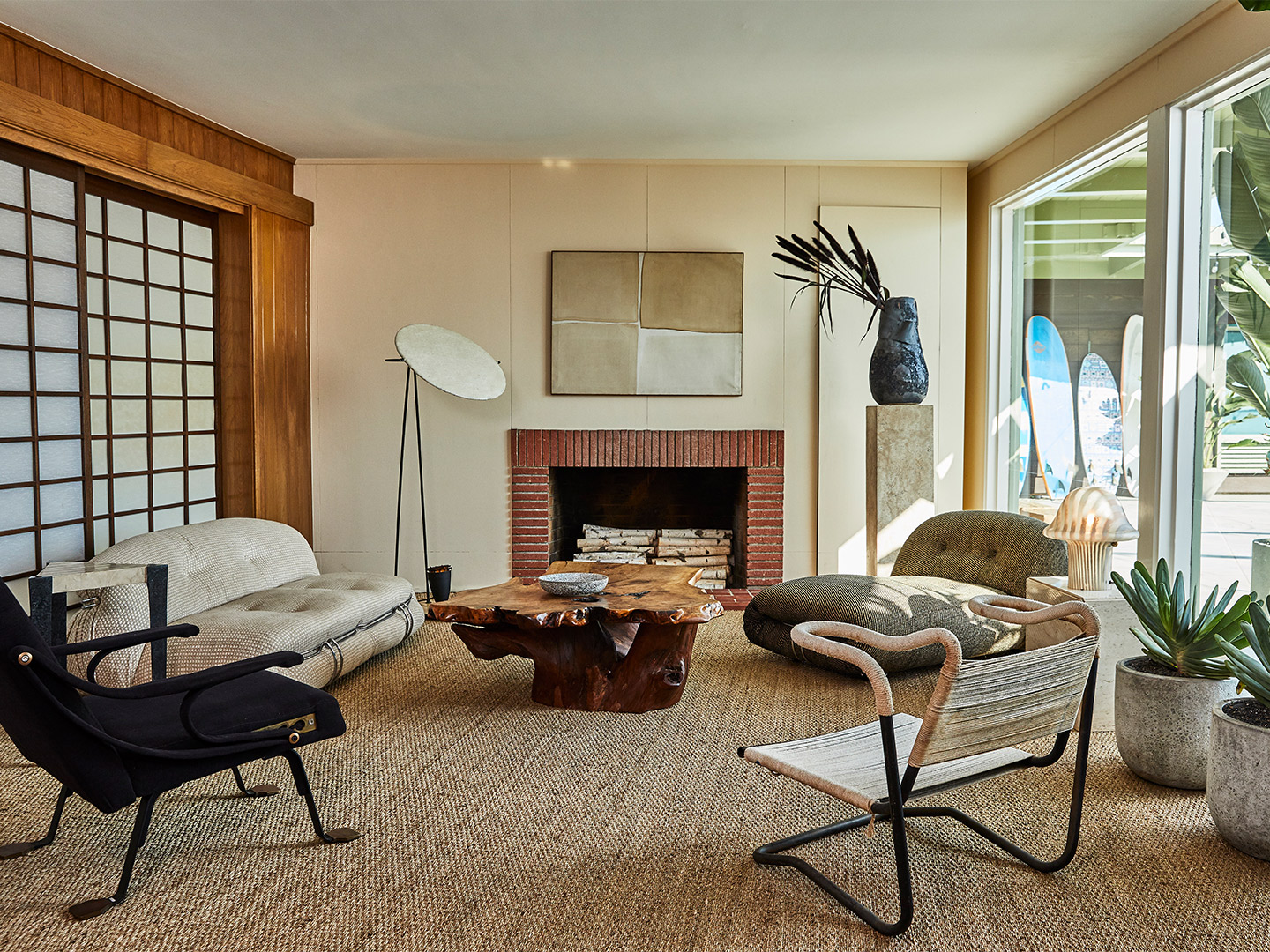
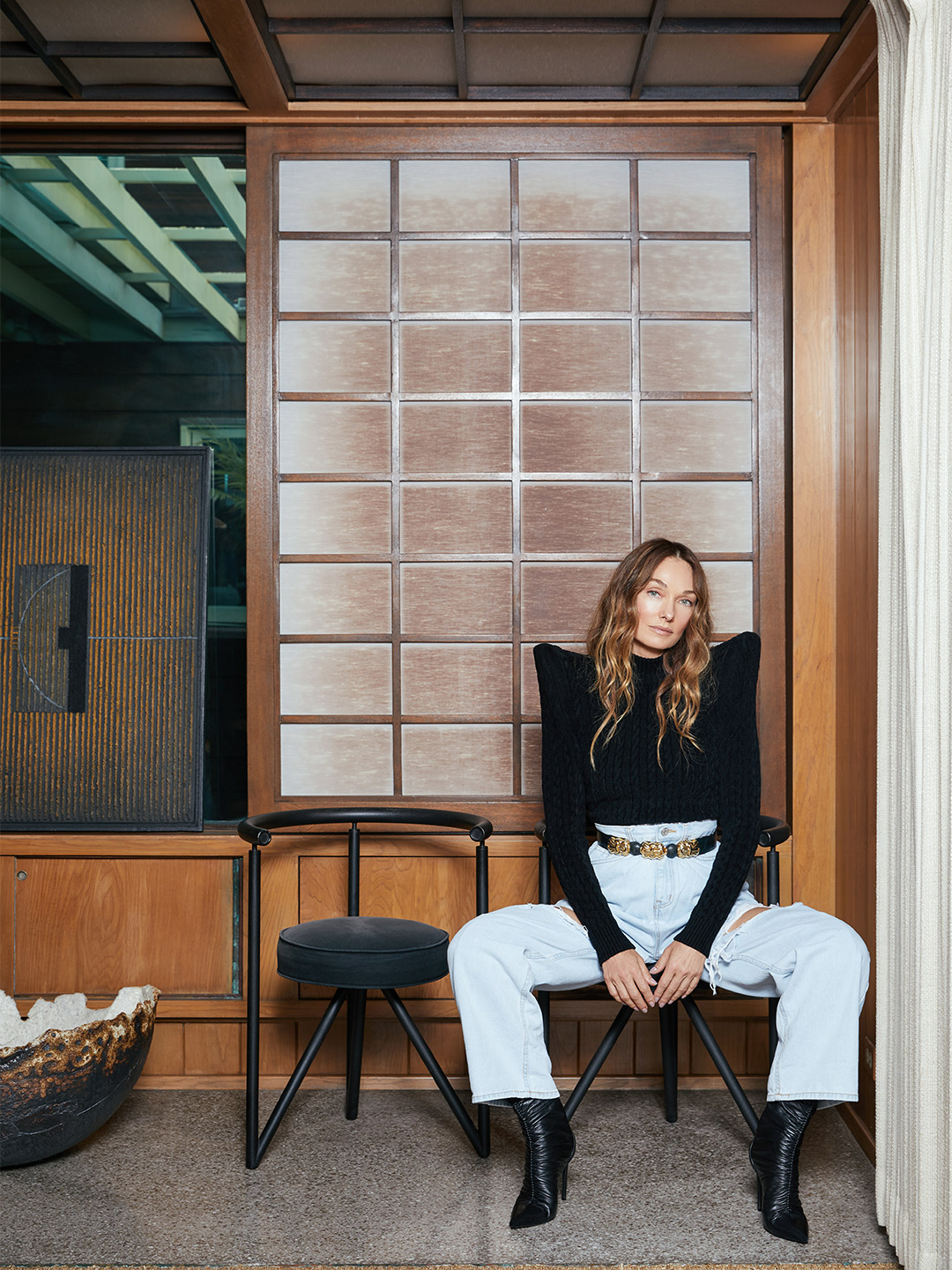
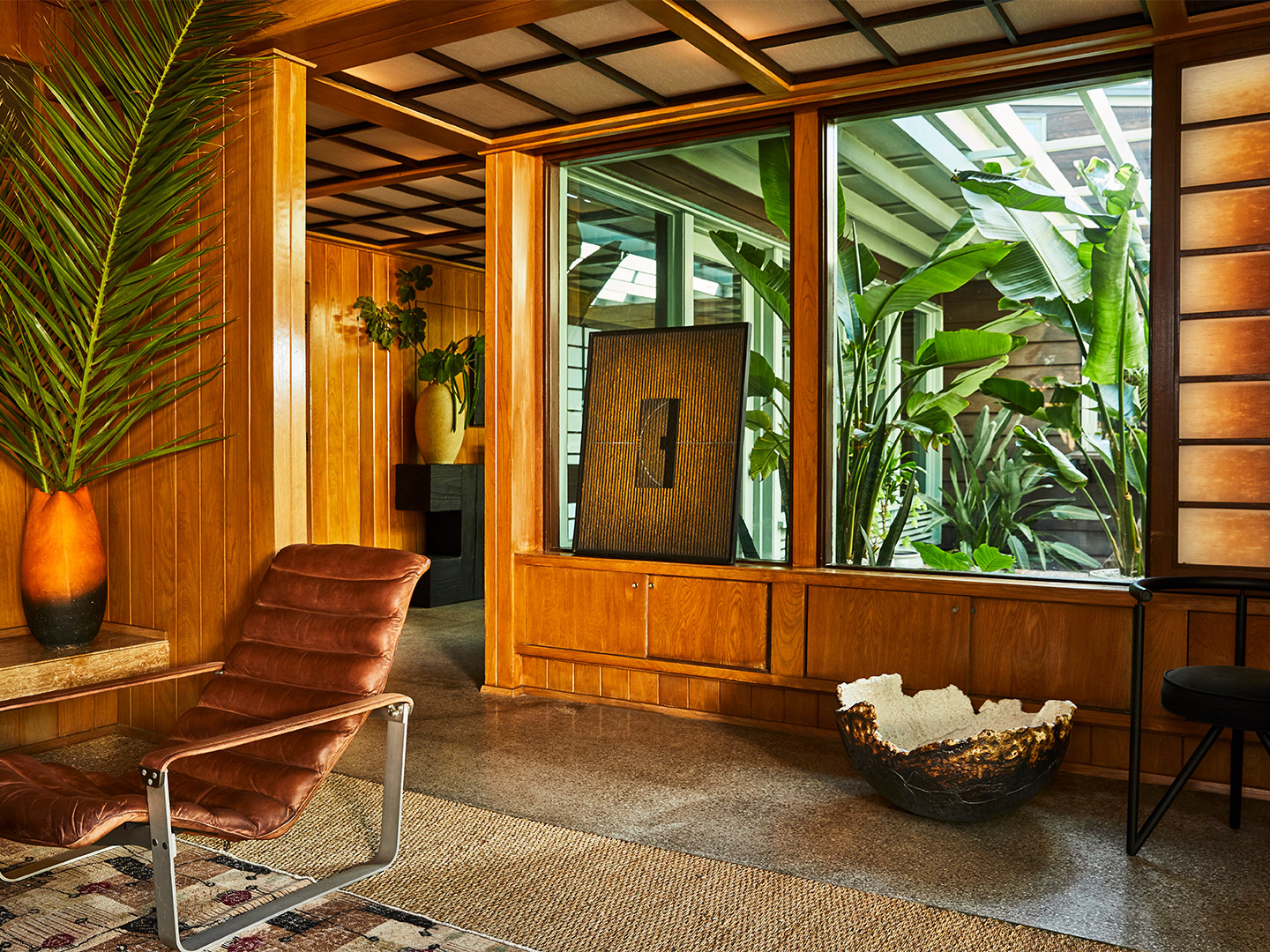
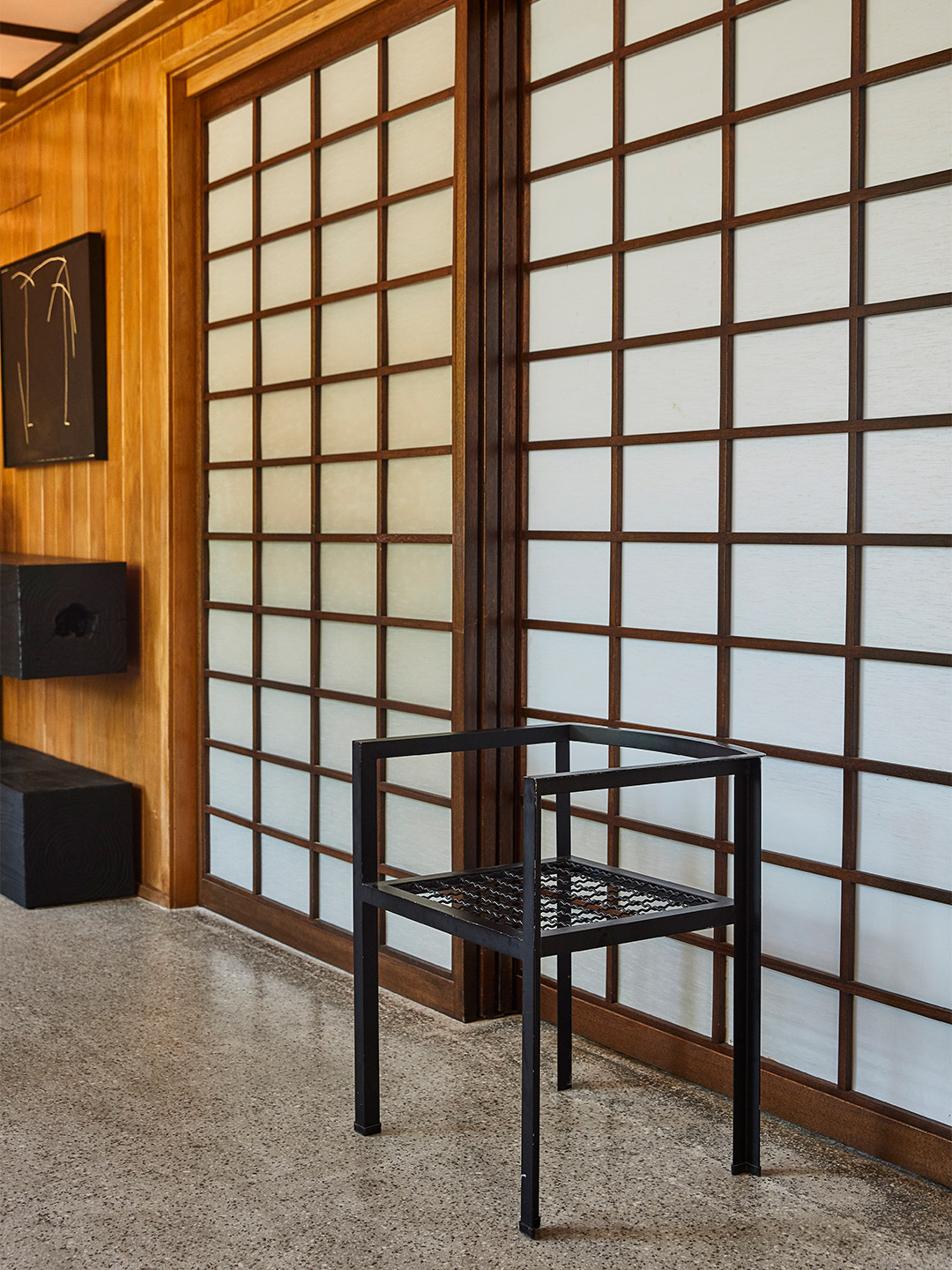
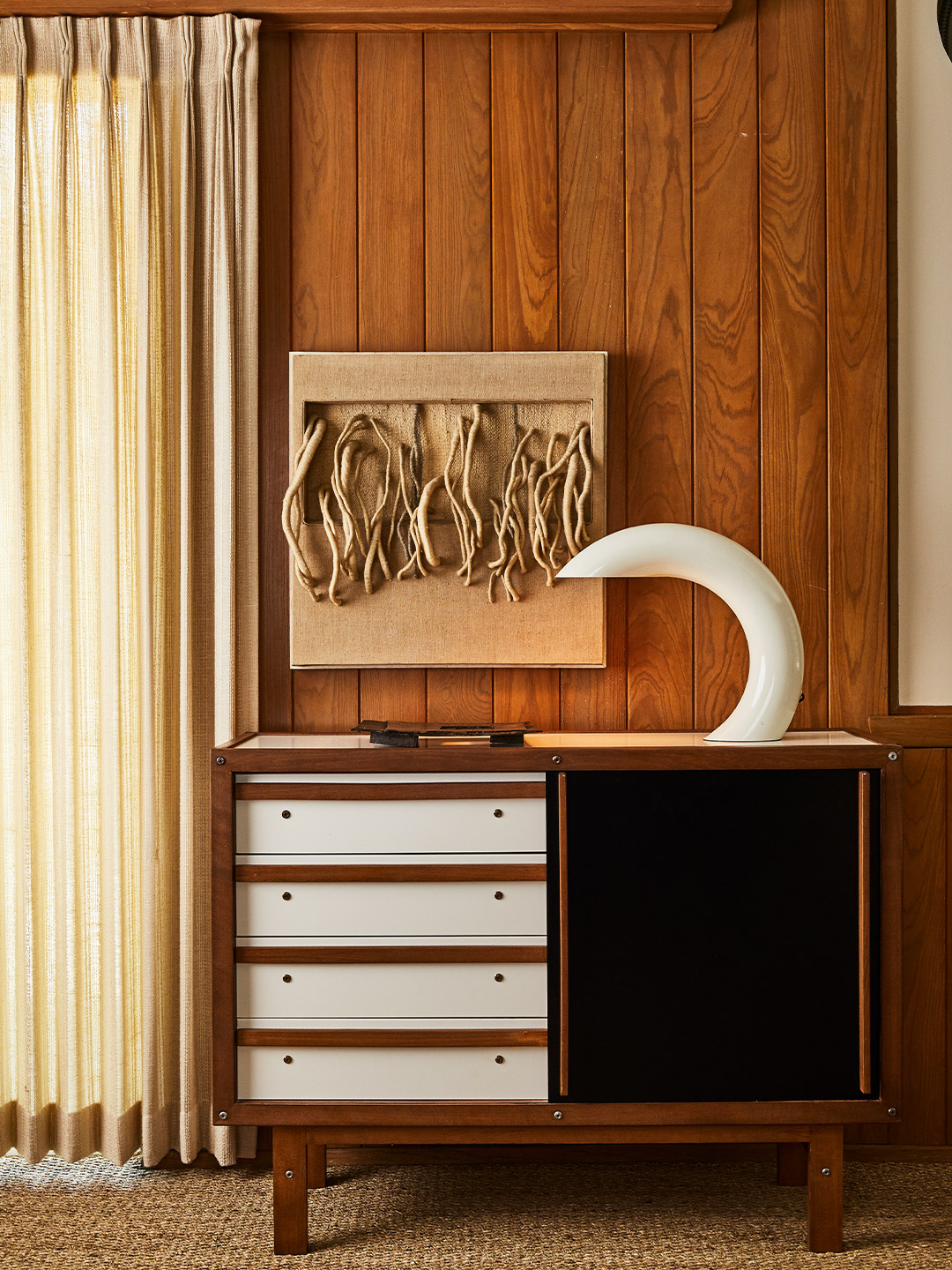
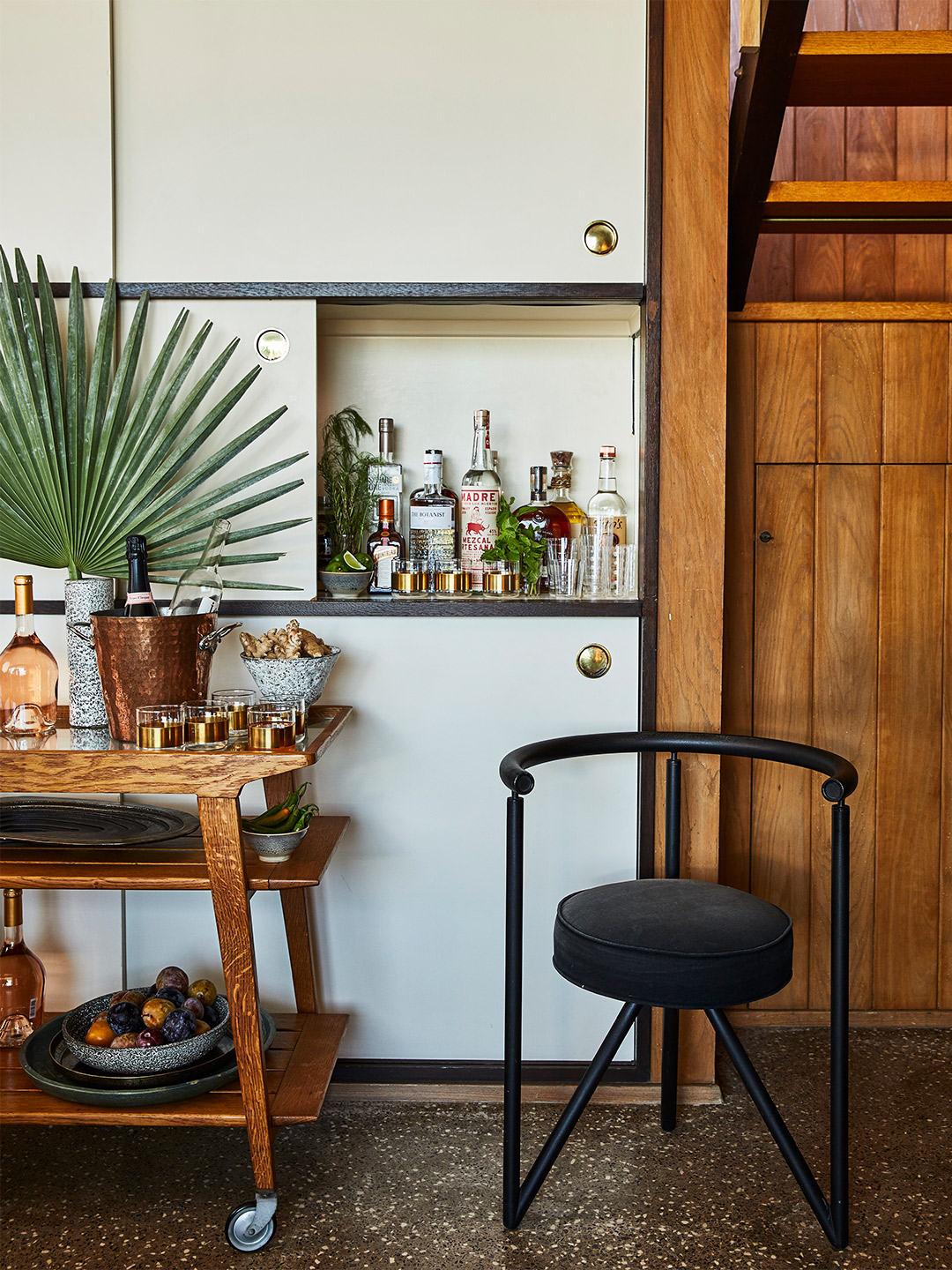
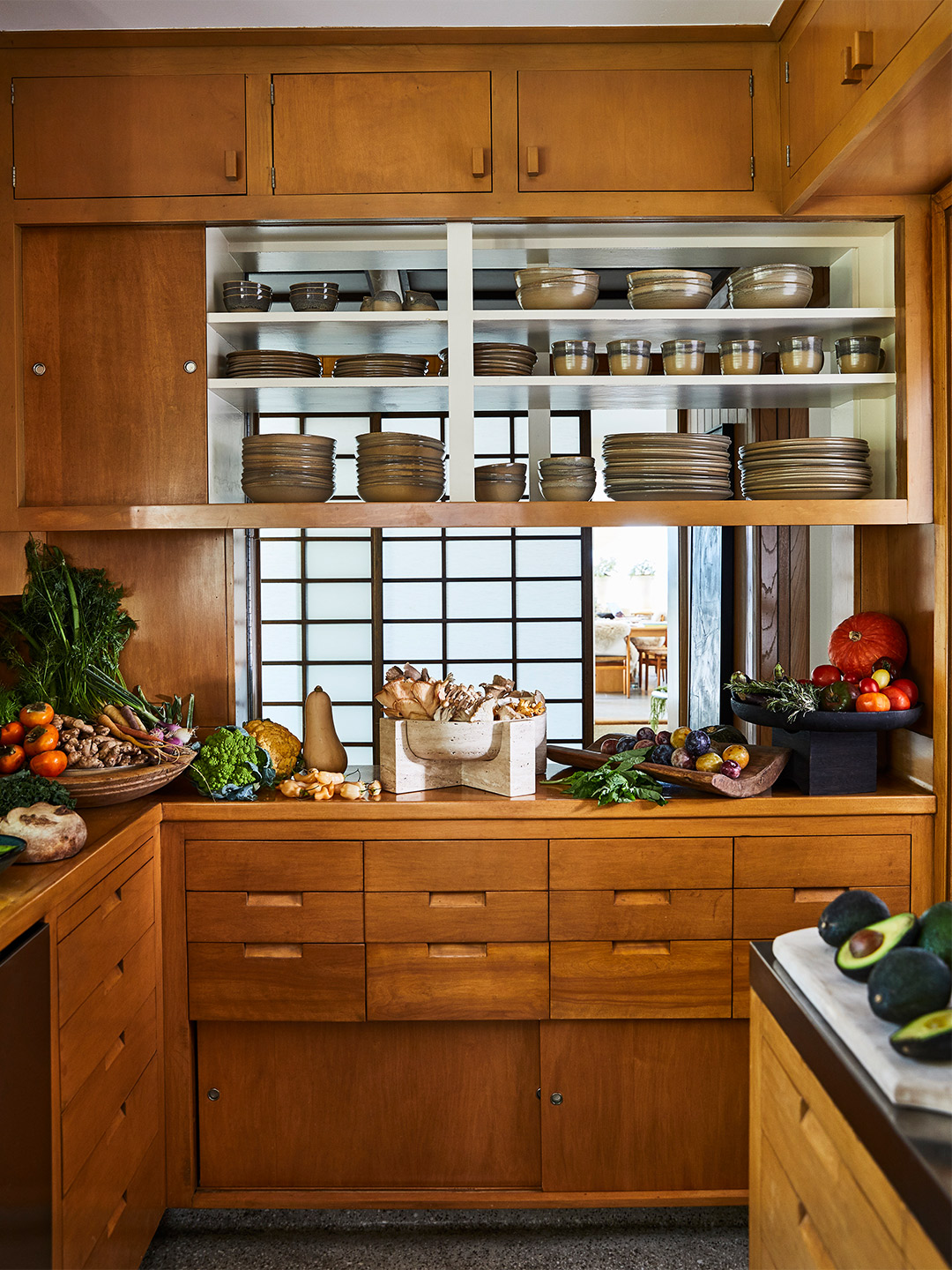
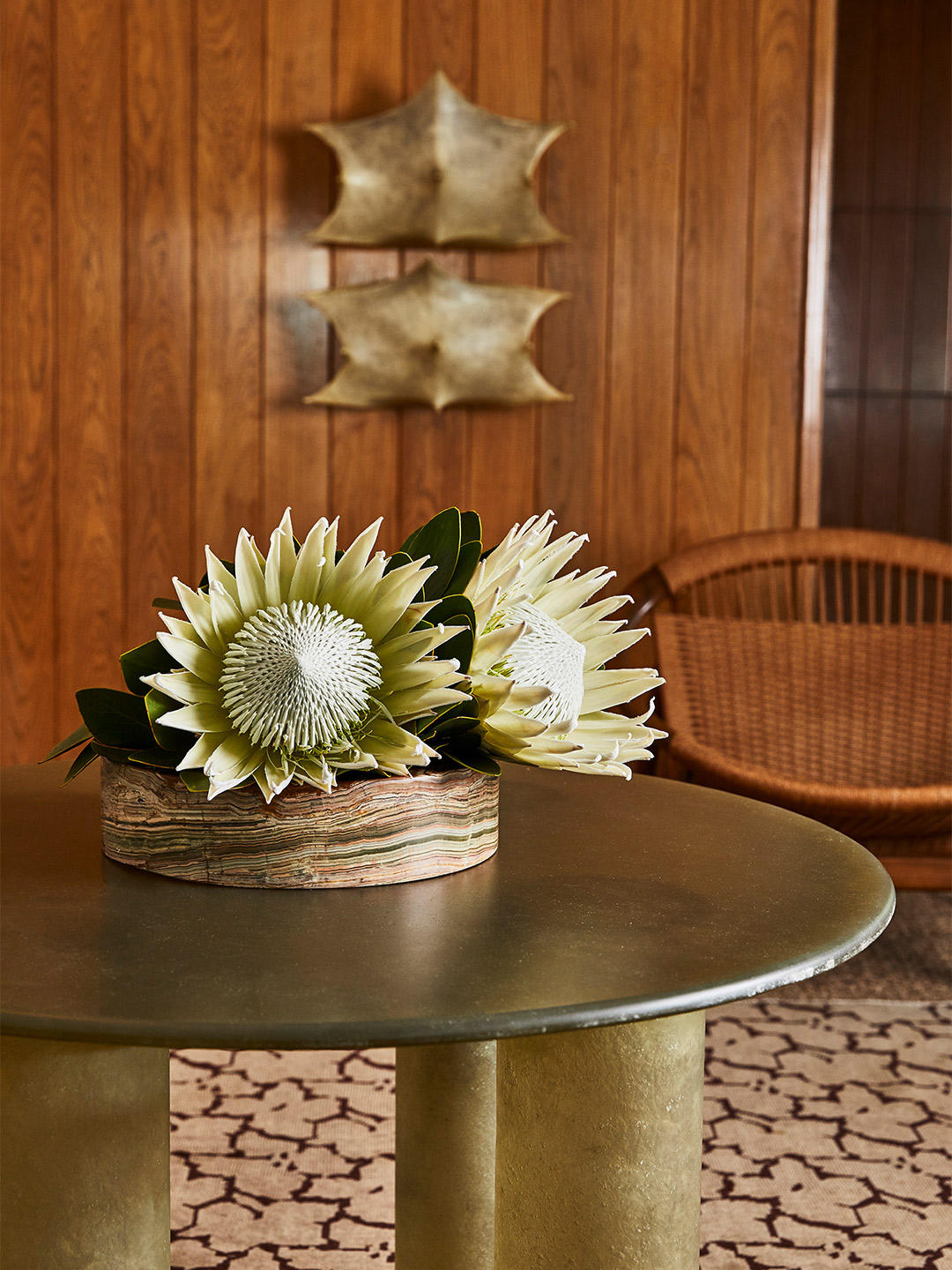
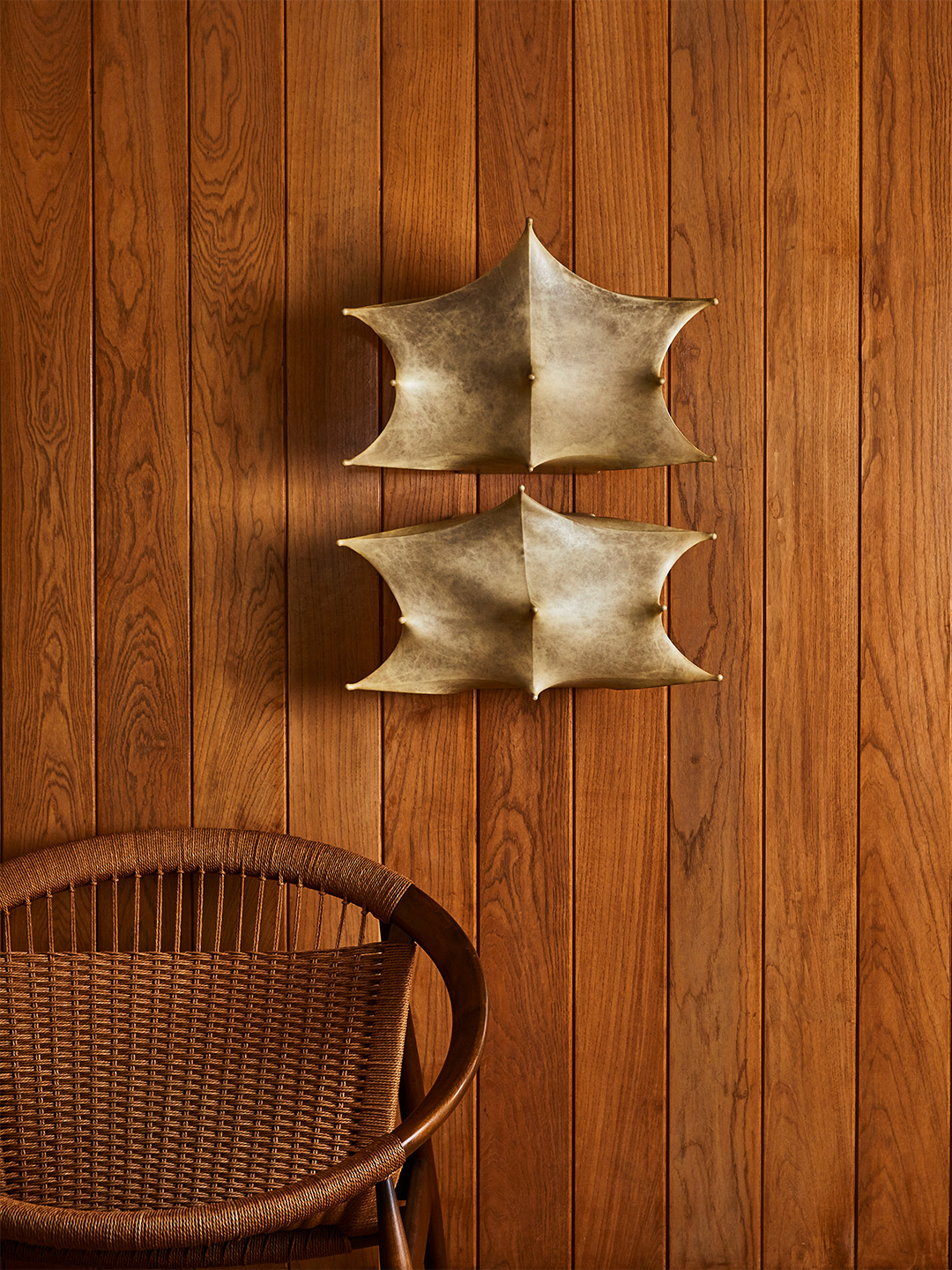
But rather than simply packing her summer wardrobe and moving in for the season, Kelly set out to create a charming live-work environment for herself and her beach-loving family. She picked up on cues from the home’s original detailing, including the prevalence of Japanese shoji screens and timber wall panelling. But the white shaggy carpet was replaced with seagrass, and rooms were filled with an eclectic mix of vintage and contemporary pieces – somewhat of a hallmark for Kelly. “I took inspiration from the house’s architectural shell – its earthy and rustic tones,” she says. “I wanted to choose objects that were hand-crafted, rustic and raw.
Kelly Wearstler reinvented a Malibu surf shack for the summer
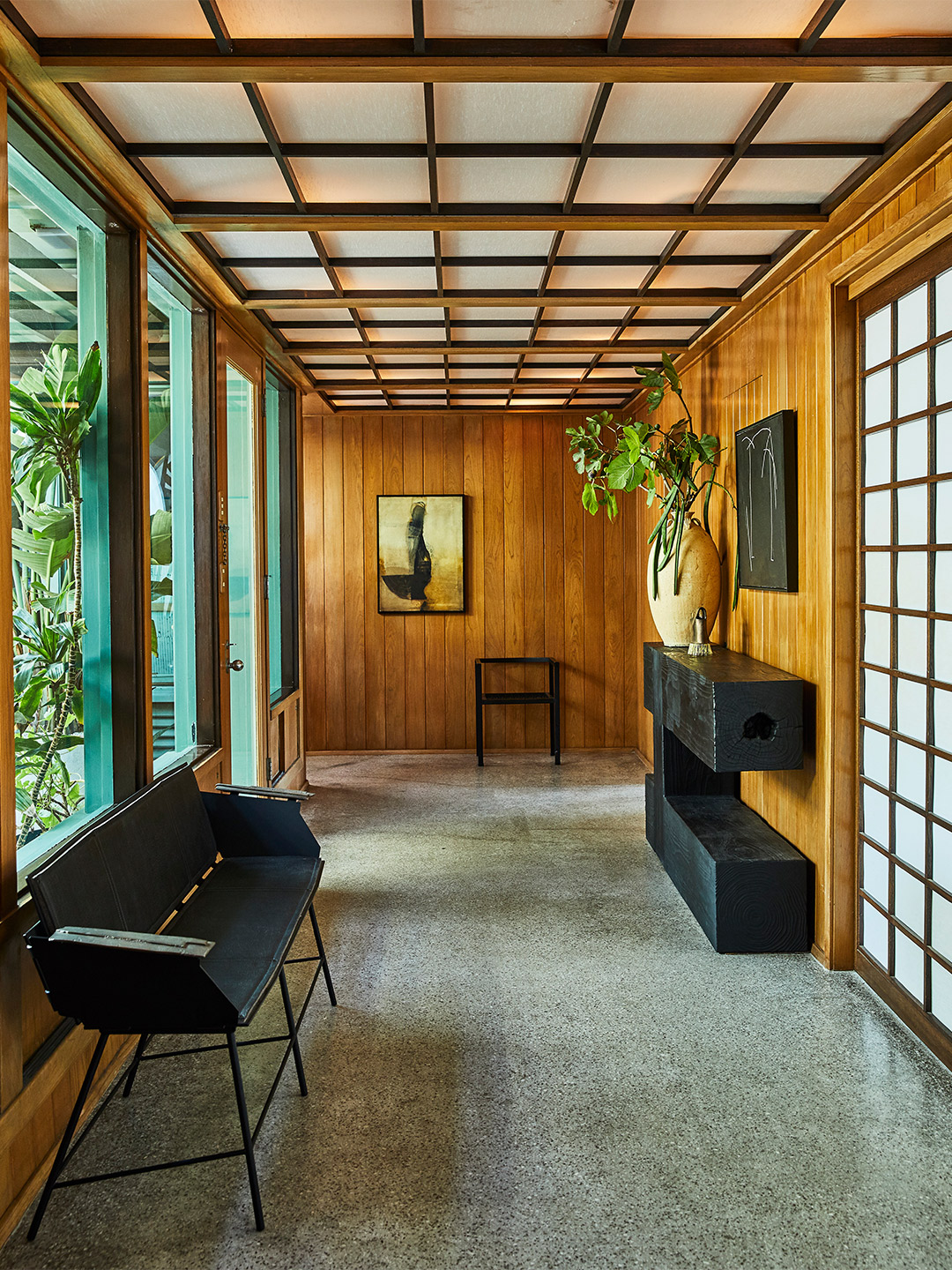
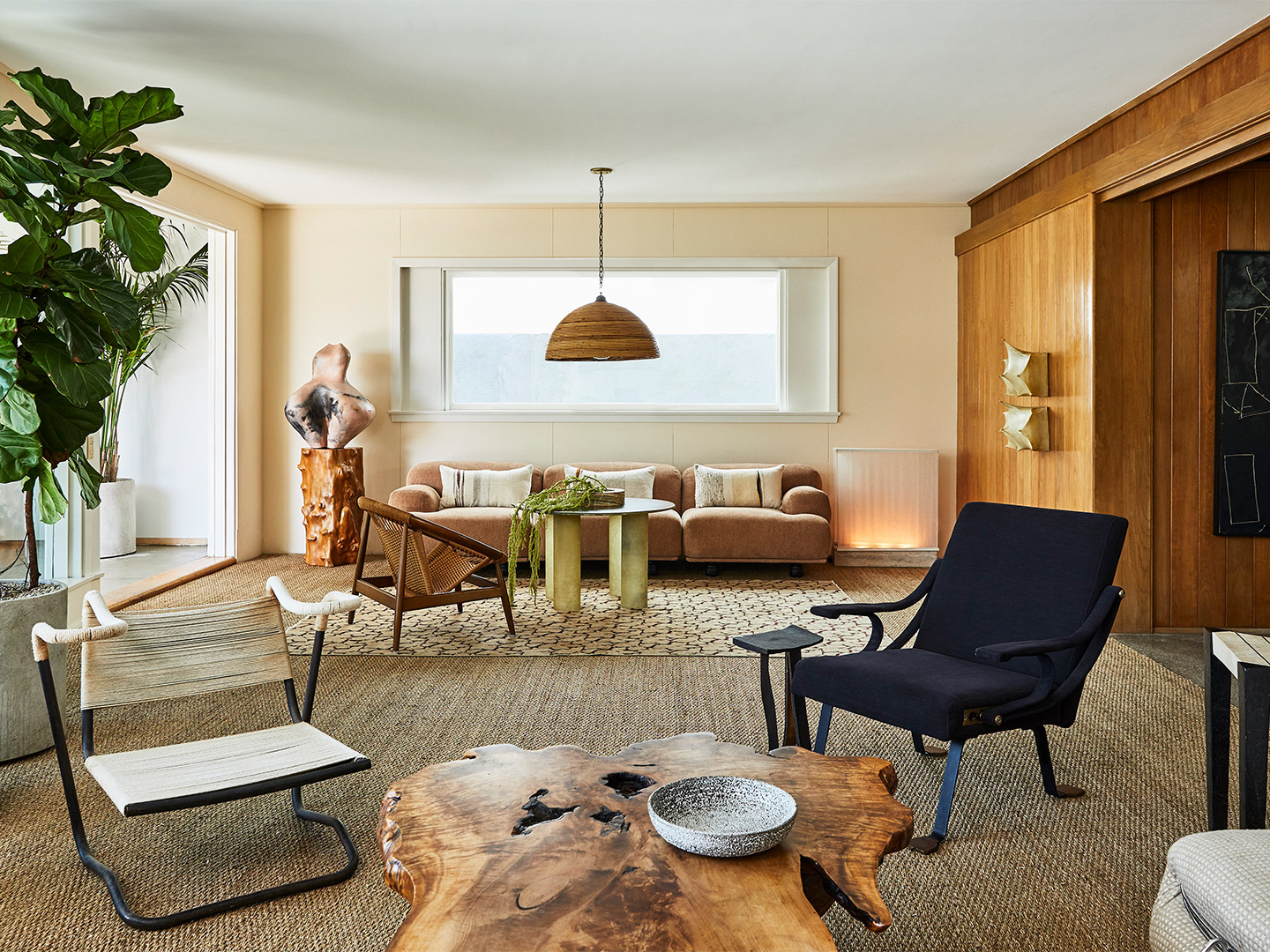
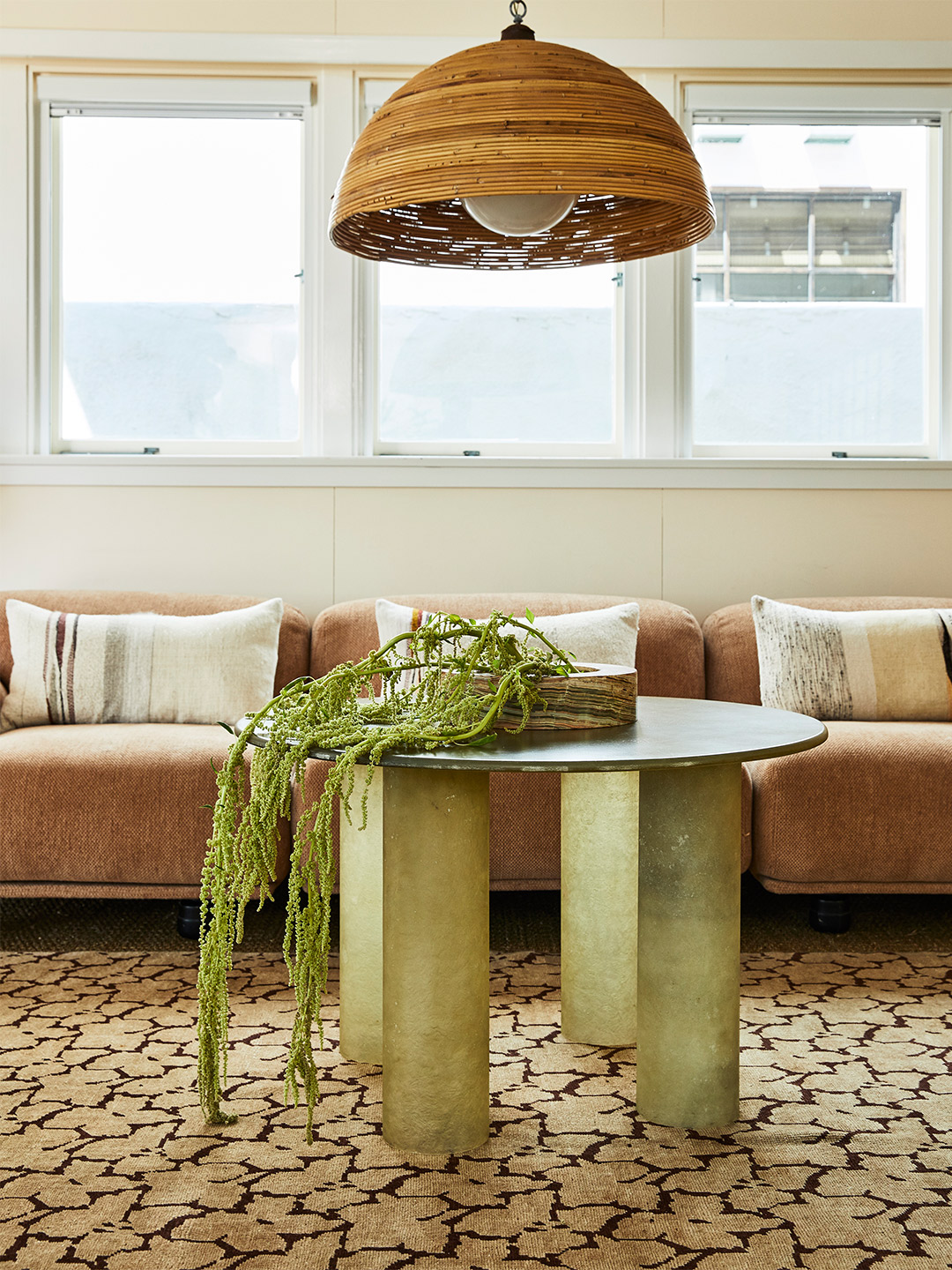
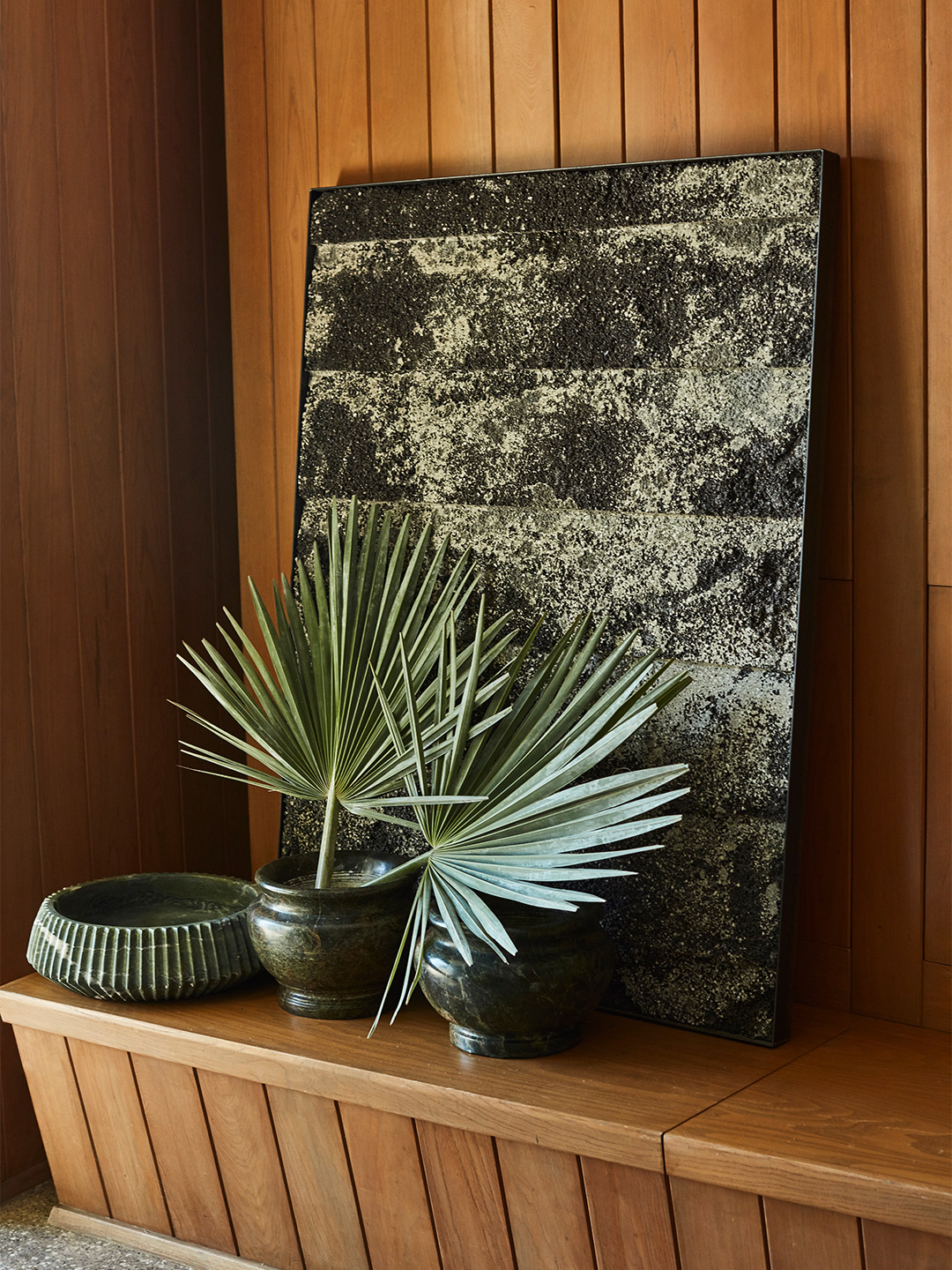
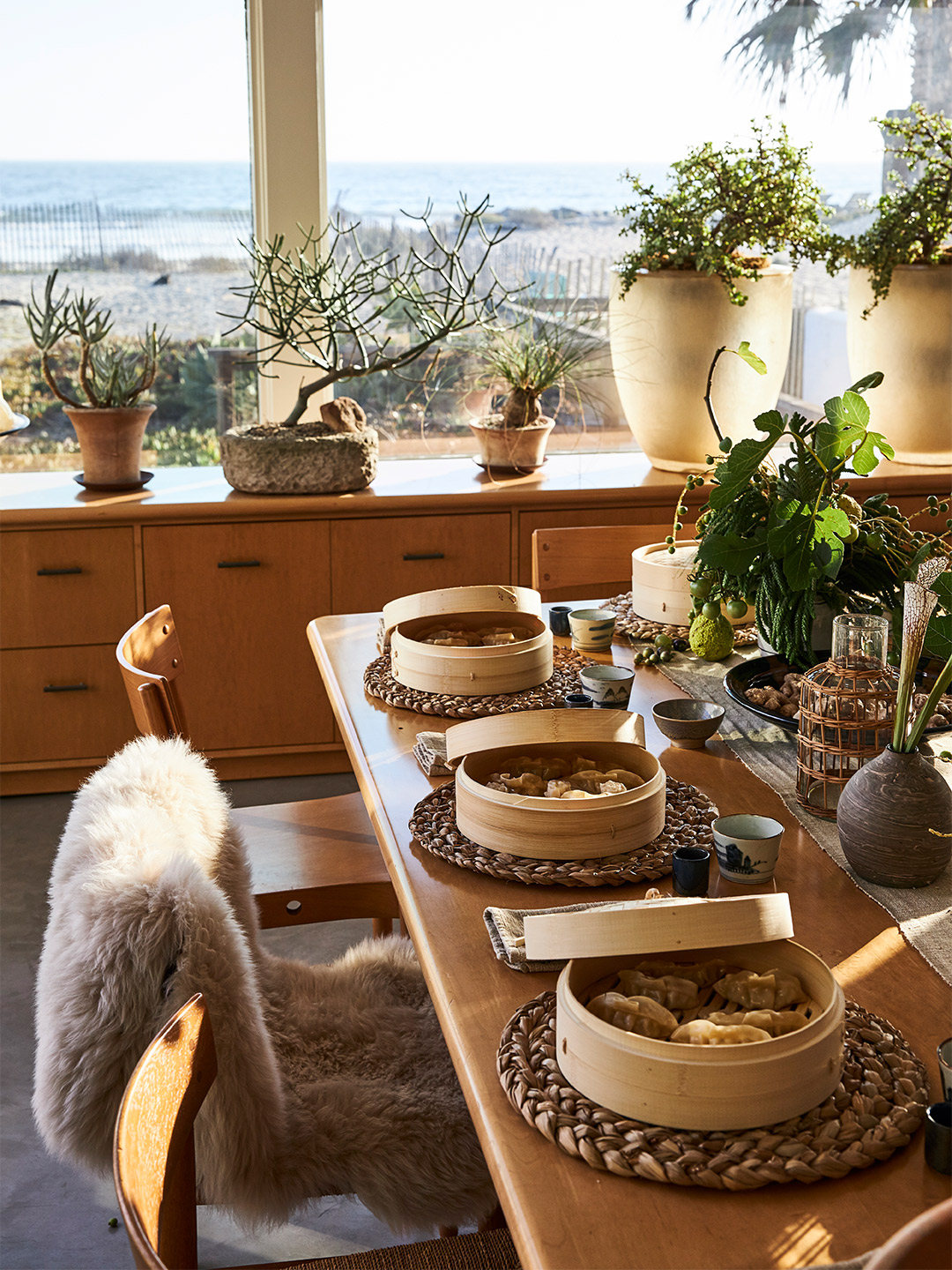
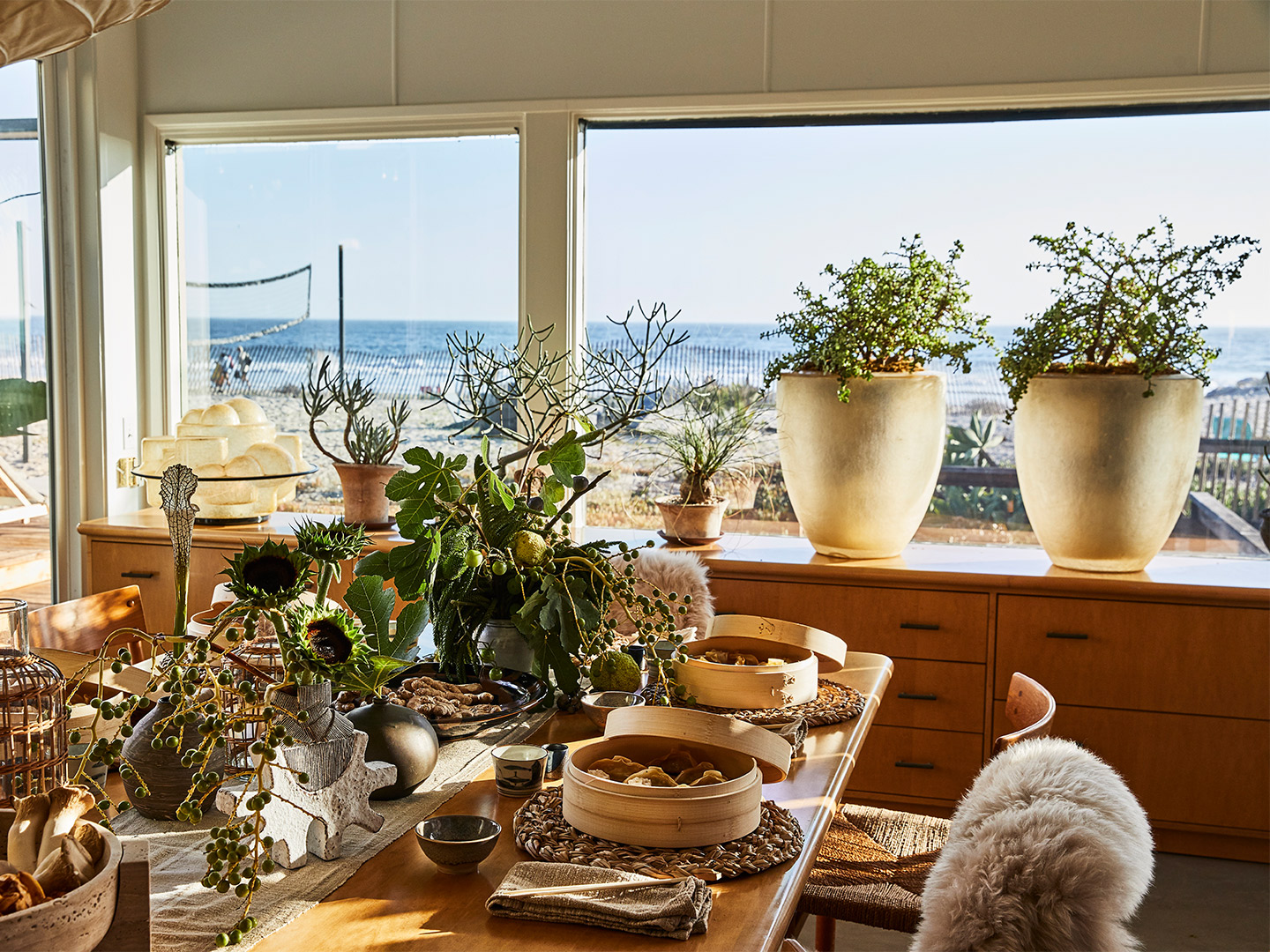
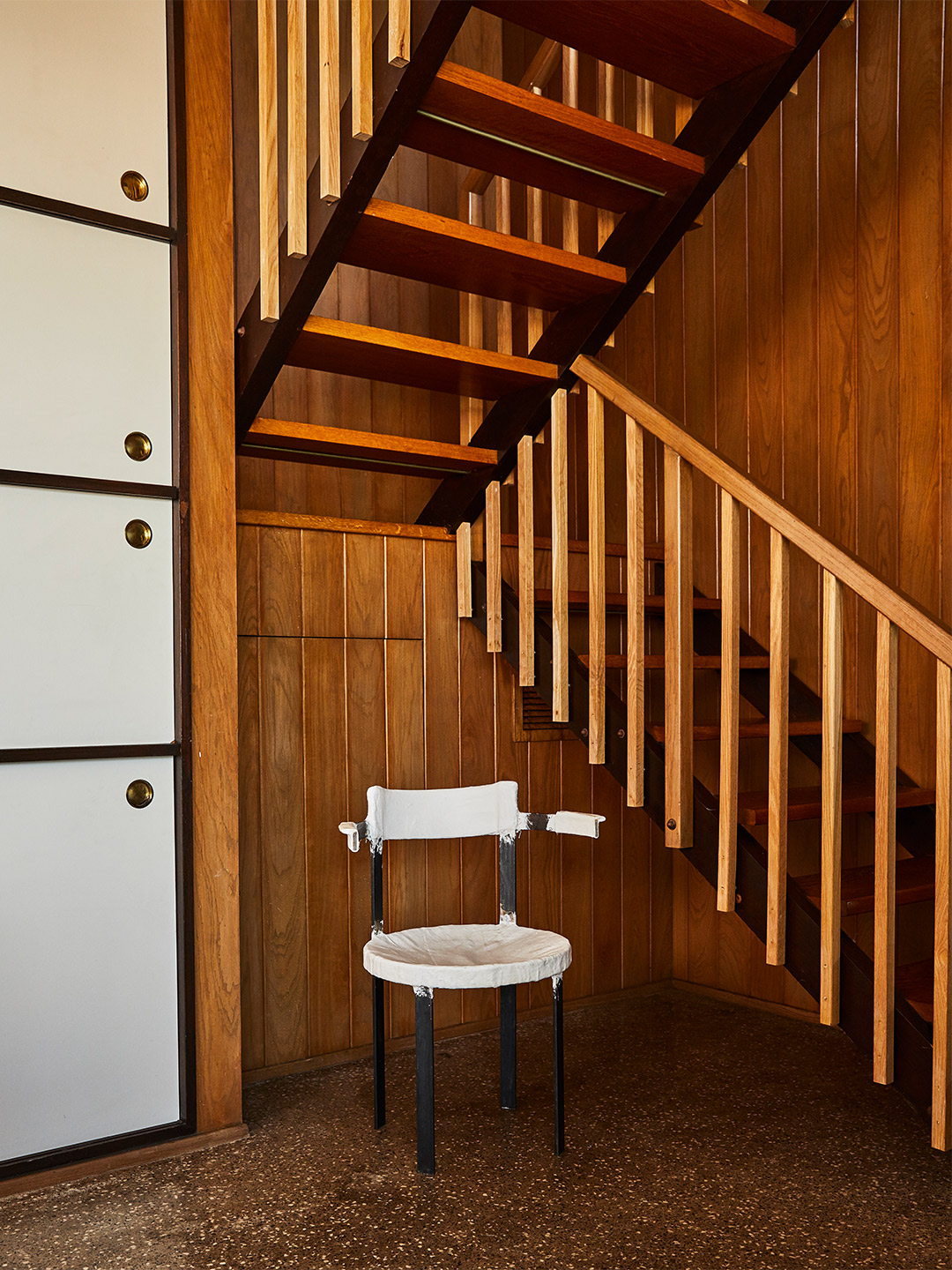
The melange of styles and textures begins at the entrance of the home, where a bronze and leather bench by Chuck Moffit is partnered with a chunky blackened-timber console from the LA studio Base 10. Under the stairway, a steel chair draped in white plaster – a piece by Austrian designer Lukas Gschwandtner – is awaiting its moment to offer respite. The designer brought in a ‘Soriana’ sofa by Afra and Tobia Scarpa, and a 1950s ‘Control’ lamp by American designer Mitchell Bobrick. Envisioned as a light and plant-filled solarium, the dining room features an Isamu Noguchi pendant, Danish mid-century chairs and a table set with earthenware planters and vintage fibreglass vessels brimming with foliage.
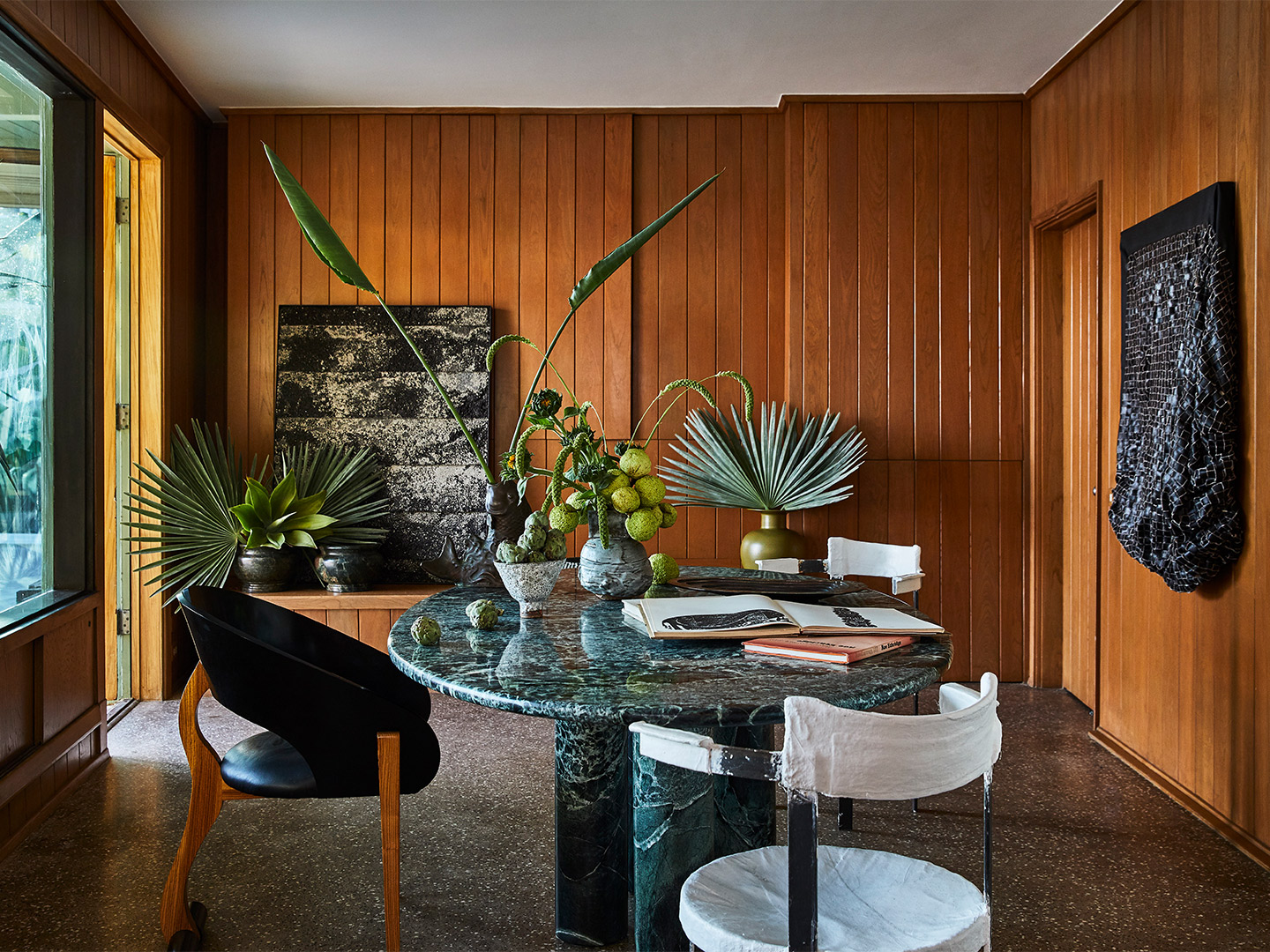
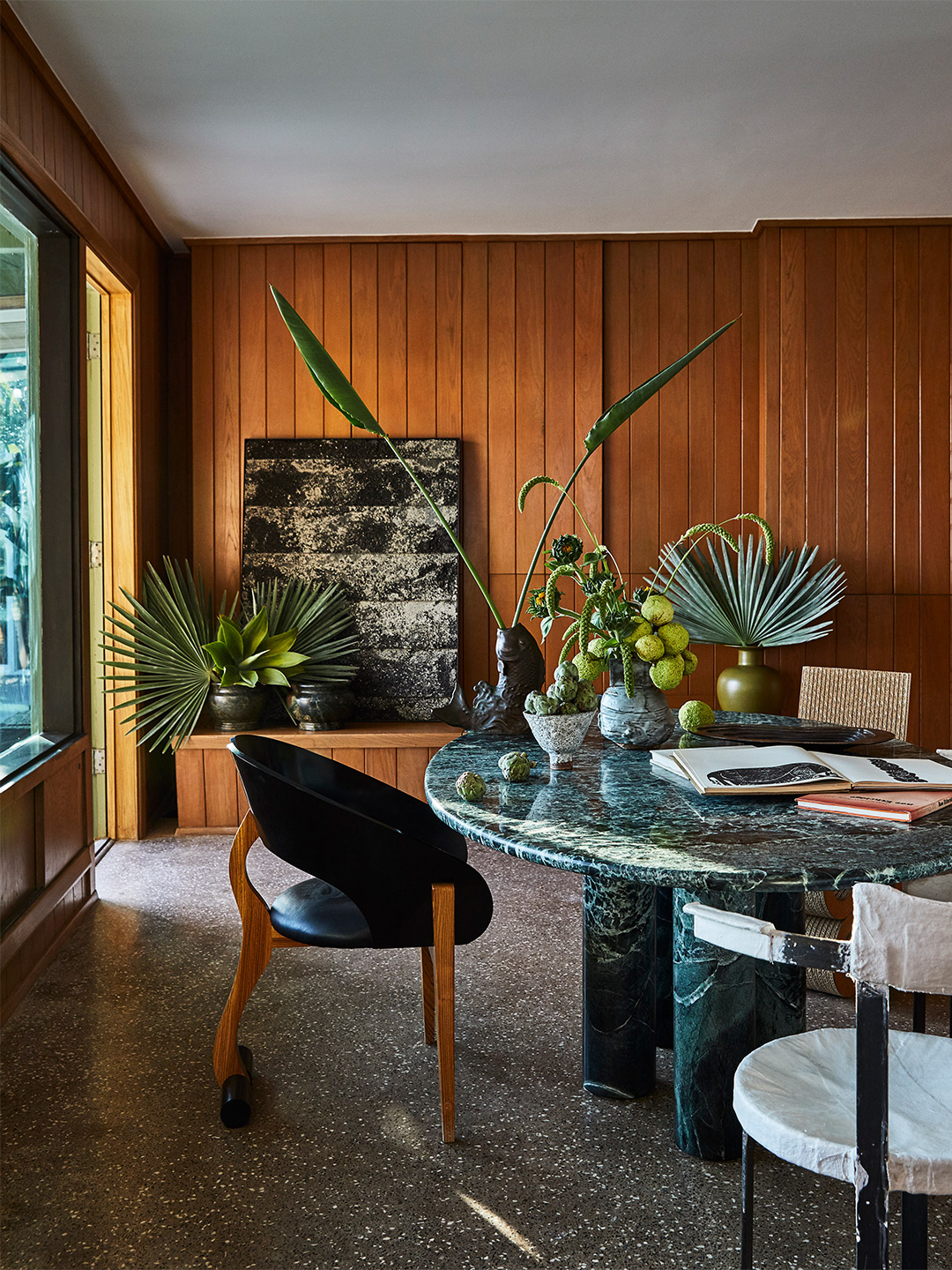
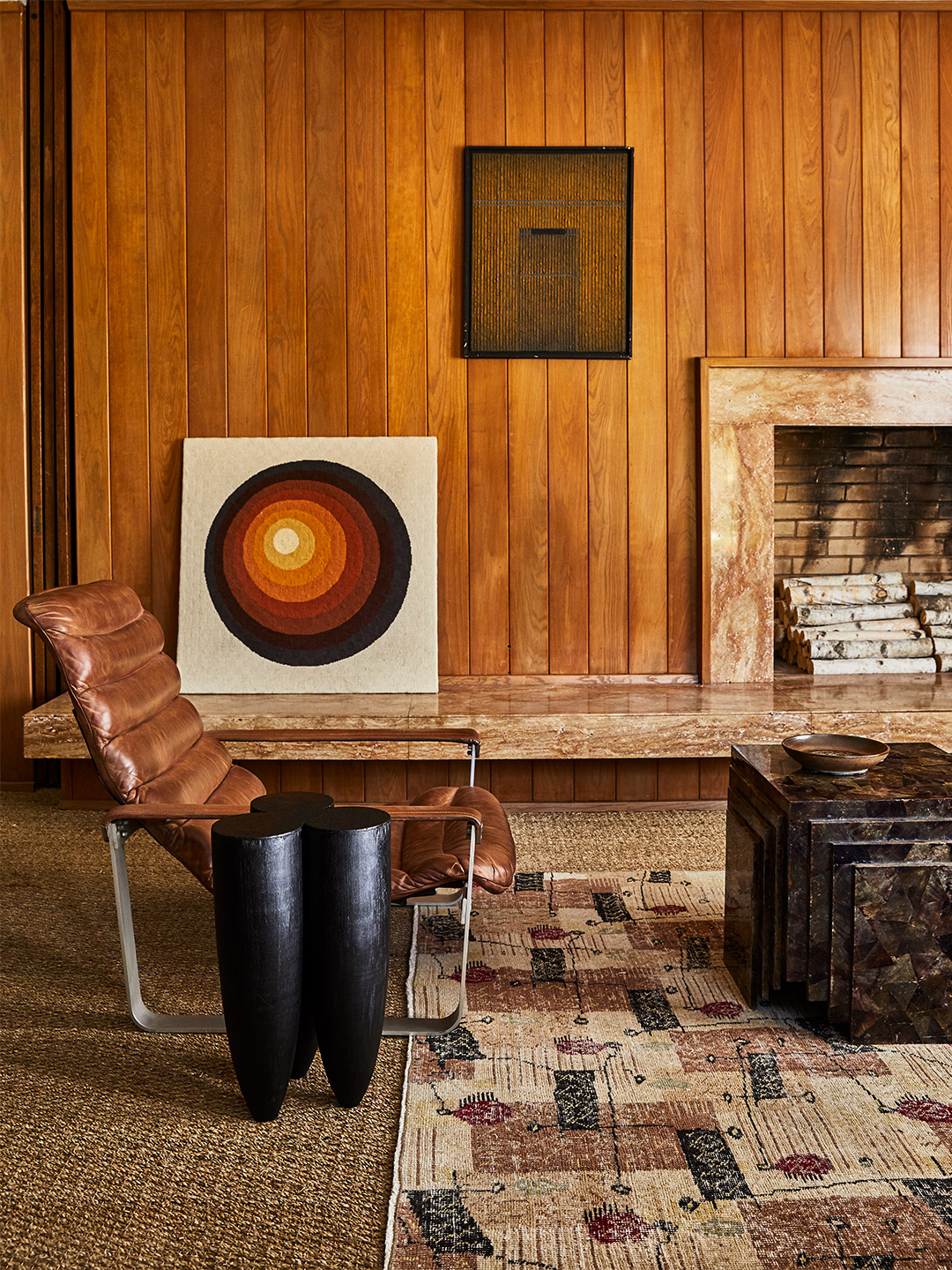
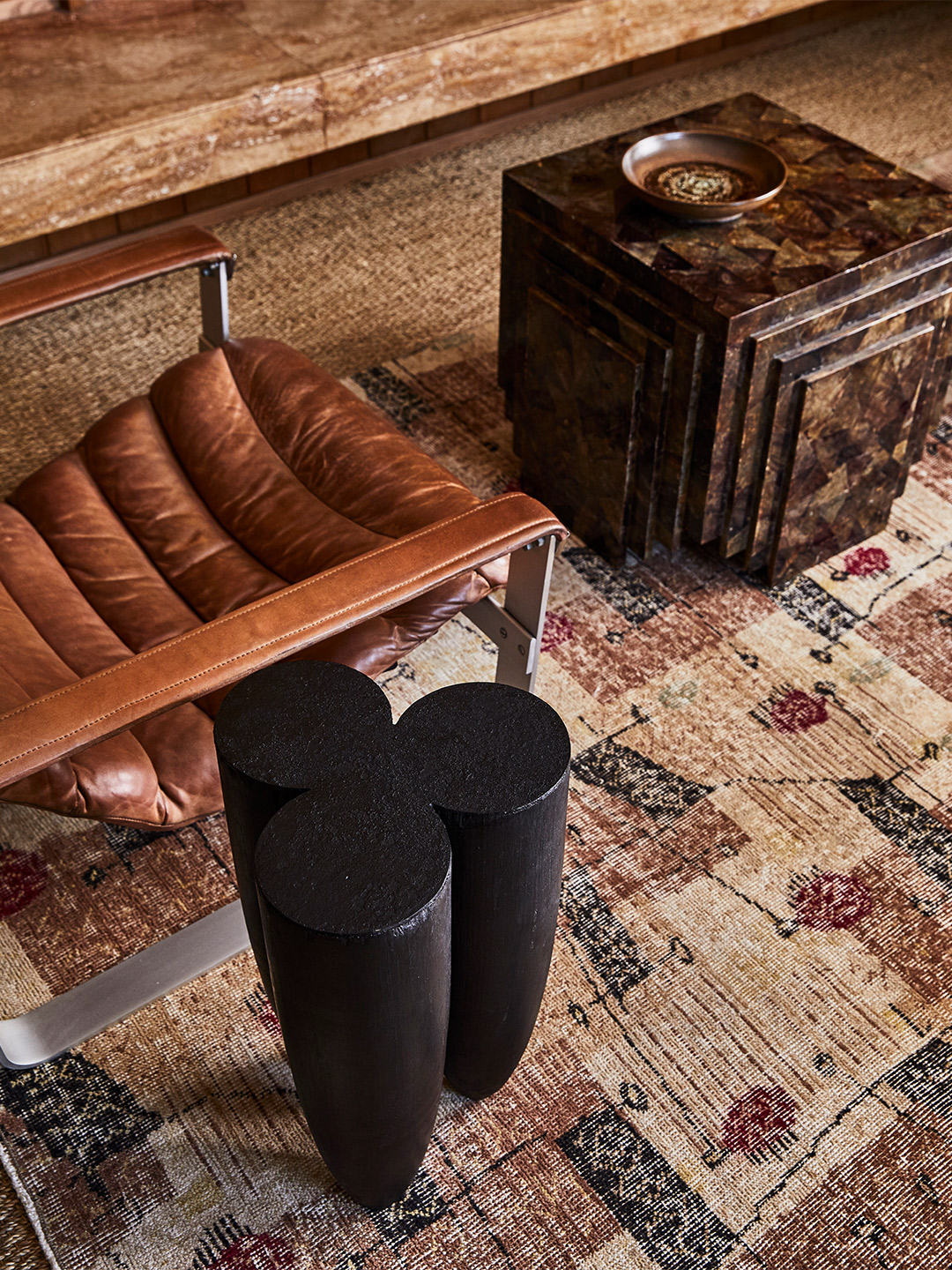
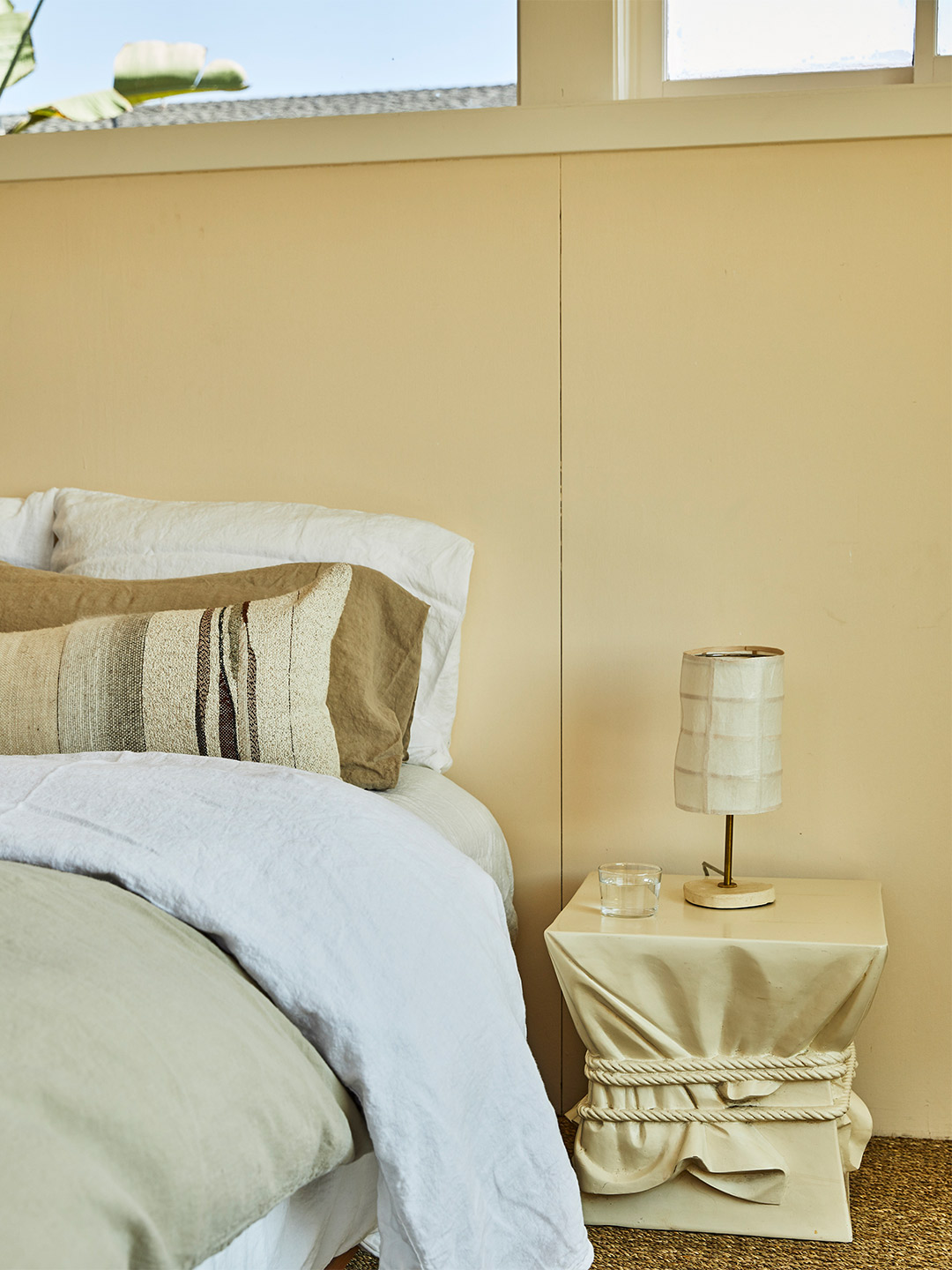
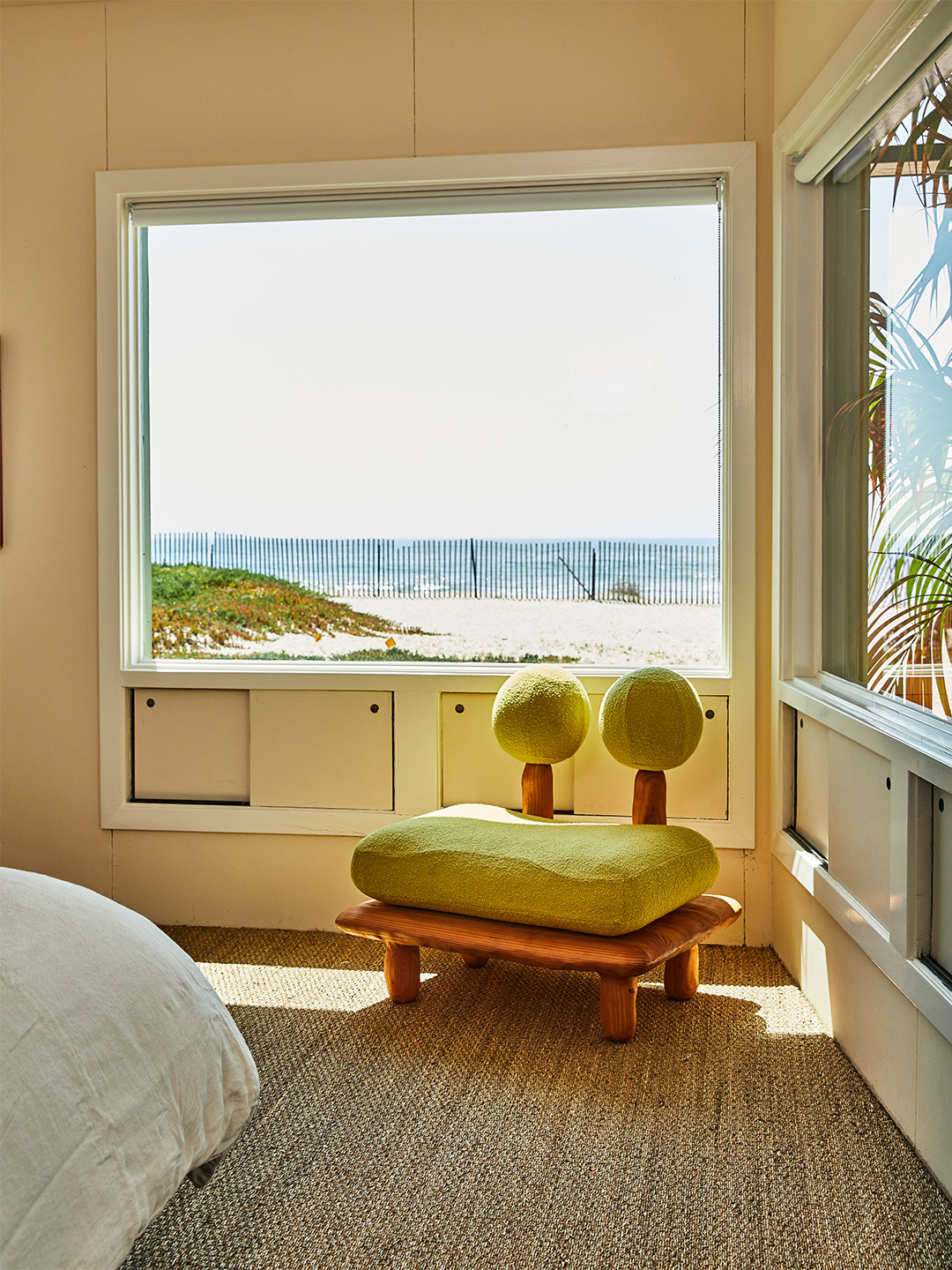
In the living room, lounge chairs by Ilmari Lappalainen are paired with a tapered side table made of iroko wood, and cubic coffee tables finished in tortoiseshell. A 1980s green marble table by Mario Bellini can be spotted in Kelly’s office, where the designer would work for one or two days a week when not in the studio. One of the bedrooms is swathed in breezy colours and laidback decor, including a vintage nightstand, linen bedding and a plaster and paper mâché table lamp; a sculptural lounge chair by Ryan Belli adds some signature Wearstler whimsy.
Most of the furniture was drawn from the designer’s extensive collection of vintage pieces, something she has been building since a child (her mother worked as an antiques dealer which sparked a longtime passion and successful career). “I shop all over the world, and anytime I see anything that is unusual, I buy and store it in my warehouse,” Kelly says. Having brought in the key pieces to set the tone, she then turned to Joel Chen of LA antiques emporium JF Chen for the rest. “I’ve been purchasing things for projects from him for as long as I remember,” she explains. “He has a 30,000-square-foot store that stayed open [during the Covid pandemic] because there’s a lot of room for social distancing. So I went and got a few pieces from him.”
Astonished by the transformation that Kelly had lovingly bestowed upon the property, the owner commissioned a photographer to capture the home in its reimagined state, and updated the real-estate listing. About a month later, the residence sold – to a young Silicon Valley couple who, like Kelly, adored the home for its original charms. Kelly and her family packed up after the summer and removed the furniture pieces (as there are a number of pieces that she “would never part with”). But they left the home knowing it’s in safe hands. “You could have built a house three times the size of this one, which is what everybody unfortunately does on Broad Beach. But [the owner is] not tearing the house down, just fixing up the original bathrooms and doing a little more landscaping,” Kelly says. “That was amazing to hear!”
I shop all over the world, and anytime I see anything that is unusual, I buy and store it in my warehouse.
Catch up on more architecture, art and design highlights. Plus, subscribe to receive the Daily Architecture News e-letter direct to your inbox.
Related stories
- Home tour: Memphis Milano apartment in Italy by Puntofilipino.
- Home tour: New meets old at the hands of Channon Architects and Burton Architects.
- Home tour: The undulating Fold House in Canada by Partisans.
During an extraordinary year, cutting-edge design and inspiring architecture has continued to pave the way for a bright future. Since launching Daily Architecture News in mid-2020, we’ve had the pleasure of publishing a cross-section of stunning homes, hotels and brilliant bars. Plus, tech-focussed launches and surveyed cutting-edge projects with an eye firmly set on the future. In this week’s global video round-up (above), we take a look at some of 2020’s most popular projects and stand-out stories.
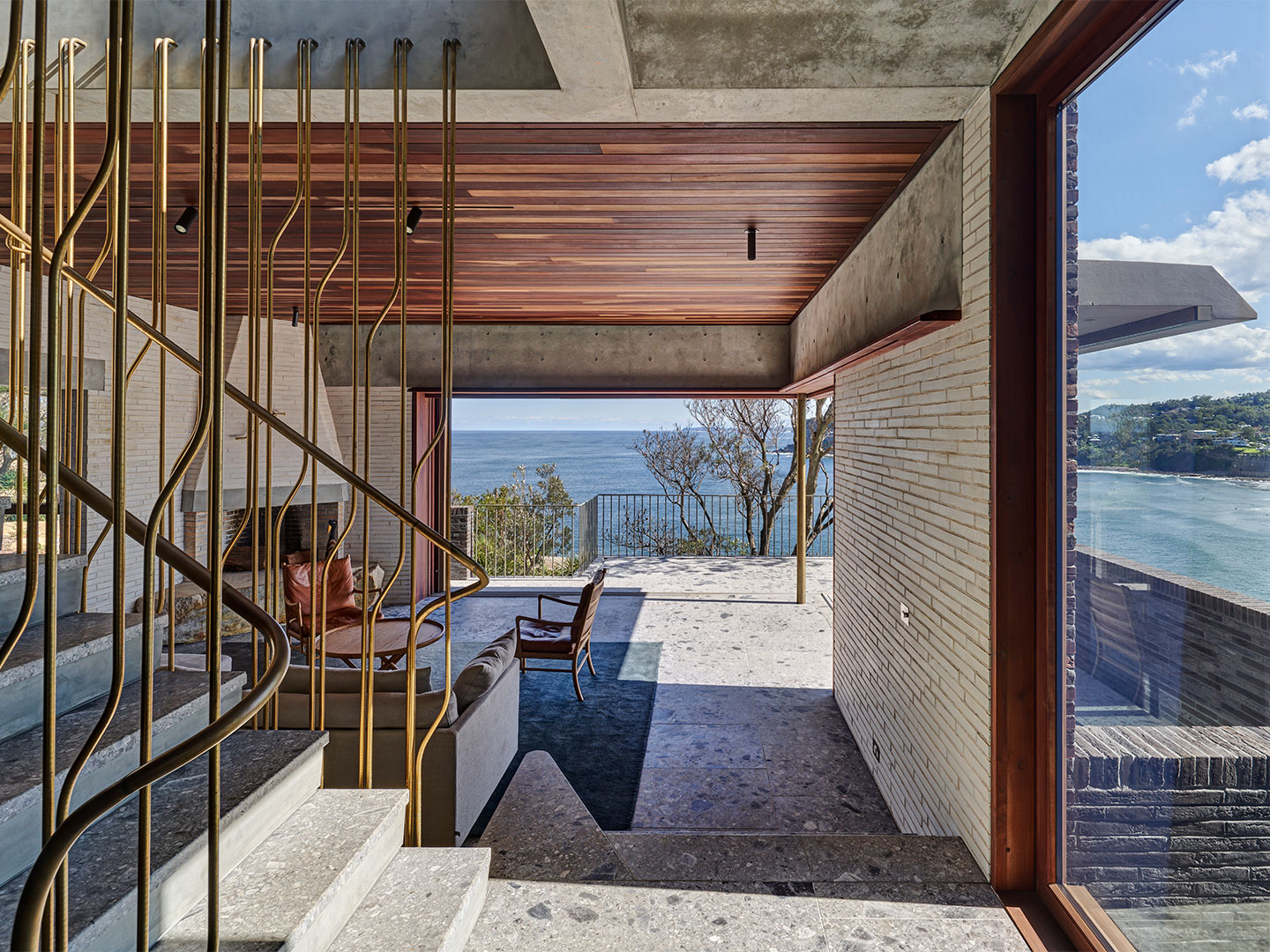
- Beautiful homes: From inner-city abodes to breathtaking beachside beauties, the year’s most popular residences include La Scala by Richards and Spence and Casey Brown Architecture’s Bangalley House (pictured). Read more.
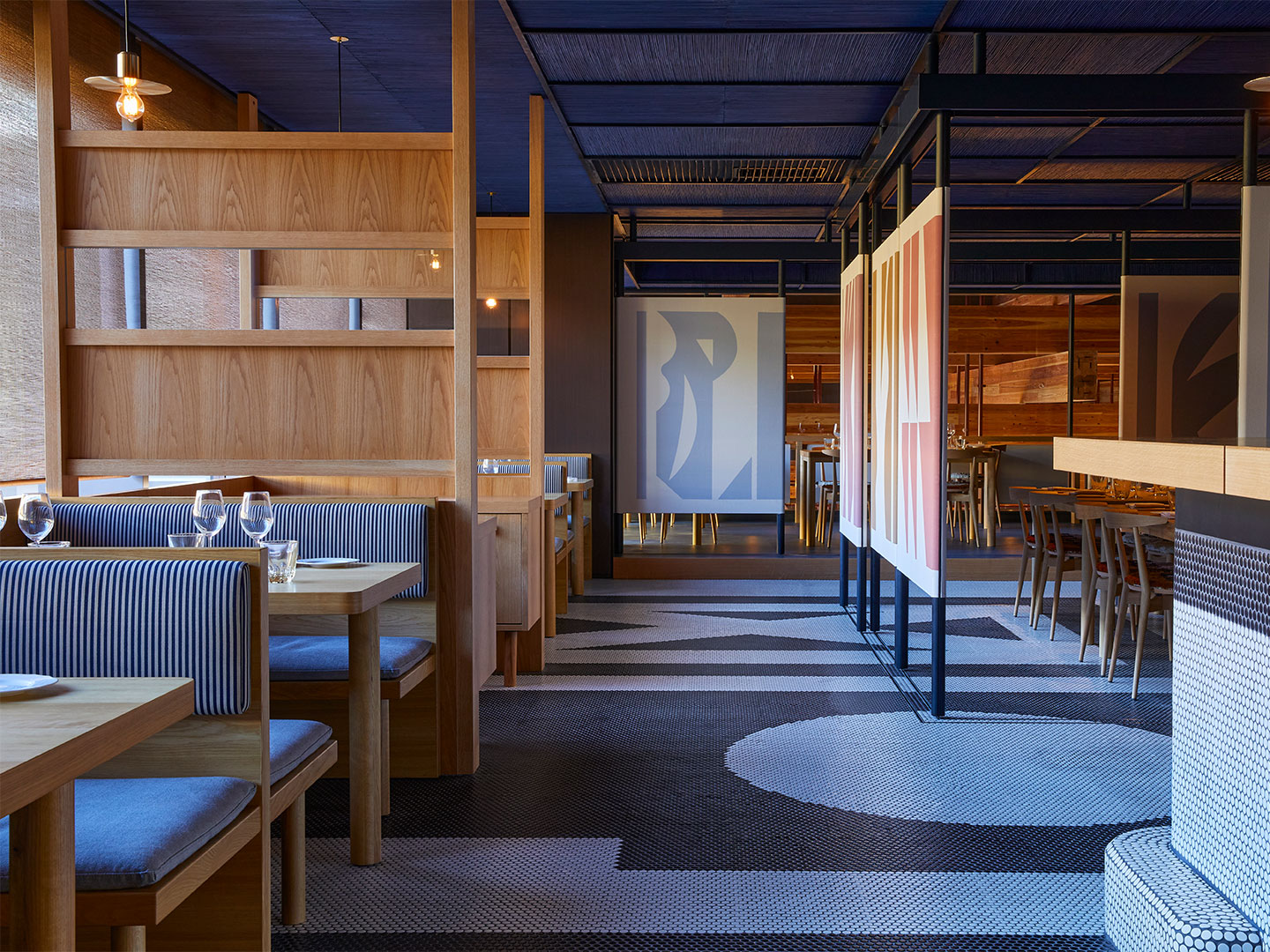
- Hot hotels: Heading around the globe, 2020’s hottest designer destinations include Camp Sarika by Amangiri in Utah and Japan’s Ace Hotel Kyoto (pictured) by Kengo Kuma and Commune Design. Read more.
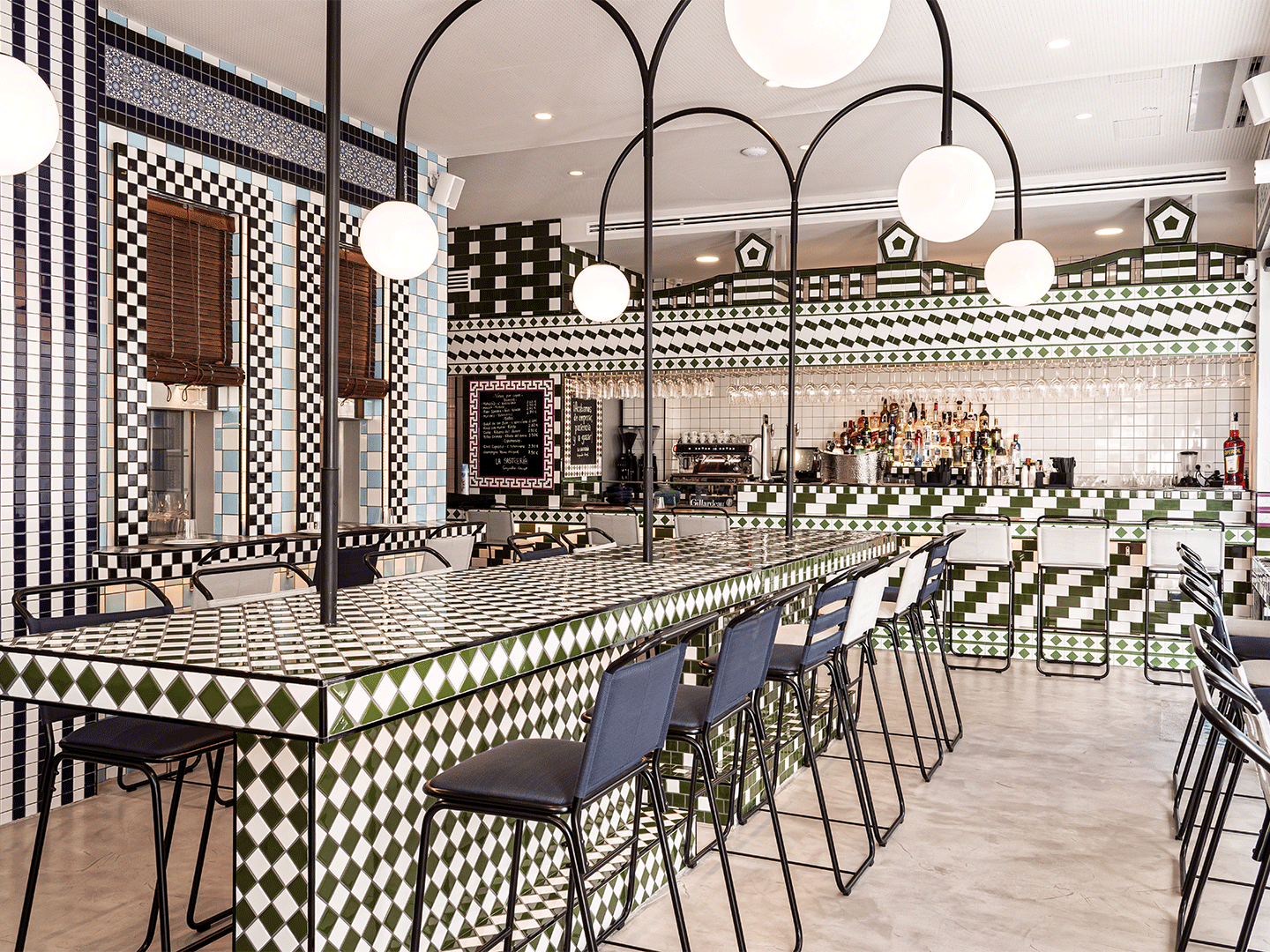
- Brilliant bars: Emerging and established designers are responsible for some of the world’s greatest watering holes this year, from Sydney’s Four Pillars Laboratory to the bar at La Sastrería in Spain (pictured). Read more.
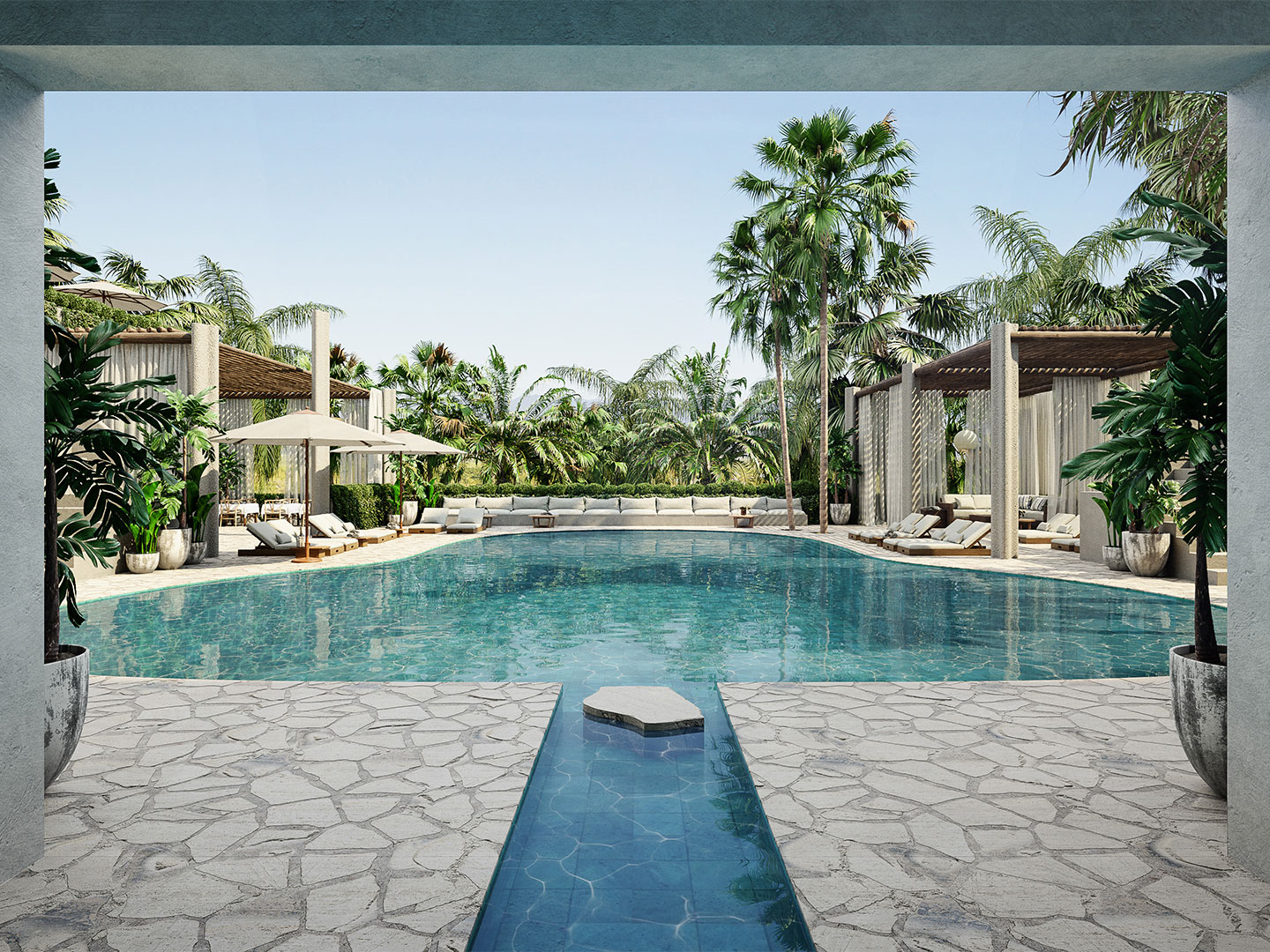
- Future-focussed projects: Vertical landscaping was popular in proposed developments in 2020, and Gurner’s plan for a luxury hotel in Port Douglas (pictured) is set to capture attention in 2021. Read more.
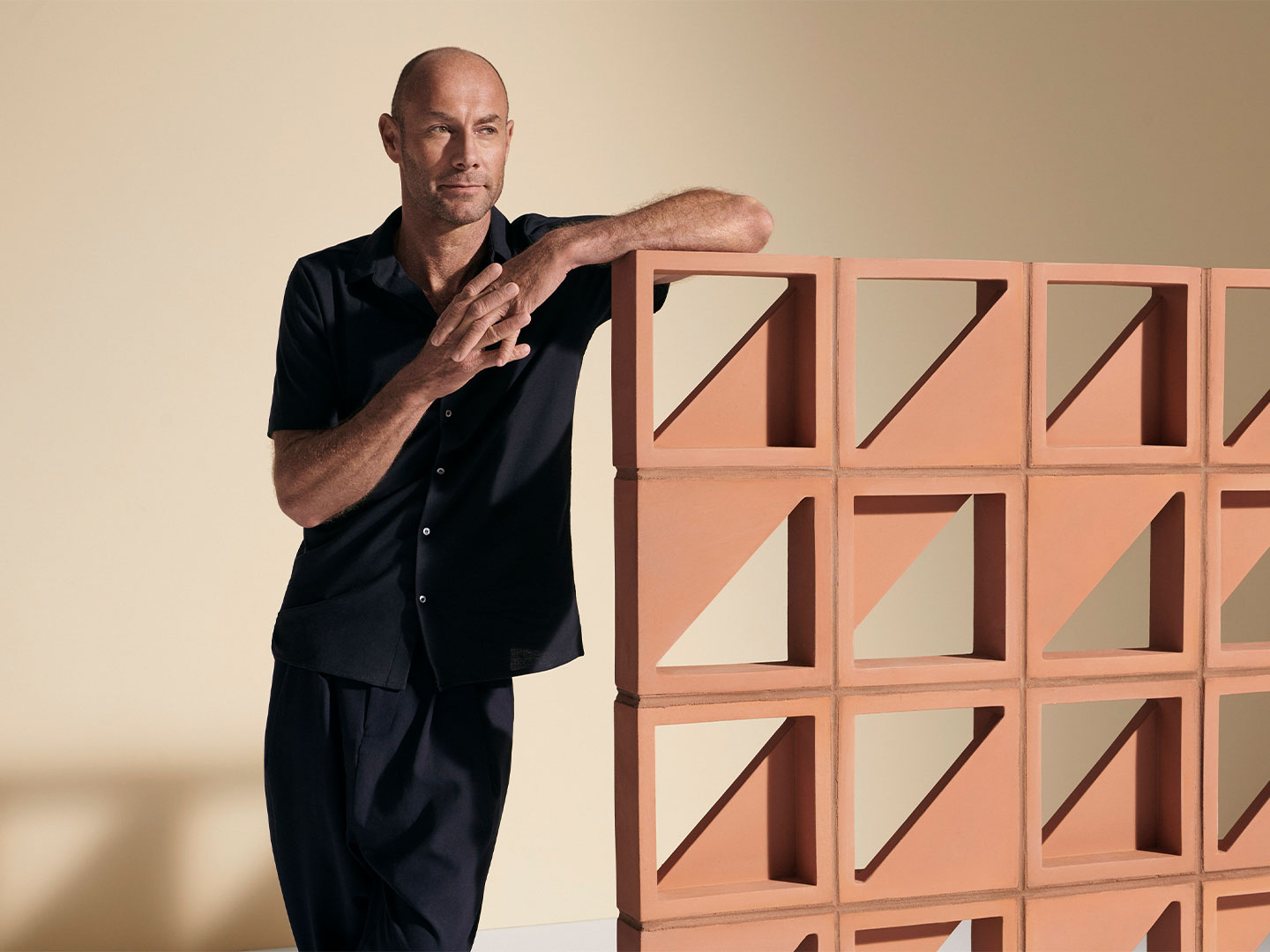
- Legendary launches: From new inventions to reimagining classic designs, such as Adam Goodrum’s breezeblock for Austral Bricks (pictured), 2020 witnessed product launches with a particular focus on game-changing technology. Read more.
During an extraordinary year, cutting-edge design and inspiring architecture has continued to pave the way for a bright future.
Related stories
Locals who wander the foothills of Mount Coot-tha in Queensland, Australia remark that the distinctive, textured brickwork at Couldrey House is akin to sedimentary rock, tree bark or corduroy fabric. Wildly more playful and sweet-toothed with their words, “children say it is cake with icing,” says architect Peter Besley, who designed the recently built home for a member of his own family.
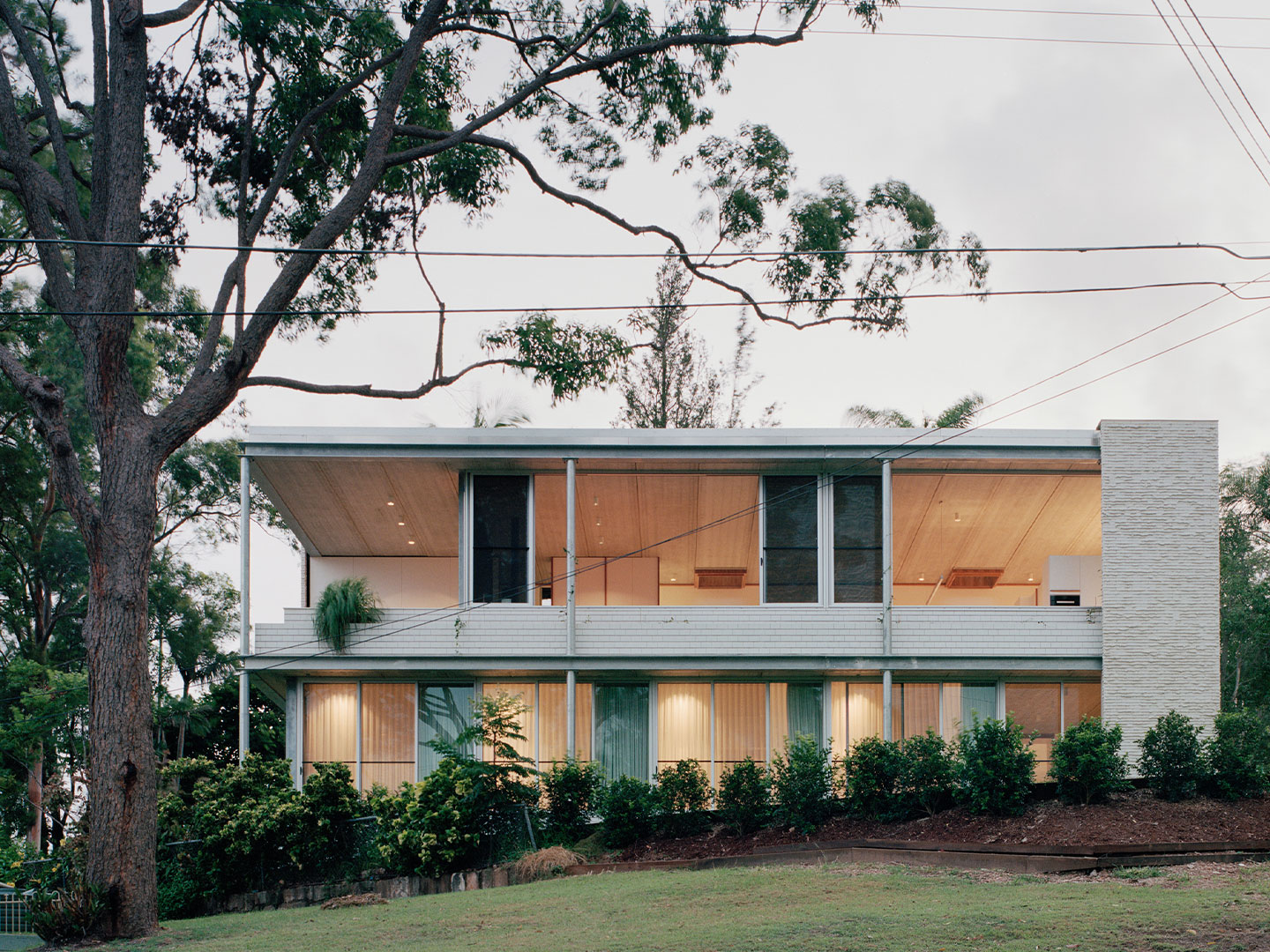
It’s the slender, off-white bricks and the way in which they were laid with lashings of matching mortar that garners so much attention from passers-by. But take a step back from the imaginative chit-chat of the neighbours, and it’s the brave use of brick in the first instance that sets the home apart from most residential architecture in sub-tropical Queensland. “Many houses [in Queensland] tend to hover over the ground with lightweight materials which need re-coating and replacement,” says Peter. “I instead designed Couldrey House to spring directly from the subterranean rock and to be made of heavy materials lasting a very long time.”
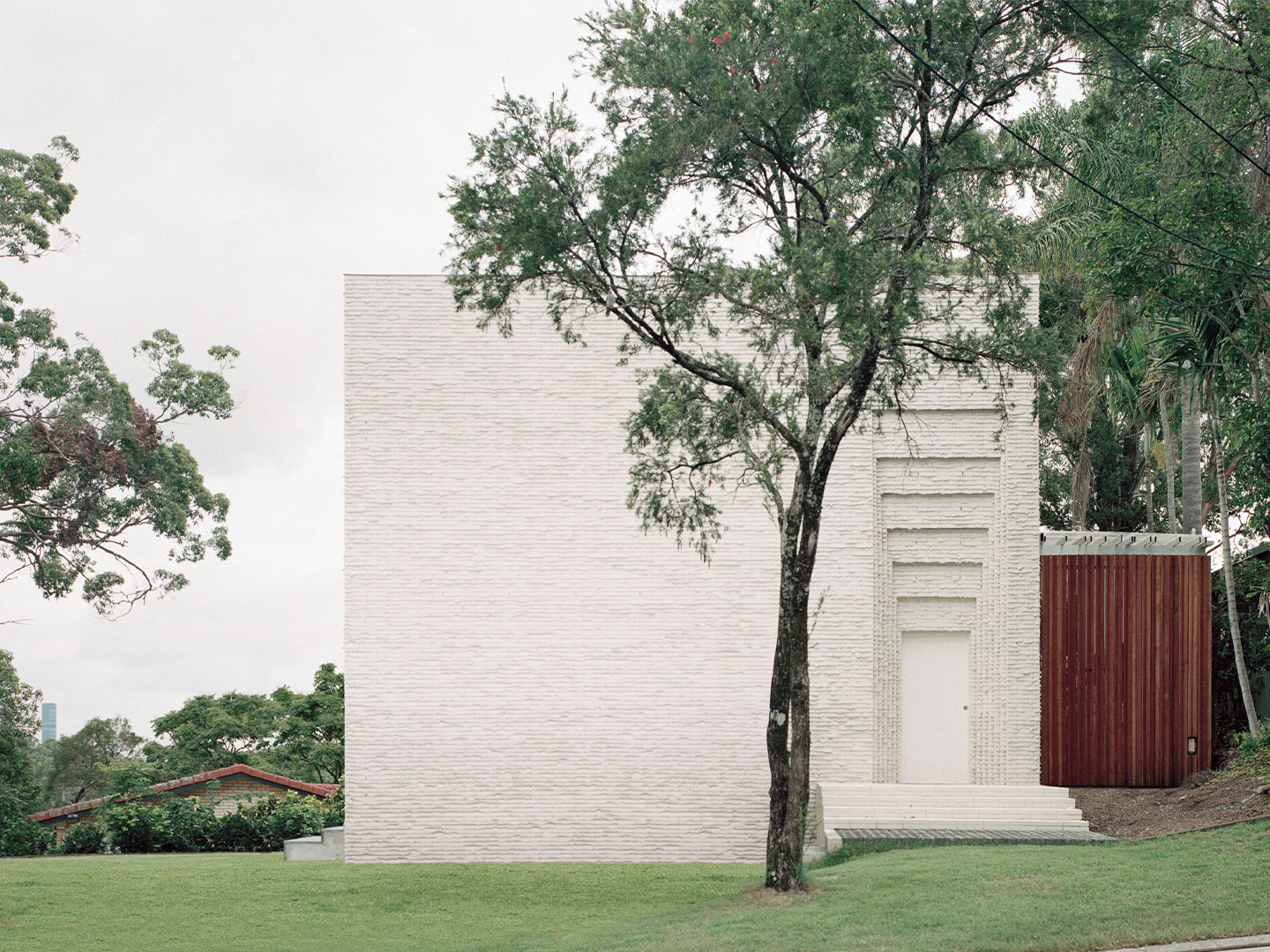
The decision to use masonry at Couldrey House was one that was made early in the design process and, together with the concrete superstructure, it firmly anchors the house to its rocky foundations. “The building is designed to be immensely heavy,” says Peter, who recognises that this home, west of Brisbane, parallels his architectural work in the Levant, particularly in Iraq. “Buildings there seem aware of the scale and solemnity of the land in which they sit,” he says. “The forms and spaces are compelling but simple. They sit heavily on the ground. They seem to say to the landscape: ‘I can accompany you in your long journey’.”
There is a shared monumentality between building and landscape, even when that monumentality is intimate.
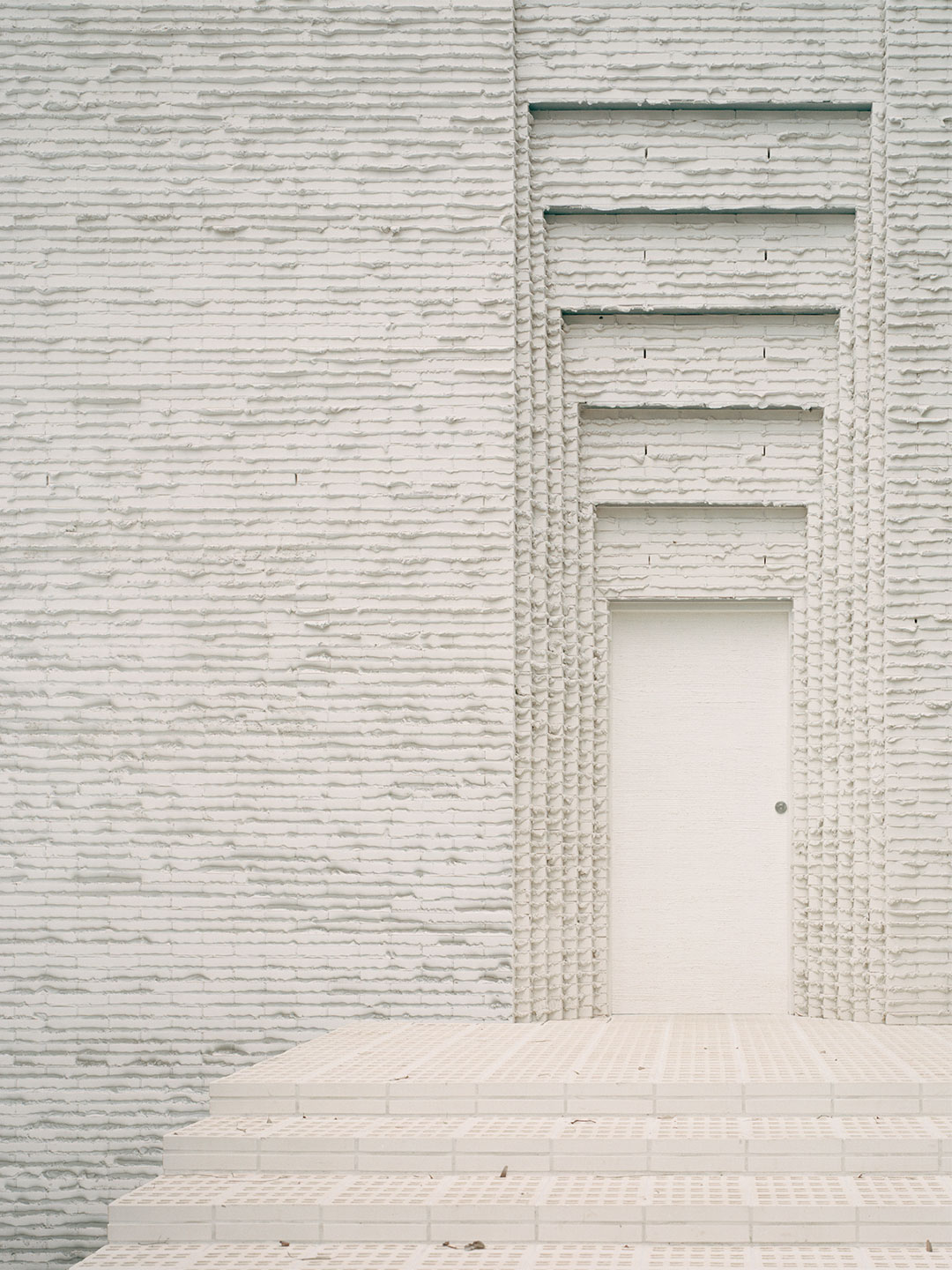
Couldrey House is wrapped in a brick envelope, shaped in a simple rectangular prism, says Peter, which is open to the views and breezes of the north and east. The home is completely closed off to the south and harsh conditions of the western side. On the street-facing western elevation, the brickwork is folded in concertinas, in a reducing scale-play around the main entrance door. This design detail and its shadows, benefited by the frothy, whipped cream-like mortar, has its greatest impact in the afternoon light. A similar expression of brickwork stretches horizontally along the western facade and forms a set of stairs, laid in a way so that the brick’s extrusion holes are exposed for drainage.
To the south, Peter specified large horizontal slots in the facade to create “louvres” which adopt a dual role as shading and privacy devices. The house has parapet walls and no overhangs – its flat, internally draining concrete roof is piled with stones. The roof also has what Peter calls “plug and play” functionality whereby various tech-centric contraptions such as antennas, satellites, solar hot water tanks and photovoltaics can be added or removed as technology evolves with no impact on the house.
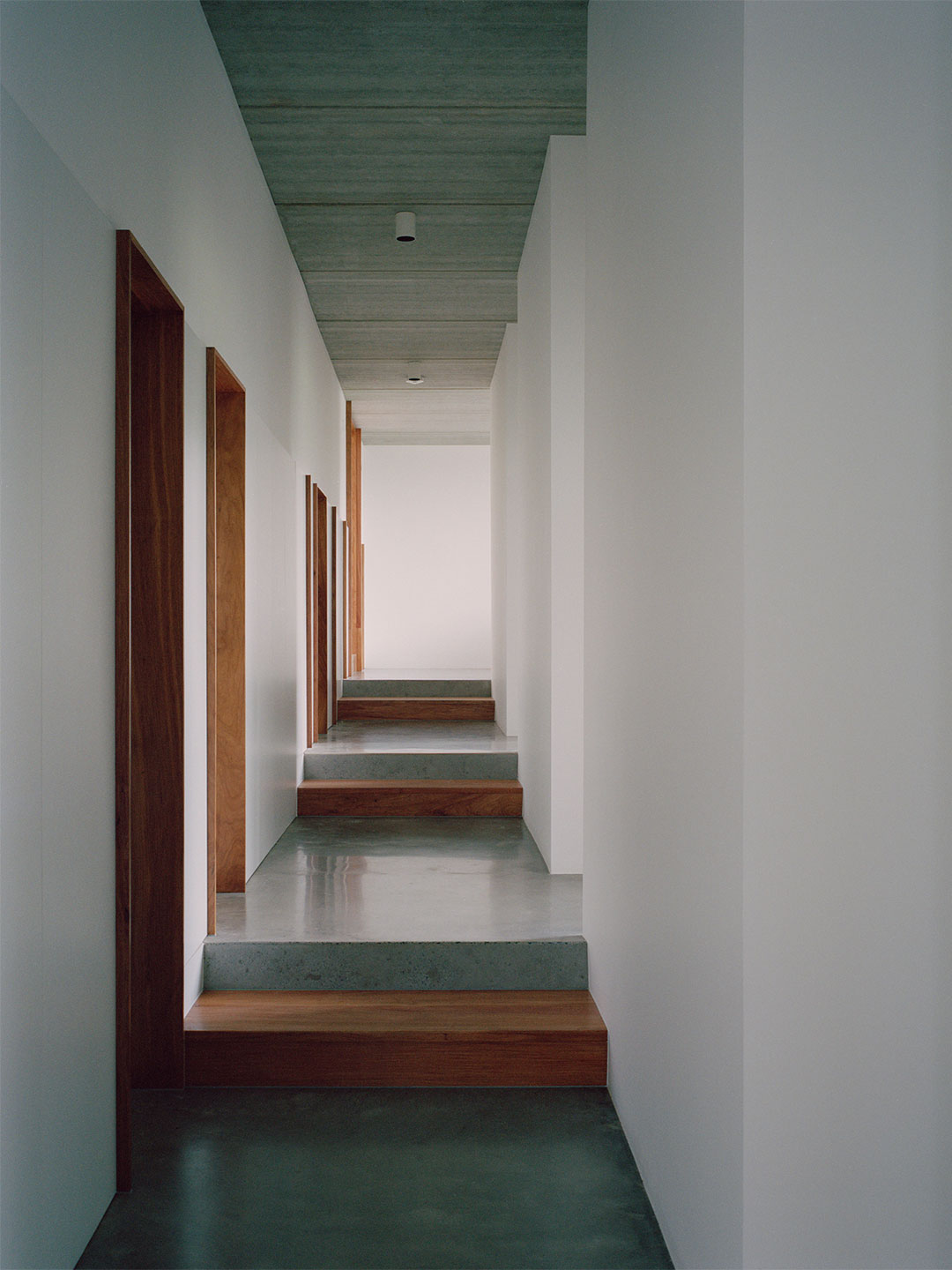
In response to Queensland’s evolving climate situation, Peter says, “it is now hot-dry as much as it is hot-wet”. An observation that he believes allowed for a hybrid approach to cooling the home – one that goes beyond the traditional reliance on intermittent breezes only. While the home does continue the region’s tradition of catching cooling breezes with its good aspect and a permeable layout, Peter explains that the house is designed to create radiant cooling using thermal mass via its 30 nine-metre-long precast concrete floor and roof units. “Diurnal temperature difference recharges the thermal mass at night, ready to cool the residents each day,” he says. “Radiant cooling does not rely on air, so [this] supplements traditional convection cooling and humidity control.”
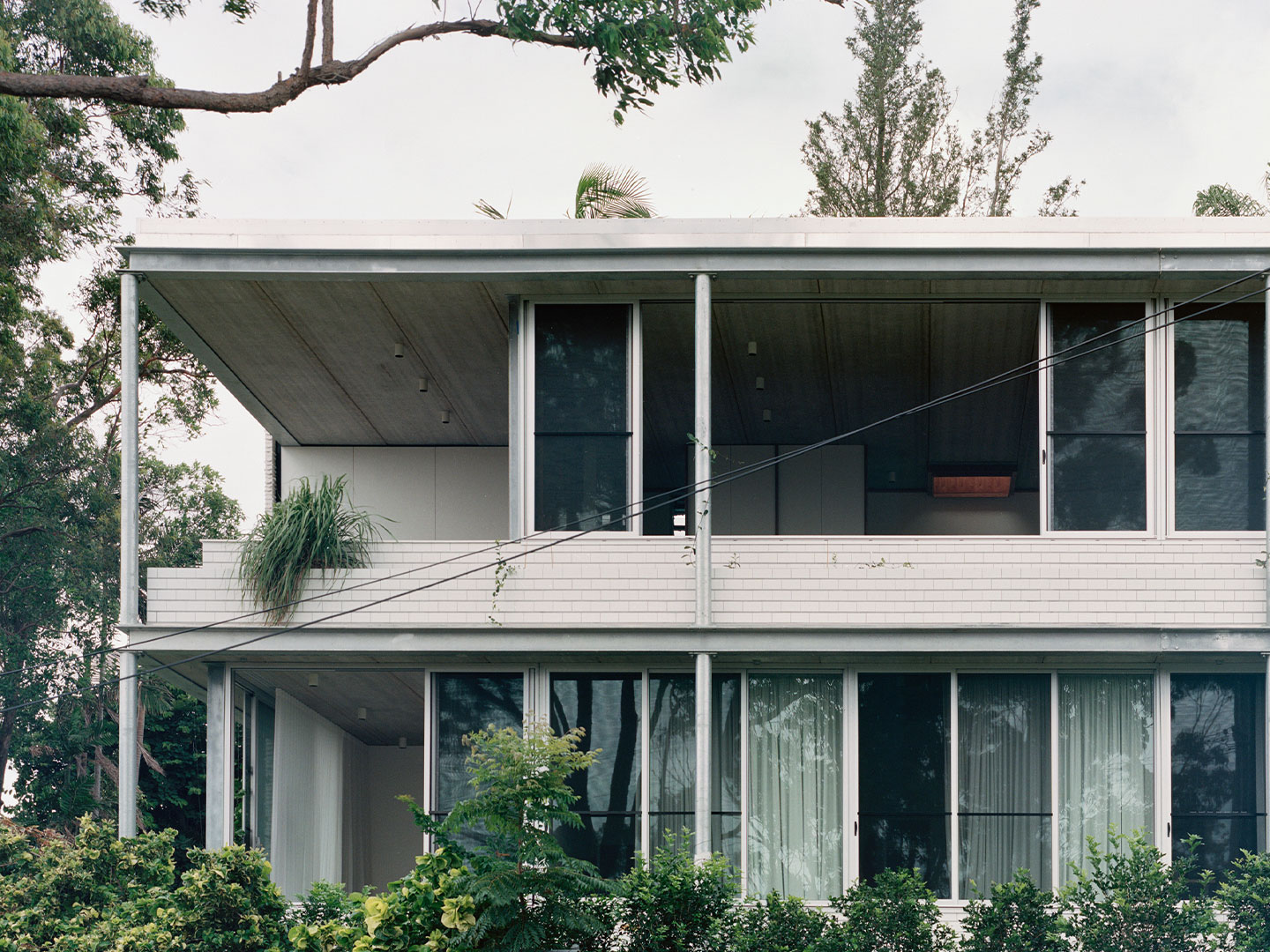
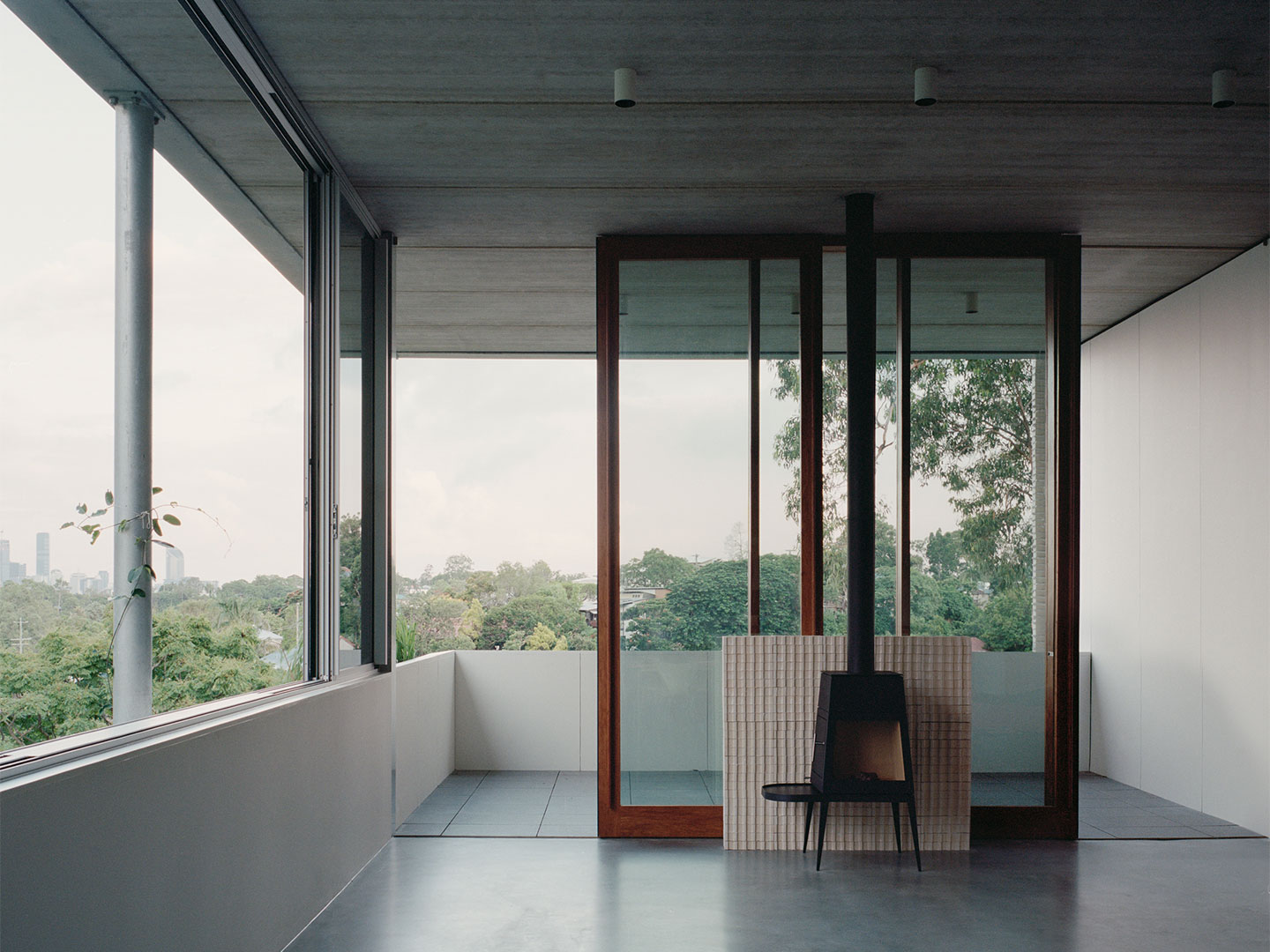
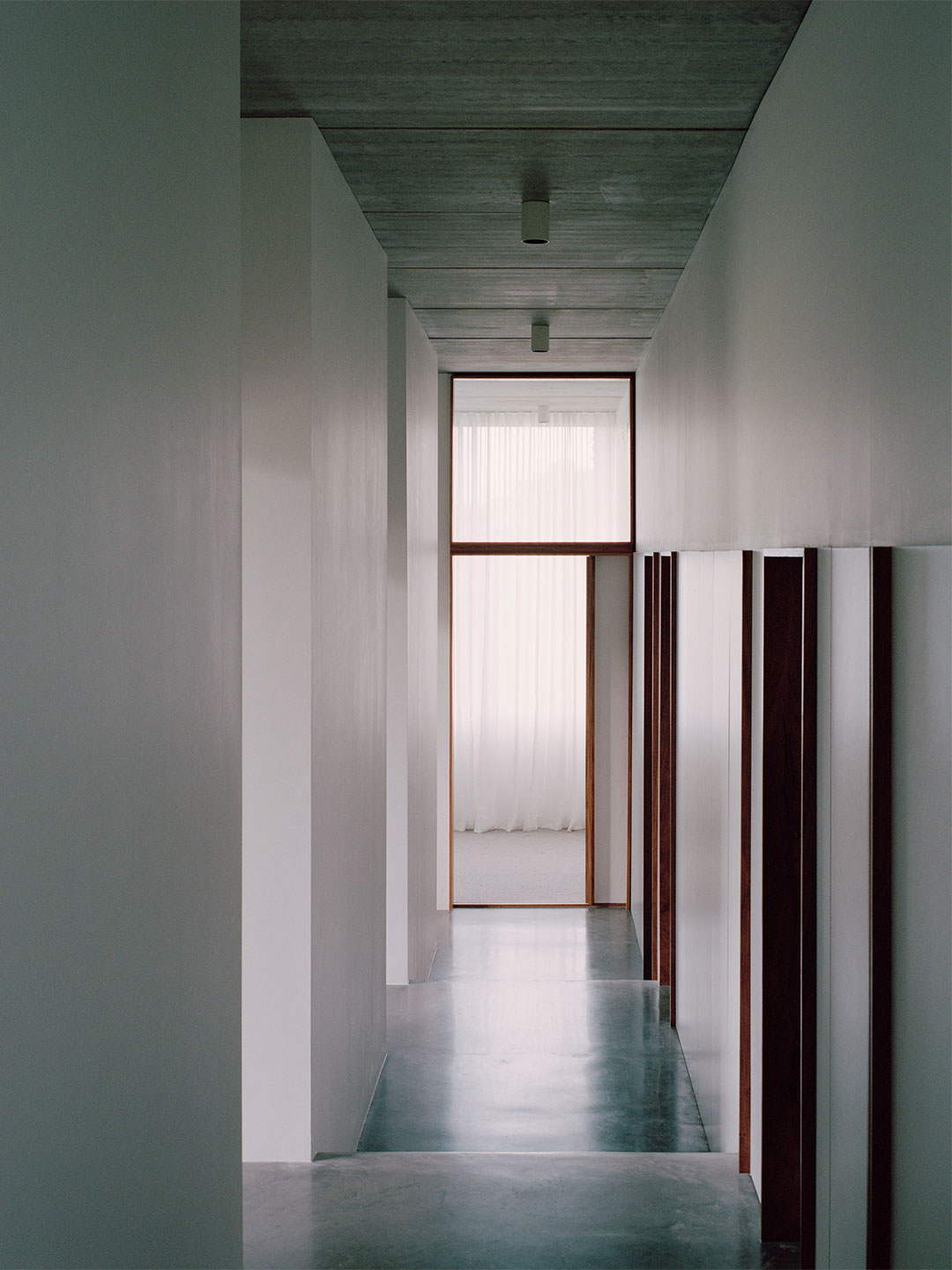
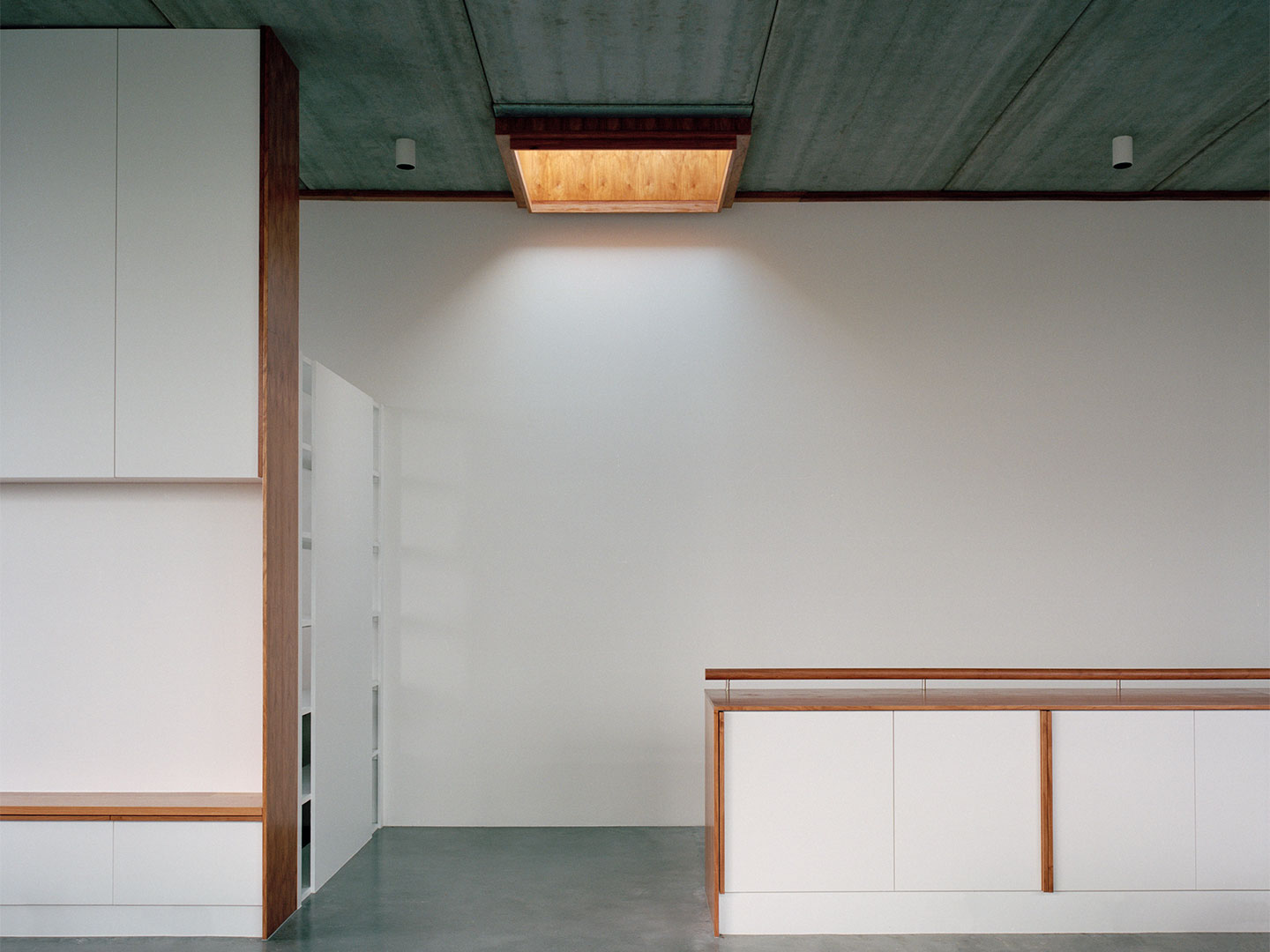
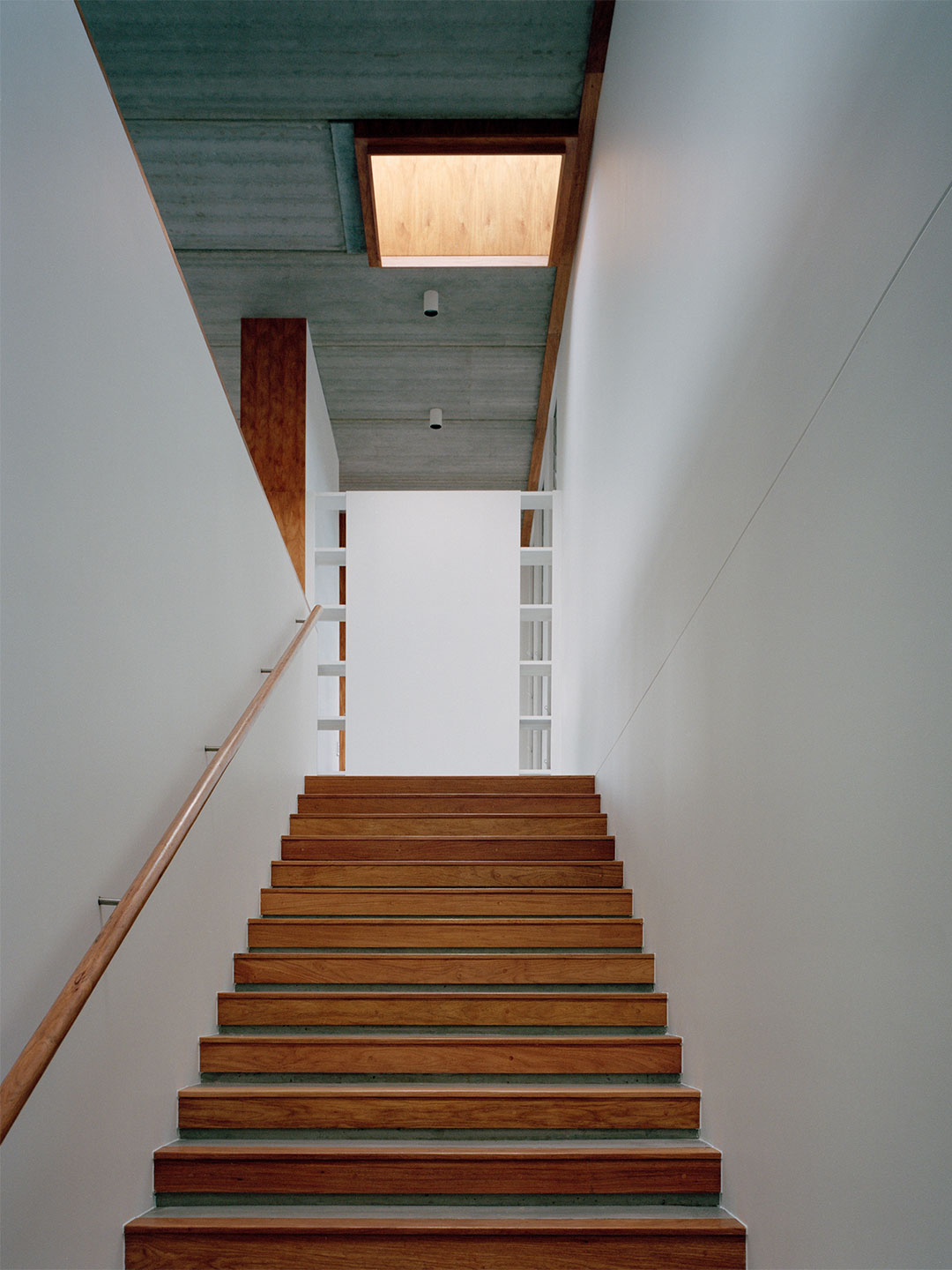
The internal configuration of the two-level home is clean and straightforward, but it flips the standard floor plate arrangement on its head. The common spaces are housed in the upper level of the home and the bedrooms are positioned underneath. When combined with the home’s tall ceilings, this planning technique provides the residents with a feeling of living high in the tree canopy – a sensation that’s accentuated by the approach to glazing. Upstairs, the windows start at one metre above floor height as opposed to running floor-to-ceiling which ensures openness but also provides privacy from the street and creates “a nest-like experience for the occupants”.
While the builders have packed away the tools and the project is officially finished, Peter says Couldrey House, in a sense, remains incomplete. “The building stands waiting for endless cycles of weather to be cast down upon it, to gain the finer patinas of age.” Plants are yet to overrun the masonry envelope, says Peter, not least from the two 25-metre-long elevated planter boxes. “The building should get better, not worse, with time.” The neighbours will no doubt call that the cherry on top.
Related stories
- Home tour: A contemporary house in Subiaco with quaint cottage appeal.
- Home tour: WOWOWA’s castle by the creek.
- Home tour: A concrete house in Singapore with lush tropical gardens.
Locals who wander the foothills of Mount Coot-tha in Queensland, Australia remark that the distinctive, textured brickwork at Couldrey House is akin to sedimentary rock, tree bark or corduroy fabric. Wildly more playful and sweet-toothed with their words, “children say it is cake with icing,” says architect Peter Besley, who designed the recently built home for a member of his own family.
Subiaco House, however, is far from cliché.
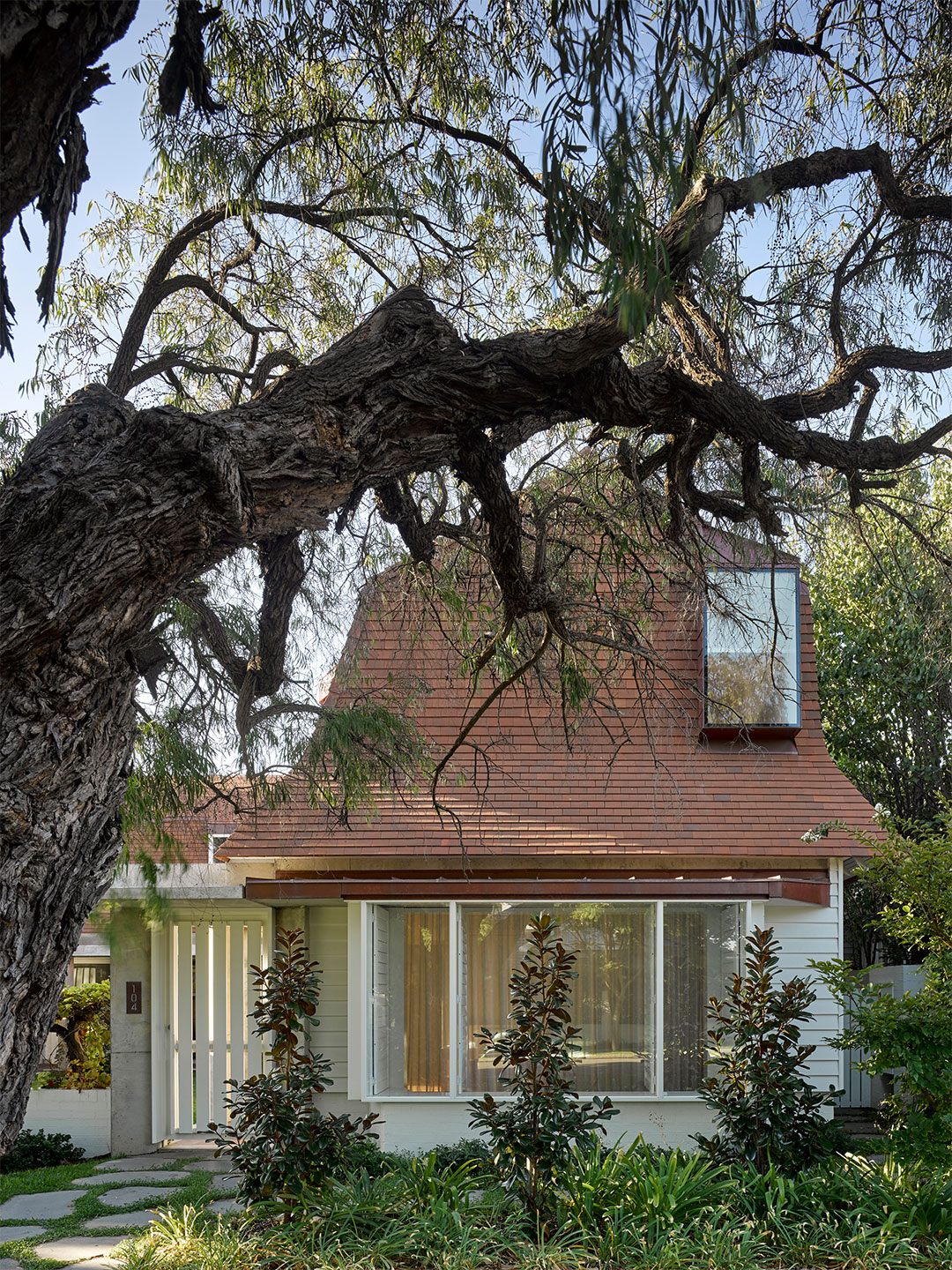
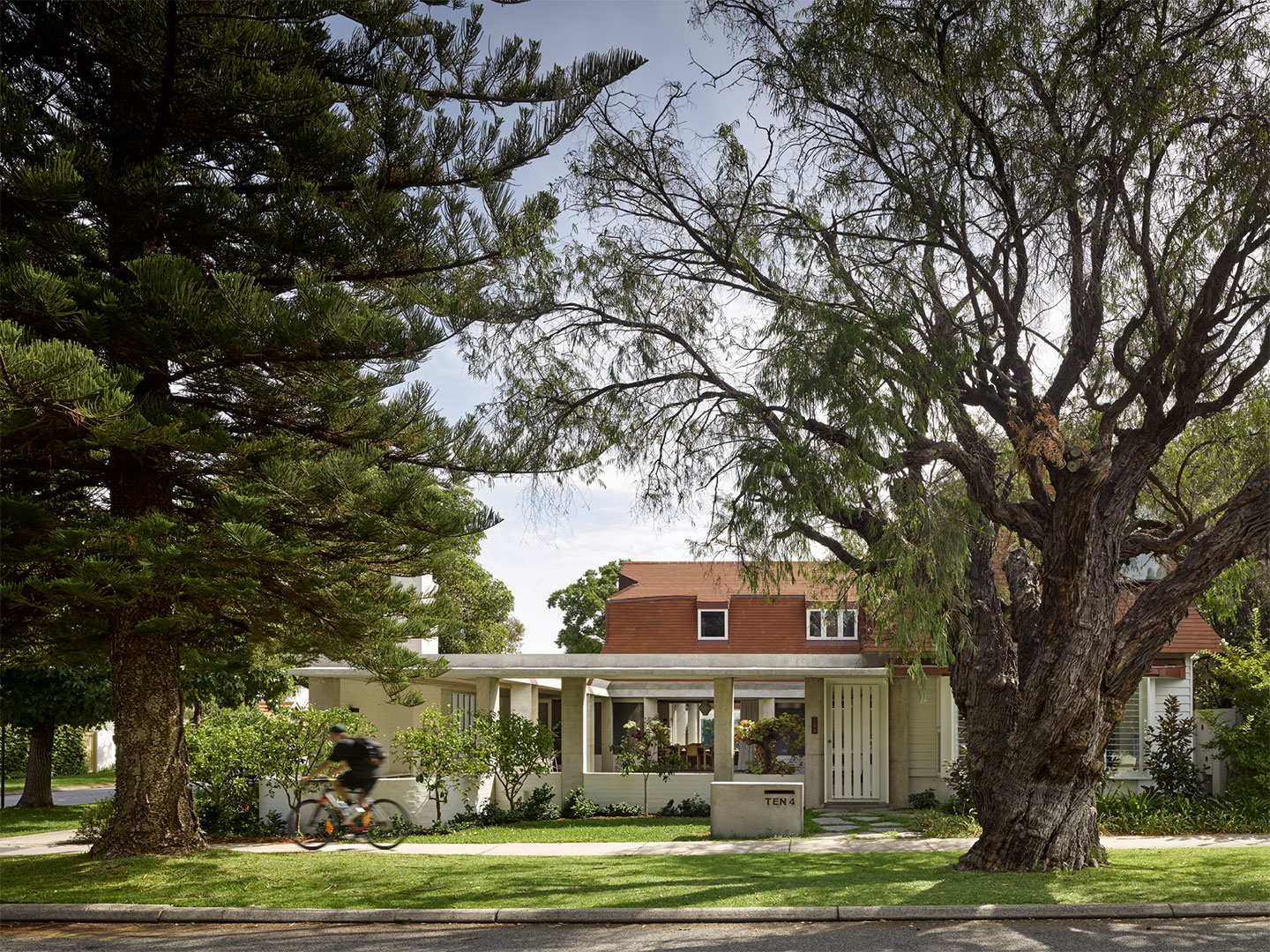
Designed and coordinated from nearly 4500 kilometres away by Brisbane-based architecture practice Vokes and Peters, the two-storey family abode is located on a prominent corner block and wears a distinctive bell-shaped ‘top hat’ clad in petite terracotta shingles.
At ground level, the suburban home engages politely with the conservative streetscape through its classic timber bay windows. It responds more openly through its adjoining ‘public’ courtyard garden: a generous lawned space which is directed toward the footpath and bordered by a multi-use cloister that extends from the main dwelling.
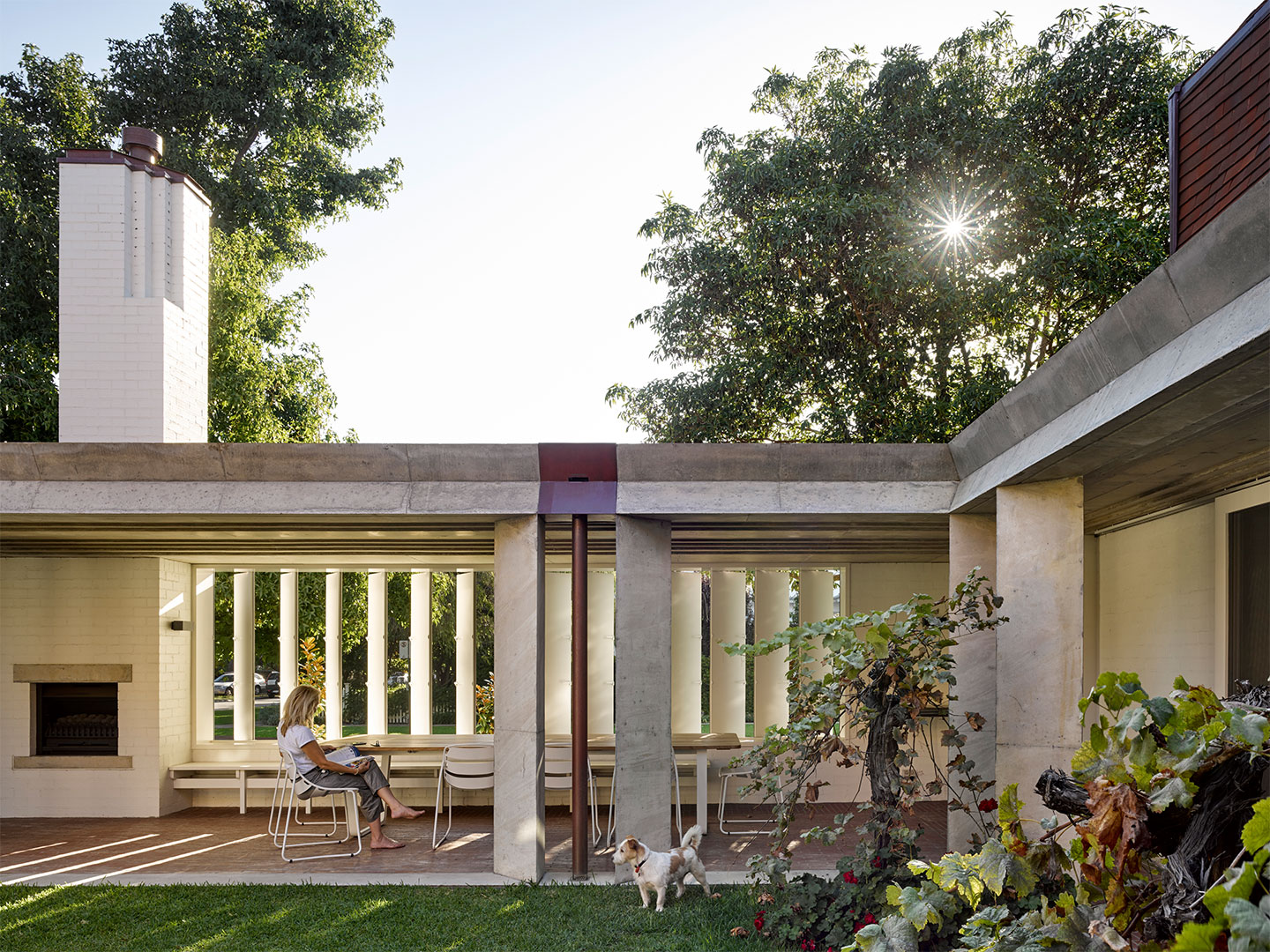
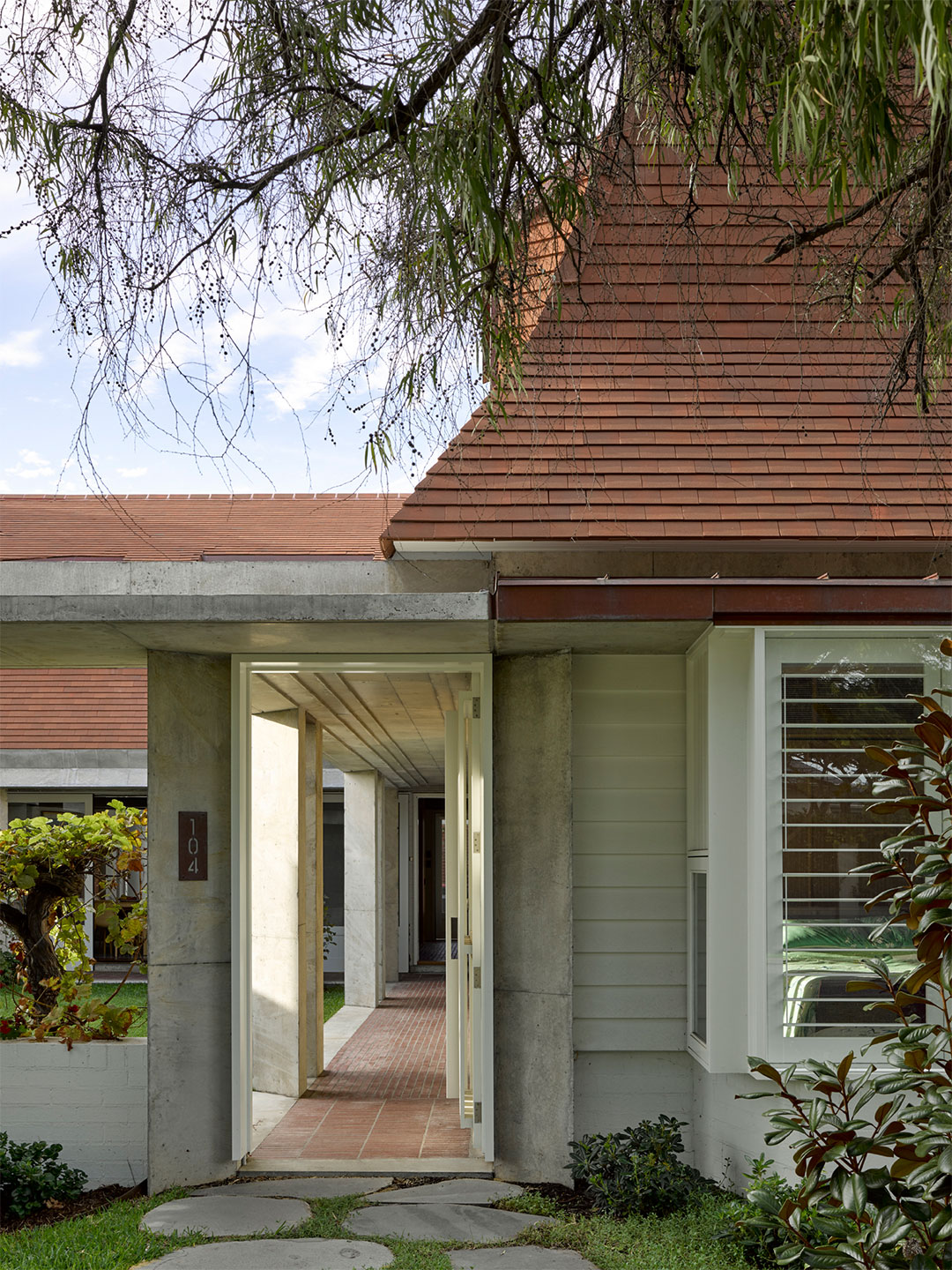
Both private and public interactions are filtered throughout the cloister, which doubles as an open-air pathway and occupiable extra ‘room’ partially screened by large vertical louvres and developing gardens. Through this contemporary cloister technique, and the flurry of activity that it generates, the line between inside and outside is constantly blurred. So, too, is the boundary between the public sphere and private residential spaces.
The push-and-pull of public and private realms is less at play when it comes to the upper level of the home. Observing Subiaco House from the street, the charming terracotta roof tiles are the home’s most attention-grabbing gesture. But cocooned behind this veil, the upper-level program of the house is kept almost completely out of sight – the only reminder of the second storey’s existence is the sparingly placed windows on its elevations.
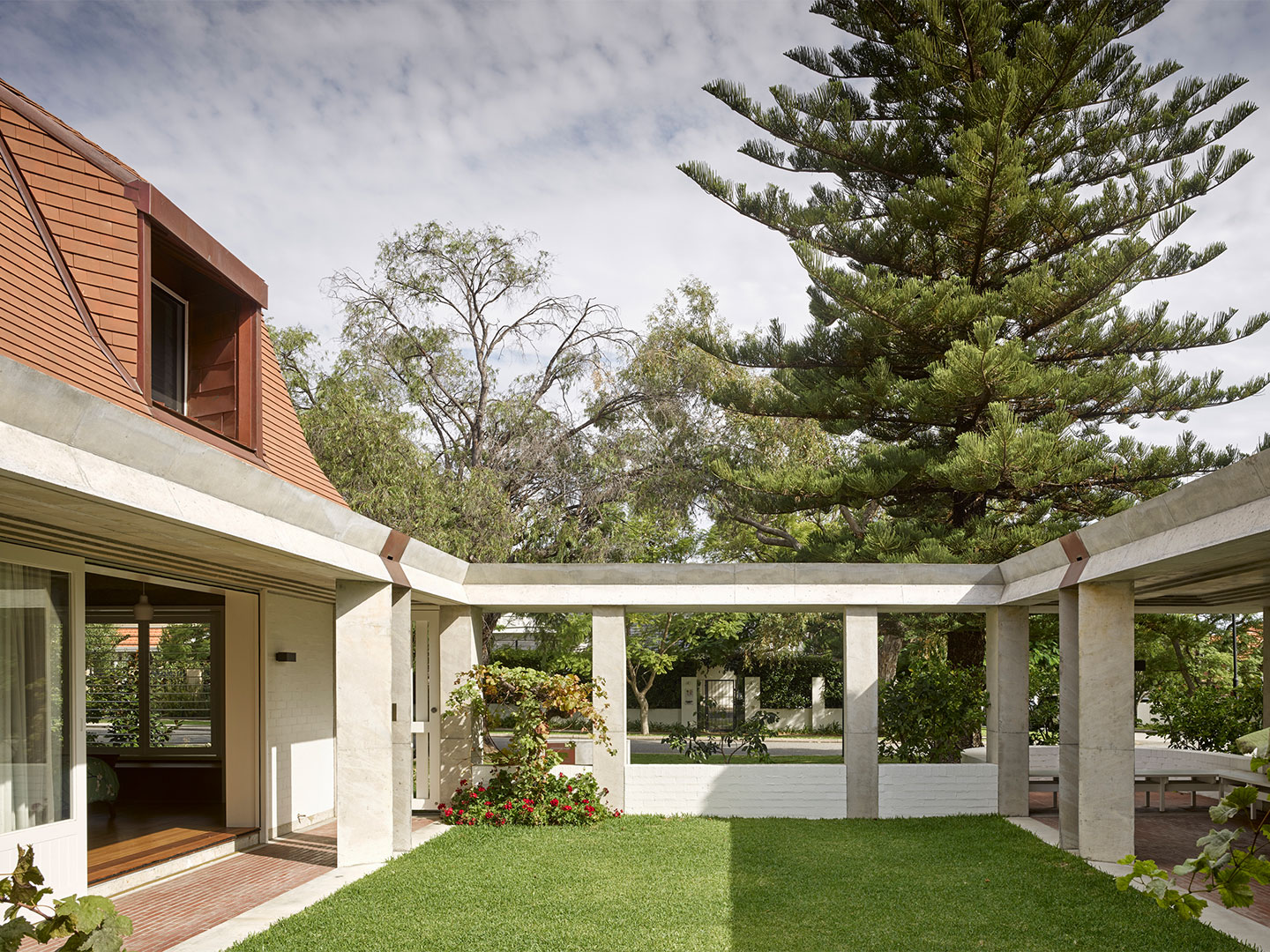
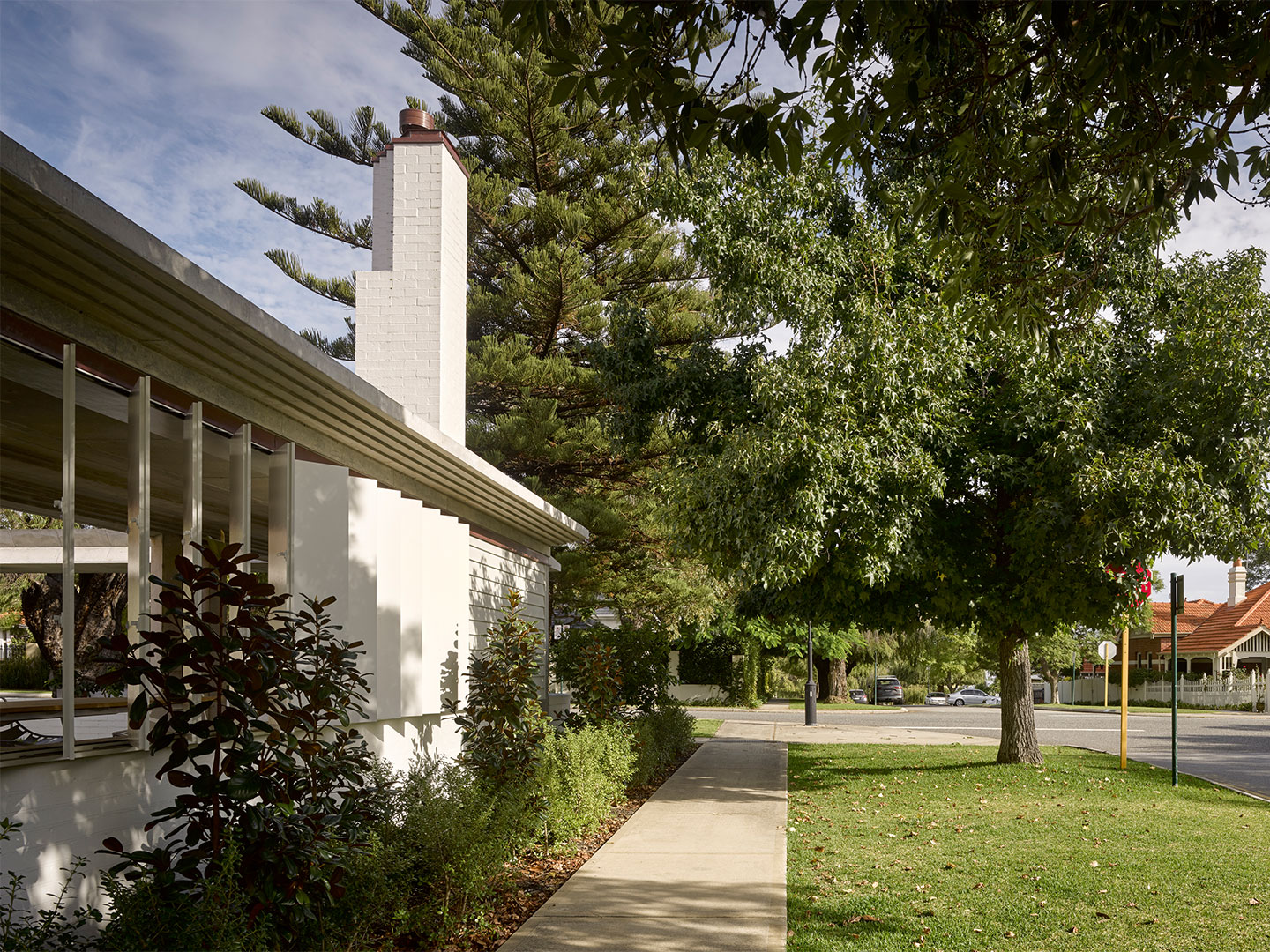
While the home and its garden-rich setting can be seen to reference the well-groomed visage of its Federation-era neighbours, there are also influences from formal European plazas and immaculate country cottages, both in the planning and the impressive craftsmanship of the home.
It’s unusual for a modern home to be so thoughtfully layered with detail and craftsmanship but at Subiaco House, this is part of its DNA. Glimpses of the intricate network of rafters, battens and struts are offered from the outside. The rainwater heads align in absolute precision with the notched concrete edges of the cloister. The underside of the same concrete plane features patterned impressions, discoverable only when the passer-by takes the opportunity to direct their gaze upward. Even the tip of the chimney that extends from the outdoor fireplace is flourished.
It’s unusual for a modern home to be so thoughtfully layered with detail and craftsmanship but at Subiaco House, this is part of its DNA.
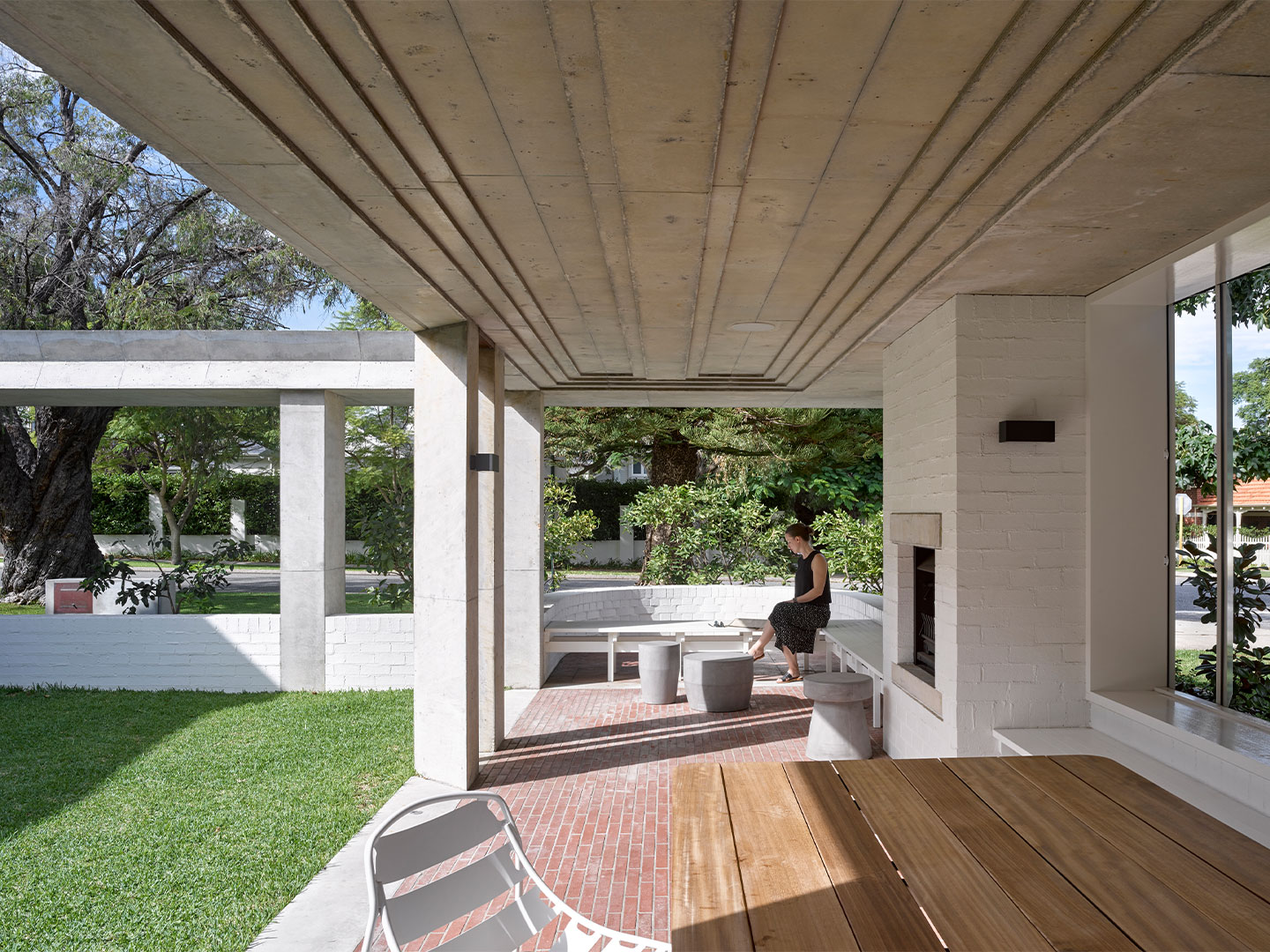
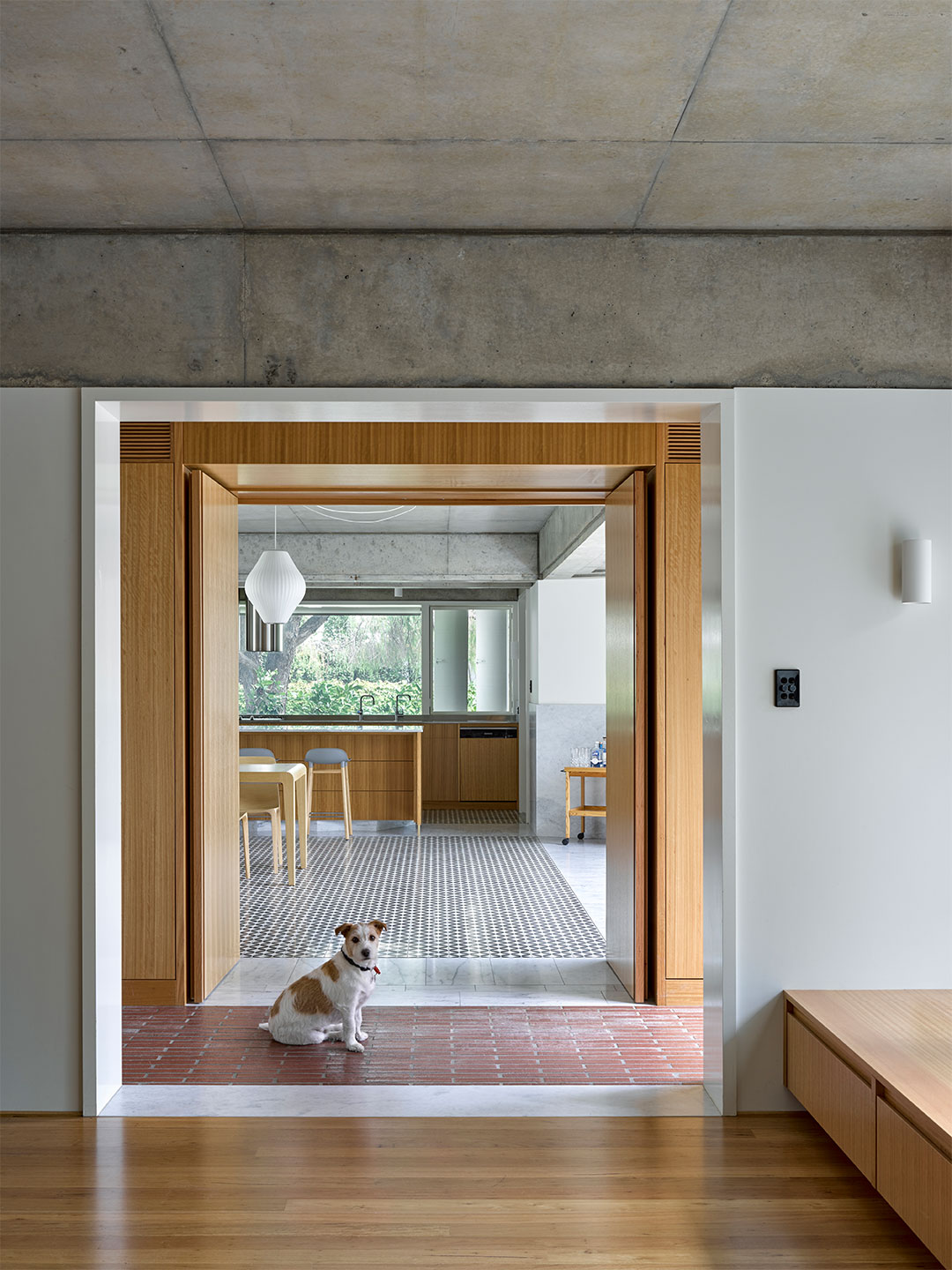
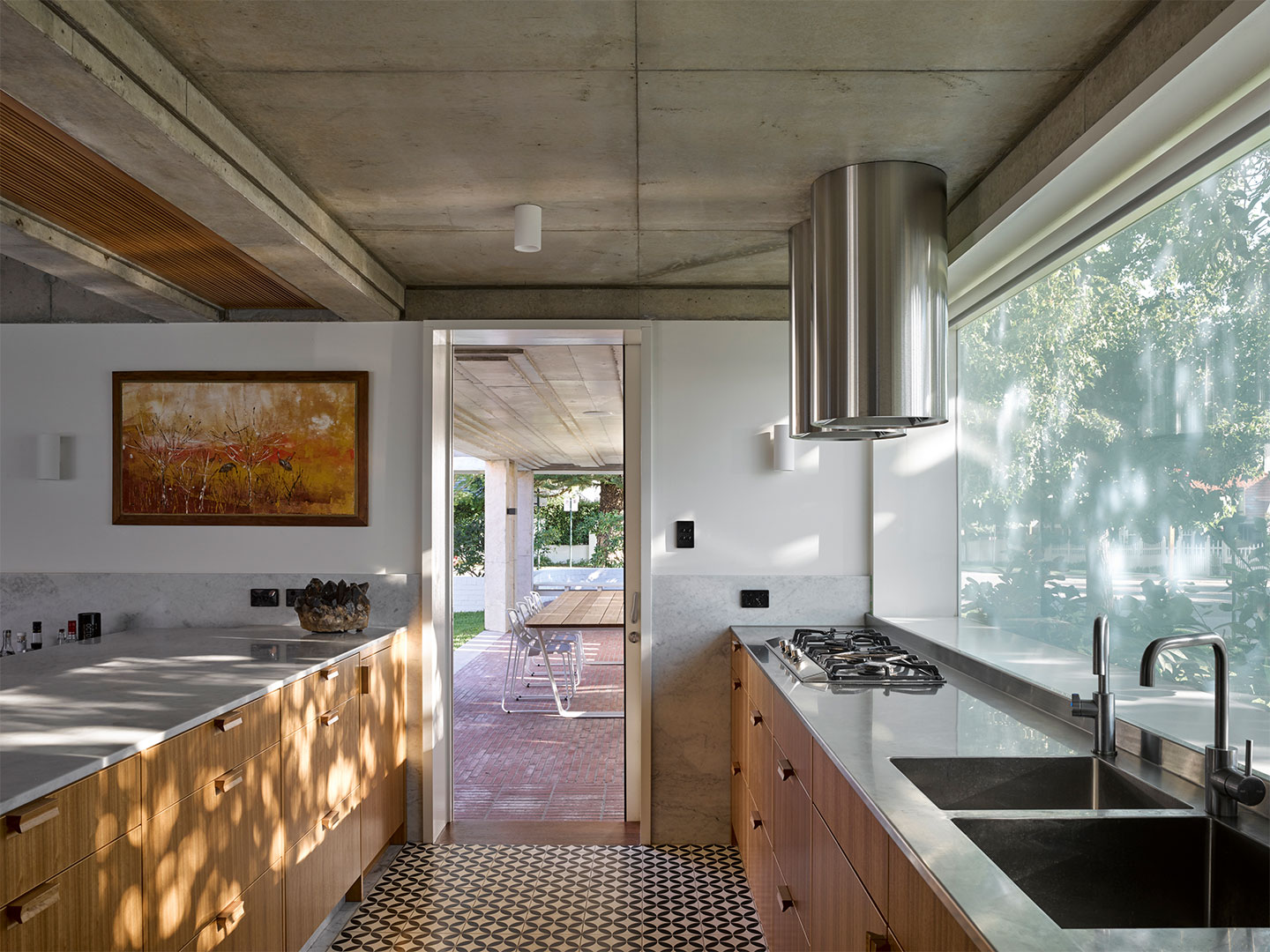
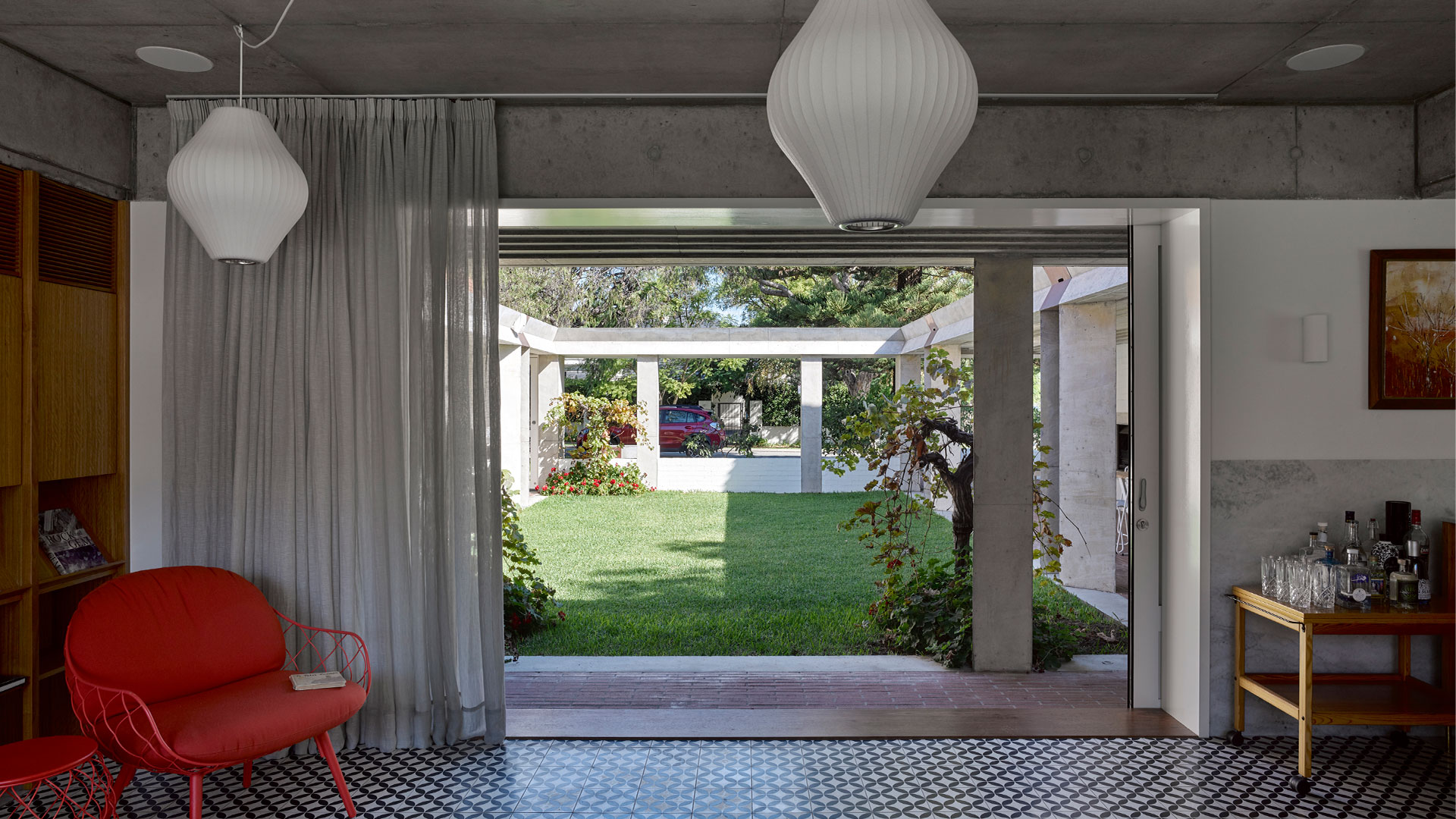
It comes as no surprise, then, that the interiors of Subiaco House are equally considered and rich in detail as the outward-facing elements. Tile, stone, brick, concrete and timber unite in a harmonious interplay that is quintessentially the design language of Vokes and Peters. Here, the brick-pattern paving of the cloister makes its way confidently indoors and is joined by the same impression technique in the concrete overhead.
When the house is opened up to the daylight, sightlines from within the home extend along the walkways out to the nearby streetscape, further drawing together indoor-outdoor spaces and private-public worlds.
By overcoming geographical distance and stringent development guidelines that favoured a single-storey dwelling, Vokes and Peters have realised a home that further adds to the local fabric of a tightly held suburb. The shared vision of the architect, homeowner and skilled tradespeople sees the new home – a contemporary cottage fit for its custodians – comfortably rubbing shoulders with its heritage neighbours.
Related stories
- 2020 Houses Awards: Australia’s best homes revealed.
- Vokes and Peters wins The Robin Dods Award at the Queensland Architecture Awards.
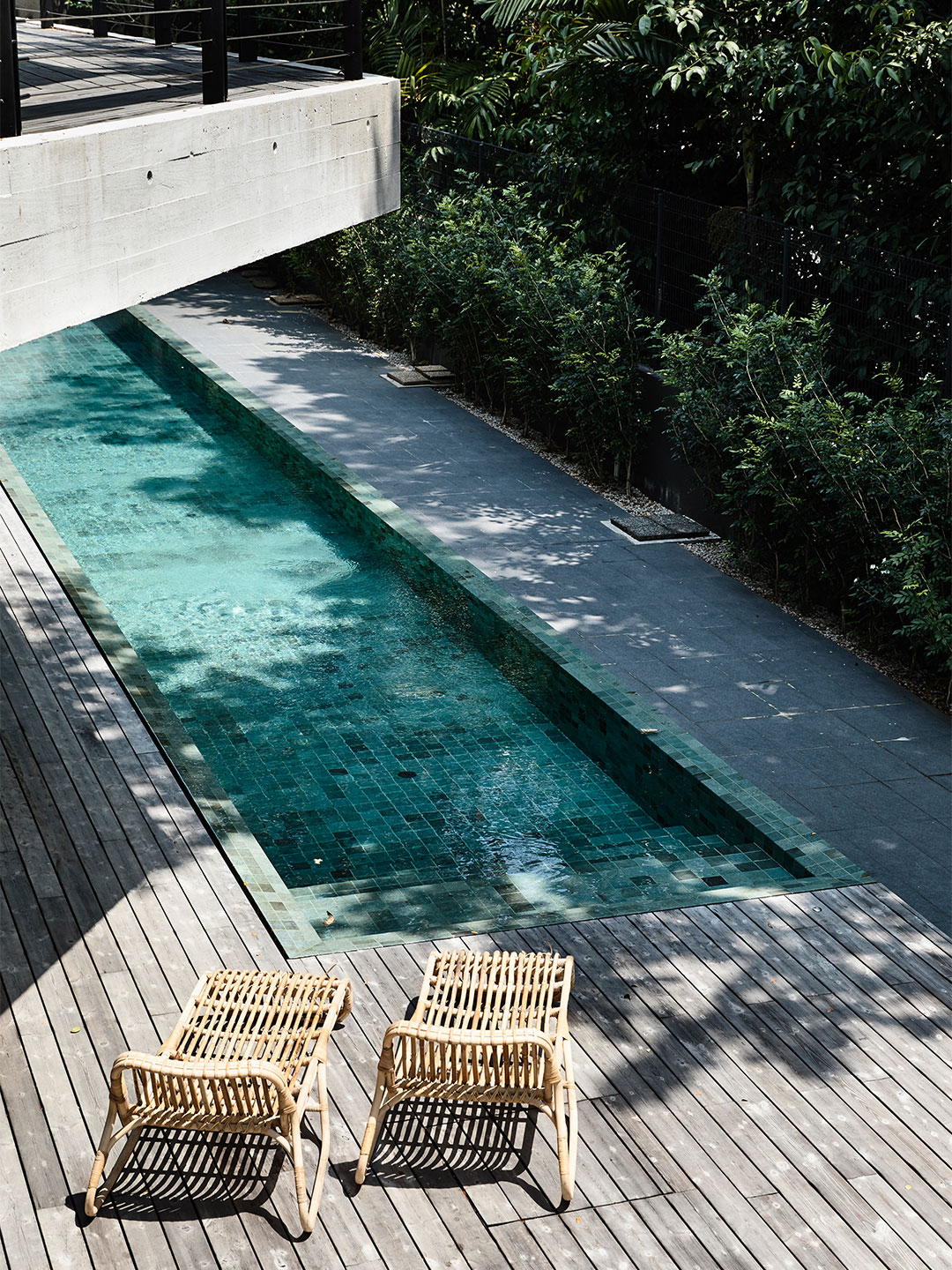
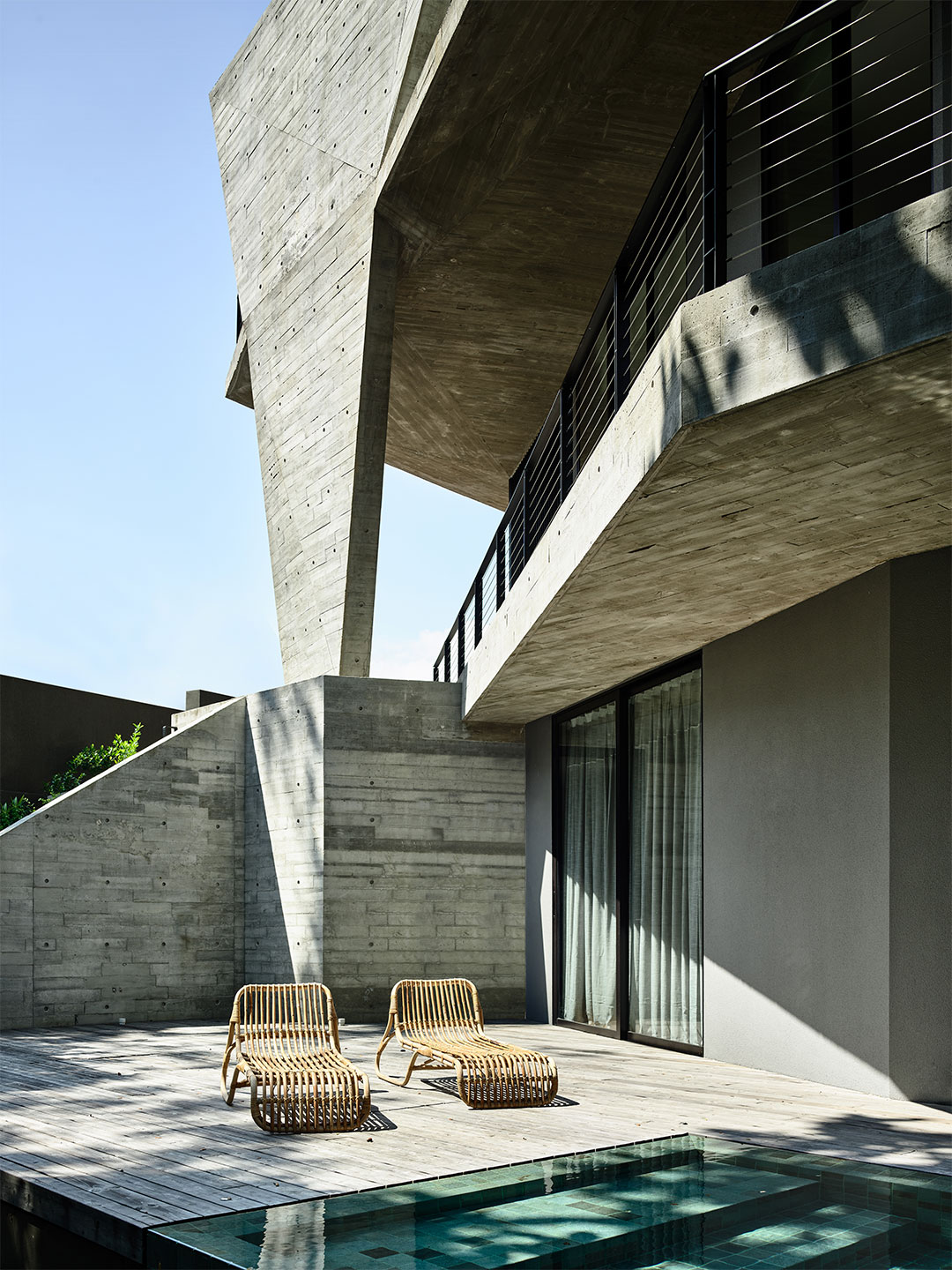
With its rebellious gardens and enticing aquamarine-tinged lap pool, you’d be forgiven for imagining this faceted and angular abode is sited in a tropical setting far from any bustling city centre. But the established lush oasis that envelops Stark House is in complete contrast to the urban program beyond its fence line. “The estate is located in an area of interesting and seemingly disparate activities,” says architect Christina Thean, director at Park + Associates.
Appearing like a mirage in the metropolis, the concrete house is situated in a Singaporean landed housing estate that hails from the 1980s. Zoom out and within a 1.5-kilometre radius the new dwelling is surrounded by typical low- and high-rise housing estates. Within the same radius, Stark House also rubs shoulders with Changi Prison, Changi Airport and several industrial and commercial areas.
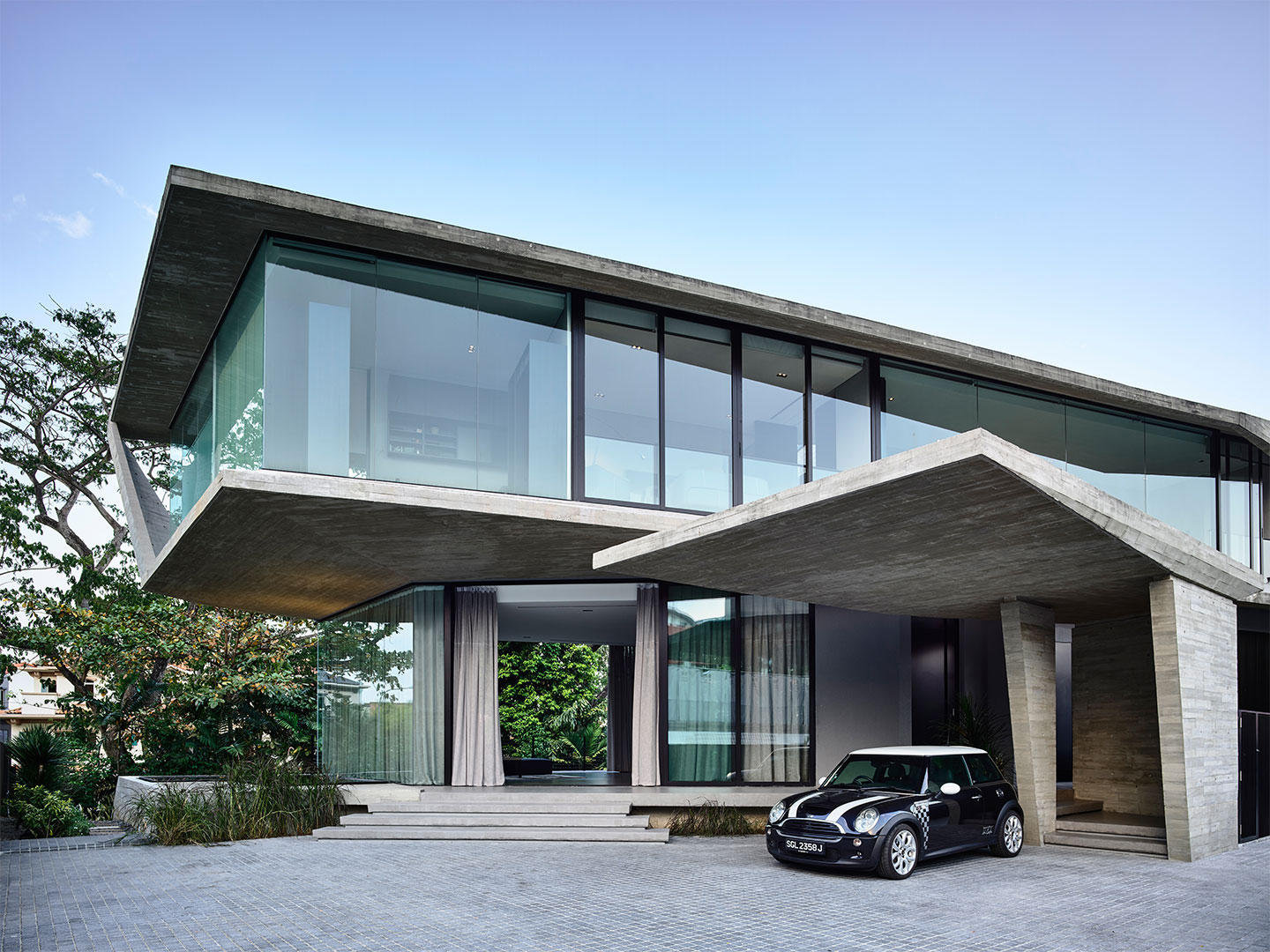
The concrete Stark House in Singapore
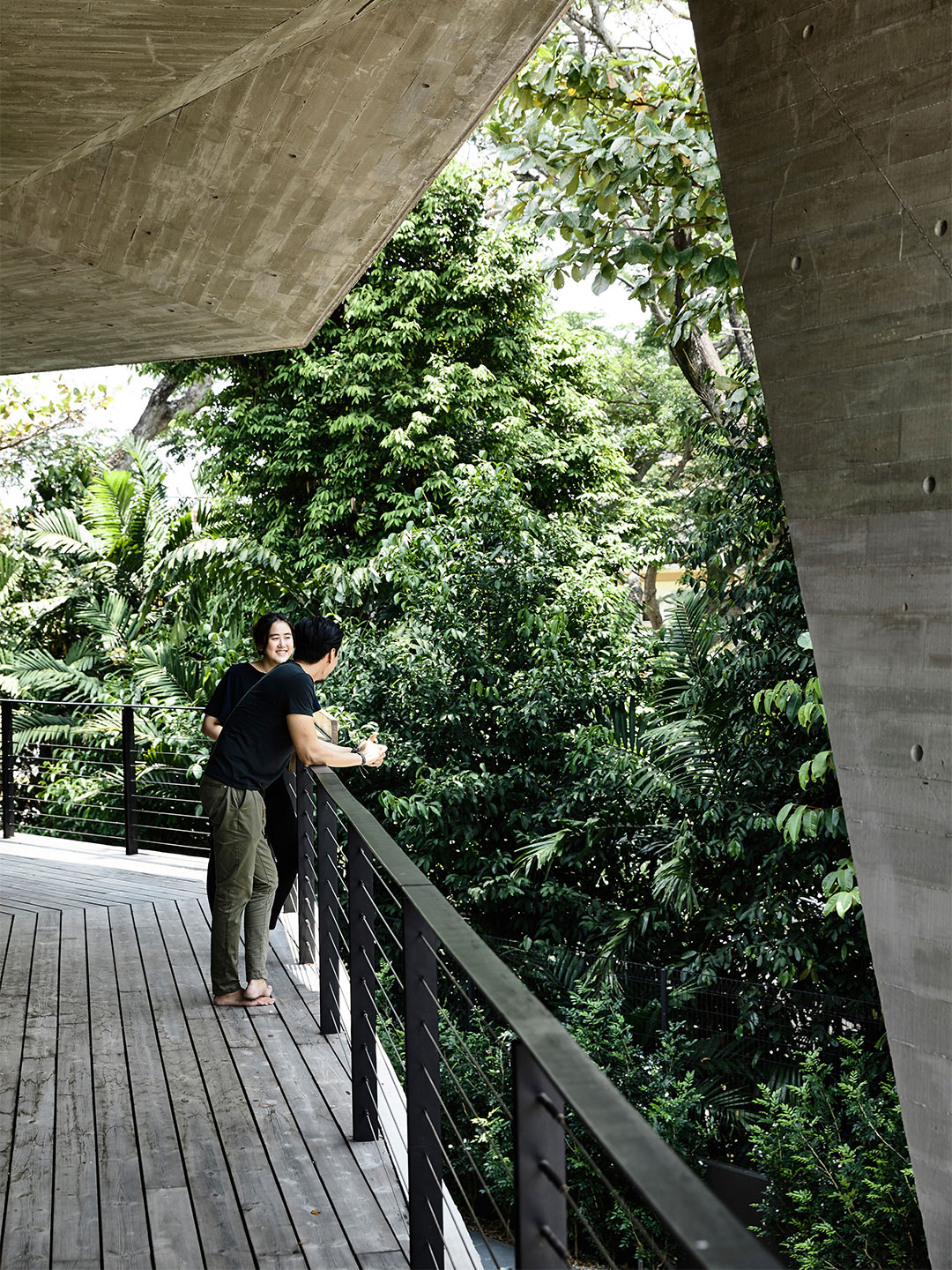
Upon arrival at the imposing concrete structure, it is instantly apparent that the regularly occupied spaces within the home are turned away from the front, a decision which Christina explains was in response to the site itself. “Stark House was conceived utilising the site’s natural topography and mature trees at the rear of the site,” she says. The internal layout of the home, across its three levels, was therefore directed toward the back of the block where the mass of tropical foliage provides a private green sanctuary away from the sight-lines of neighbouring properties.
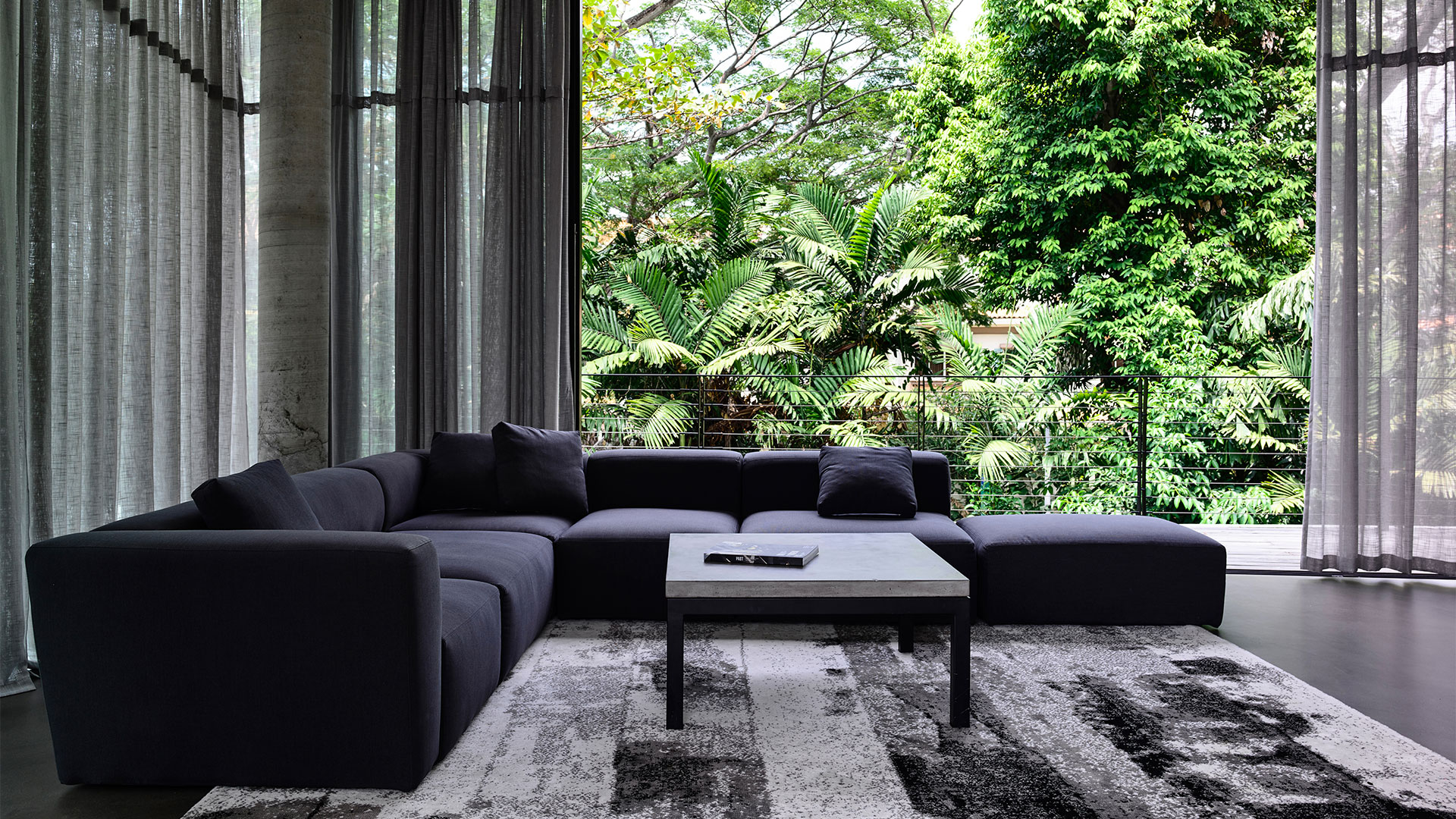
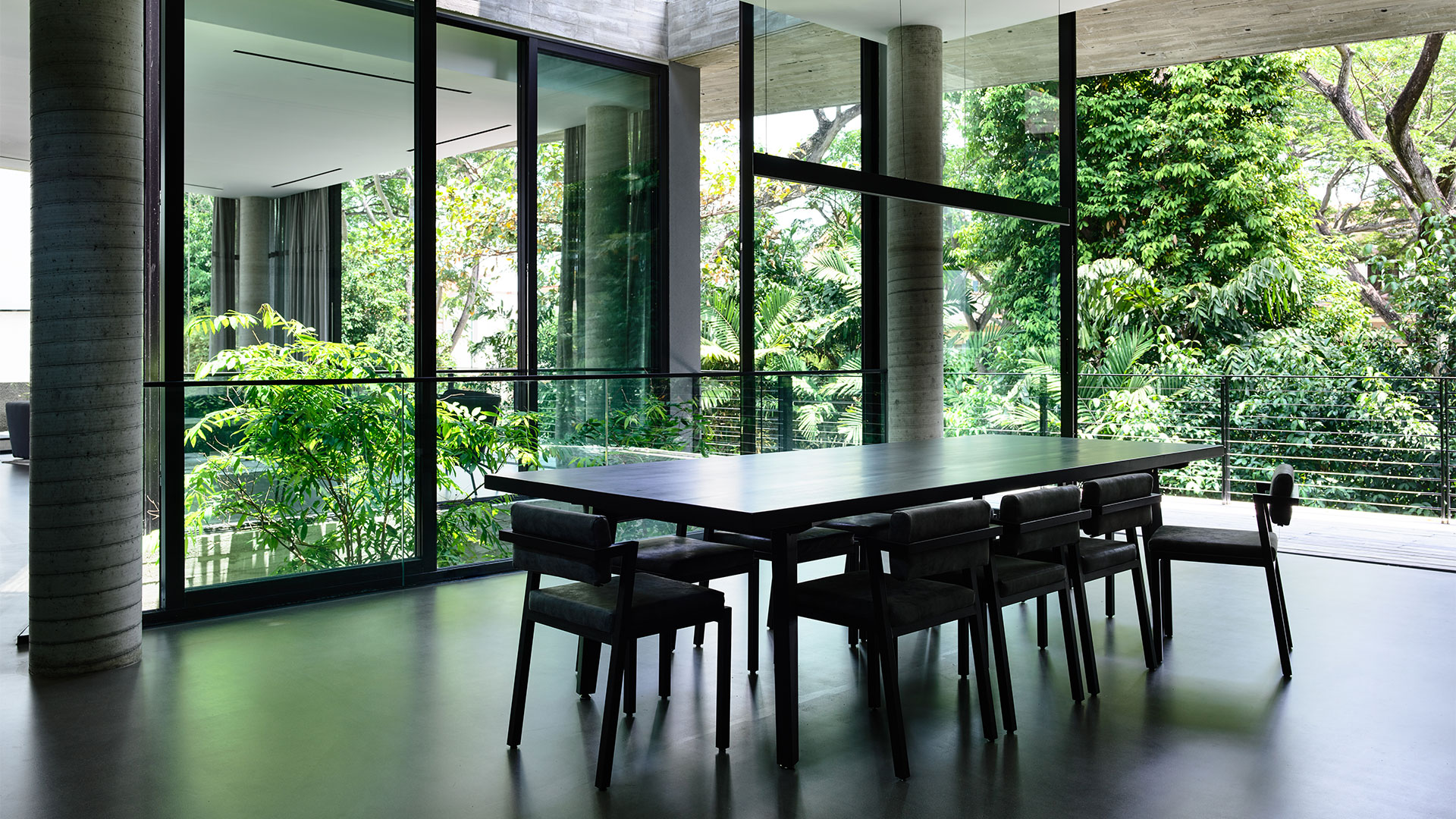
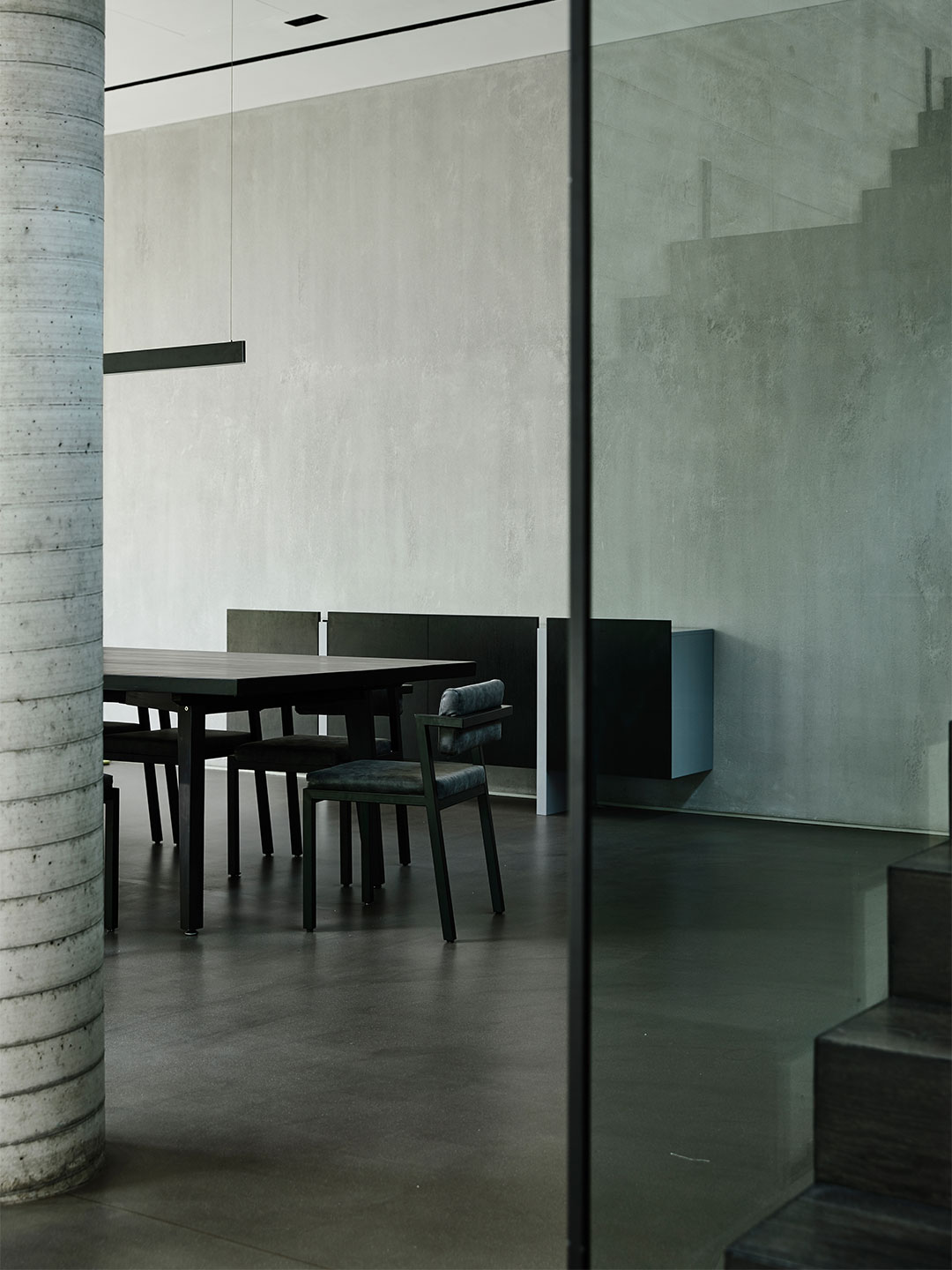
From within the ground-level entry hall, there’s a pavilion-style simplicity to its appearance. Expansive walls of glass wrap the perimeter, heightening the connection with the trees beyond, while privacy is provided to the open living and dining rooms through long sweeps of curtains that billow in the breeze when the large-format doors are wide to the garden setting. The sizeable kitchen is tucked out of sight, beyond the formal dining room, and is connected to the home by internal doorways and the lengthy timber deck that overlooks the tranquil pool area.
Perched above, the top floor of the dwelling hosts the generously sized main bedroom plus two guest rooms, each with an ensuite. The upper level of the home stretches its wings in one horizontal run with a theatrical cantilever above the entryway: an architectural gesture which is perhaps the home’s most distinctive. “The clients first approached us asking that their new home not be just another square box,” Christina says. “Our clients’ request reflected the very human desire to be different as a unique individual.”
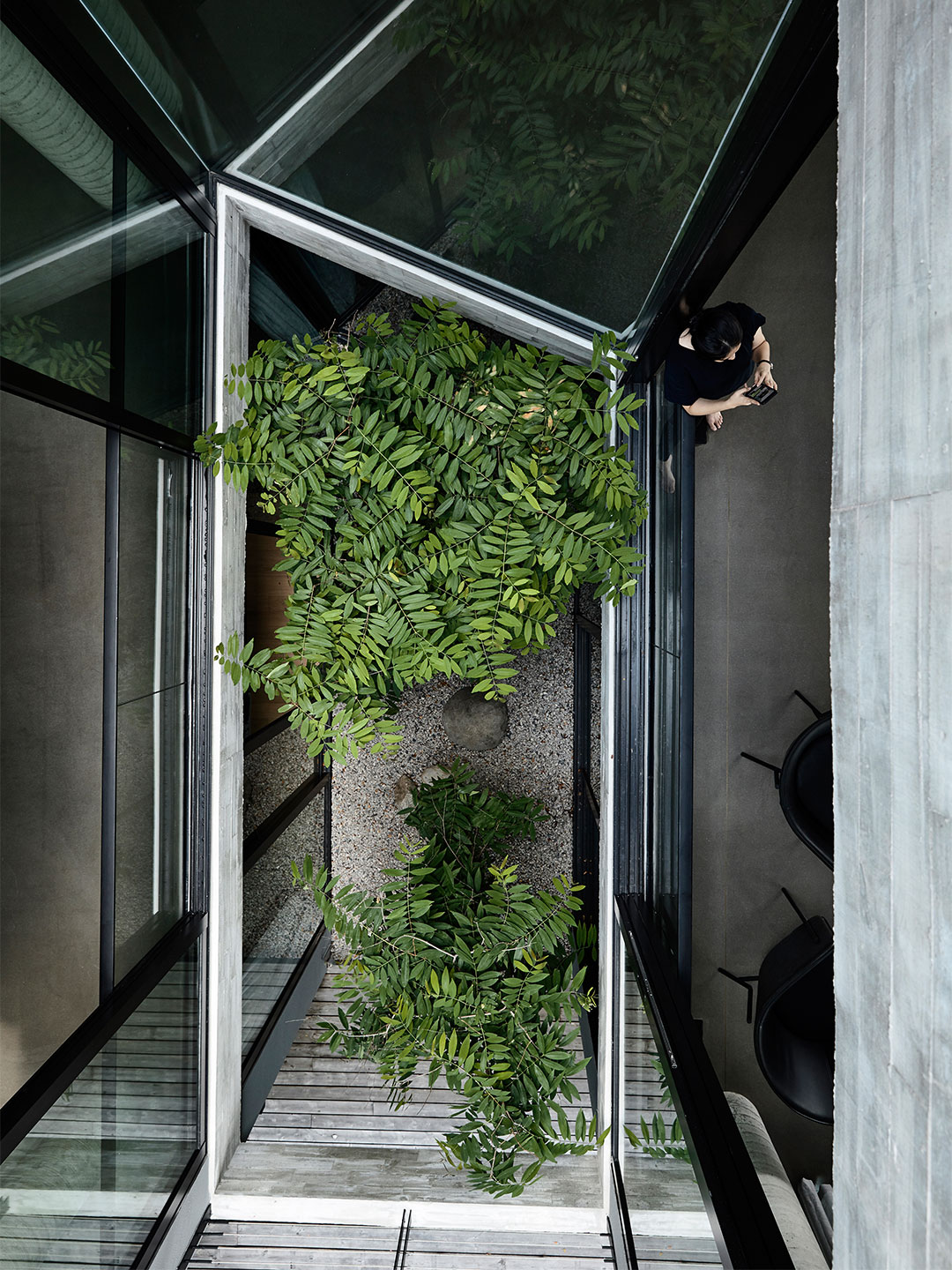
Aligned with this brief, an internal “open garden” courtyard planted with trees connects the two upper levels with the lower-ground level – a semi-basement area that is tucked out of sight from the entry and which takes full advantage of the natural slope of the property. It is here that the family room and two additional bedrooms spill out onto the sun-silvered Kebony timber deck beside the pool.
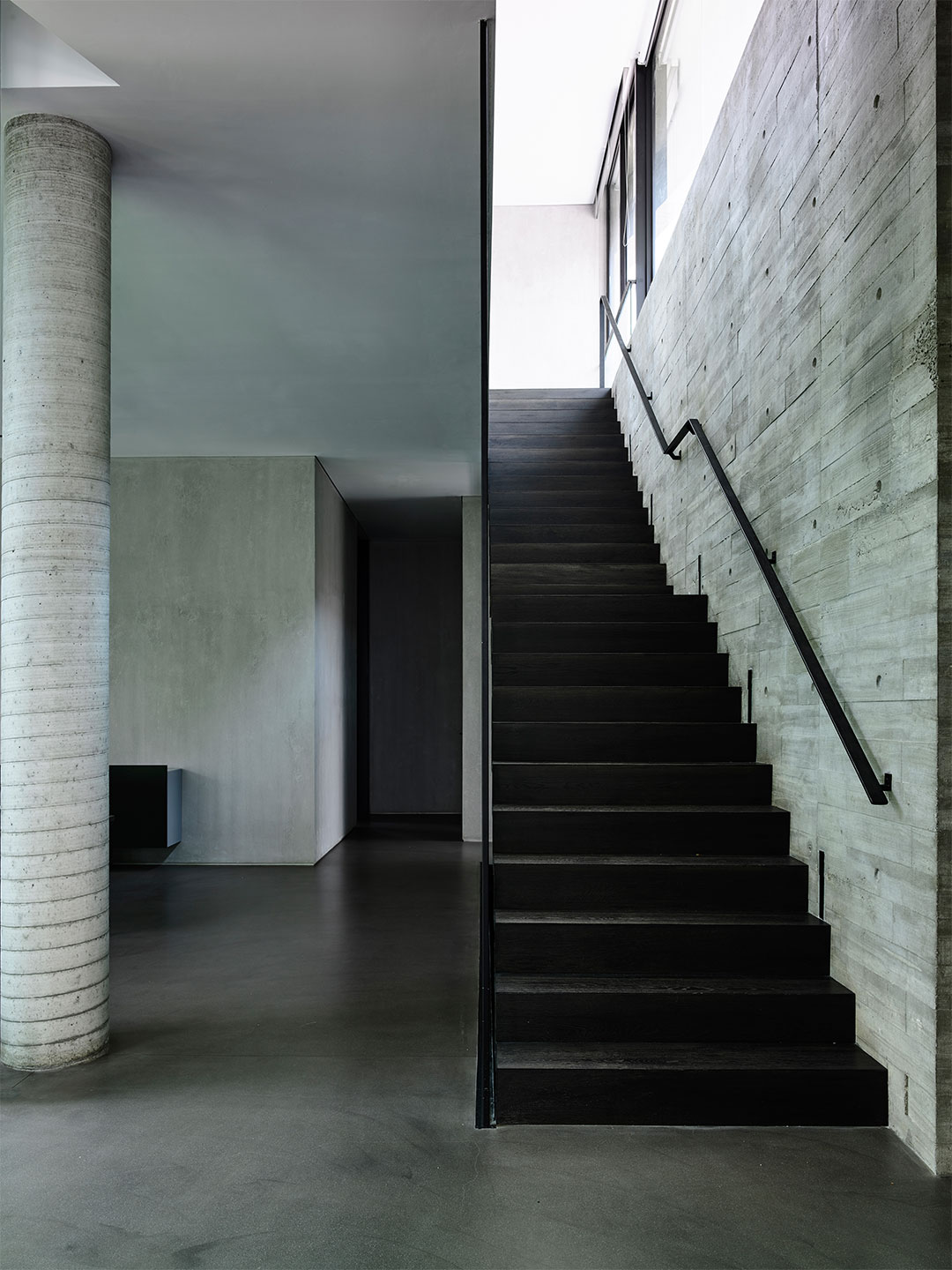
The weathered finish of the natural timber decking is mirrored in the woodgrain patterns imprinted in the gently textured concrete, a connection which Christina explains is in understated harmony with the home’s austere materiality. “Off-form concrete, roughcast plaster, deep rich grey hues and blacks – with subtle textural characteristics – govern most of the house’s palette,” she says.
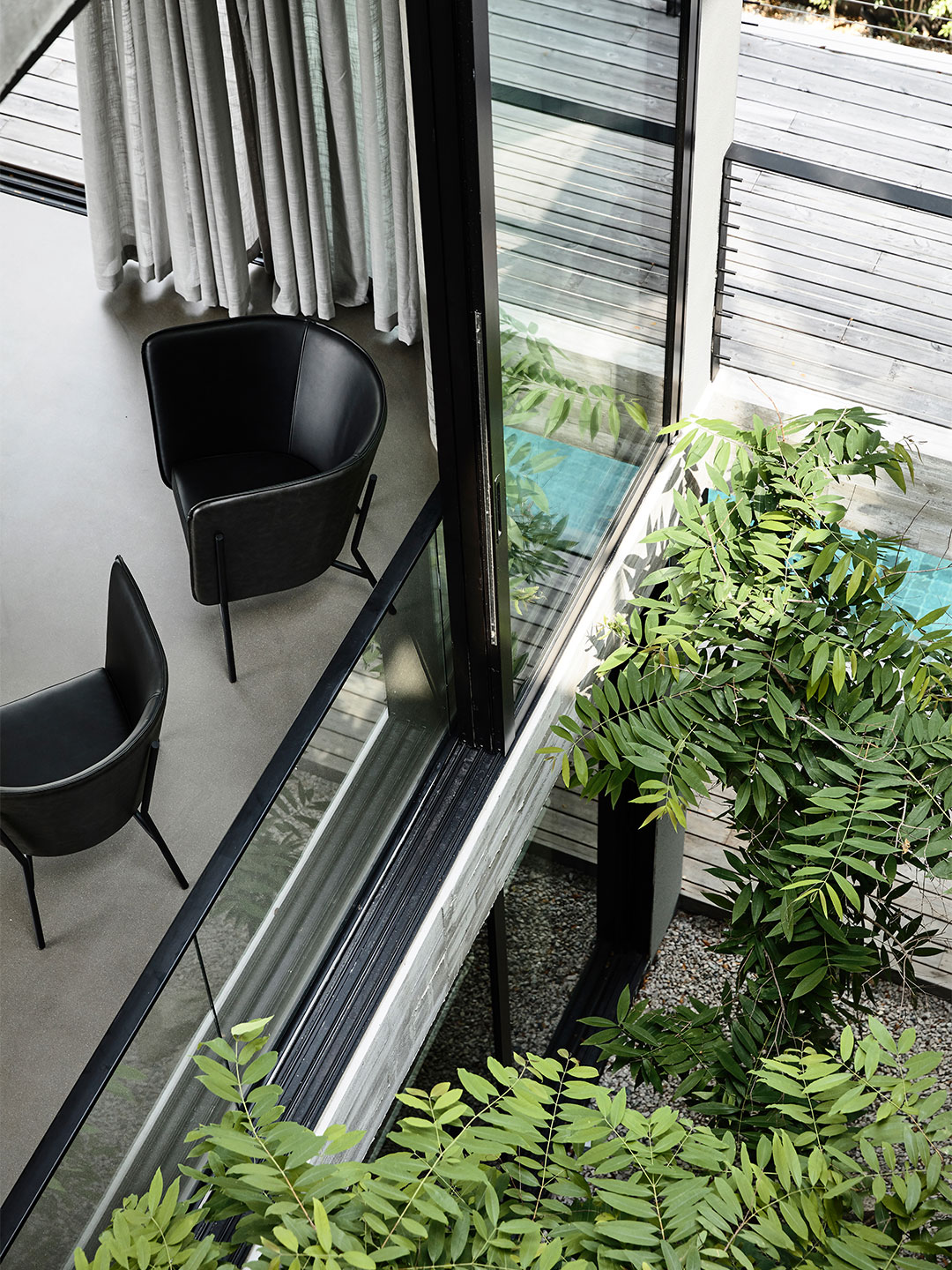
And while decoration within the home is almost non-existent, there’s something hearty and fulfilling about the way the architecture ensures connectivity between interior spaces and the vibrant jungle-like setting. It’s a relationship which delivers pace and energy and fills the void. “By detaching the house from ornamentation [and] concentrating on form, the house is expressed as such,” says Christina.
Reflecting on the successes at Stark House, Christina is outwardly pleased with what she and her colleagues at Park + Associates have created for their clients. “During the schematic design stage of the project, we wanted to achieve an architecture that pushed the envelope of how far we can test what responding to context meant for us as a practice, for the site, and for the neighbours,” she says. “Fortunately, we have received positive responses from several neighbours, acknowledging that Stark House’s architecture, sitting in contrast with its surroundings, was refreshing [and] has brought about a sense of rejuvenation for the estate.”
The clients first approached us asking that their new home not be just another square box.
Related stories
- WOWOWA’s castle by the creek.
- Tristan Wong draws upon his layered creative foundations to reimagine Melbourne’s skyline.
- The Ocean Grove surf club by Wood Marsh casts a quiet gaze over Bass Strait.
Bookended by a tree-lined street and a green belt of local bushland, the unconventional Merri Creek House by WOWOWA stands at attention in an inner-city enclave of Melbourne, outwardly resembling a whimsical millennial-pink castle – cylindrical turrets and all. Named after the nearby Merri Creek waterway, this refreshing family home is a modern interpretation of fairytale dreams, suited up in robust brick armour, with broad arched windows, a sweeping spiral staircase and copper livery.

When Monique and Scott Woodward of WOWOWA Architecture first imagined Merri Creek House, their overriding design ambition was to make “the familiar strange and the strange familiar”, a fitting concept for this out-of-the-ordinary home where modern and gothic influences intersect in the most wondrous and playful way.
Built by Atma Builders, Merri Creek House is anchored to the earth by its three turrets. One turret sits to the south and is occupied by a rumpus room in the lower half with a study above. The central turret accommodates the family dining room and the wall-hugging staircase. The third, intentionally ‘deconstructed’ turret sits to the north of the home and resembles an eroding ruin directed toward the neighbouring creek, a design twist that further adds to the underlying storybook themes at play.
Given the site’s proximity to Merri Creek and surrounding bushlands, a hearty response felt appropriate.
To realise the concave walls, arched windows and cylindrical towers at Merri Creek House – architectural features that were inspired by an intriguing combination of old-time Australian farm structures, such as silos, and European castles – Scott and Monique turned to textured clay brick. This material choice provides the turrets, while inherently romantic in nature, a sense of fortress-like strength. “Their robust nature feels grounded and protected against the elements – so solid that no fire or flood could bring them down,” says Monique. “Given the site’s proximity to Merri Creek and surrounding bushlands, a hearty response felt appropriate.”
The use of brick as the core construction material not only facilitated WOWOWA’s bold vision for Merri Creek house, it also improved the home’s overall energy efficiency. The specified bricks assist with lowering the carbon footprint of the home, which is further supported by the use of carbon-neutral bricks. The inclusion of solar panels and an on-site rainwater tank also contribute to the home’s green endeavours.


Related stories
- Tristan Wong draws upon his layered creative foundations to reimagine Melbourne’s skyline.
- Pitch perfect: Utah’s luxury tented pavilions.
With its rebellious gardens and enticing aquamarine-tinged lap pool, you’d be forgiven for imagining this faceted and angular abode is sited in a tropical setting far from any bustling city centre. But the established lush oasis that envelops Stark House is in complete contrast to the urban program beyond its fence line. “The estate is located in an area of interesting and seemingly disparate activities,” says architect Christina Thean, director at Park + Associates.
Comprising renowned architects and academics from across the Sunshine State, the jury for this year’s program presented the awards to more than 20 projects across 14 categories including residential, commercial, sustainable architecture and urban design.
“Each of the awarded projects reflects a response to the environment in their own way,” says jury chair and director of COX Architecture, Richard Coulson. “The projects include opportunities that allow many members of the Queensland public to benefit from good architectural design. They include innovation in technology and materials balanced with a pragmatic response to climate – a hallmark of Queensland architecture.”
Among the individuals and practices recognised during the presentation, architecture firm Vokes and Peters received The Robin Dods Award within the Residential Architecture – Houses (New) category for the coastal abode, Casuarina House.

Casuarina House at the Queensland Architecture Awards
Casuarina House, built by SJ Reynolds Constructions, is a new family home of compact proportions, occupying a coastal subdivision with its own private garden setting. The atypical beachside dwelling has been designed by Vokes and Peters to encourage a connection with the outdoors, facilitated by a long verandah that travels the entire length of the home, and sited to celebrate the coastal lifestyle of northern NSW.
From the outset, Vokes and Peters and the homeowners say they shared the same end goal: to create a garden, not just a home. “Unlike many of the neighbouring houses, the Casuarina House has been pushed to the southern edge of the block to free open space for a large garden that spans the full length of the site,” says the architects. “New living spaces located on the ground floor have large door and window systems allowing the interior to open to the outside. Internal floors are raised on timber platforms, a step above the brick circulation zones to manage sandy feet.”
All projects that received a ‘named’ award or a state award at the Queensland chapter event will be eligible for the Australian Institute of Architects National Architecture Awards to be held later this year.
Casuarina House has been pushed to the southern edge of the block to free open space for a large garden that spans the full length of the site.


