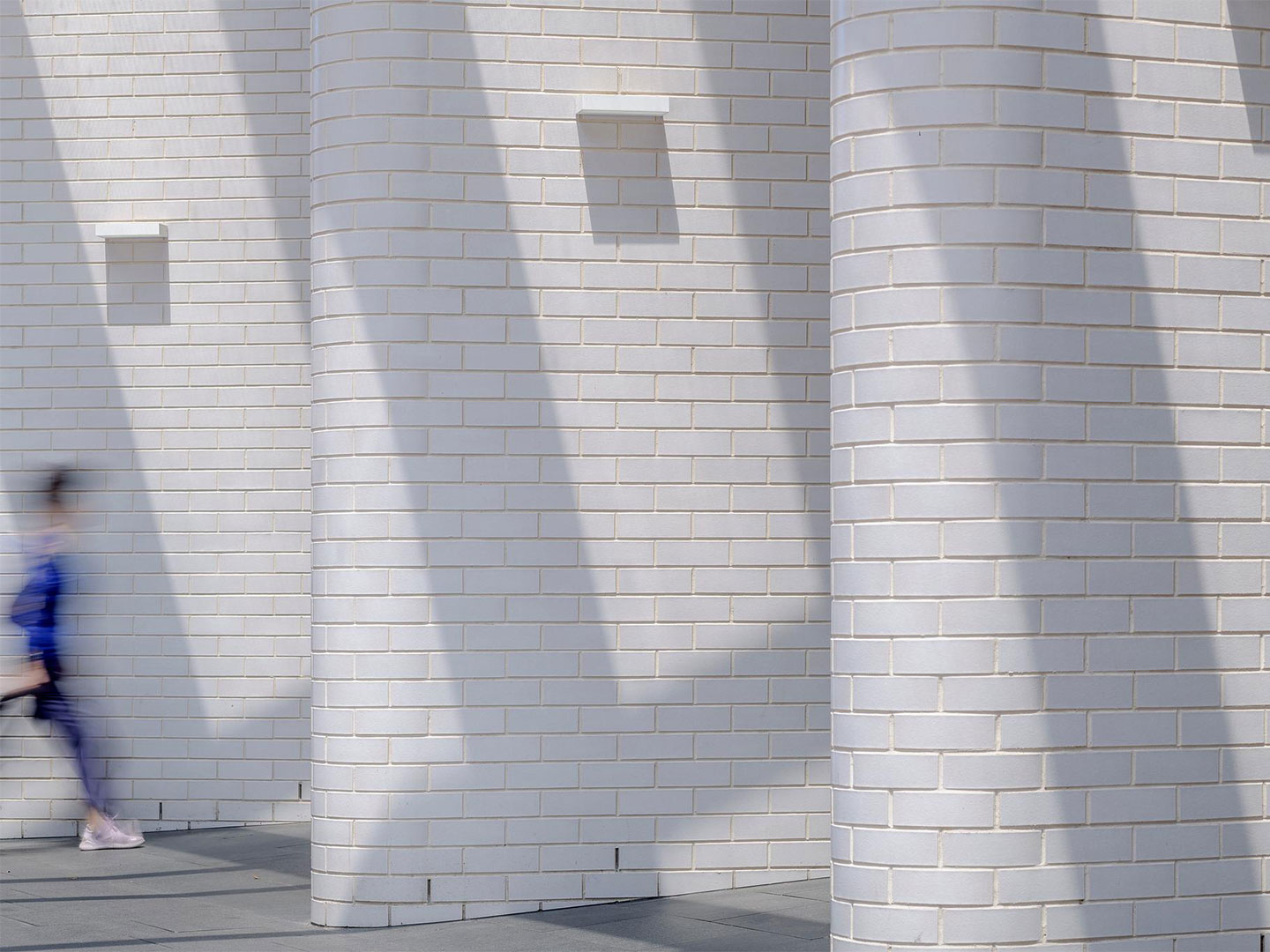
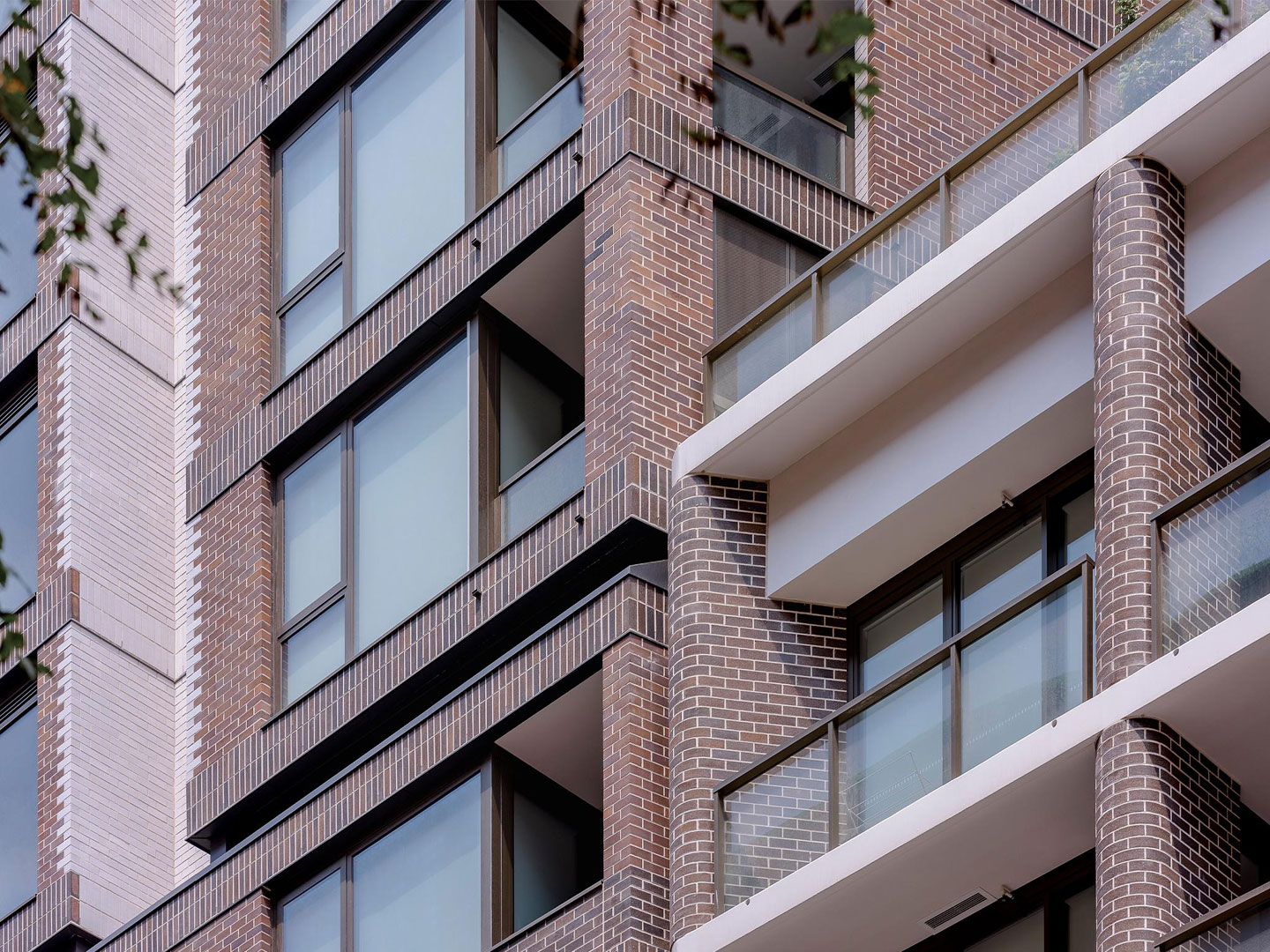
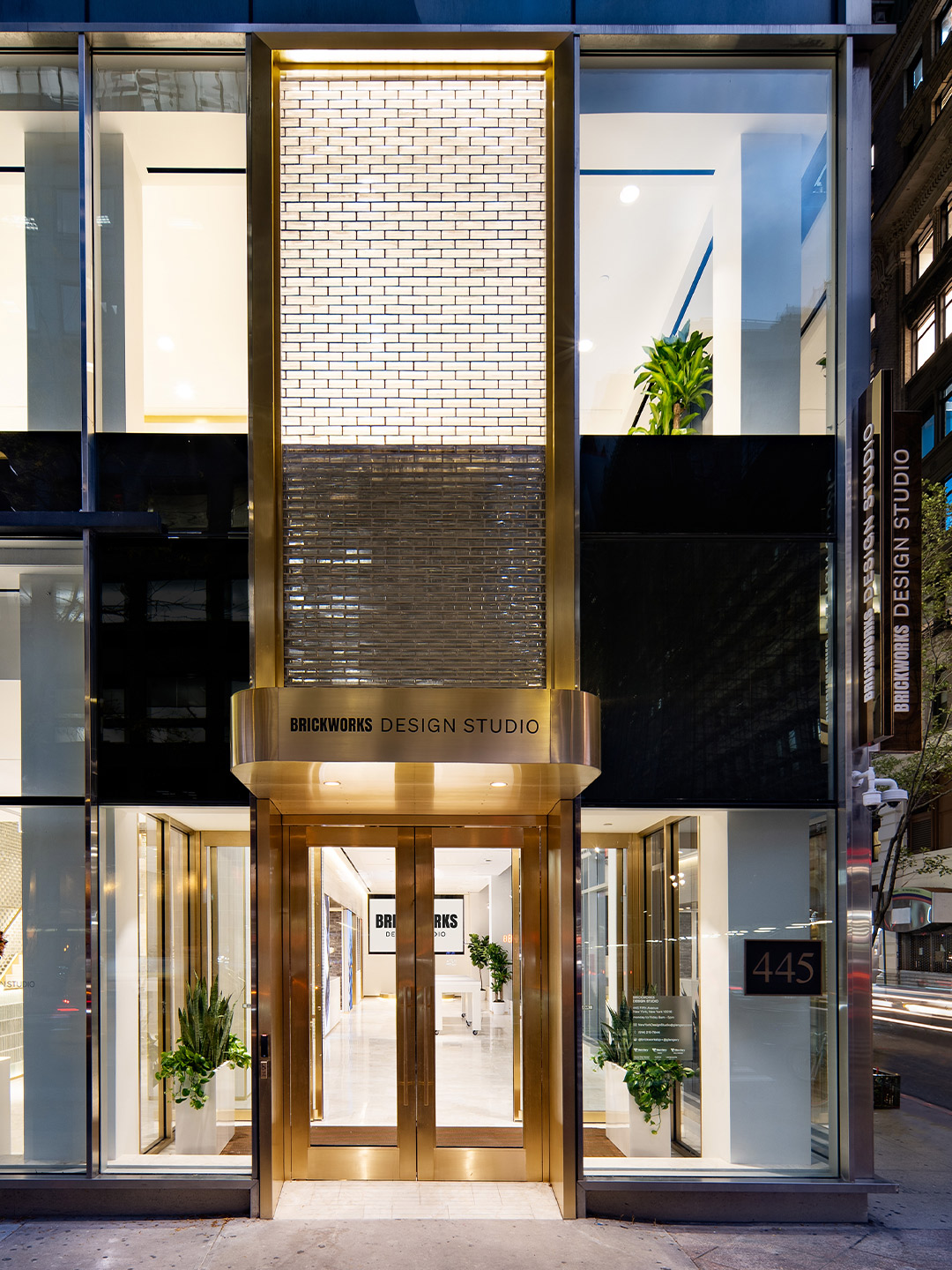
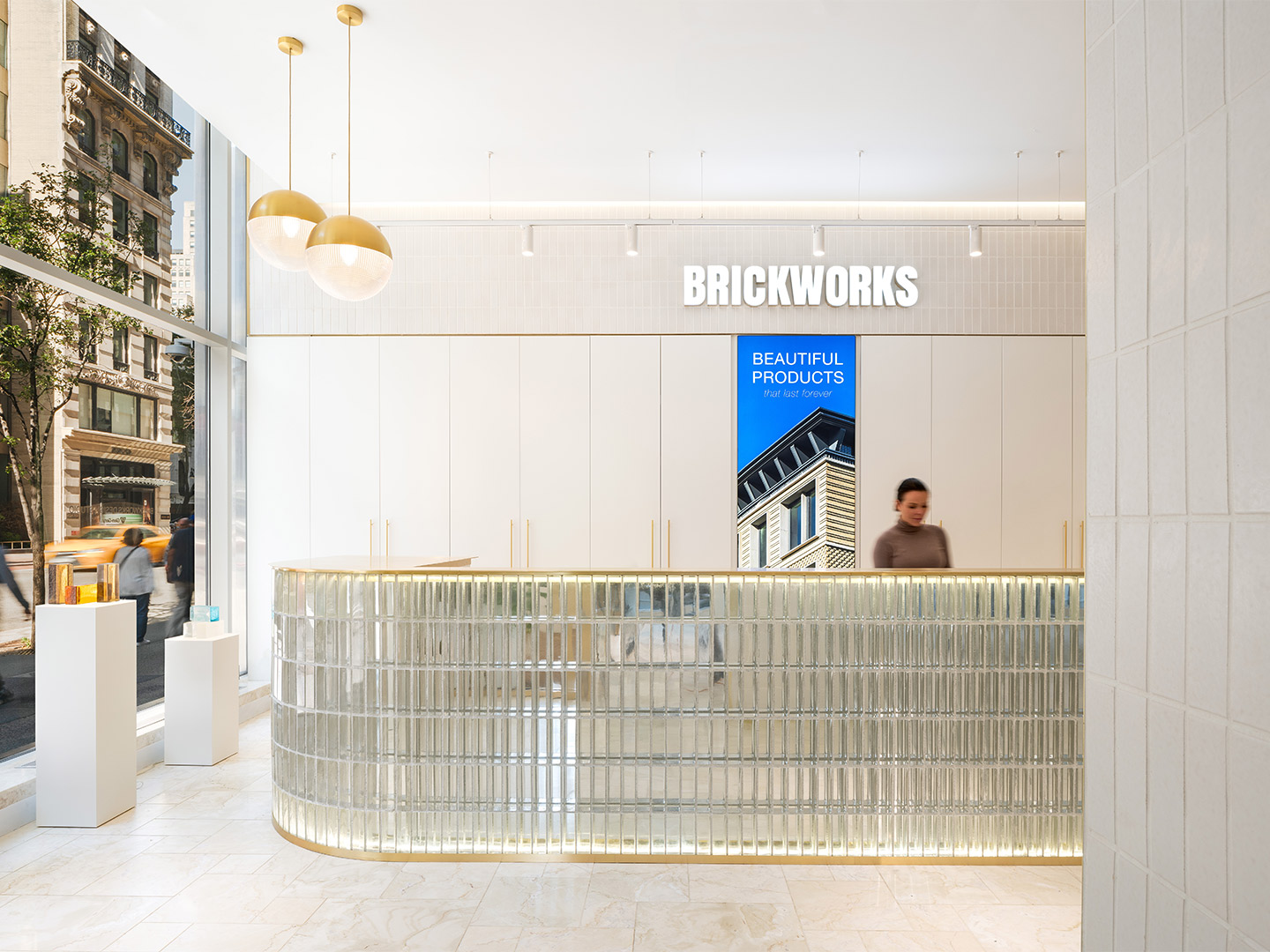
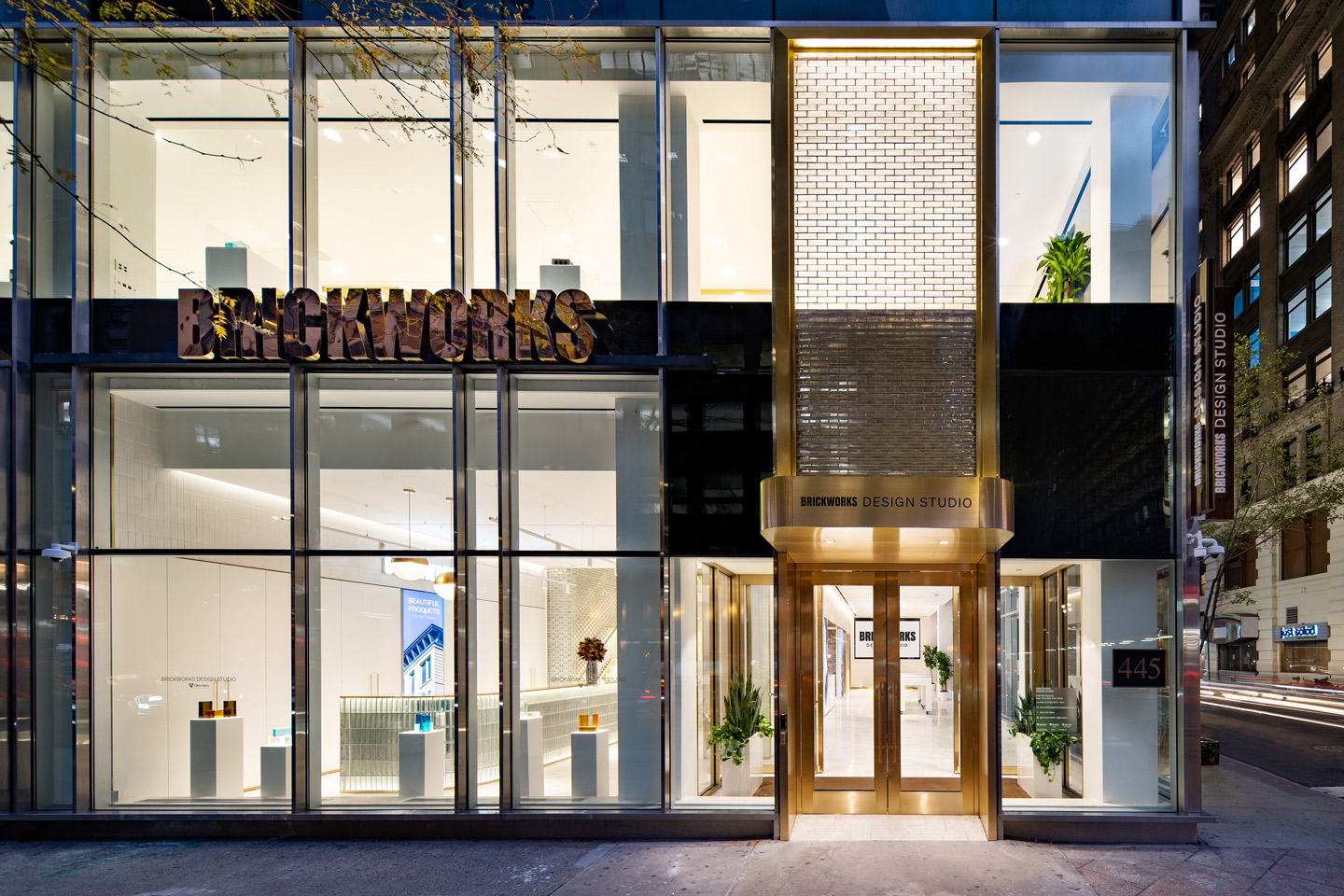
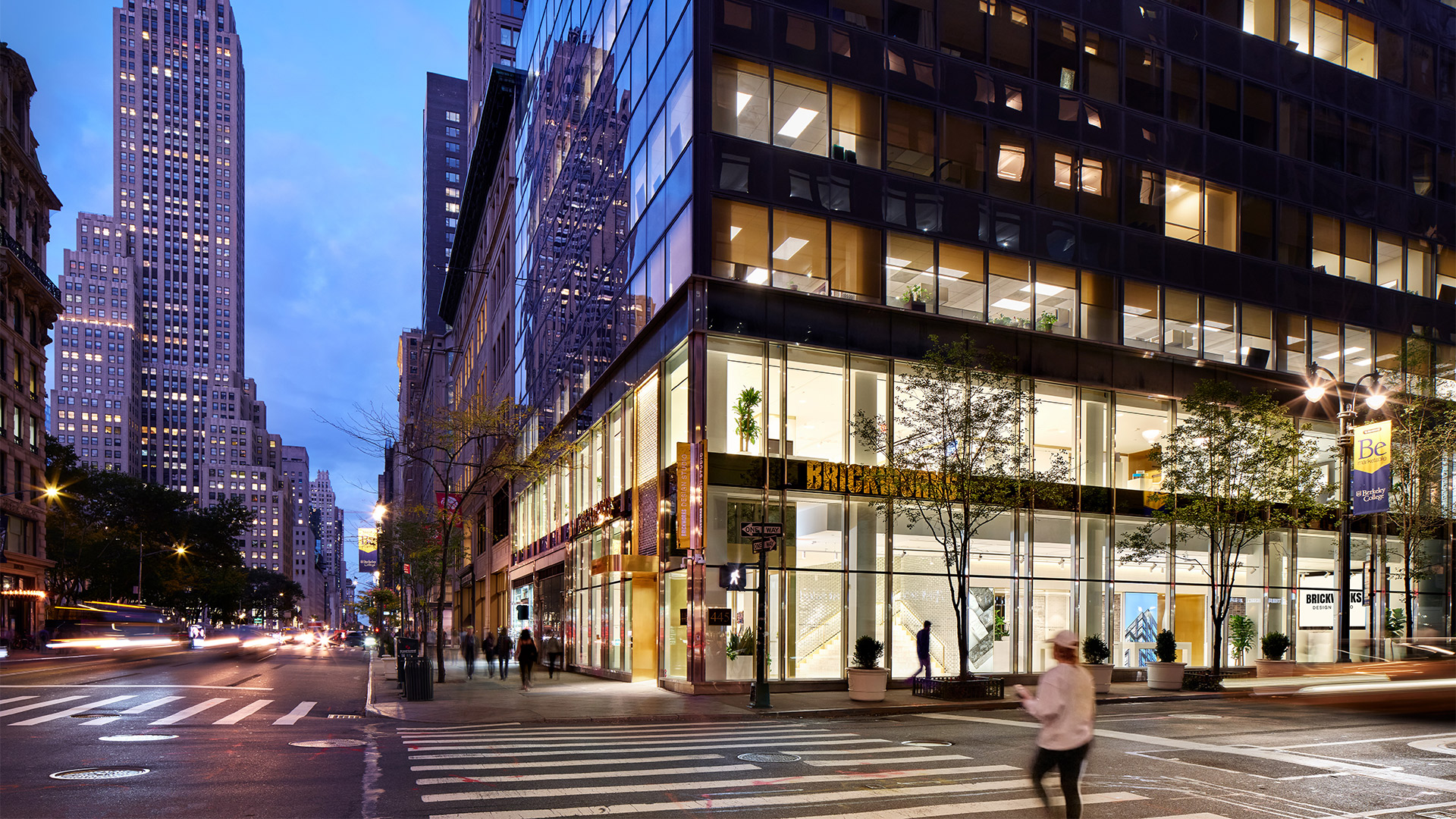
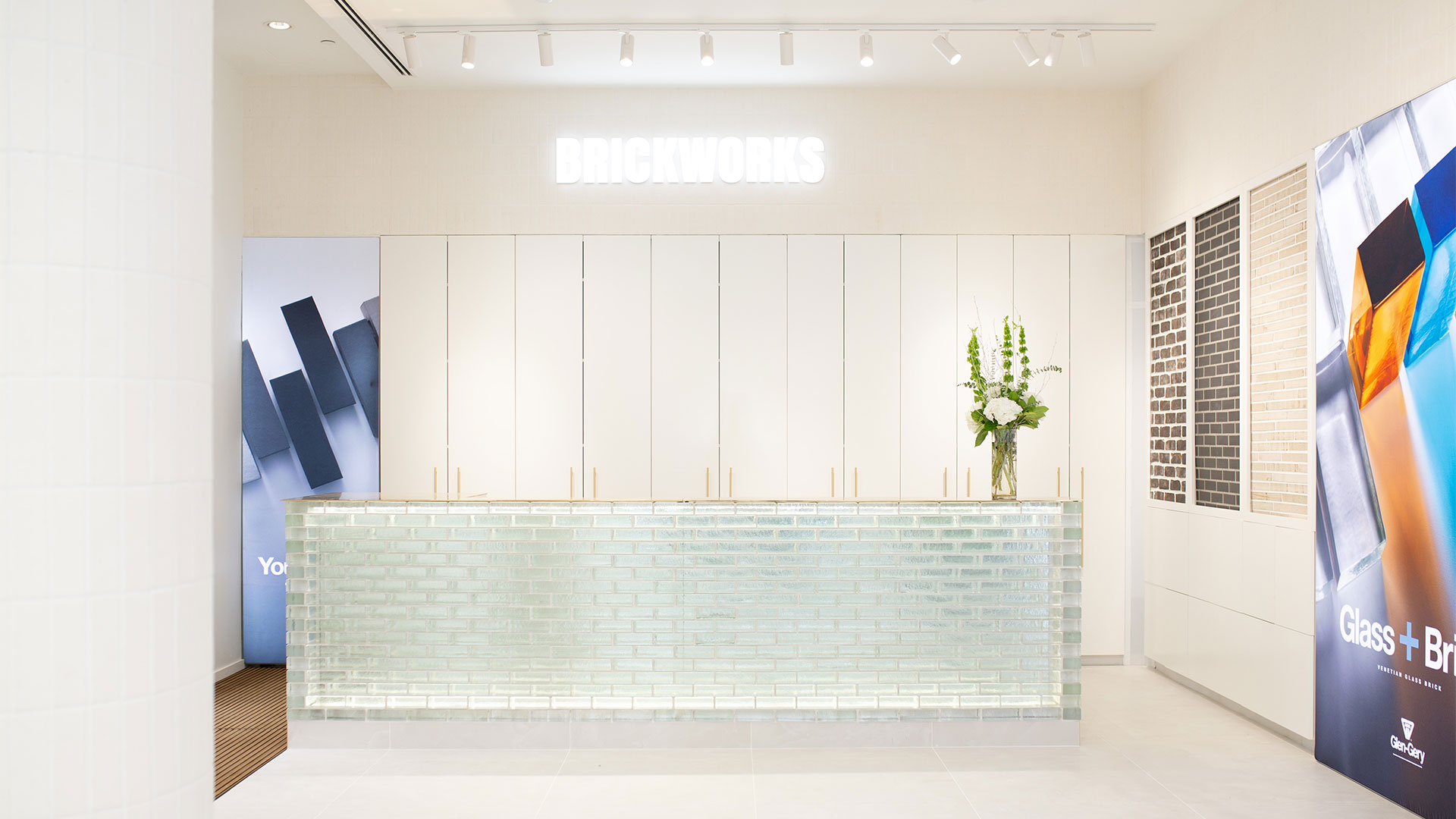
A monogrammed trunk from Louis Vuitton. Solid gold bracelets from Cartier. The latest Apple watch. And a batch of premium designer bricks. Not often are these luxurious products available to procure in the same place, but as of this month they are all on offer to peruse and purchase from one of the world’s most glamorous shopping strips. Brickworks Building Products – the maker of super-fine construction materials and parent company of North America’s Glen-Gery Bricks – has opened the doors to its flagship store on New York’s Fifth Avenue. Rubbing shoulders with the likes of Rolex, Saks and Tiffany & Co, the studio welcomes the Big Apple’s brimming pool of design talent to consult with experts, specify spectacular products and – most importantly – stay inspired.
Lindsay Partridge, managing director of Brickworks, says the company is “thrilled” to have opened its global flagship on New York’s most famous shopping street among other legendary brands, a stone’s throw from famed buildings such as the Empire State and Chrysler. “[The Design Studio] is a pivotal milestone for Brickworks,” he declares, referencing the continued expansion of the brand in North America. “It’s an honour to bring our expertise to New York City, home to some of the most diverse, lively and iconic architectural structures in the world.”
Brickworks opens New York Design Studio on Fifth Avenue
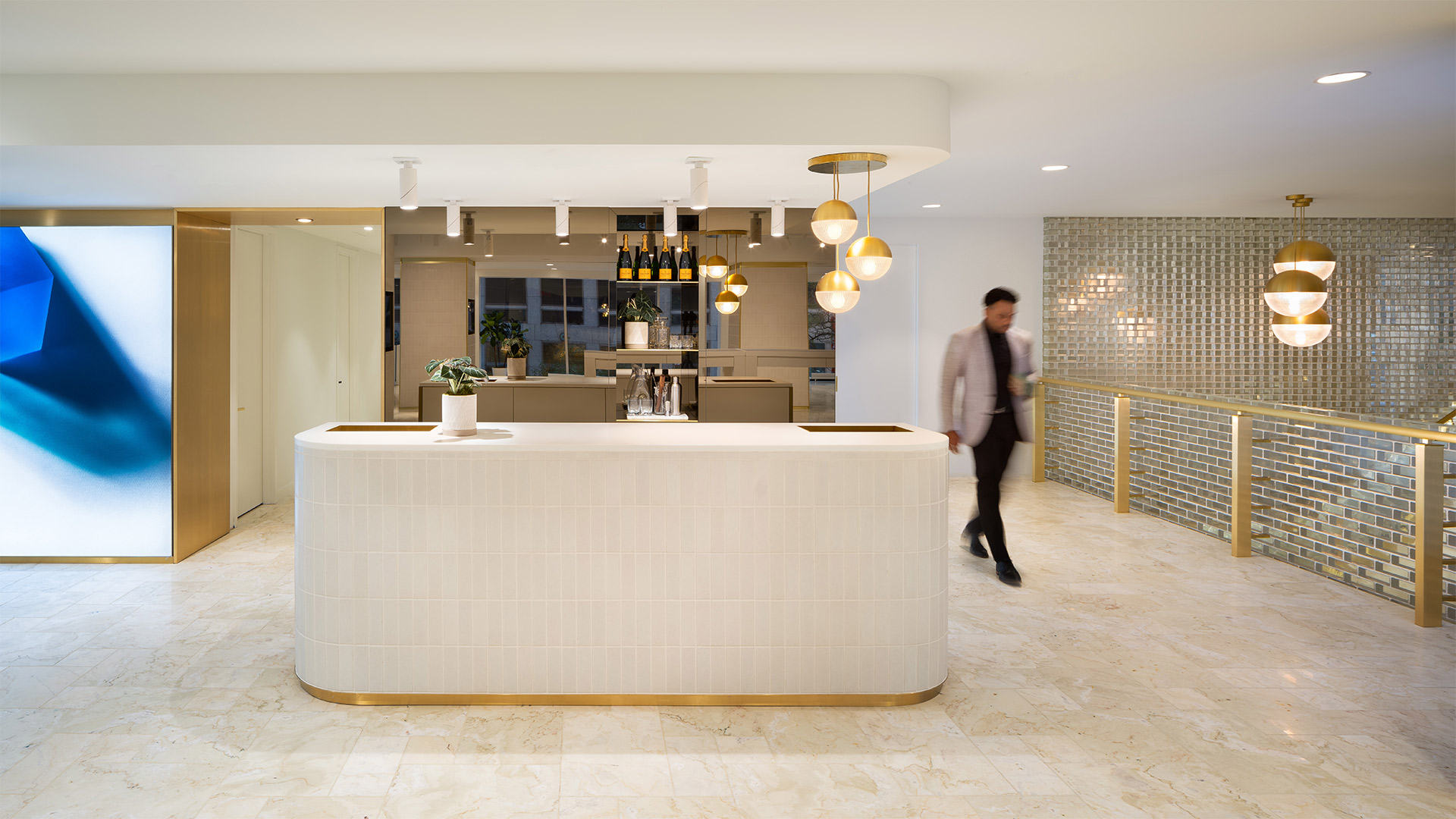
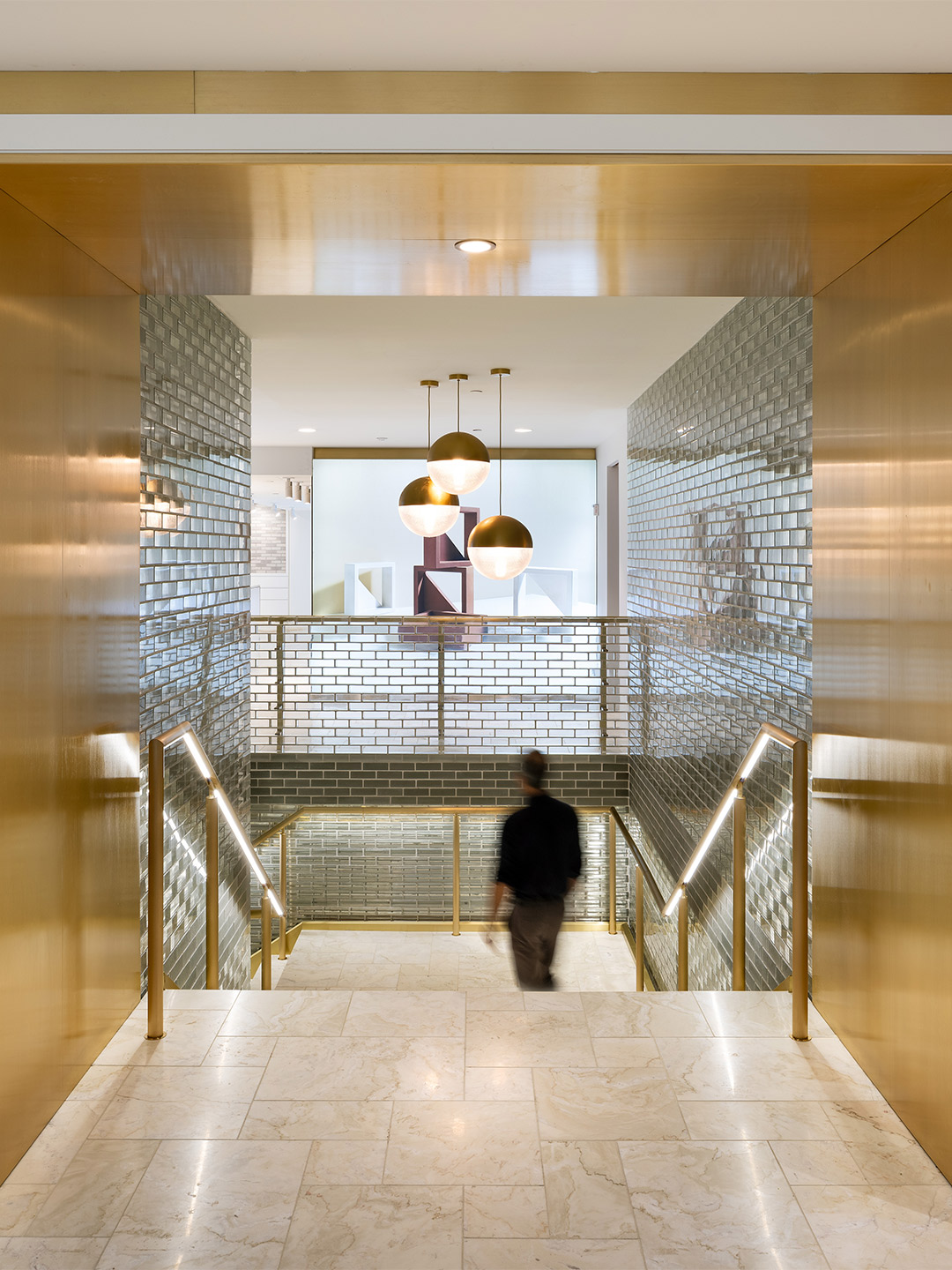
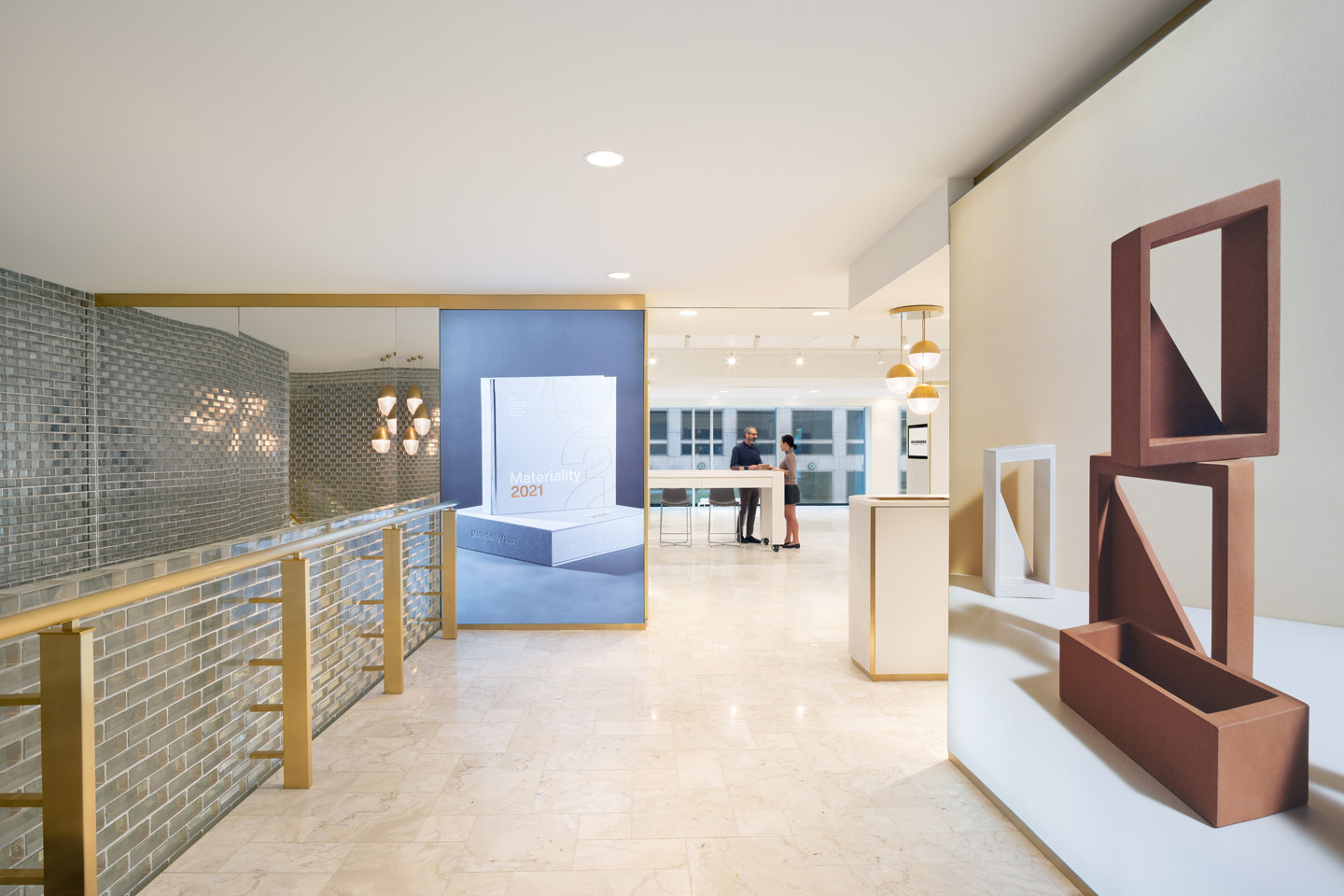
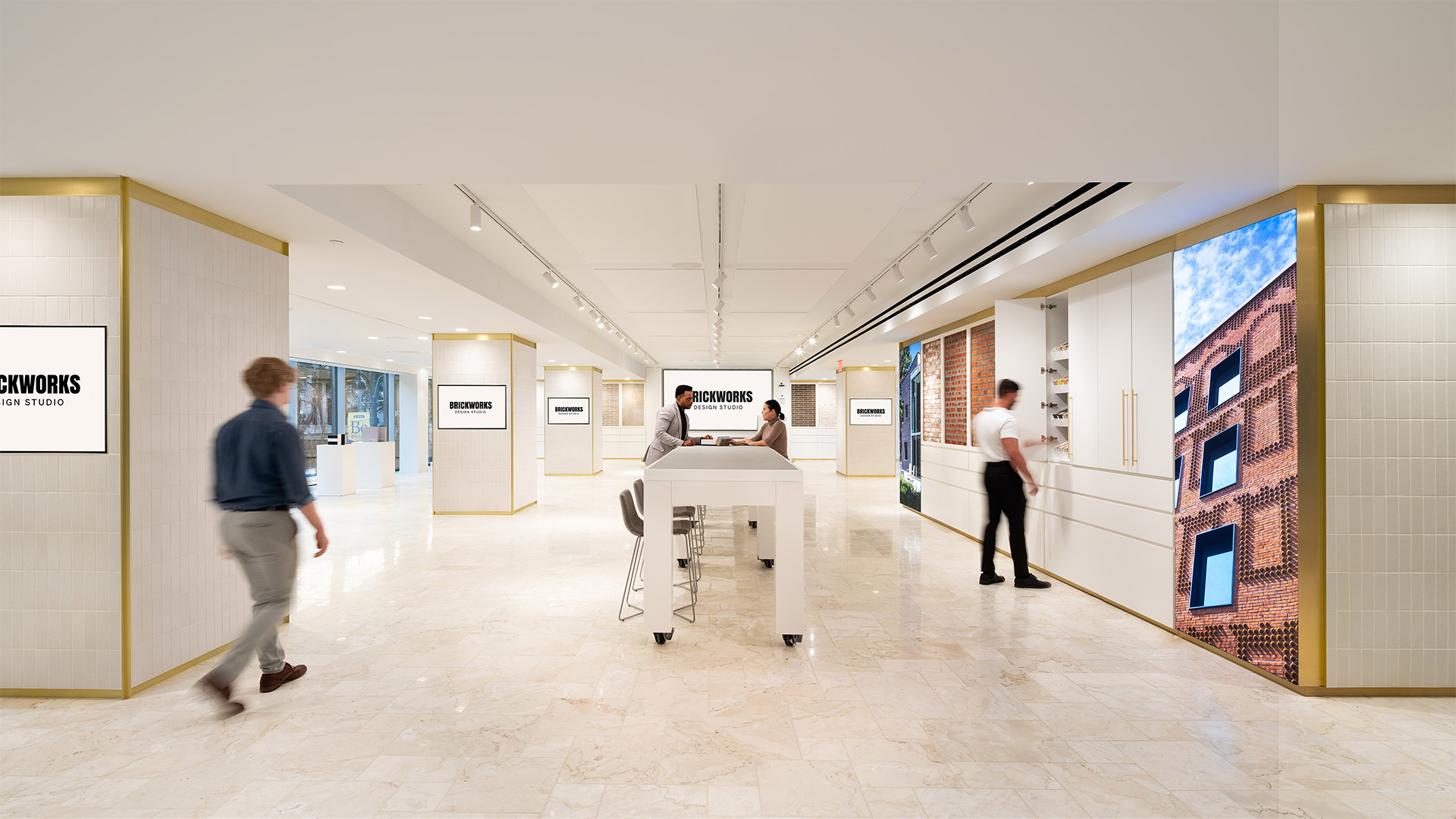
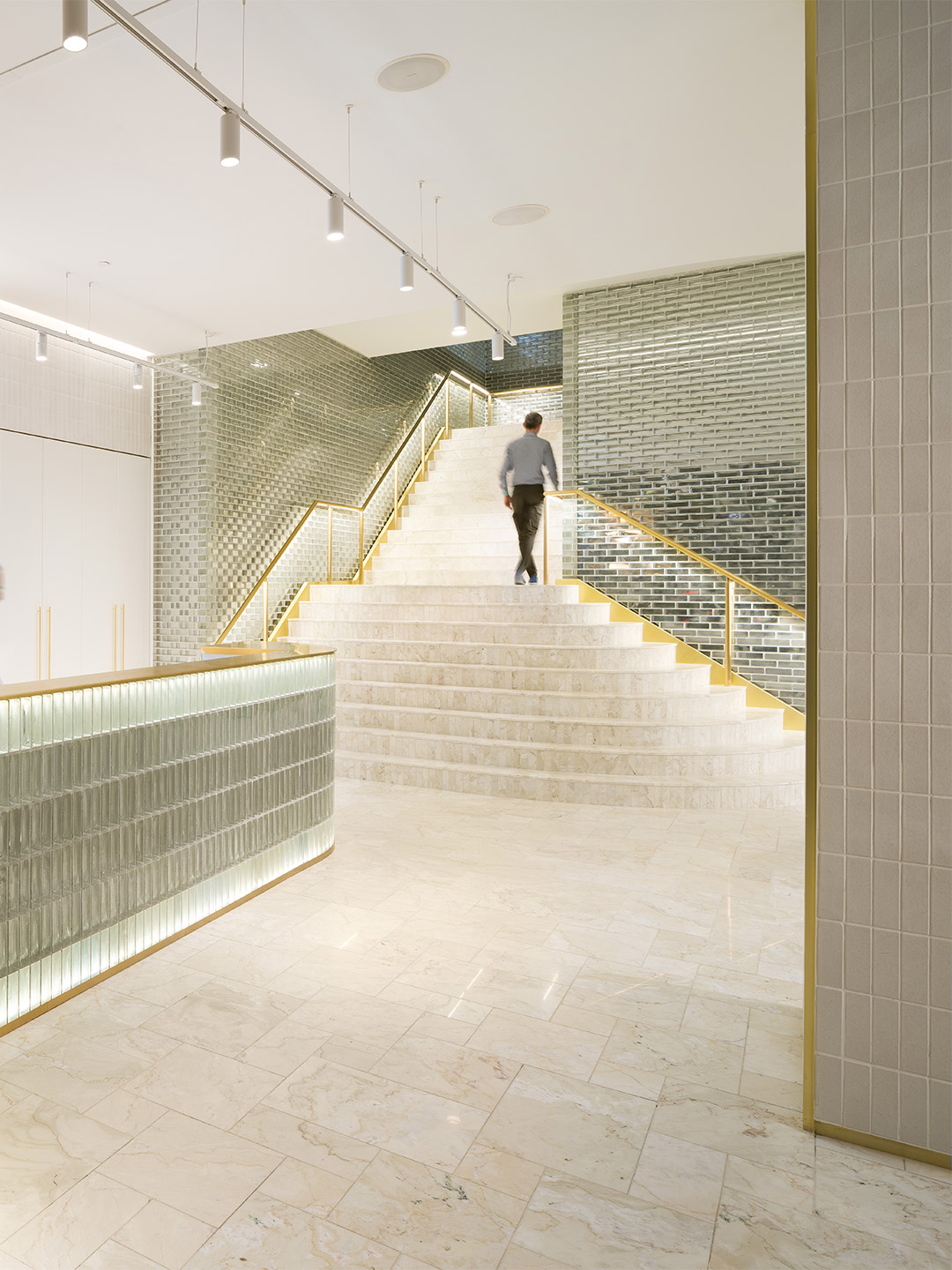
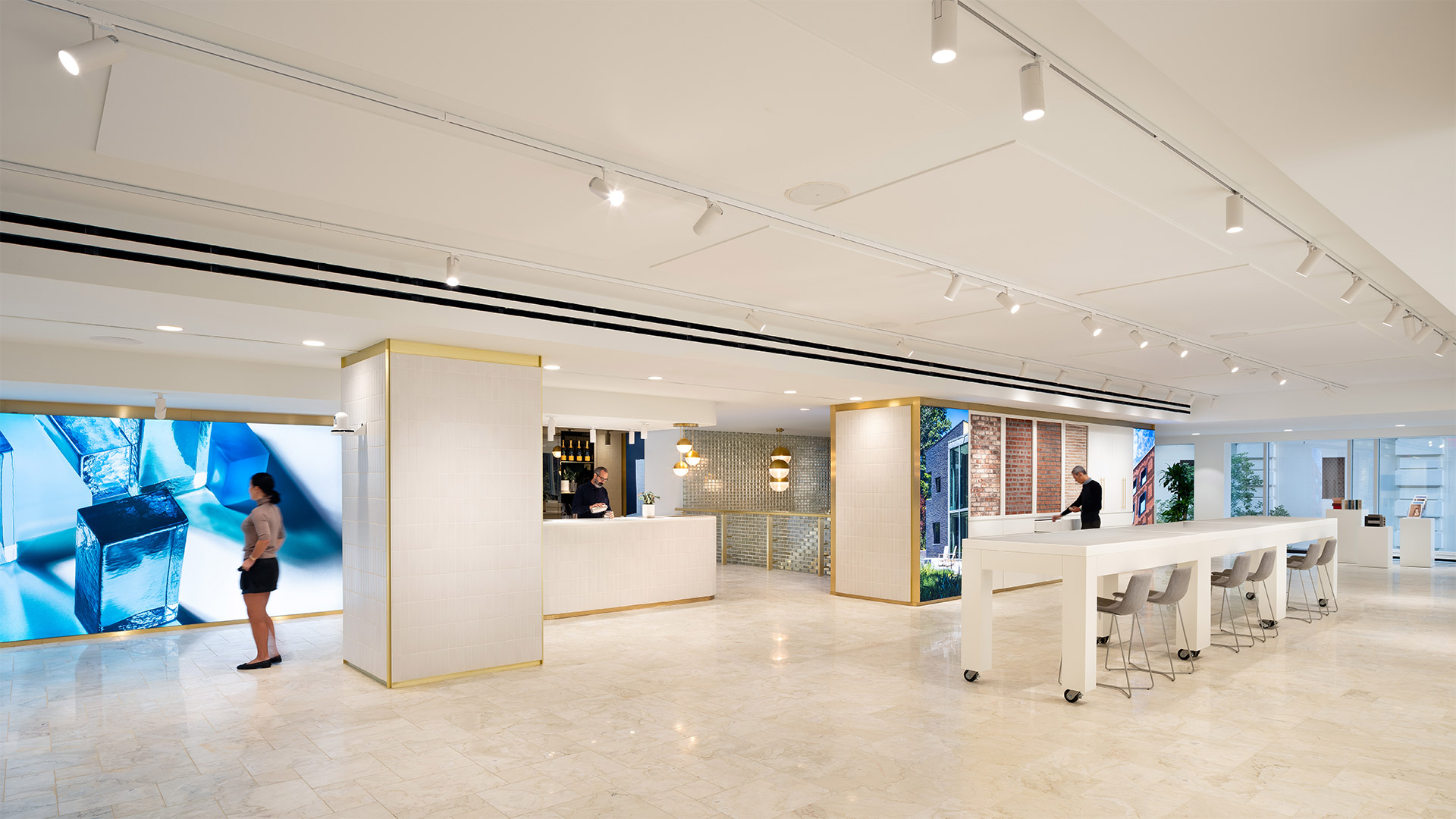
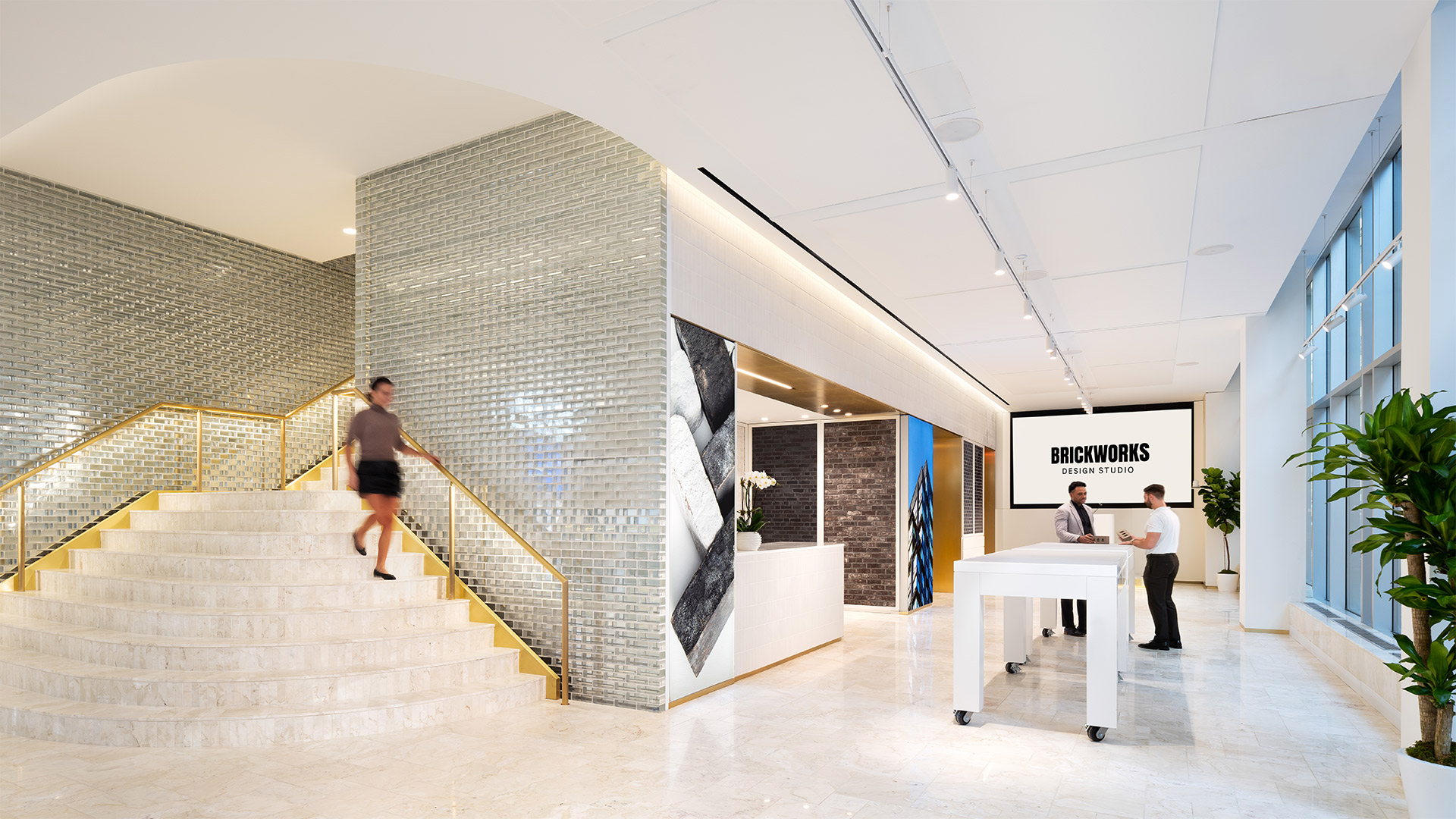
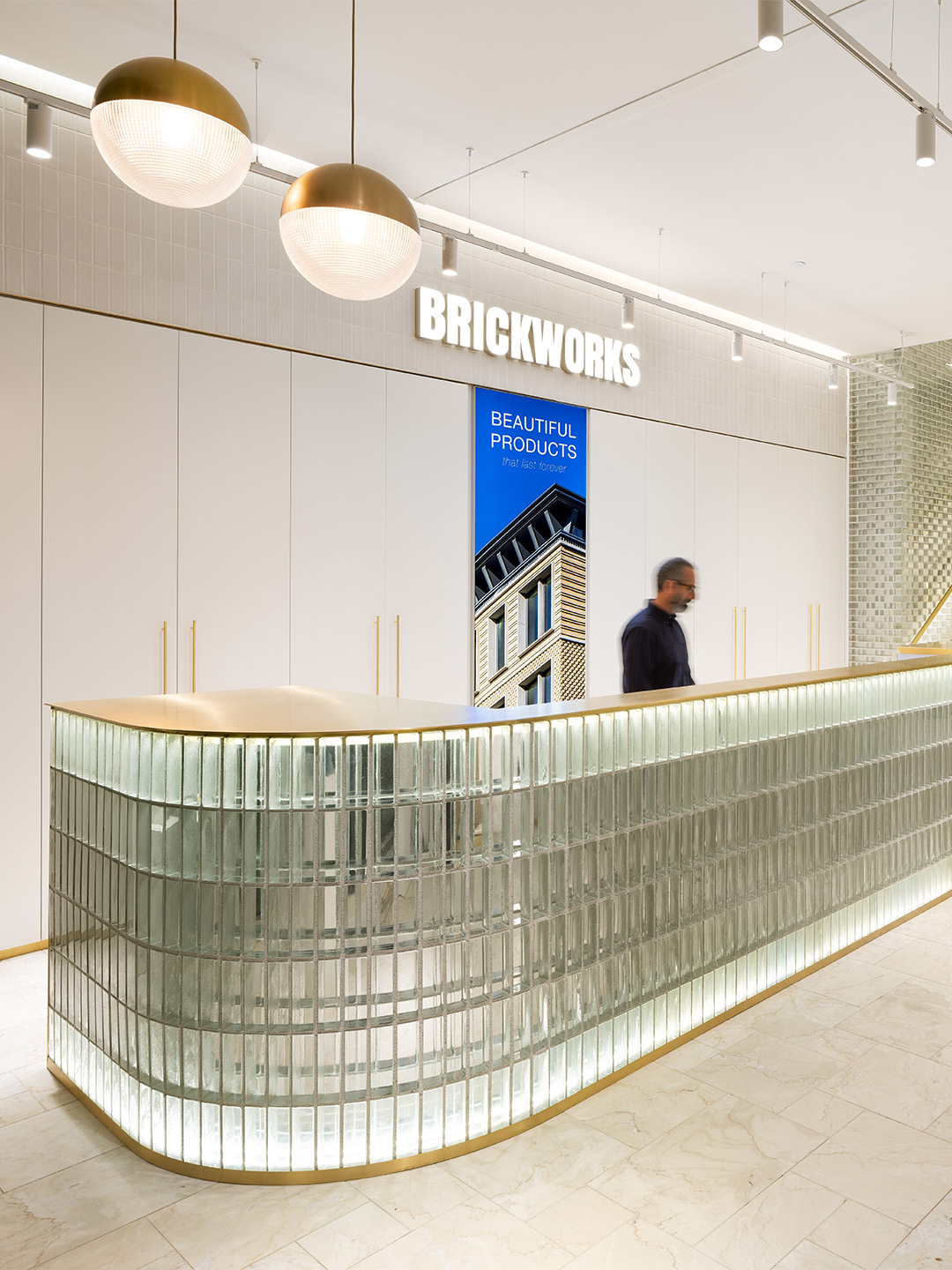
Synching up with the ambience created in other Brickworks Design Studios, including in Sydney, Brisbane and Melbourne, the New York showroom offers a light-filled canvas for the range of products to take centrestage. Set over two levels, walls of clear glass brick meet shimmering golden metallic surfaces. Product nooks filled with samples offer a modern take on apothecary-style drawers, beckoning visitors to touch and feel. And moveable consultation tables allow designers to lay-out their selections, backdropped by all-white surfaces.
It’s this ability to get up-close with Glen-Gery’s range that opens endless possibilities for trade professionals such as architects, designers, developers and builders. The studio features at least 20 product displays, including Glen-Gery’s 2022 releases, as well as international products from GB Masonry, Urbanstone and the award-winning ‘Kite Breeze’ breezeblock by celebrated Australian designer Adam Goodrum.
But as the suave-looking bar on the upper level suggests, Brickworks isn’t just about selling bricks. The company is well-regarded for spearheading industry events, architect speaker series’ and launching hefty monographs – all of which can be accommodated in the New York studio. Not confined to the limits of its four glittering walls, the showroom is also equipped with a state-of-the-art broadcast studio, offering a connection point with creatives from all around the world and a space to create engaging content for local and international audiences.
Brickworks New York Design Studio is located at 445 5th Avenue, New York.
glengery.com; brickworks.com.au
It’s an honour to bring our expertise to New York City, home to some of the most diverse, lively and iconic architectural structures in the world.
Brickworks Building Products is the owner of this masthead.
Catch up on more architecture, art and design highlights. Plus, subscribe to receive the Daily Architecture News e-letter direct to your inbox.
Related stories
- Venus Power collection of rugs by Patricia Urquiola for cc-tapis.
- Bitossi celebrates centenary in Florence with new museum and 7000-piece display.
- Casa R+1 residence in southern Spain by Puntofilipino.
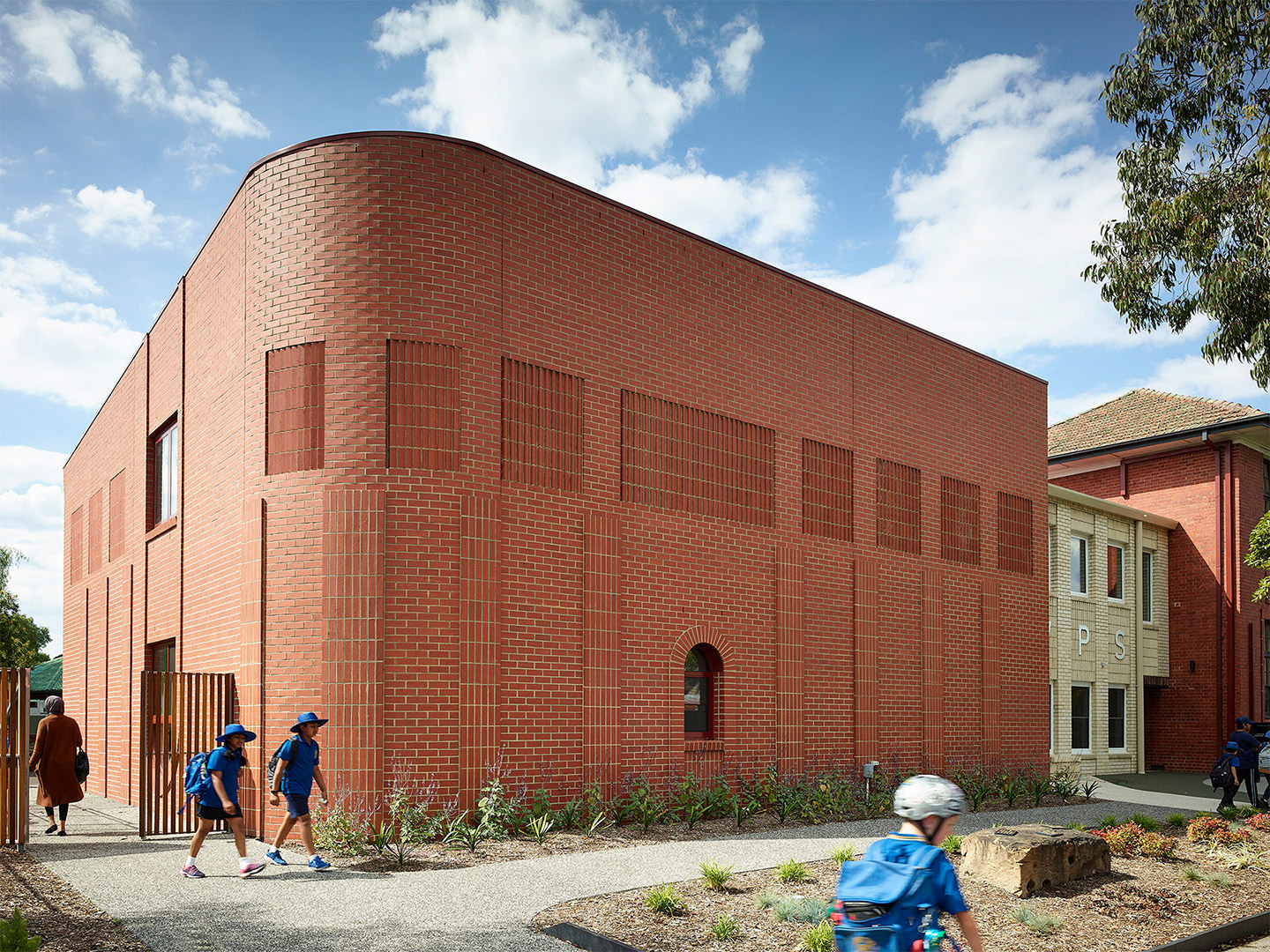
Located just 10 kilometres north of Melbourne’s CBD, Pascoe Vale Primary School represents a fine example of neo-classical school design. Considered “significant” by the Heritage Council of Victoria, the original two-store building was devised in 1929 by Edwin Evan Smith, chief architect of the Department of Public Works. But since the school has grown and innovations in teaching practices have developed, the team at Kosloff Architecture were called upon to update the old schoolhouse by way of a sensitive new addition. They were also required to make internal modifications to the existing building, and support staff and students with a series of break-out and ancillary teaching spaces.
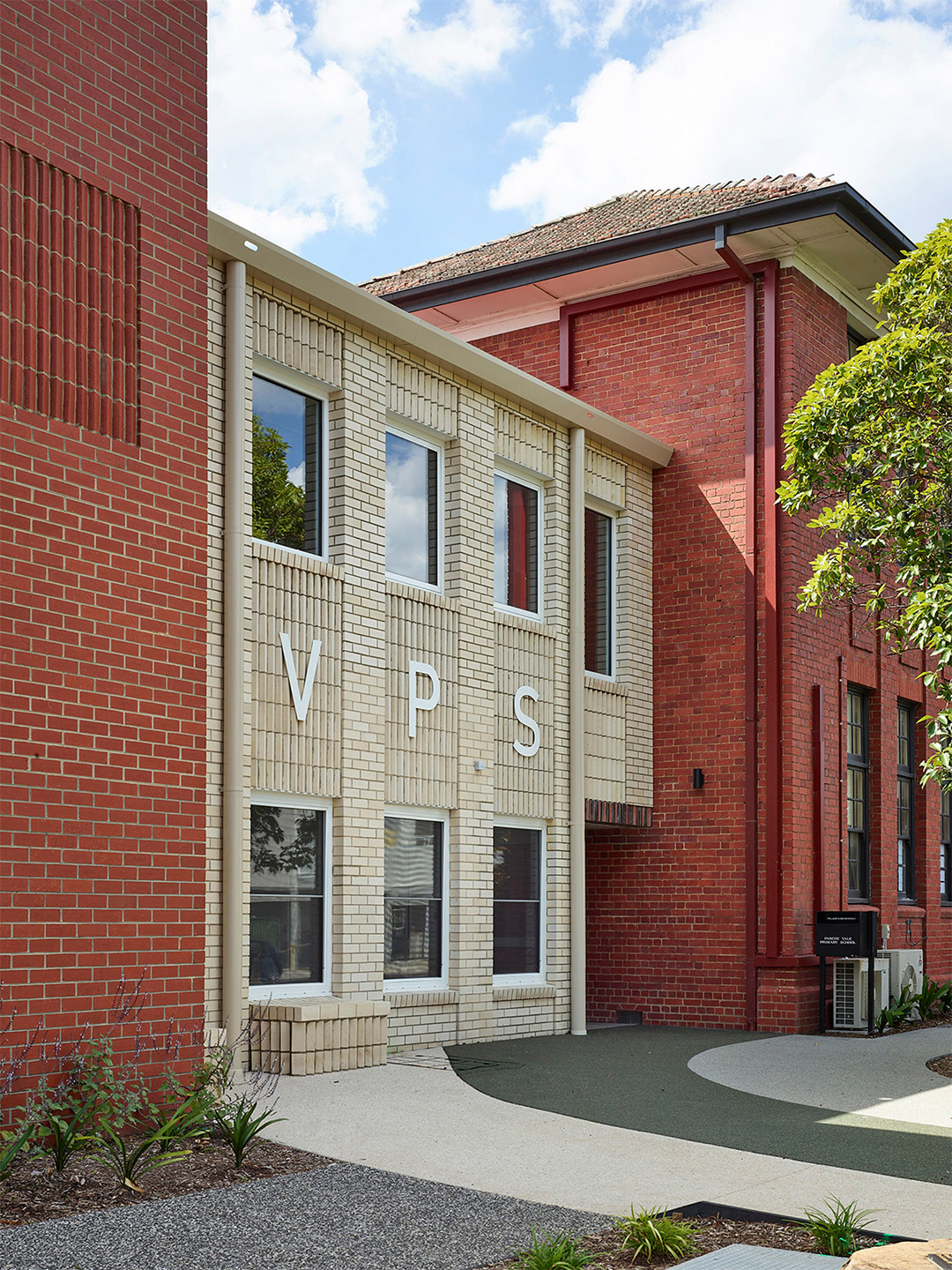
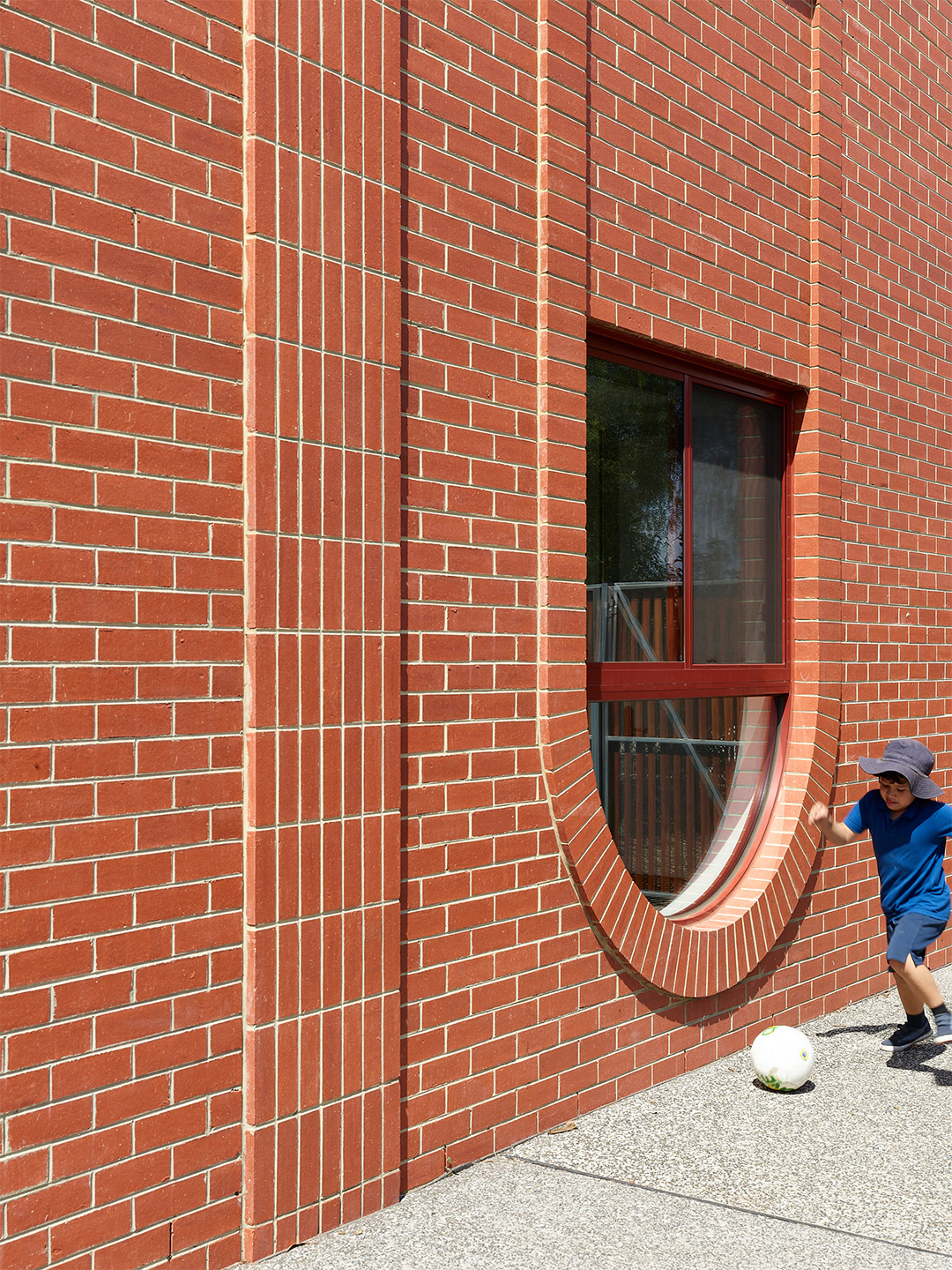
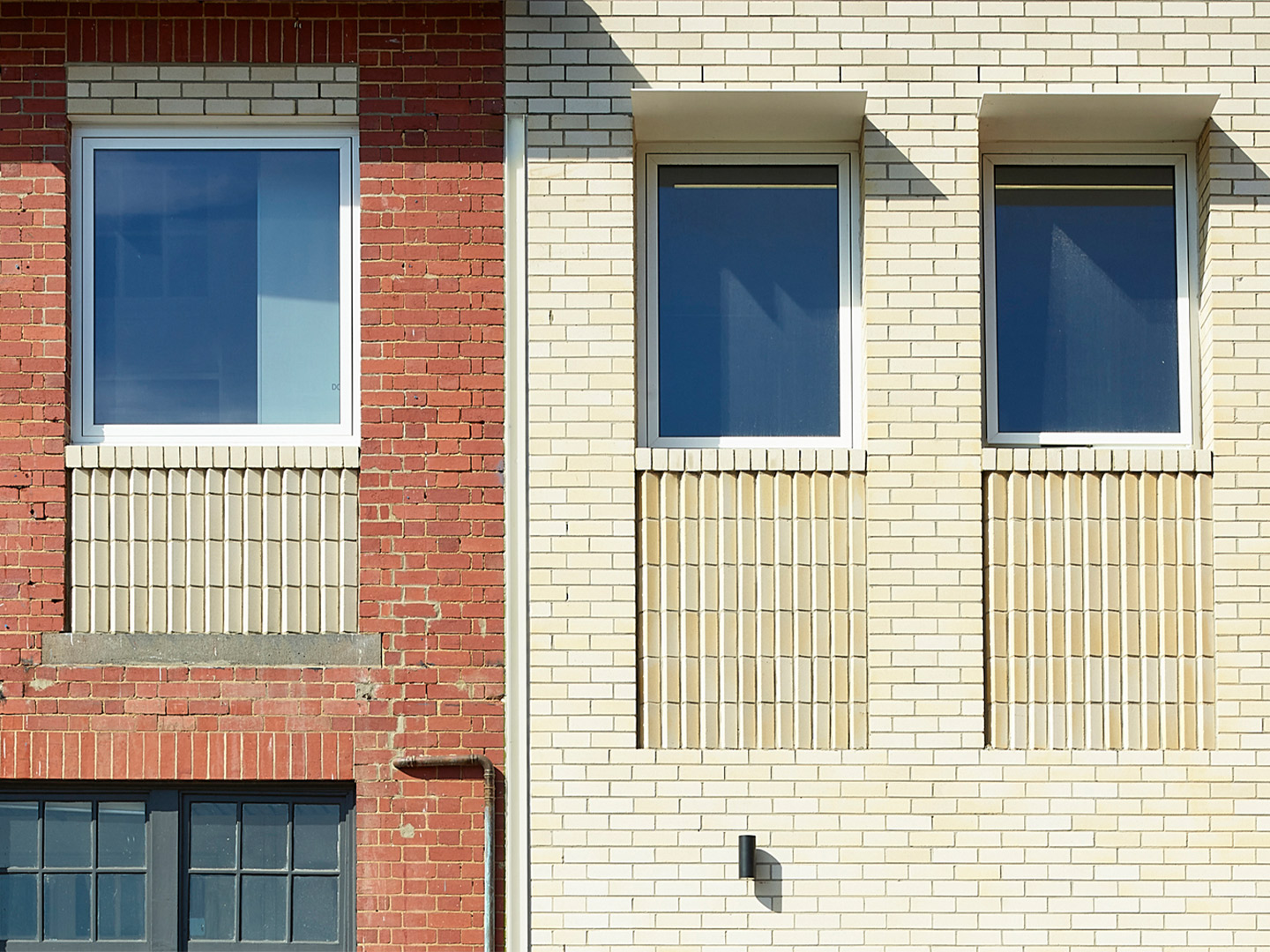
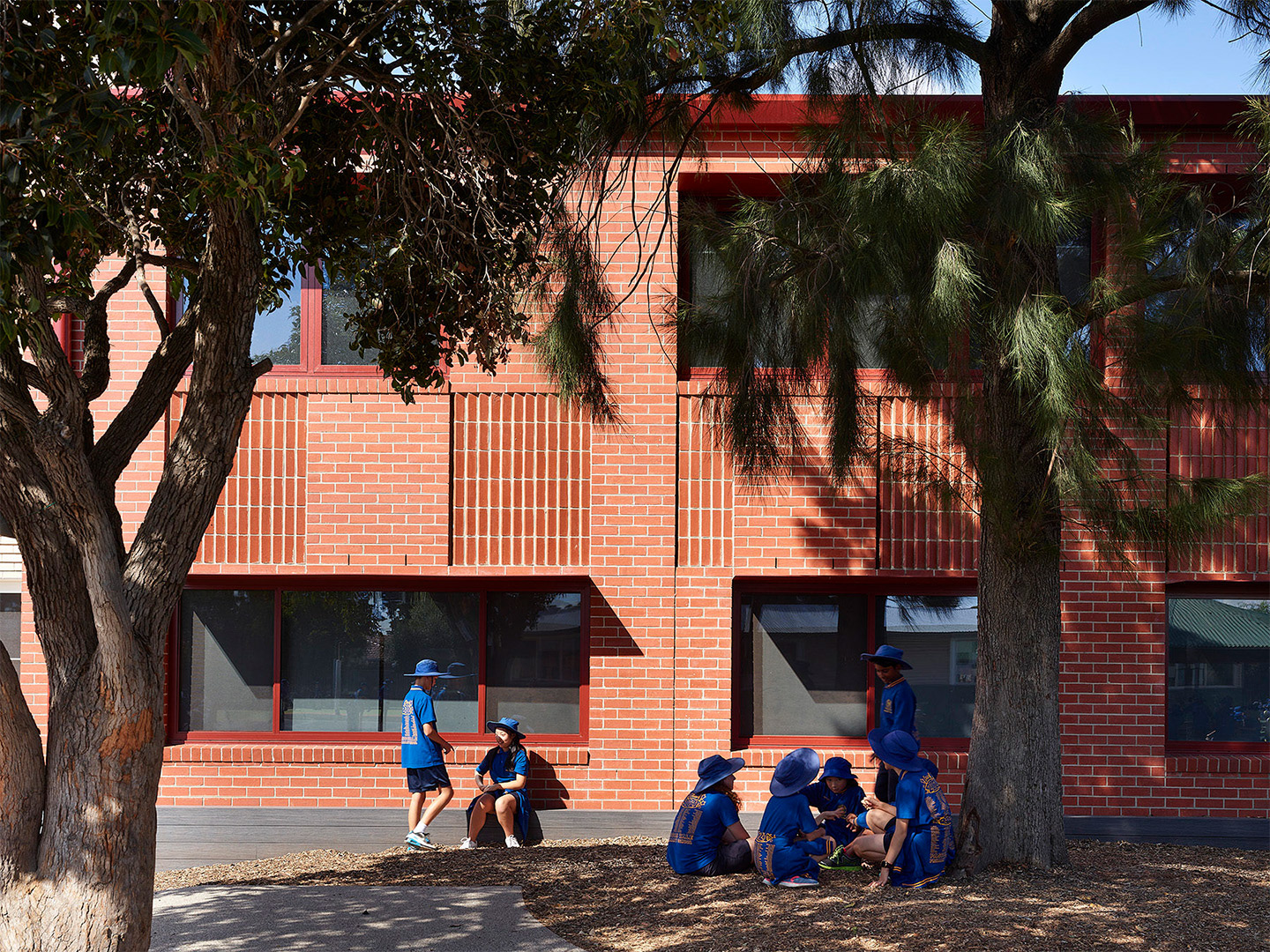
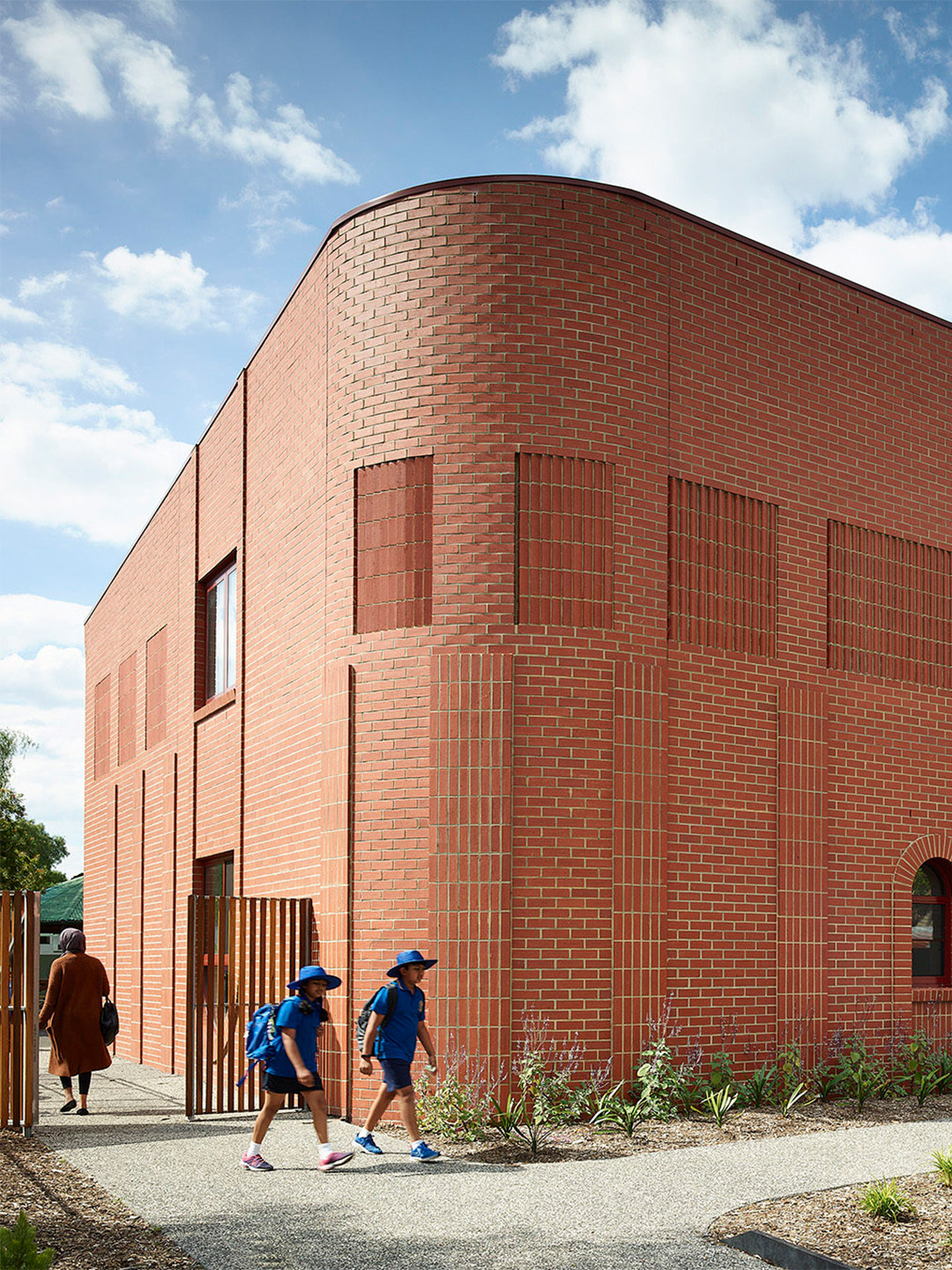
Led by co-founders Julian Kosloff and Stephanie Bullock, the Kosloff Architecture team responded to the brief by creating a generous annexe with a gently curved facade, largely realised in traditional red brick to mirror that of the original structure. Panels of perforated brick detailing adorn its exterior, continuing the framework established by the street-facing windows of the old schoolhouse. Connecting the contemporary language of the new extension to the simplicity of the main Pascoe Vale Primary School building, a clearly identifiable entry passage has been brought to life in contrasting cream bricks, emblazoned with the letters PVPS to represent the school’s name.
Pascoe Vale Primary School in Melbourne by Kosloff Architecture
While the charms of the old red-brick building have long established it as a landmark in the streets of Pascoe Vale, the school has also developed strong connections with the community. After all, it’s been a place of state education for local families for nearly a century. “The school community was very keen for the new extension to not detract from the existing heritage building, and for it to provide a high-quality addition to the existing street frontage,” the architects say. Extensive analysis of the existing heritage building was therefore undertaken and used to develop the formal expression of the extension. “[The development] acknowledges the importance in fostering relationships between parents of the school as well as the broader community,” the architects add.
Overlaid with the principles of the Burra Charter (the basic procedures to be followed in the conservation of Australian heritage places), community feedback guided the extension as well as the new entryway, which is joined by a generous public forecourt with seating. “[It’s] now a gathering space for the school community before and after school,” the architects suggest. The extension deliberately maximises northern light and minimises energy loss through careful siting and planning. Glazing is limited to the western facade; amenities and support areas are located to the south; and new window openings are concentrated to the north. Other passive design initiatives include increased levels of insulation to external walls and roofs, the application of high-performance double glazing, and the integration of shading to the northern facade.
“Our extension, which houses staff and administration, continues the existing building’s masonry language and fine brick articulation,” the Kosloff team say of their architectural response. They add that the school now also enables the exhibition of student work and ensures ongoing access to staff areas and the school grounds at-large. The staff quarters facilitate collaboration and connection, and support professional development, while the creation of 21st-century learning spaces within the existing building ensures the school’s students are well-equipped for a bright future.
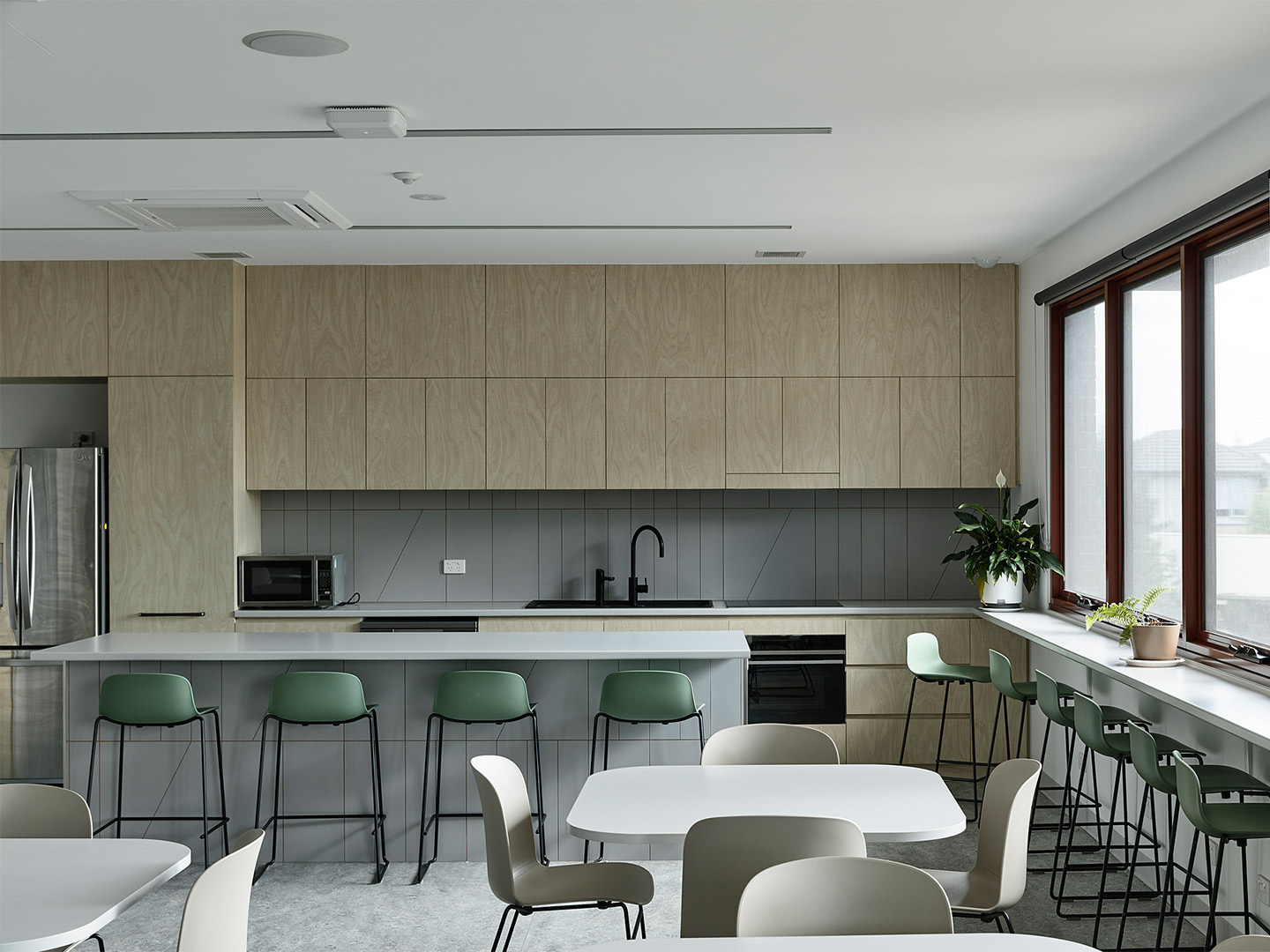
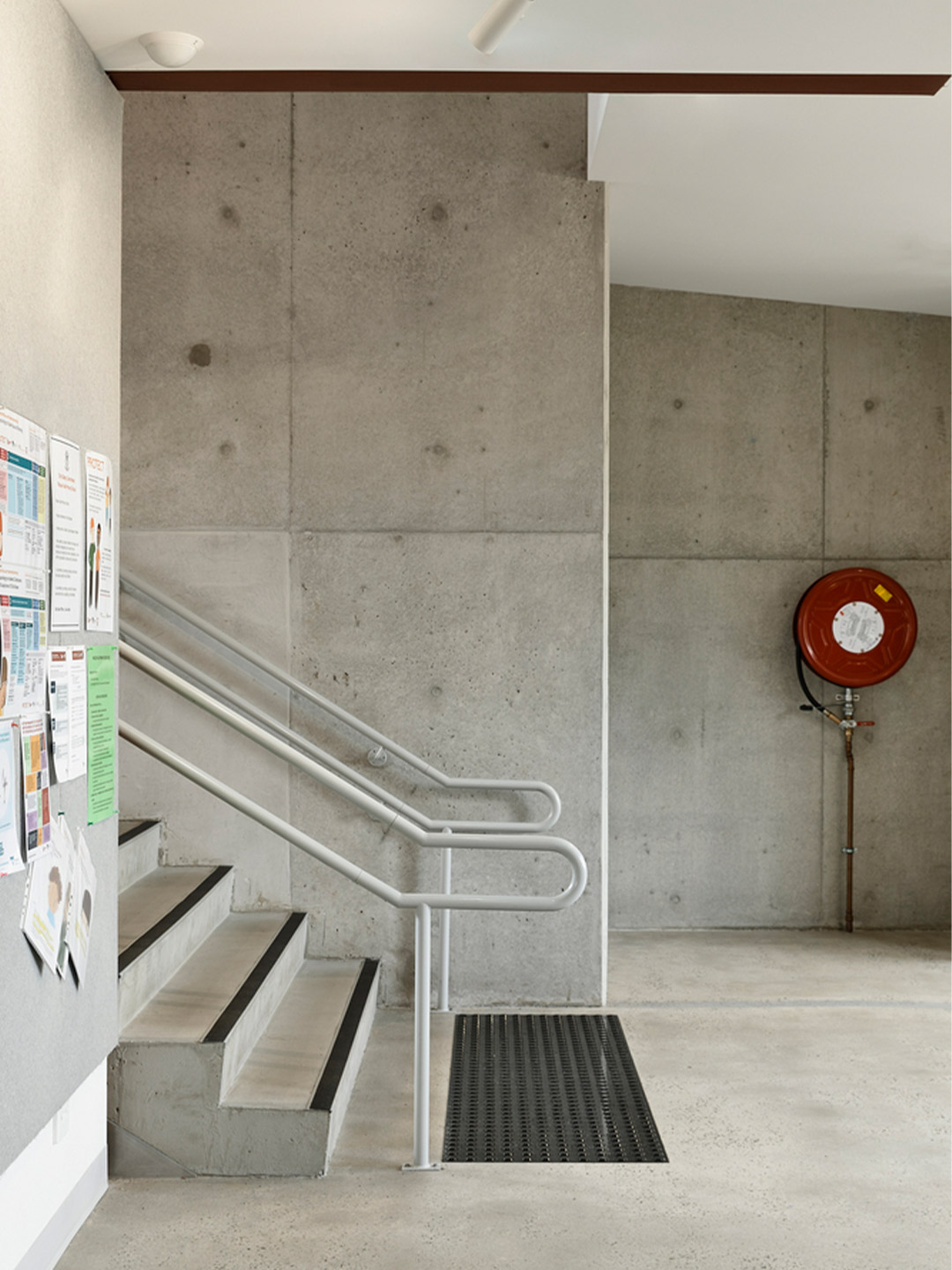
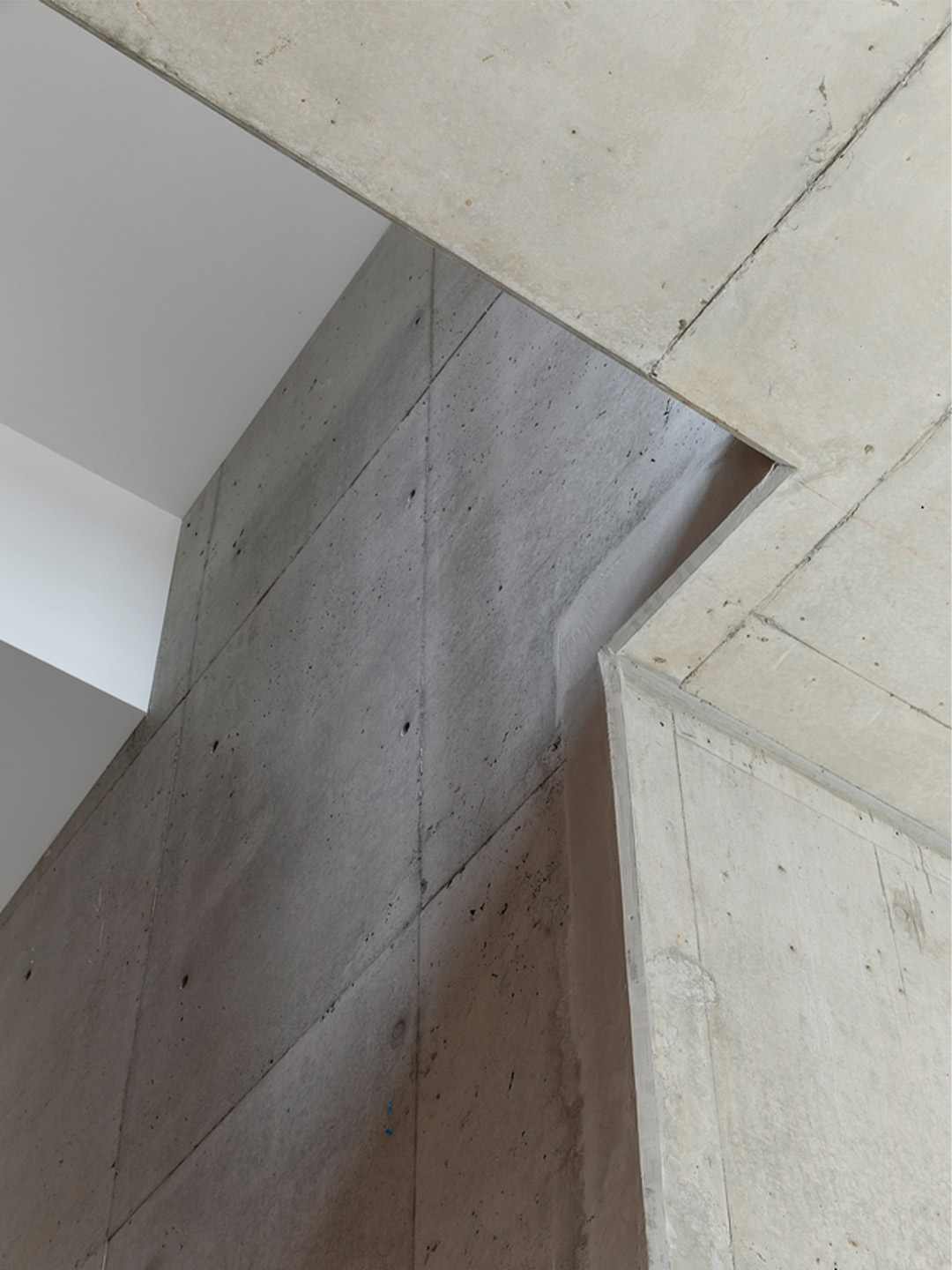
While the charms of the old red-brick building have established it as a landmark in the streets of Pascoe Vale, the school has also developed strong connections with the community.
Catch up on more architecture, art and design highlights. Plus, subscribe to receive the Daily Architecture News e-letter direct to your inbox.
Related stories
- Venus Power collection of rugs by Patricia Urquiola for cc-tapis.
- Bitossi celebrates centenary in Florence with new museum and 7000-piece display.
- Casa R+1 residence in southern Spain by Puntofilipino.
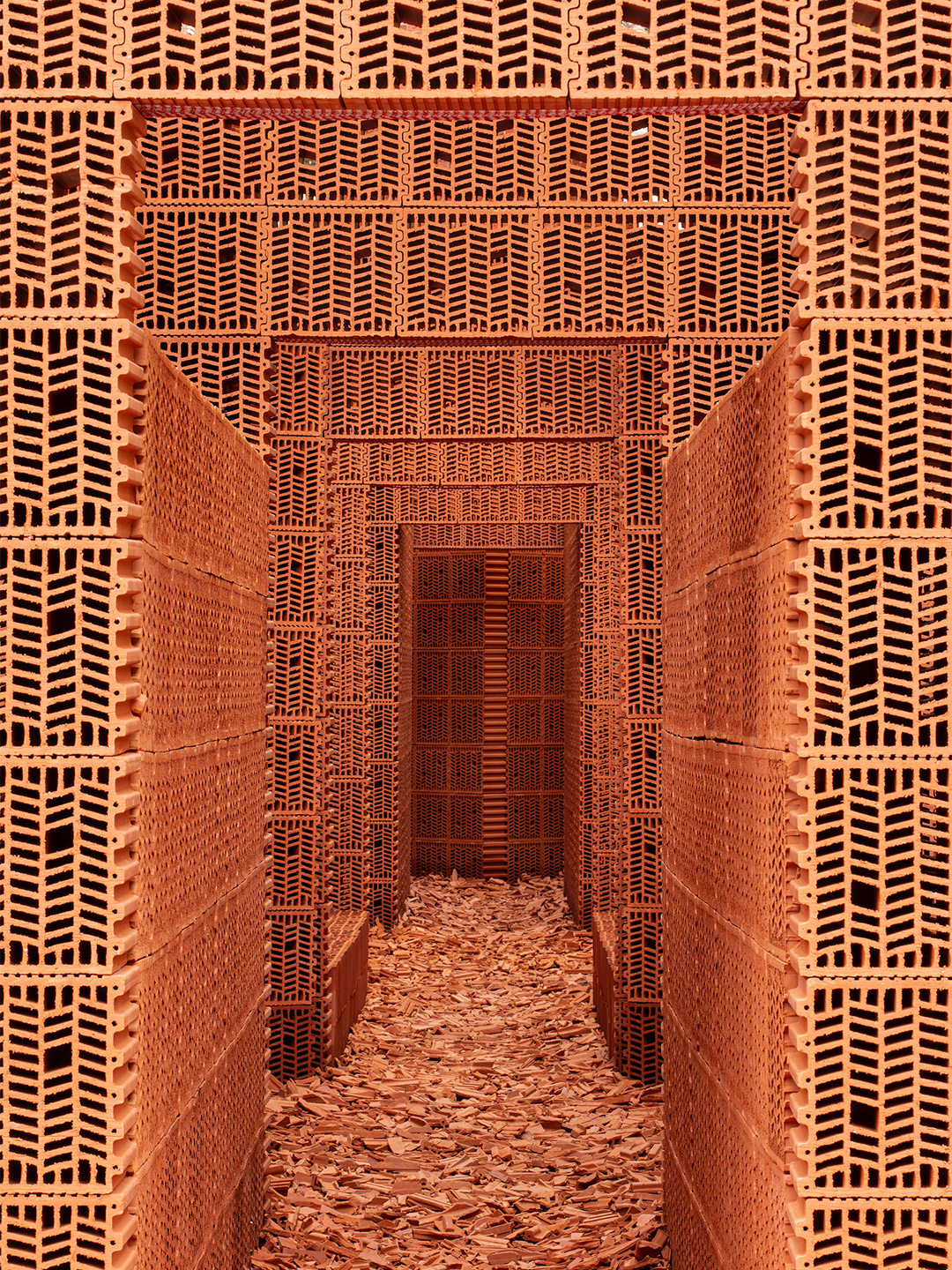
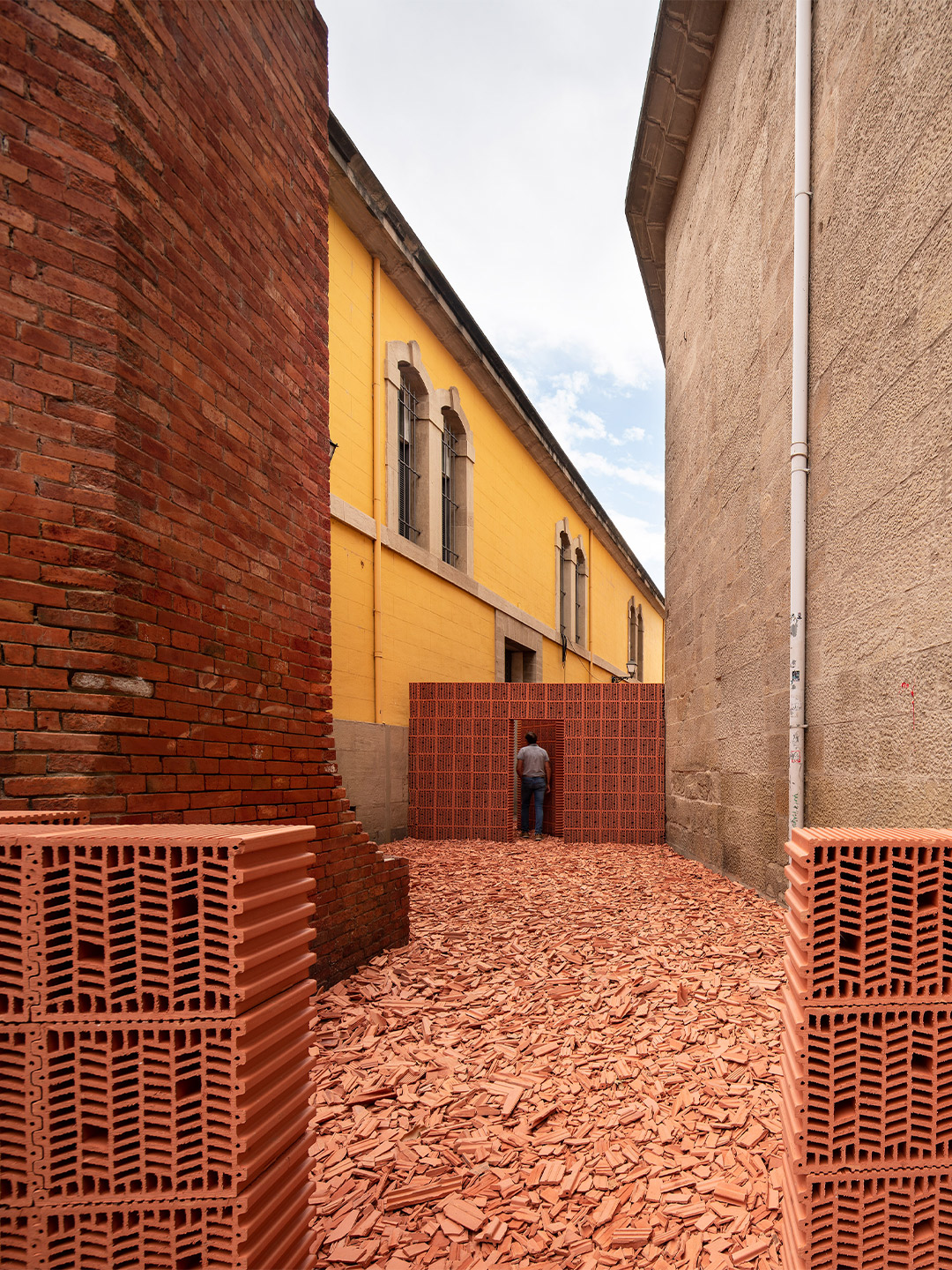
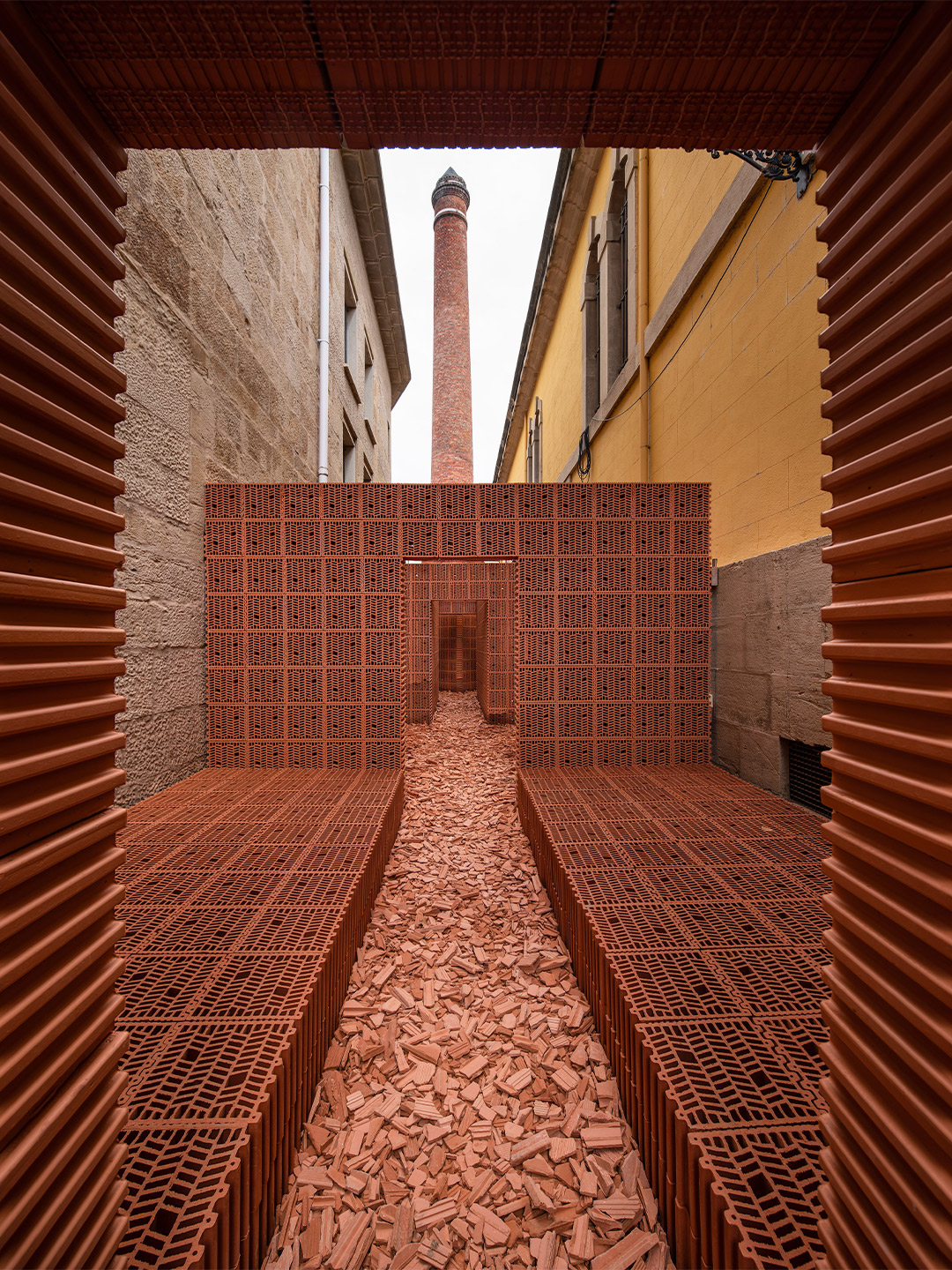
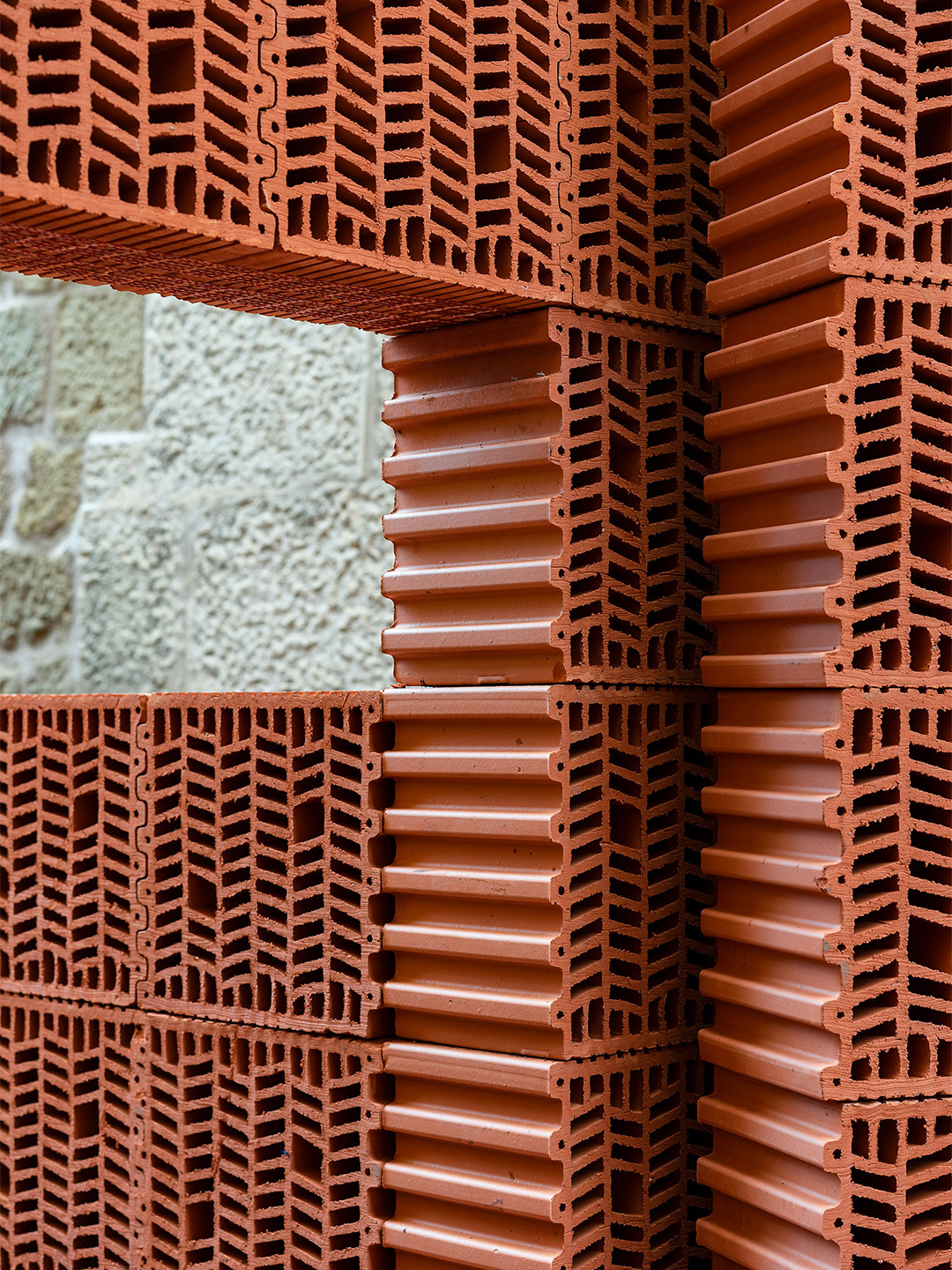
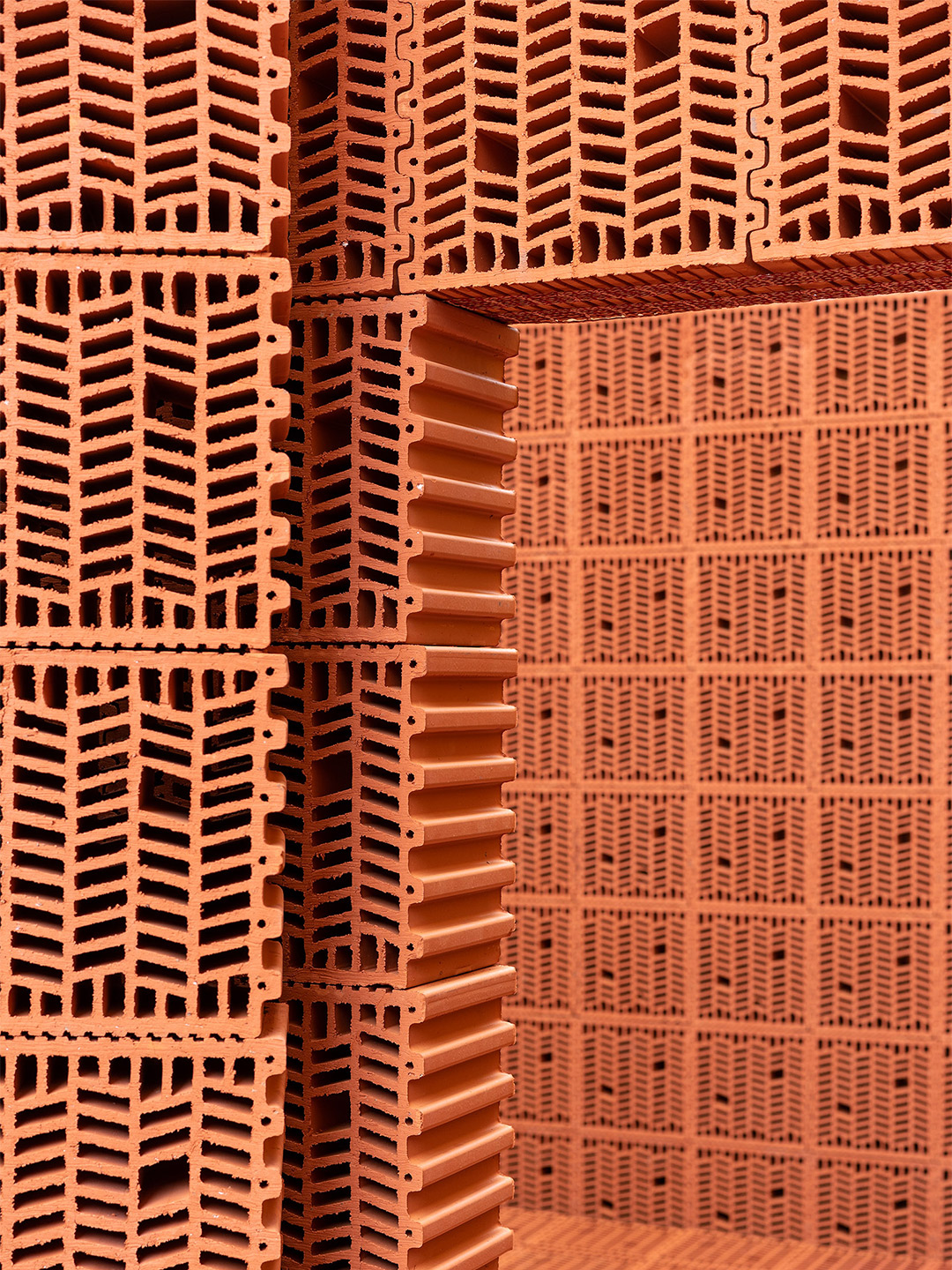
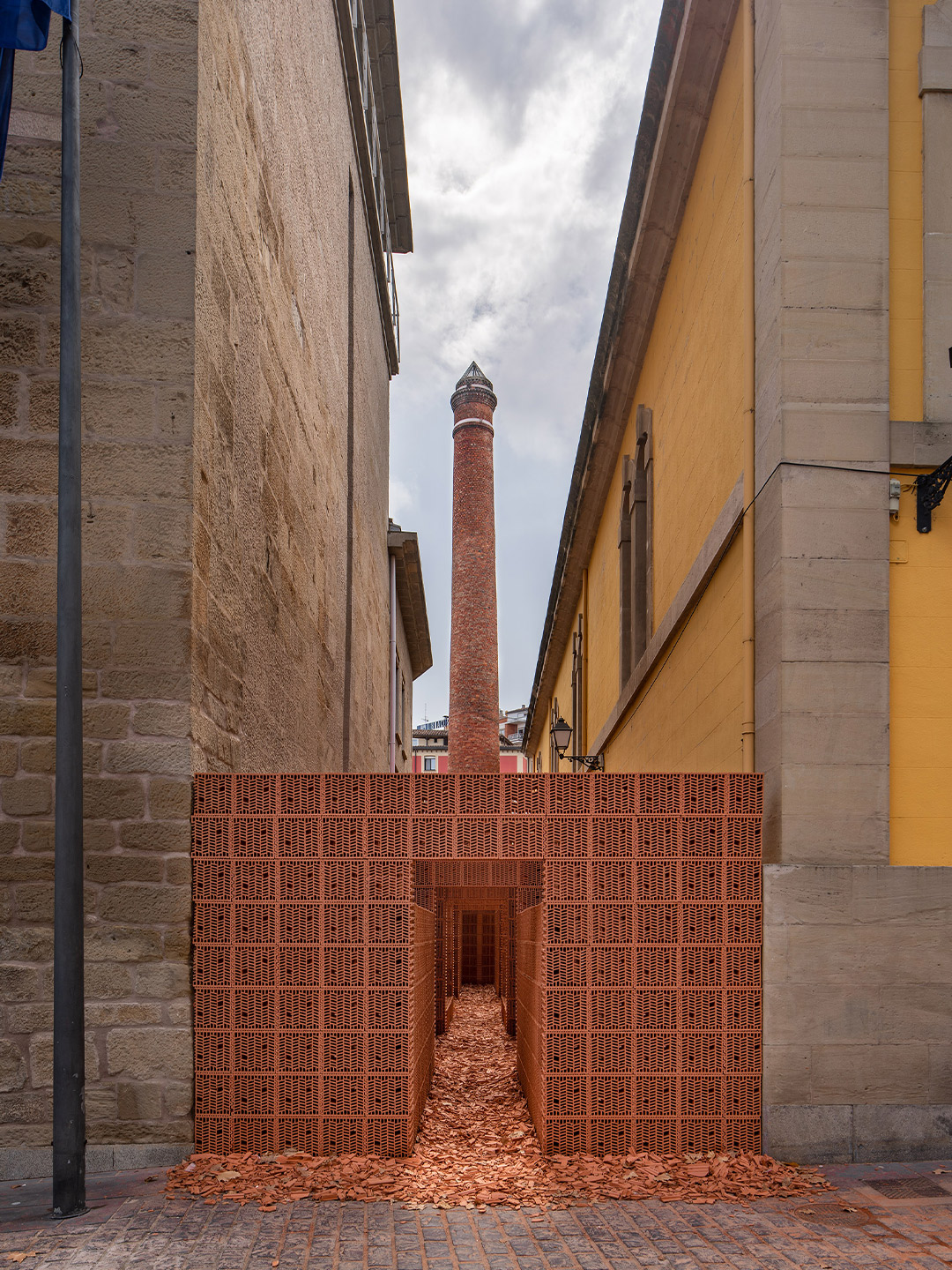
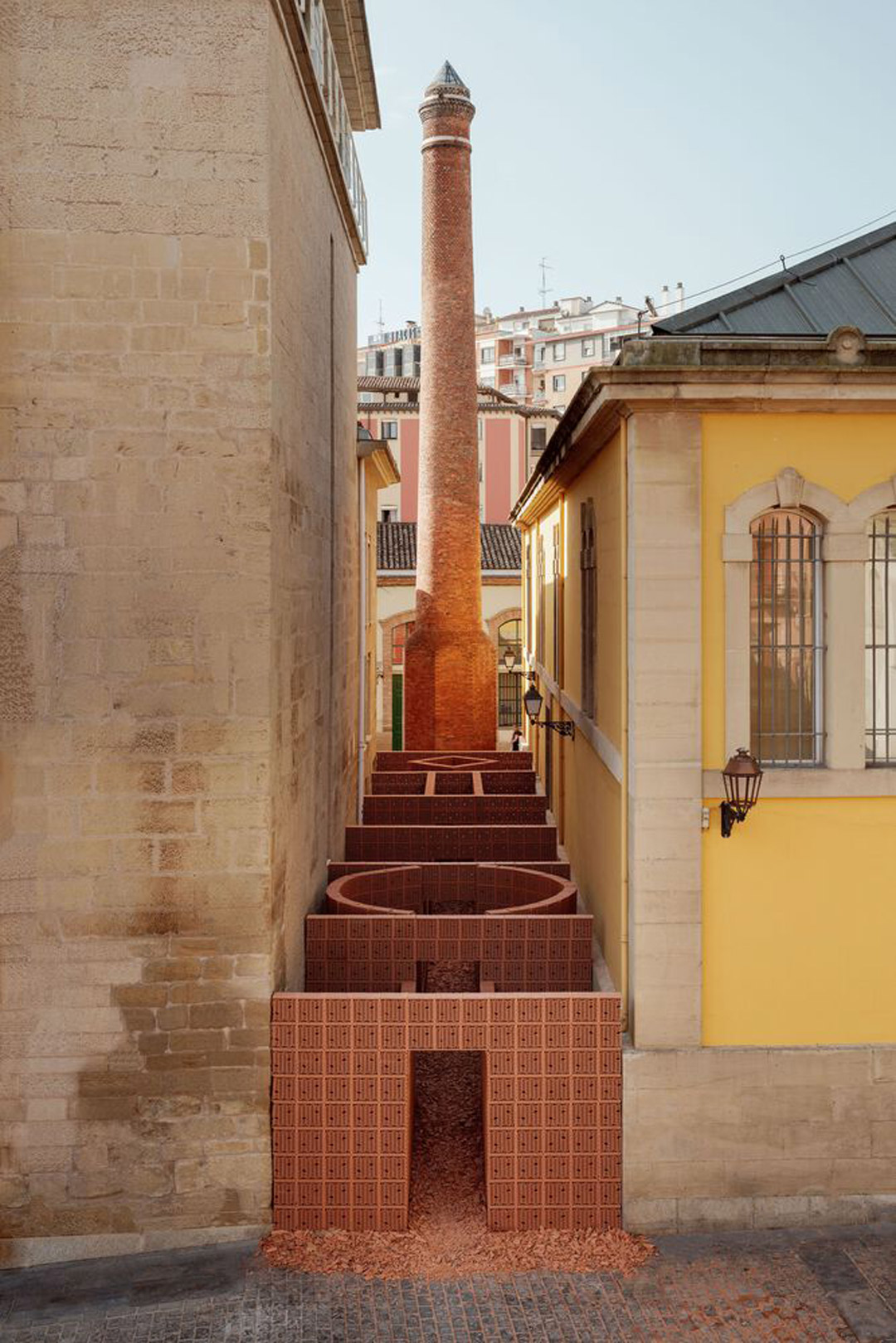
In early September, visitors who strolled down the laneway leading to the historic tobacco factory of La Rioja in Spain were confronted by a new experience – albeit one that played on notions of familiarity. Overlooked by the factory’s imposing red-brick chimney, the narrow space that trails between two buildings was filled with a procession of small corridors and rooms that mimicked the volumes of a typical house. Set within a grid of 3.6-metre squares, the rooms were traced out by domestic-scaled walls, put together with interlocking terracotta-coloured bricks that appeared to glow in the warm autumn sun.
Given the name Tipos de Espacio (translating to ‘Types of Spaces’), the temporary exhibit was created by two design offices, Palma from Mexico and Madrid-based HANGHAR, for the duration of Concéntrico, the international architecture and design festival of Logroño. This year marked the seventh edition of Concéntrico in Logroño, the capital of La Rioja, and Types of Spaces was just one of the many highlights that continued the festival’s mission: to form a dialogue between the city, its heritage and the rise of contemporary architecture.
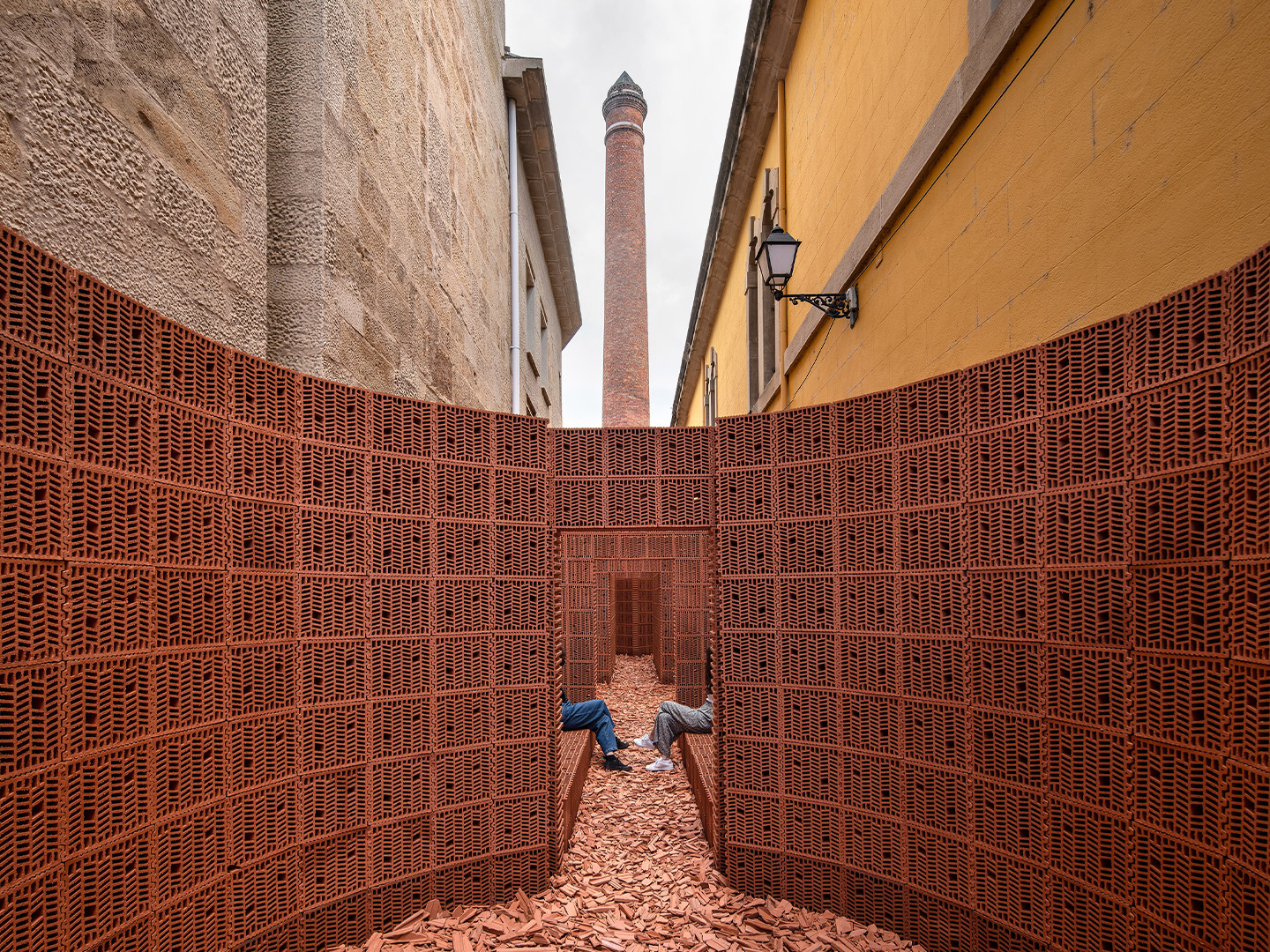
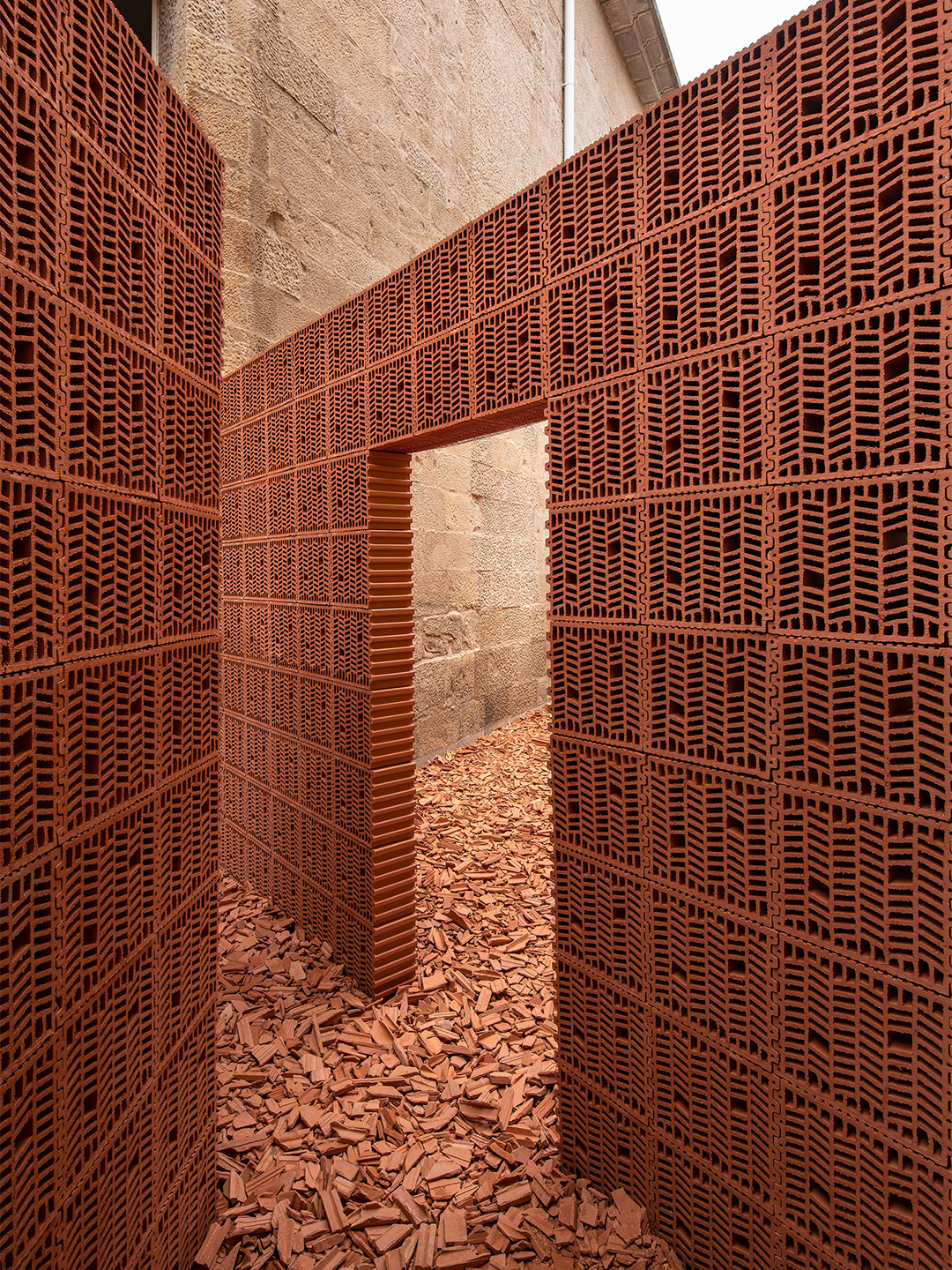
‘Types of Spaces’: a temporary exhibit in the Spanish city of Logroño by Palma + HANGHAR
Since its inception in 2015, the ambitious festival has invited visitors to experience the city through installations, discussions, activities and exhibitions that pull focus on public space and places of coexistence – a theme that’s all the more relevant during pandemic times. Each year the guest designers place particular emphasis on the sustainability of the materials and processes they use in their presentations.
With its roof-less rooms, the Types of Spaces exhibit was tasked with exploring various spatial possibilities through the “emphatic geometries” of its plan. The domestic scale of the rooms, described by the designers as feeling “alien” in the public realm, was intended to transform the occupant from casual visitor to inhabitant. Acting as a reminder of the exposed nature of the intervention, a light water mist was sprayed on guests intermittently. “This allowed a more profound interaction with the installation,” the design team say.
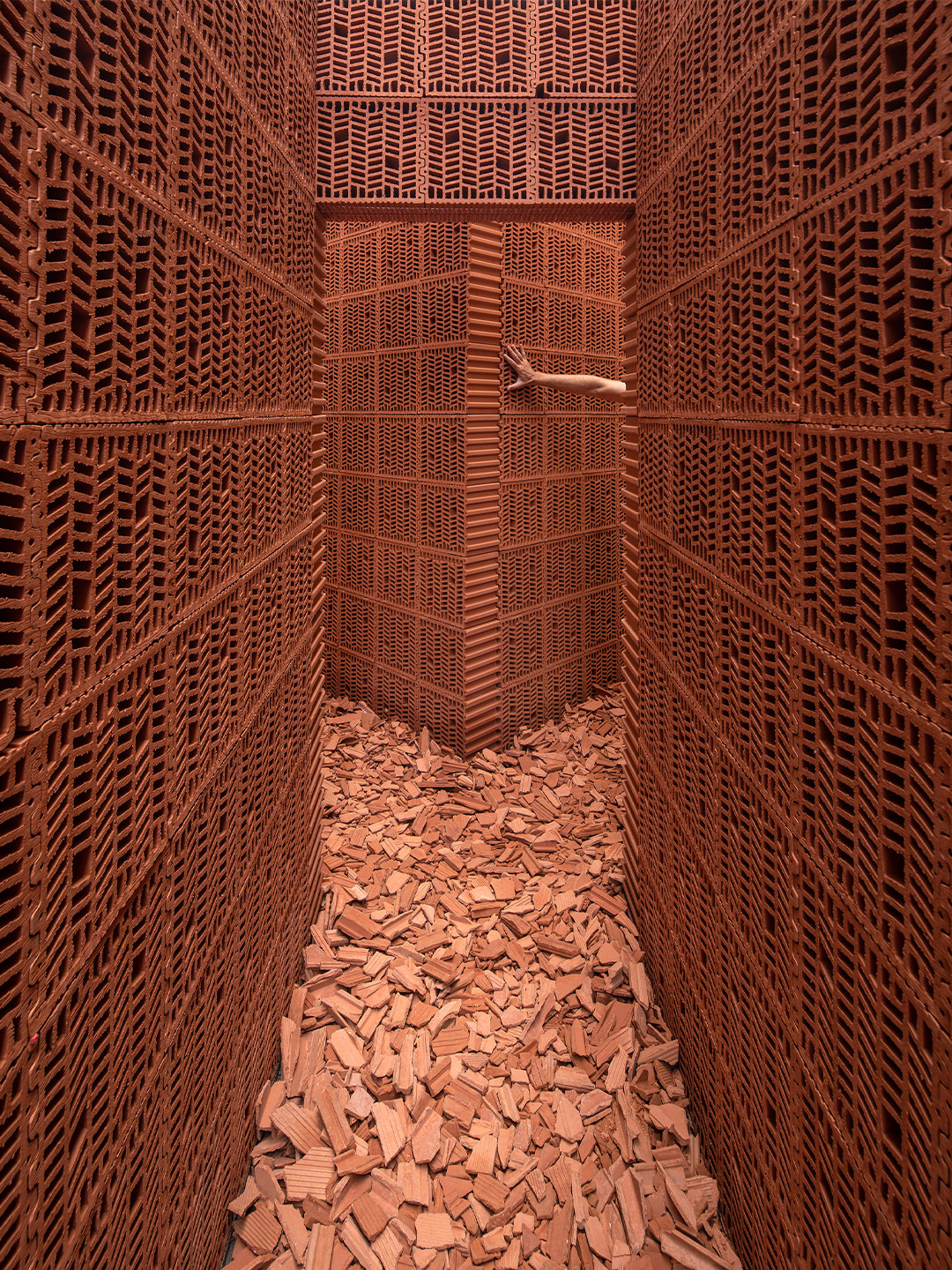
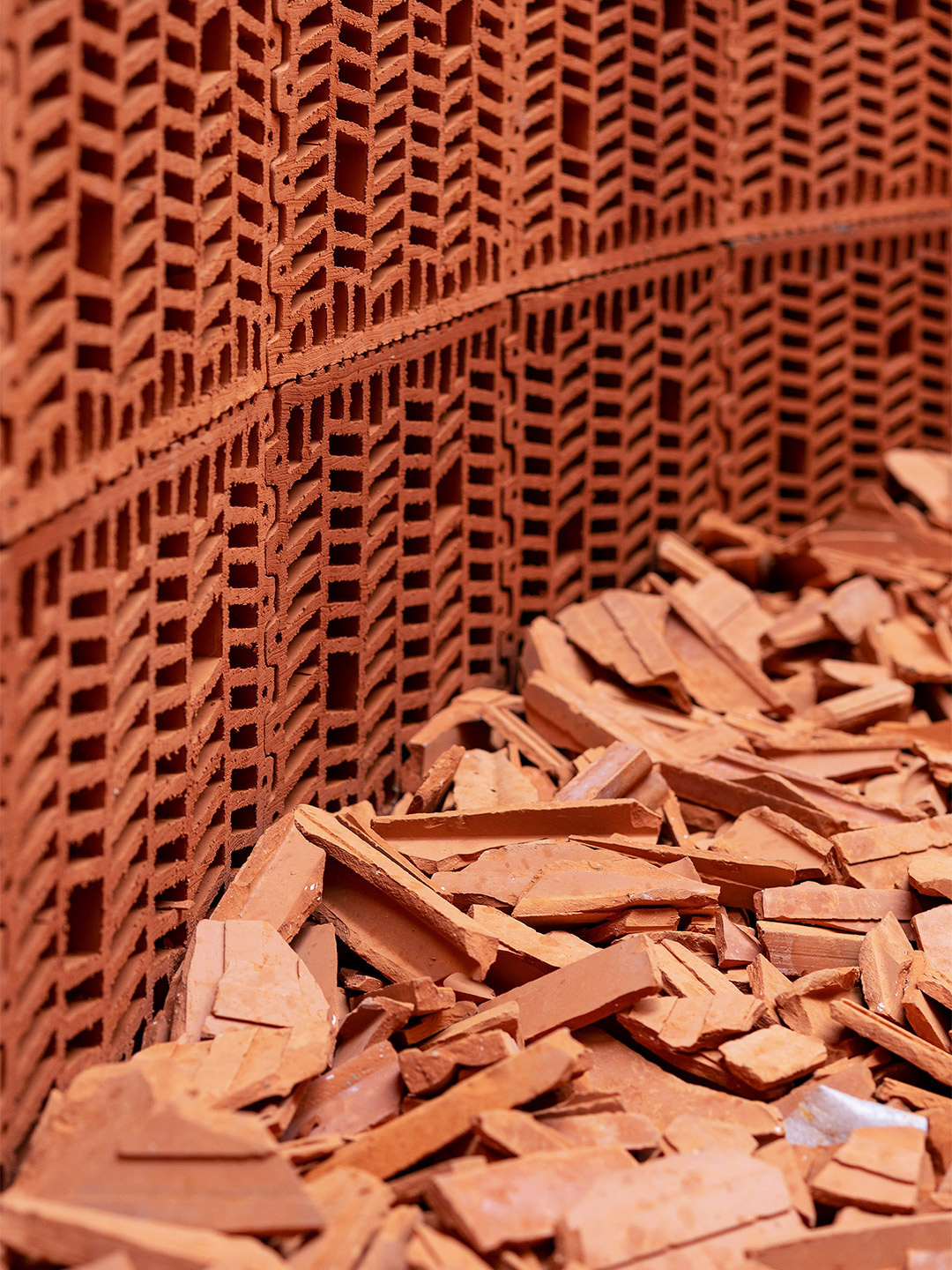
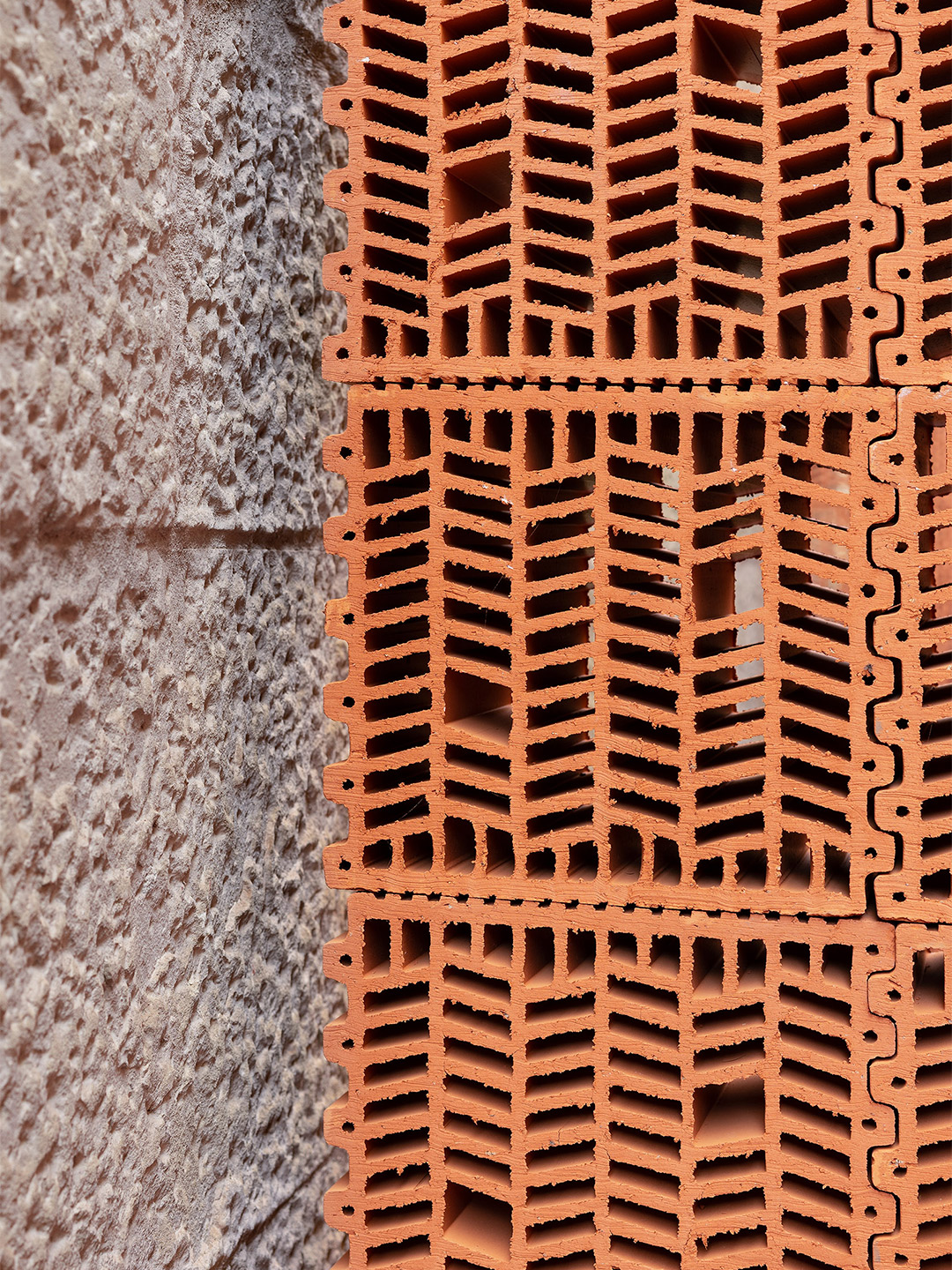
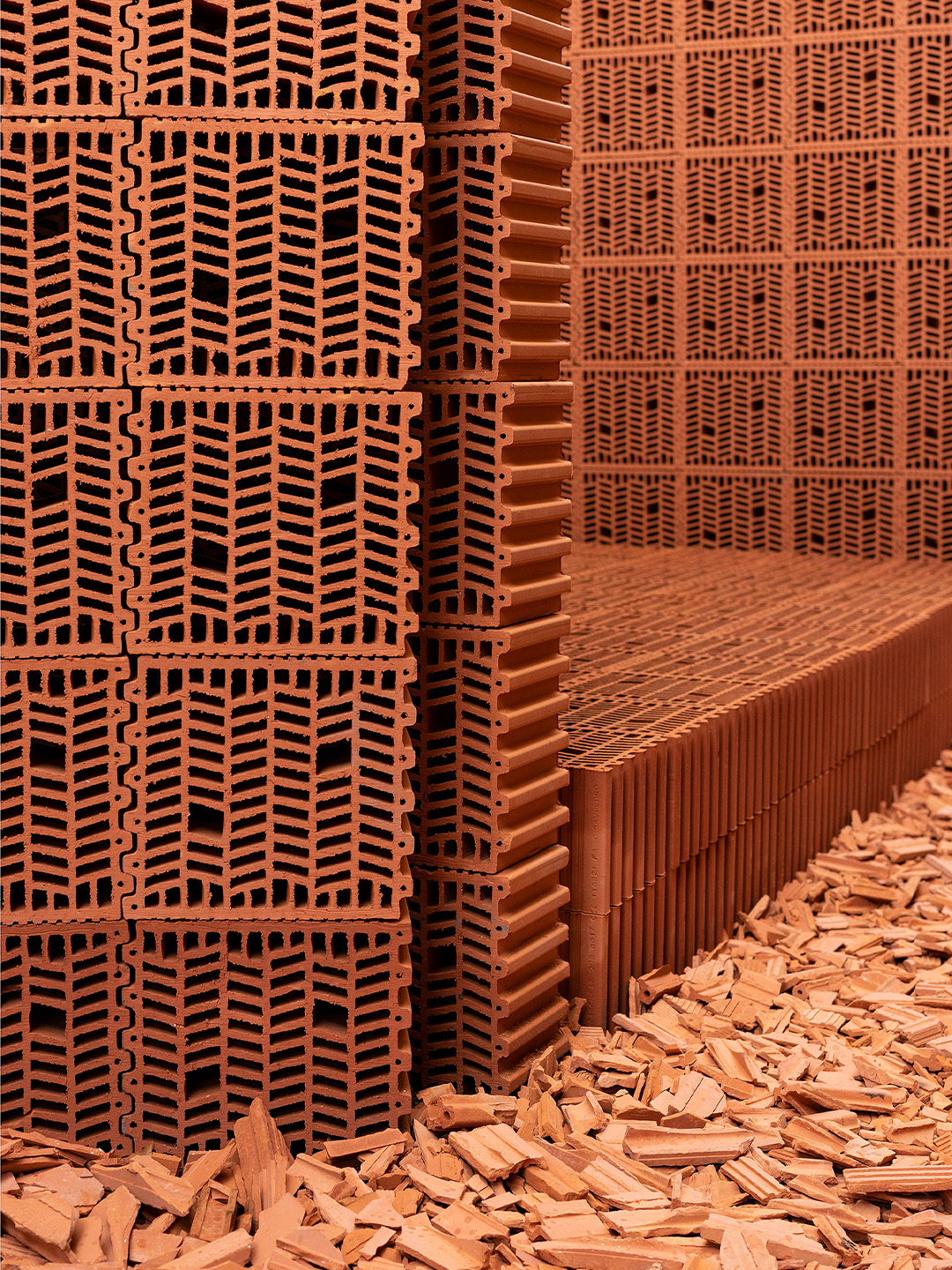
The “programmatically generic but spatially specific” areas of the installation were built with square-format thermo-clay bricks. When combined with the scale of the volumes, this everyday material gave the project its visually familiar condition. “Moreover, the brick block is both the material and spatial unit of the project,” the designers explain. They add that the bricks generated a system “with a stereotomic appearance capable of veiling its tectonic logic” which they say was made possible by the “massiveness” of the 300mm-square pieces.
The floor of the installation, carpeted with broken pieces of discarded bricks, gave the exhibit a sense of material continuity. But the gentle crunchiness underfoot was also a way to slow down the walking pace of those who passed through, allowing them more time to consider an often overlooked part of Logroño, and enjoy the experience “away from the hustle and bustle of the city,” the designers conclude.
palma-mx.com; hanghar.com; concentrico.es
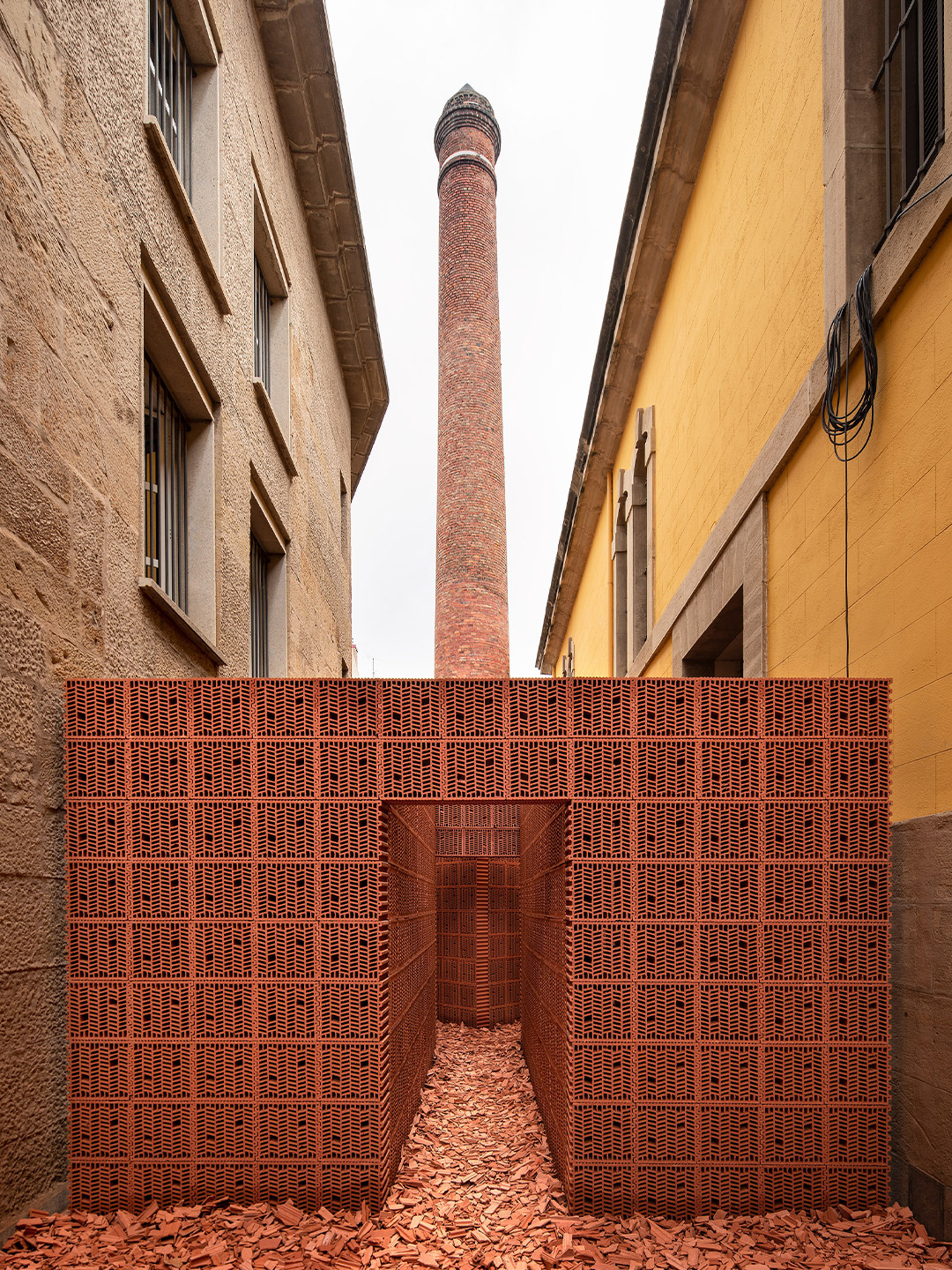
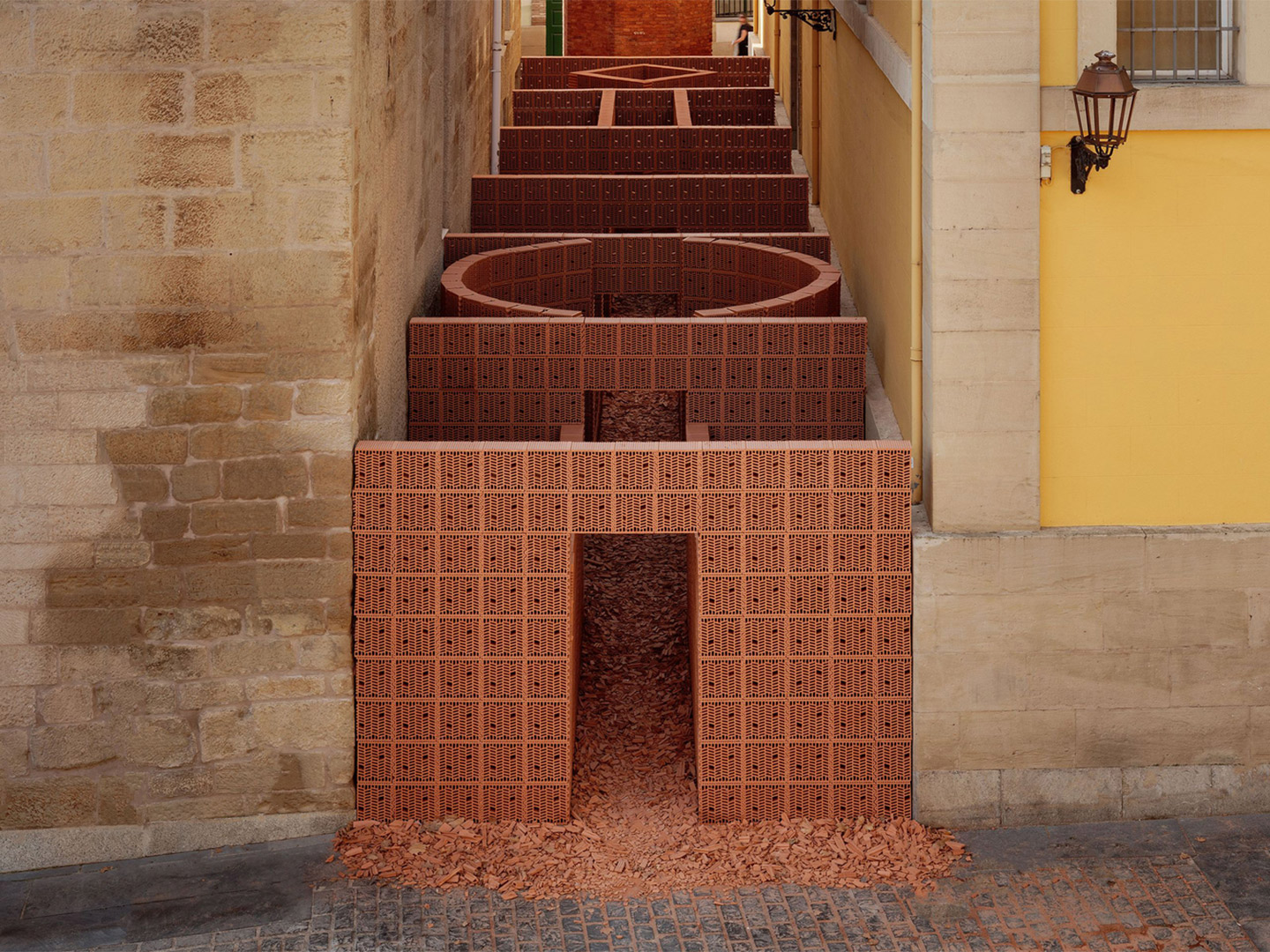
The domestic scale of the rooms, described by the designers as “alien” in the public realm, was intended to transform the occupant from casual visitor to inhabitant.
Catch up on more architecture, art and design highlights. Plus, subscribe to receive the Daily Architecture News e-letter direct to your inbox each week.
Related stories
- Adam Goodrum stamps all-Australian style on new breezeblock design.
- Bitossi celebrates centenary in Florence with new museum and 7000-piece display.
- Casa R+1 residence in southern Spain by Puntofilipino.
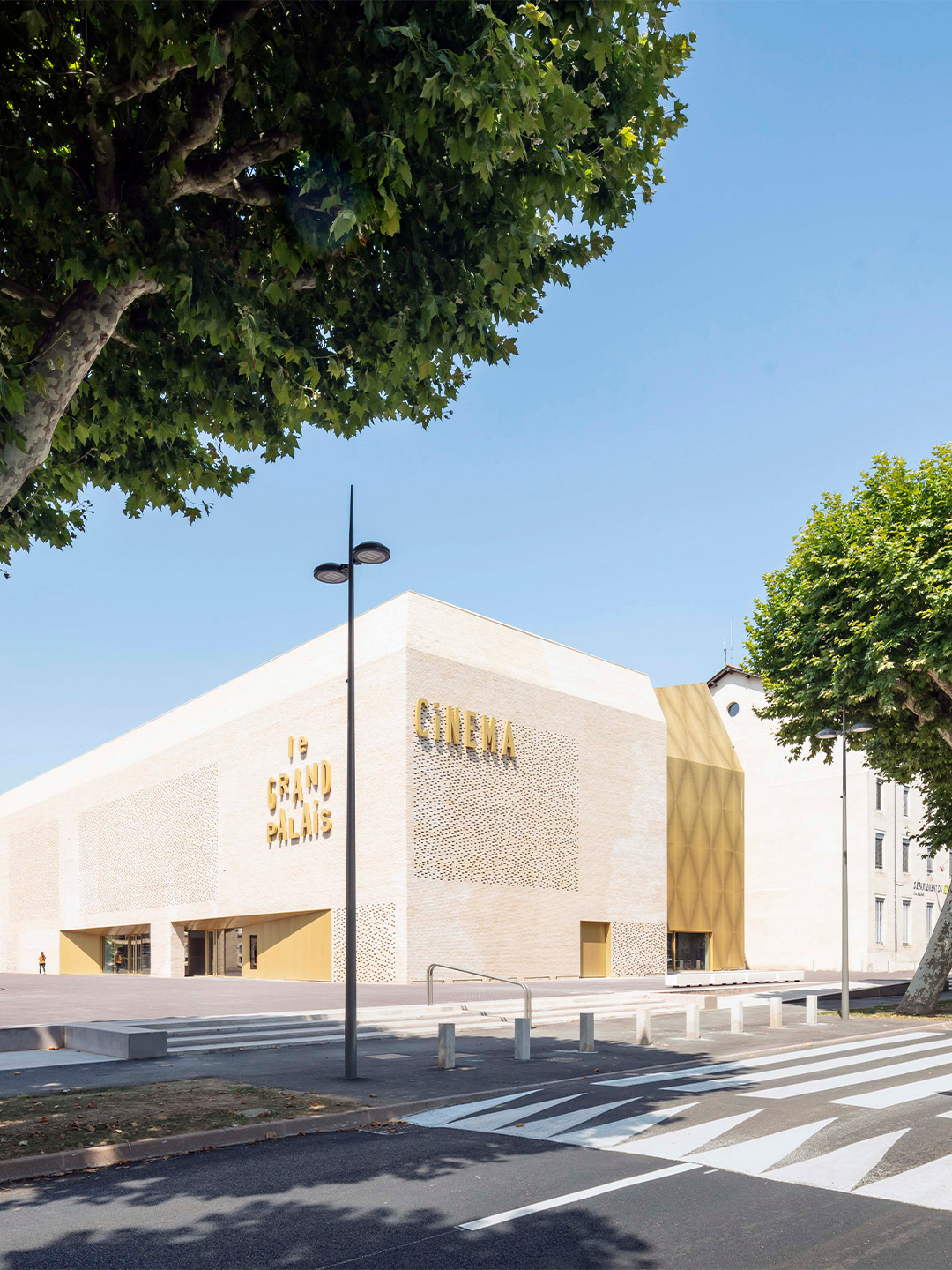
In the south of France, Cinéma Le Grand Palais is a new addition to the historic village of Cahors. Located to the north of the township’s centre, just a few steps away from the banks of the magnificent Lot River, the cinema complex joins a precinct with a storied past; an ensemble of buildings that were originally used as a convent, then later employed as a military base. After a fire in 1943 left the east wing of the complex in ashes, the then vacant space between the remaining buildings – now the site of the cinema – became a poorly defined parking lot.
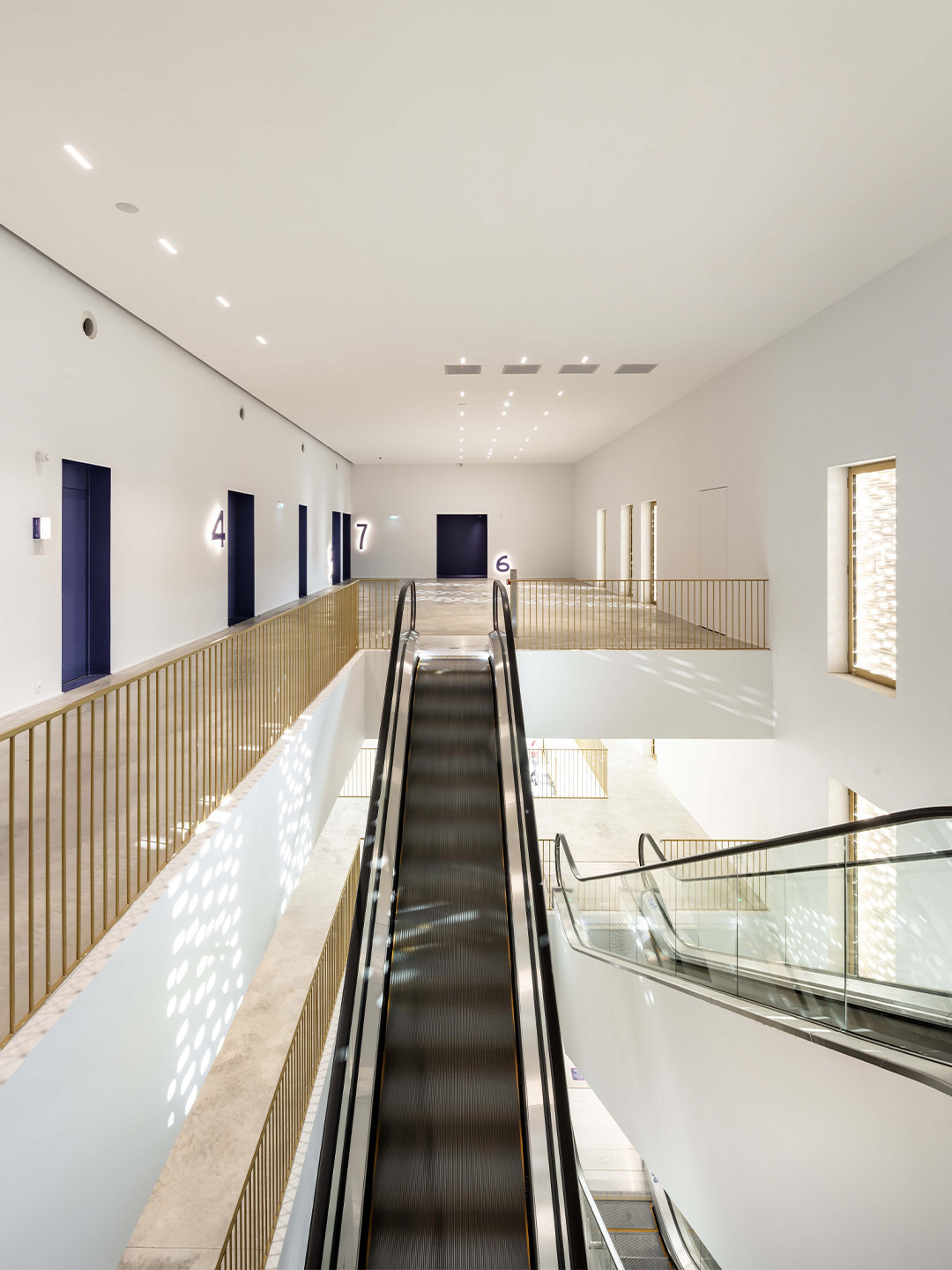
When designing Cinéma Le Grand Palais, the team from Antonio Virga Architects looked to the existing buildings and their surrounds for inspiration. In particular, a commonality that was shared between each of the structures on-site. “All of the buildings were organised according to a rigorous set of planning rules, in accordance with 19th-century design practices for military and public facilities,” say the architects. To properly restore the scale of this ensemble, where the new cinema filled a long overlooked void, the group of spaces was treated with “great simplicity,” they add. “With a coherent choice of materials, furniture and plantations.”
Cinéma Le Grand Palais in Cahors by Antonio Virga Architects
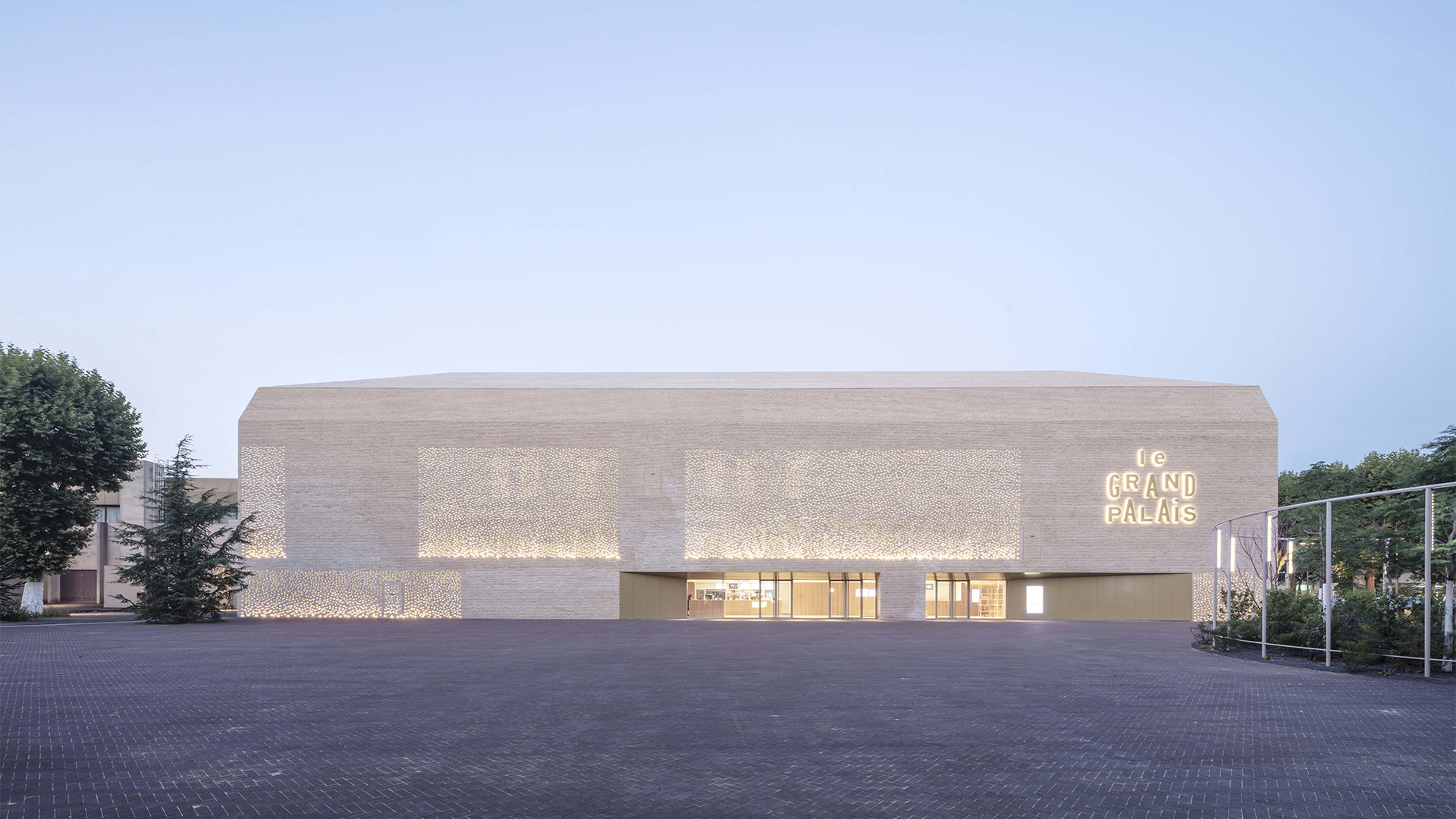
Taking full advantage of the existing elements, such as the buildings, trees and sightlines, the architects reveal that the basis of the project was to find the “lost urbanicity” that the site once had or could have. They explain: “It was important to have a timeless architectural expression, so that [the cinema] would not stand as just something new in the old, but as something that would connect strongly with the existing, maybe as if it had been there for a long time – avoiding all pastiche or faux vieux.”
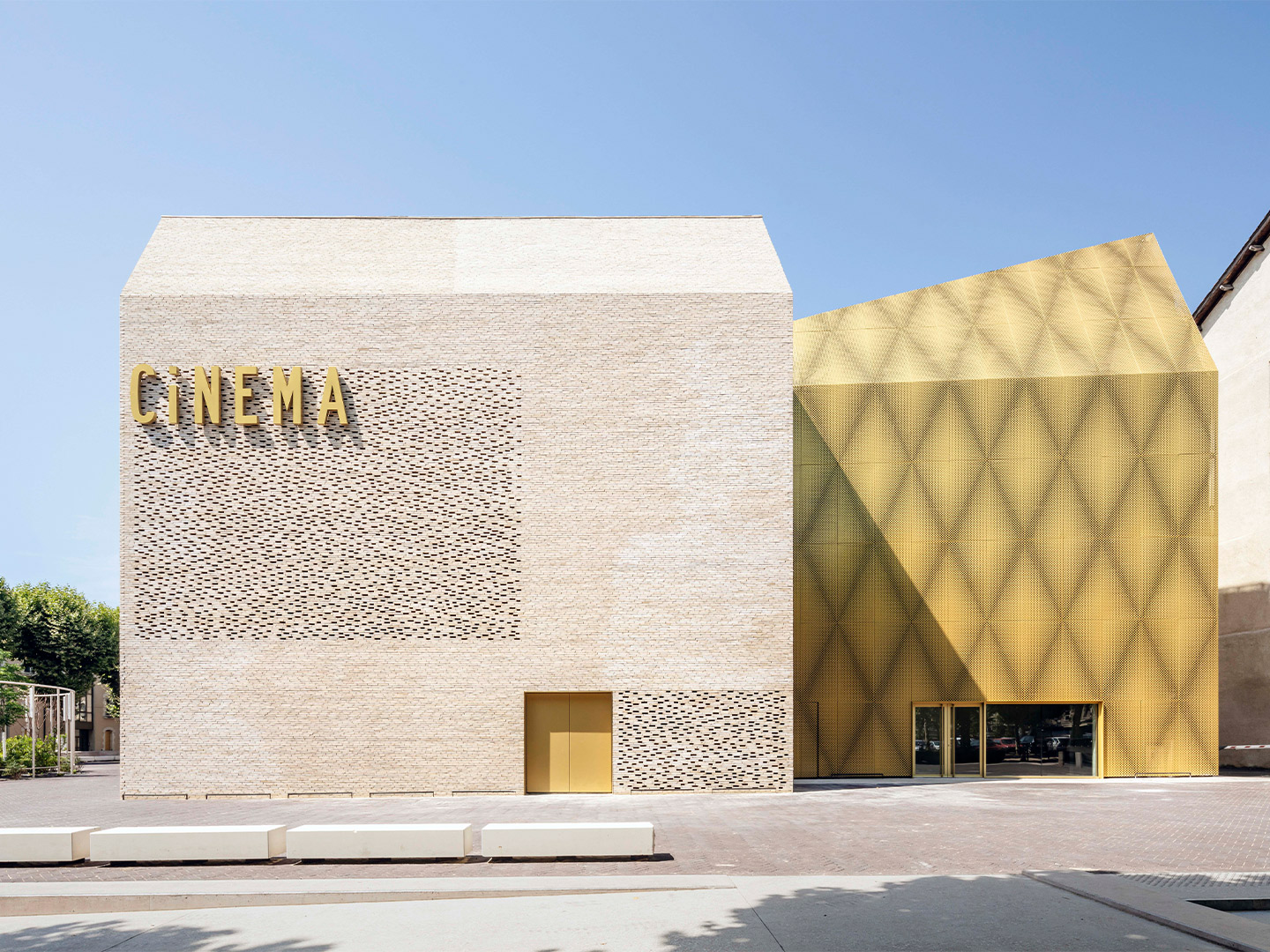
To achieve this sense of understated newness, the brick volume of the cinema mirrors the volumes of the existing buildings, reinterpreting their materiality with new-generation masonry products. “We wanted to use a material that would blend well with the materials of old Cahors,” say the architects. Brick is commonly used in the traditional architecture of Cahors – visible, for example, on the facade of the nearby church of Saint Barthelemy – and thus functions as an obvious link between the new architecture of the cinema and that of the old town.
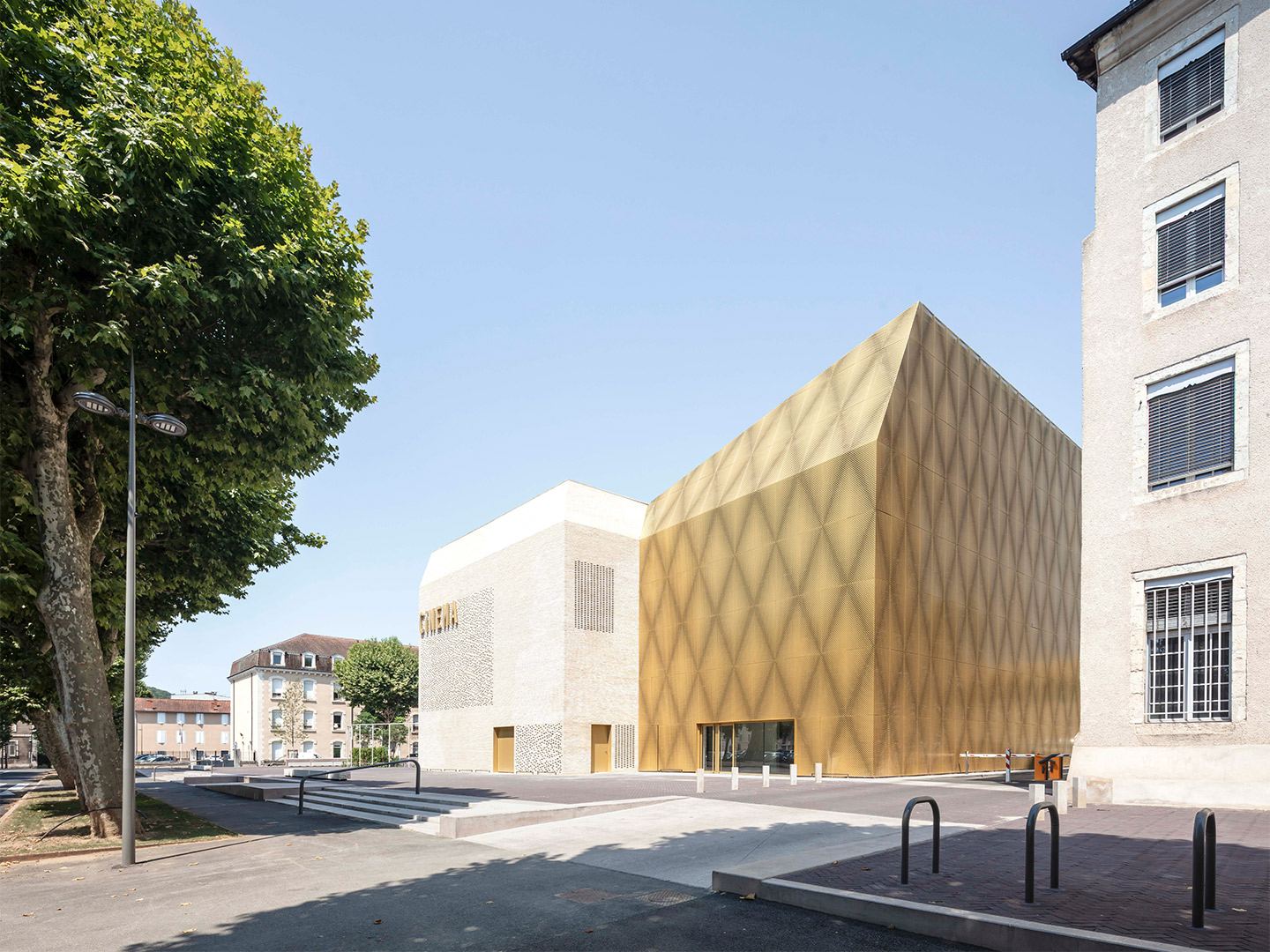
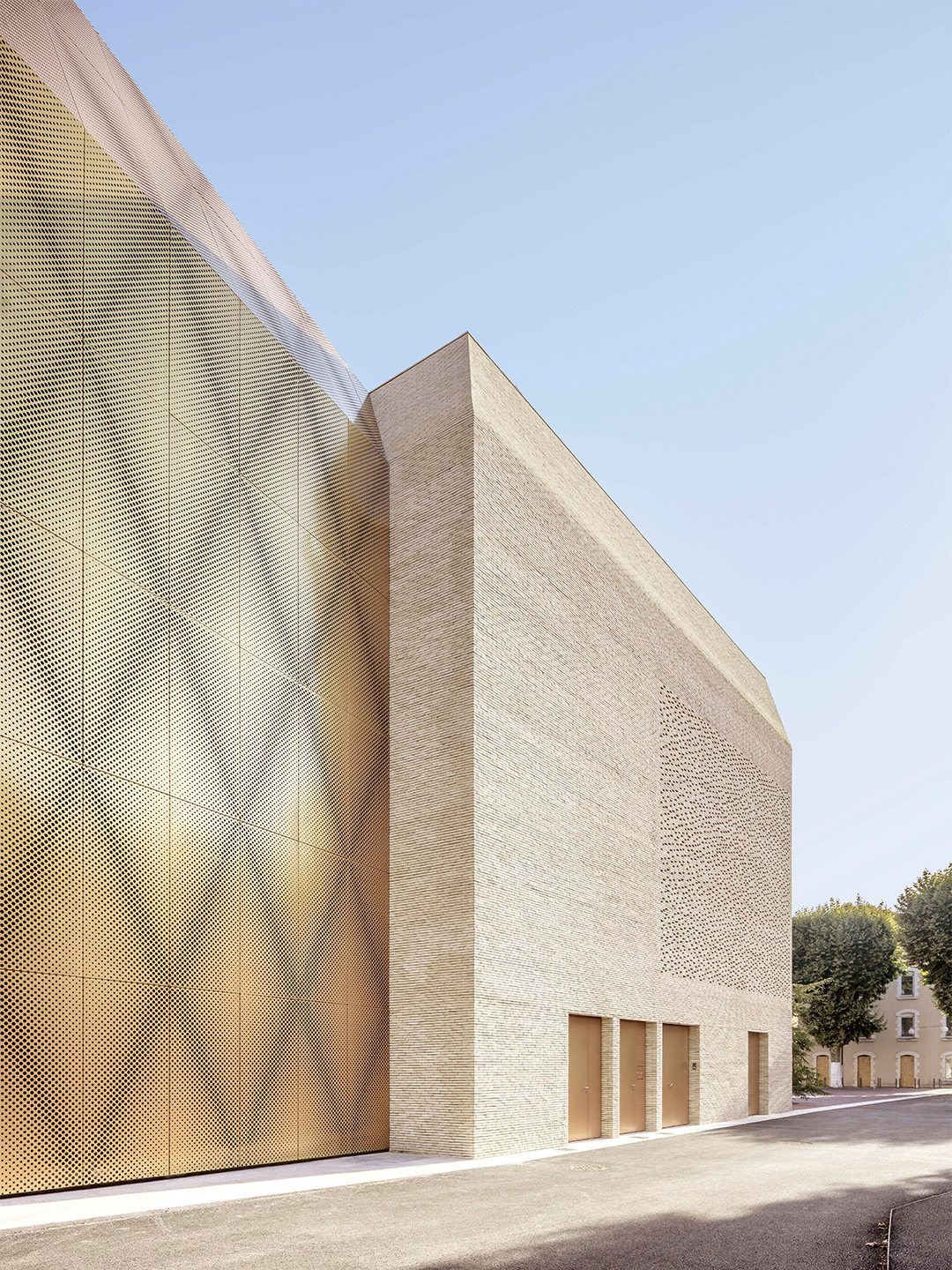
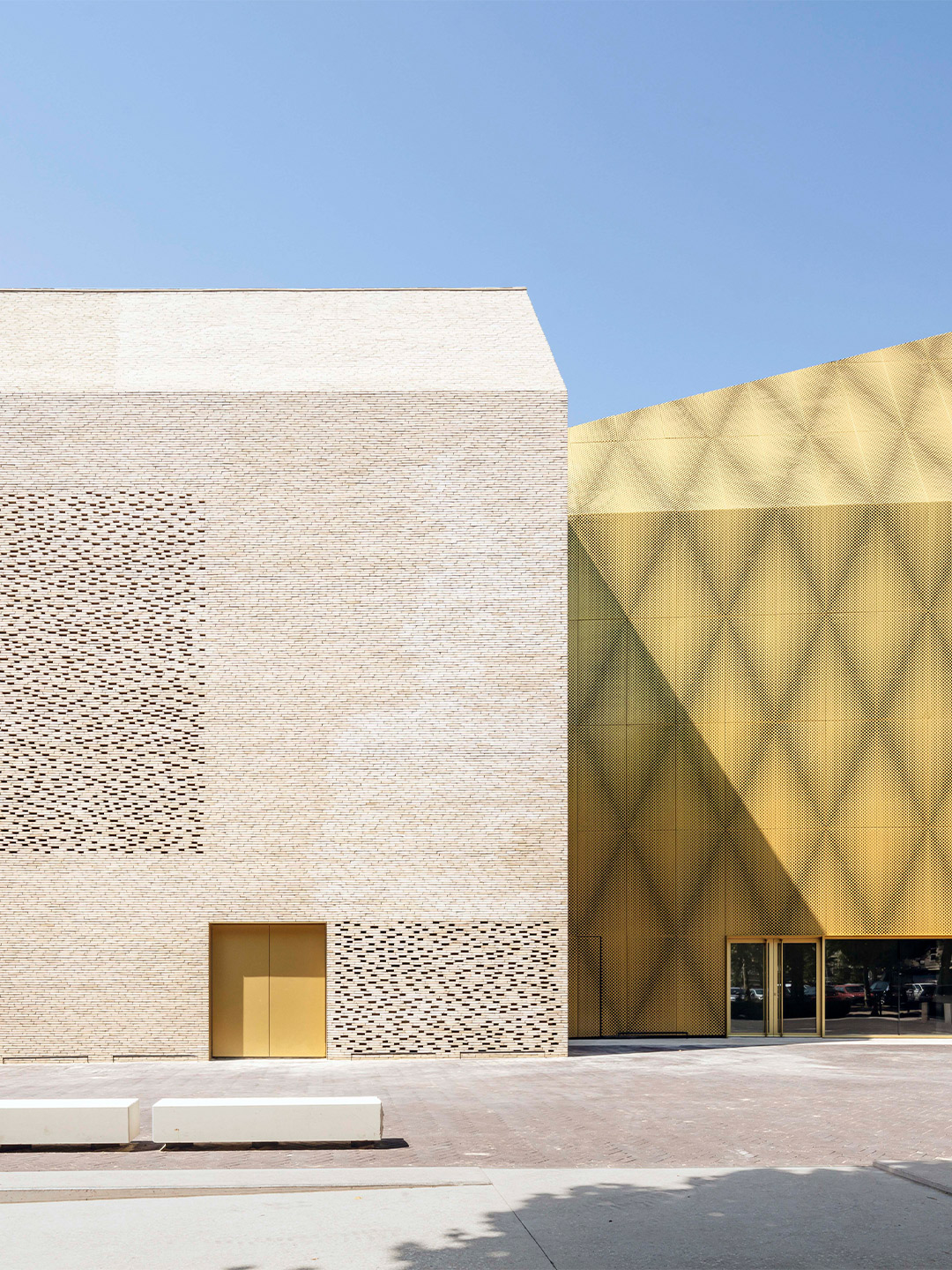
“We also chose a [brick] colour that is reminiscent of the natural stone of Cahors,” the architects add. Again, this was something new that was sympathetic to the existing architectural fabric, yet it gave the building a contemporary edge. Especially in the way the pale-coloured bricks were put to use with patches of perforated brickwork replacing standard windows. “The building was designed as a virtually windowless volume, all covered in brick – including its roof,” the team say. “We wanted to use this traditional material in an inventive and surprising way.”
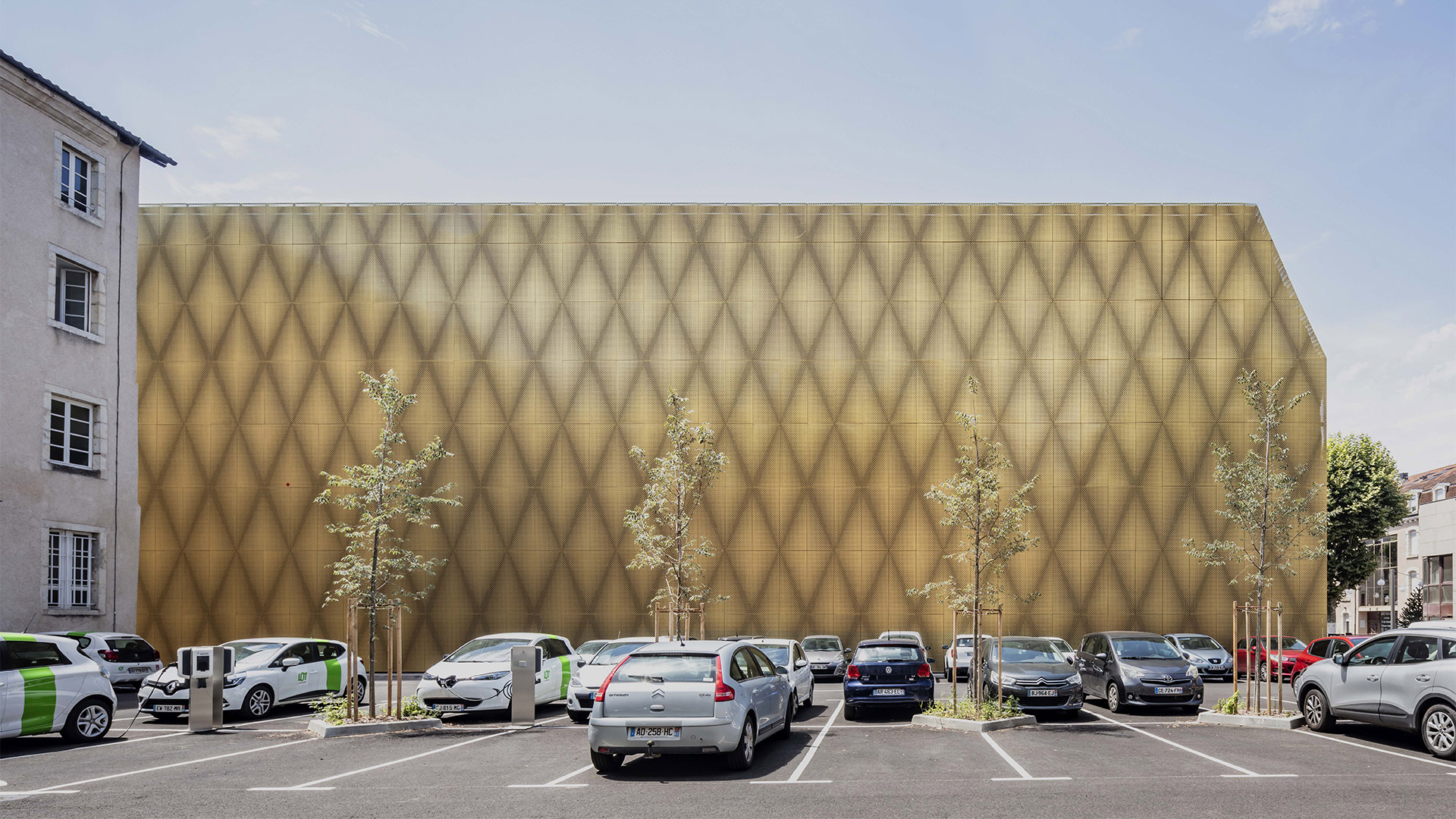
The desired program of Le Grand Palais (a cinema with seven rooms) was always going to be larger than the area made possible within the brick building, so the team at Antonio Virga Architects needed to make it bigger. This was achieved via a glimmering gold-panelled annexe. “To not lose the symmetry created by copying the older buildings, we opted for this false extension,” the architects explain. “A second building [wrapped] in golden metal – a material that, again, blends well with the colours of Cahors.” Just like the brick building, the so-called “false extension” is a totally new structure. It’s considered by the architects to be “more flagrant” than the first, but it’s also more hidden from certain viewpoints, positioning the cinema complex as an architectural jewel and cultural gem just waiting to be discovered.
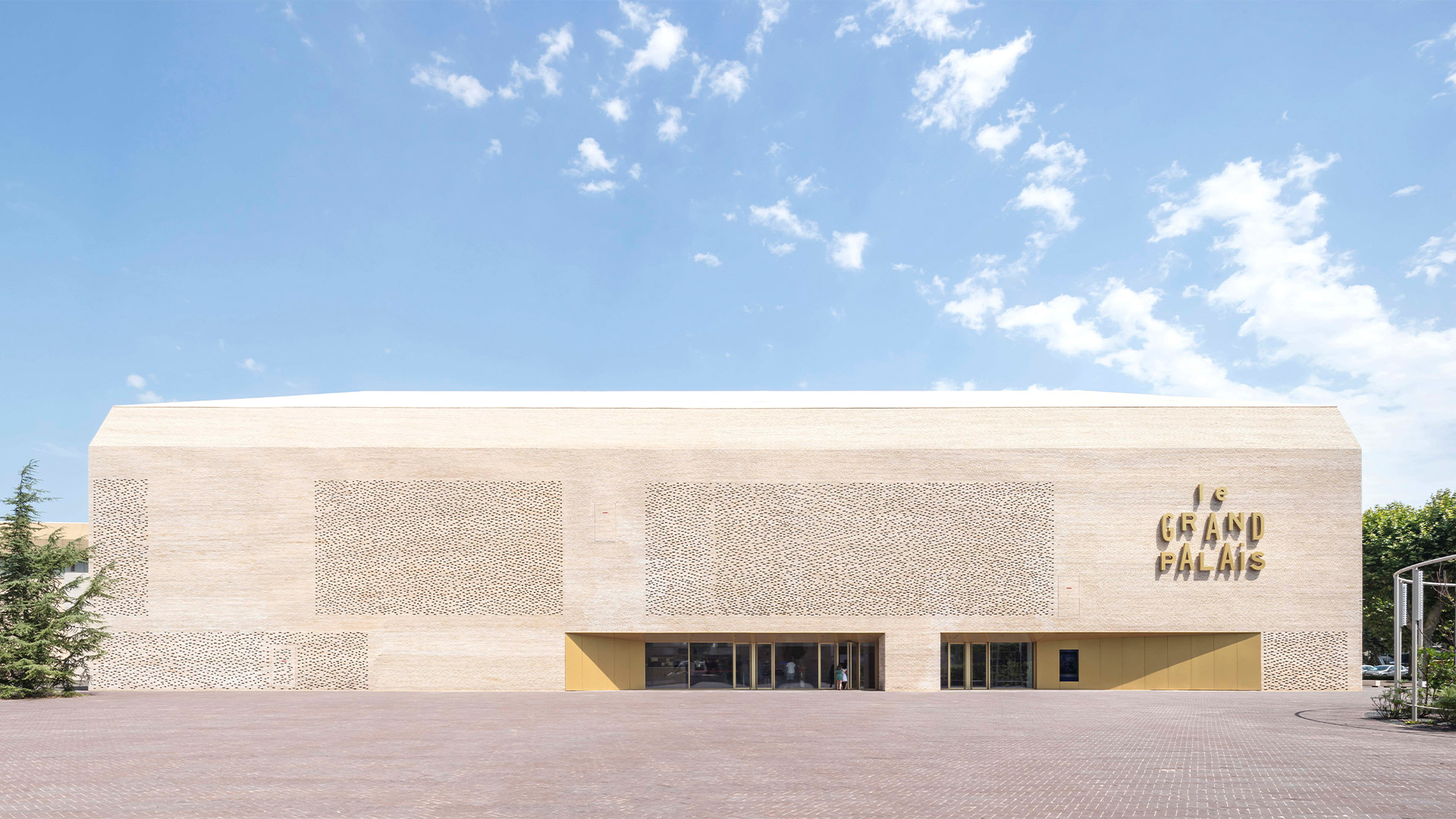
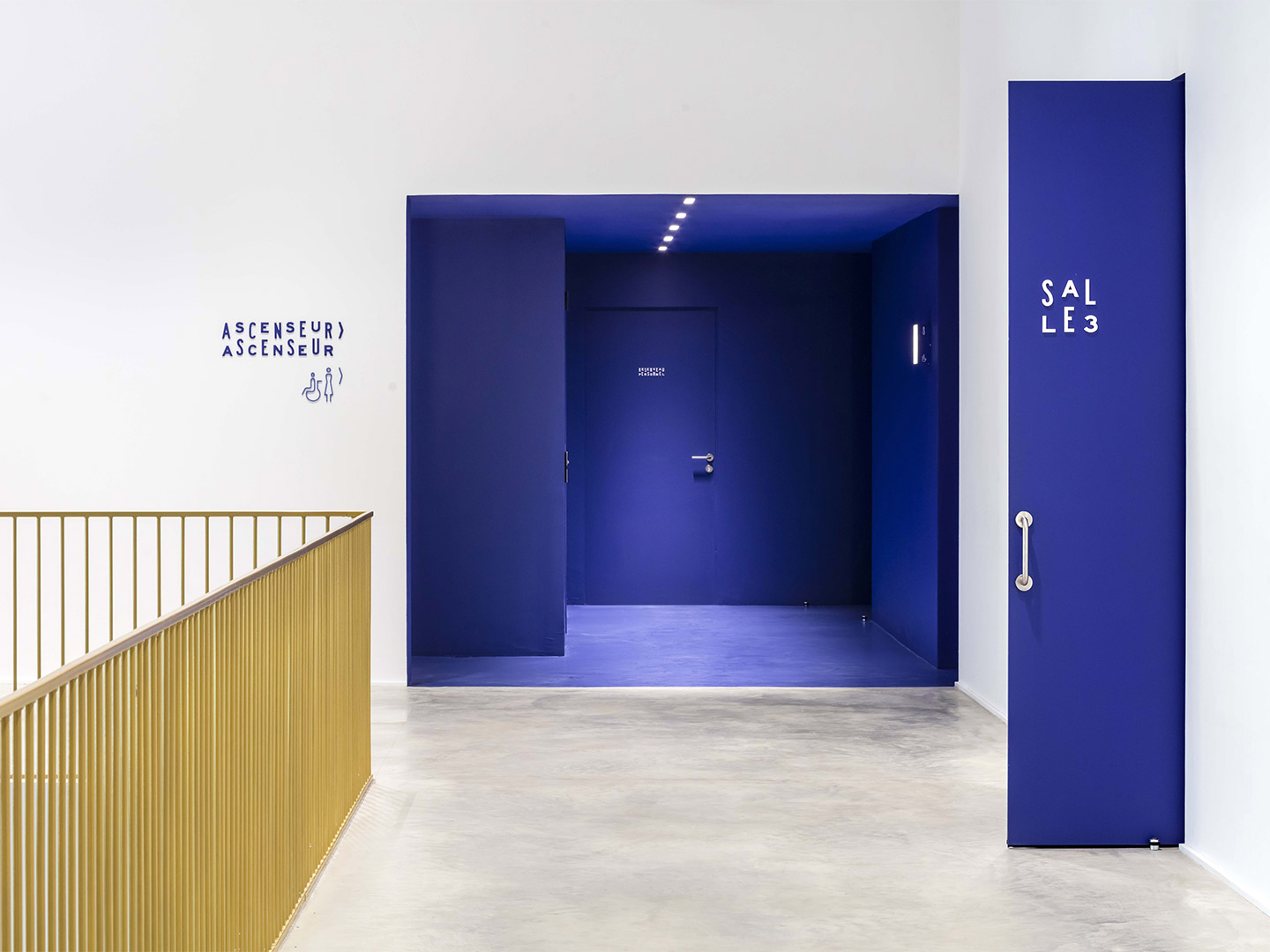
It was important to have a timeless architectural expression … maybe as if it had been there for a long time.

Catch up on more architecture, art and design highlights. Plus, subscribe to receive the Daily Architecture News e-letter direct to your inbox.
Related stories
- Venus Power collection of rugs by Patricia Urquiola for cc-tapis.
- Bitossi celebrates centenary in Florence with new museum and 7000-piece display.
- Casa R+1 residence in southern Spain by Puntofilipino.
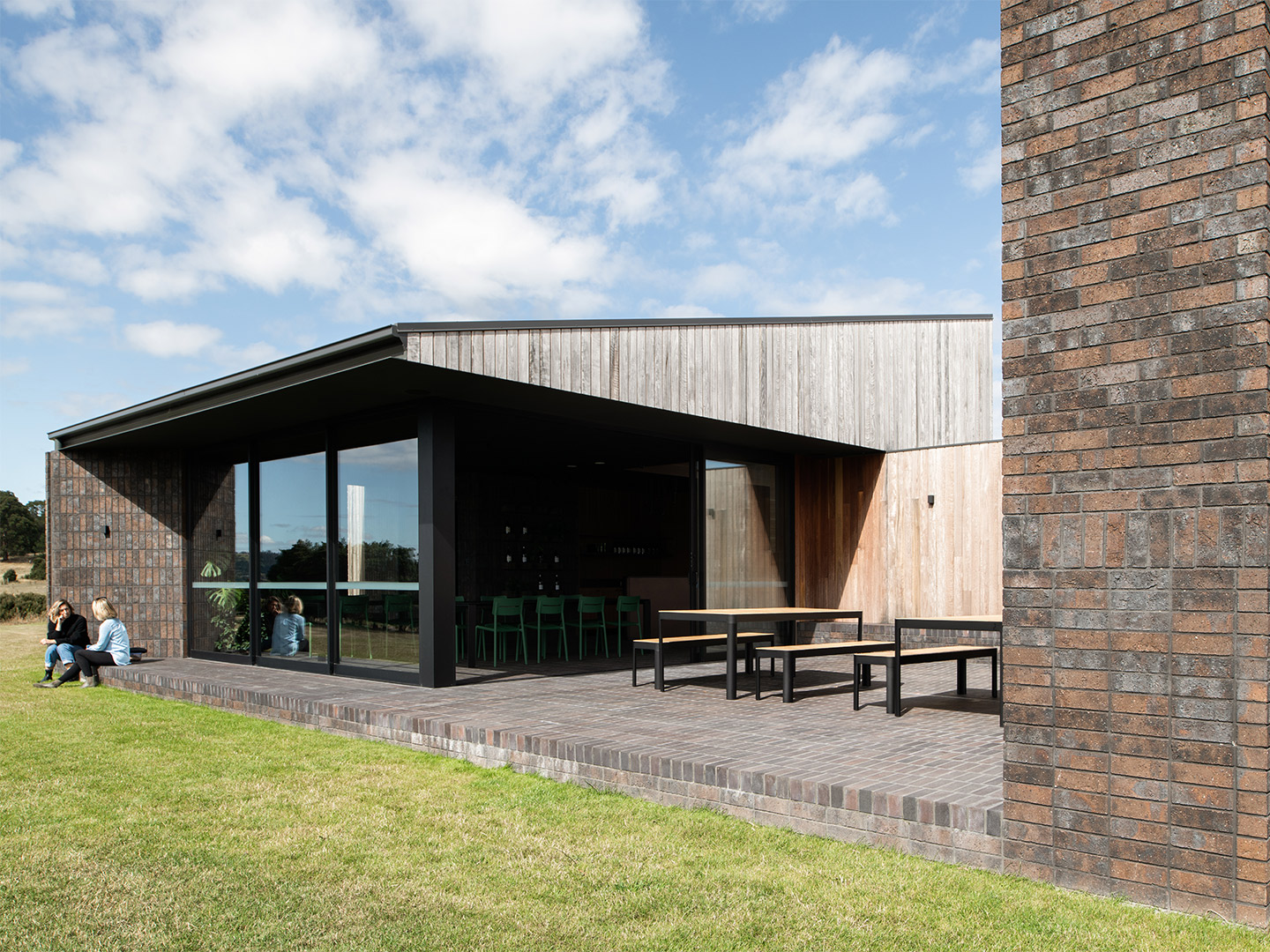
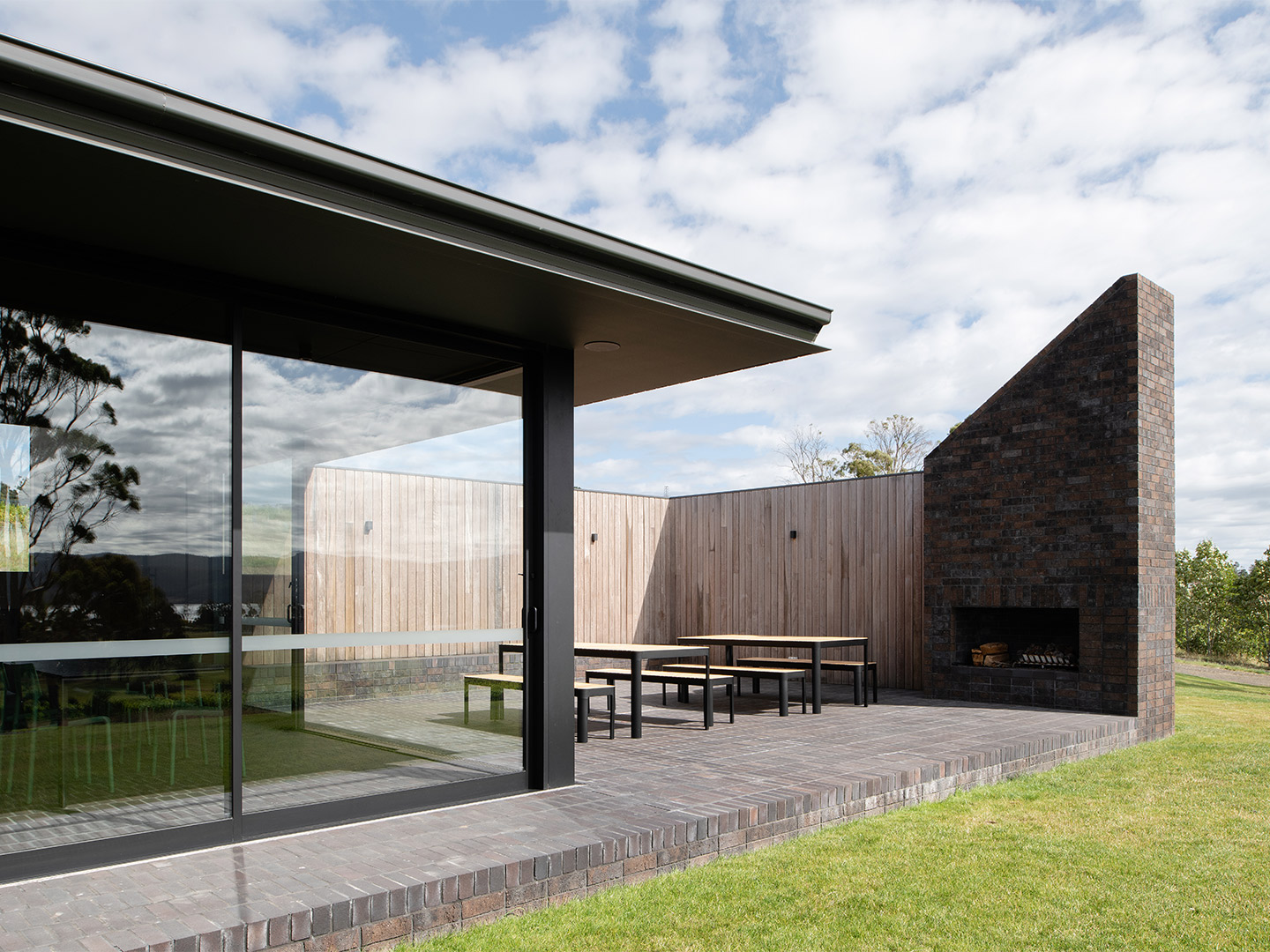
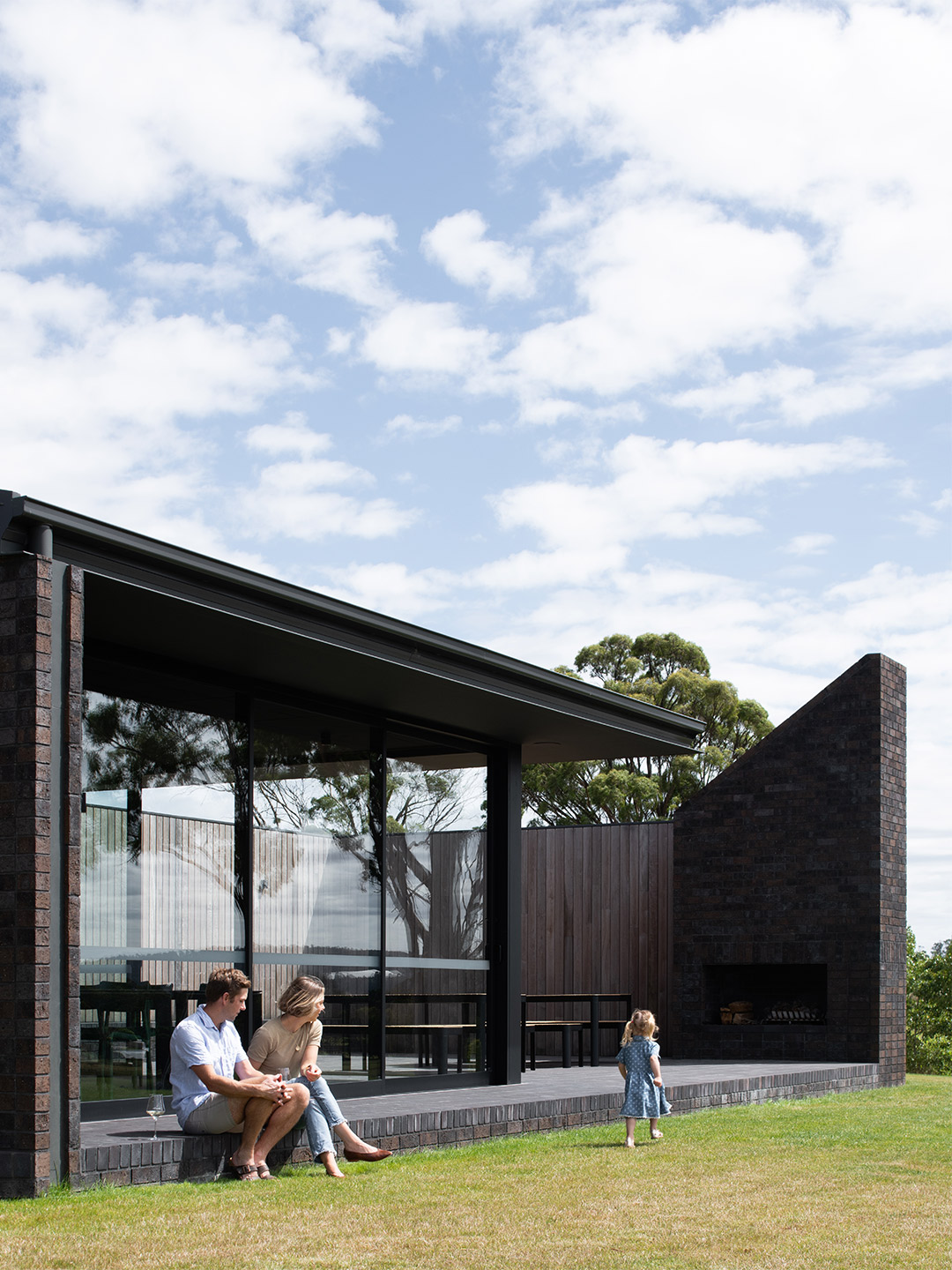
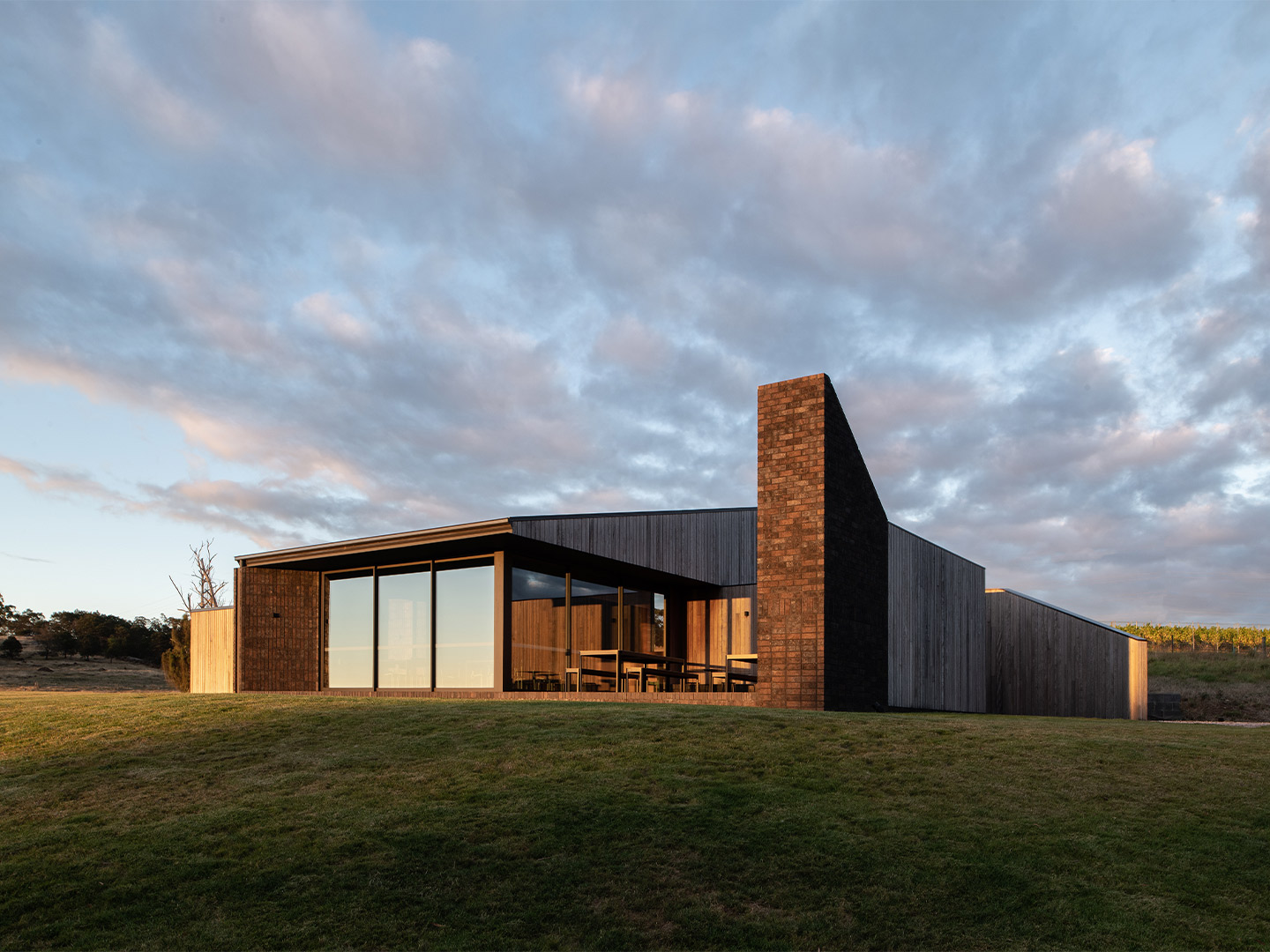
Conceptualised by Cumulus Studio, the new cellar door for Stoney Rise Wine is a sculptural build, where modern forms meet natural materiality. Set in the idyllic township of Gravelly Beach on Tasmania’s Tamar River, it’s an angular architectural arrangement with sloping diagonal features. The project plays with light, casting shadow over the grassy hills that surround the small but striking structure.
Given the awe-inspiring landscape, and the character of the client’s business, the materiality of the project was deeply considered. The team at Cumulus Studio wanted to ensure that the selected material palette for the cellar door was durable and hard-wearing, and that its patina would develop beautifully over time, adding more texture and character to the project.
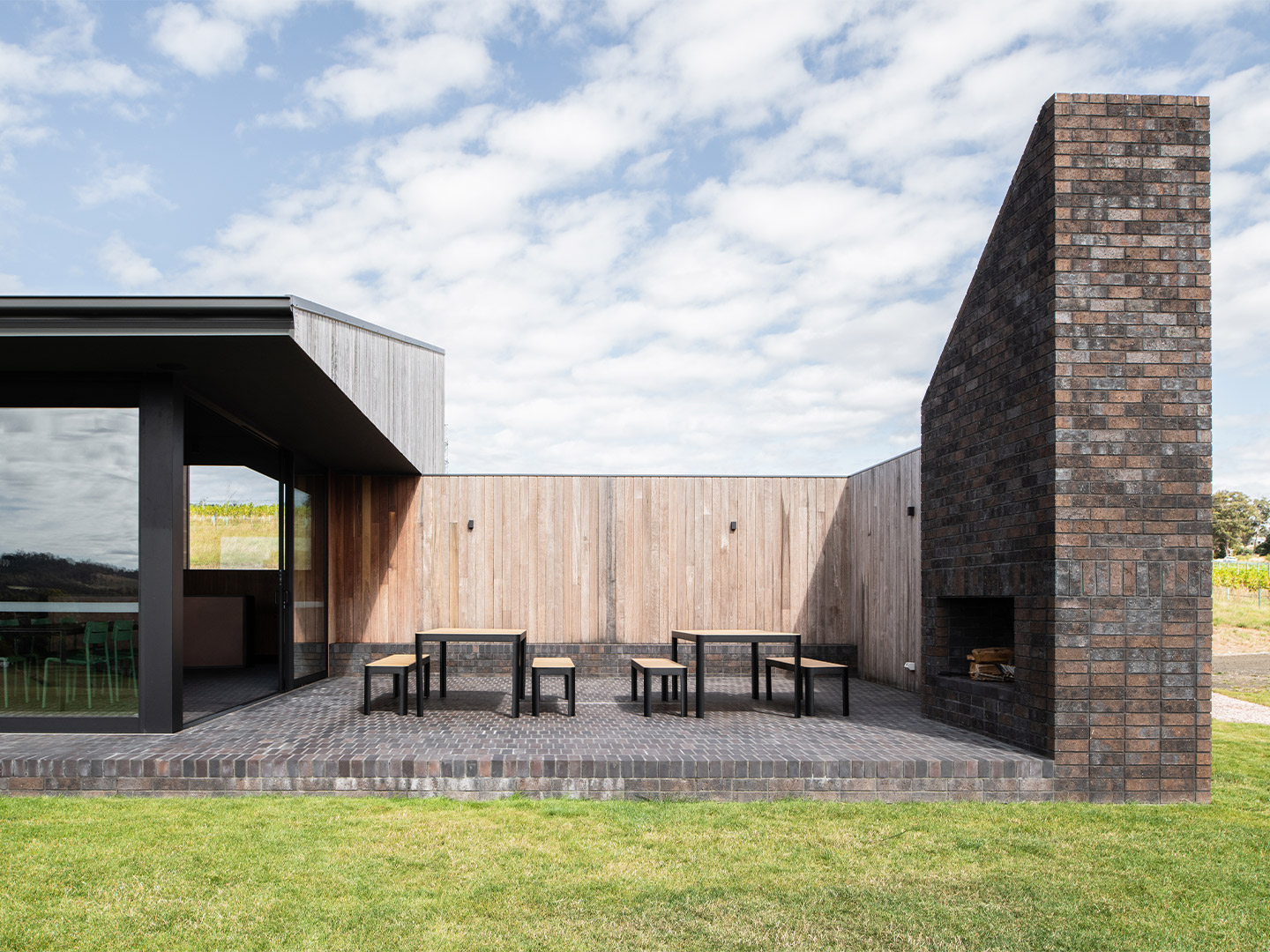
The Stoney Rise cellar door in Tasmania by Cumulus Studio
Since the building stands alone, atop a grassy knoll without any protection from the elements, the materials chosen had to have the wherewithal to withstand any impact from environmental factors. With this in mind, the key materials chosen were brick and concrete, with timber detailing that will silver as it weathers under the Tasmanian sun.
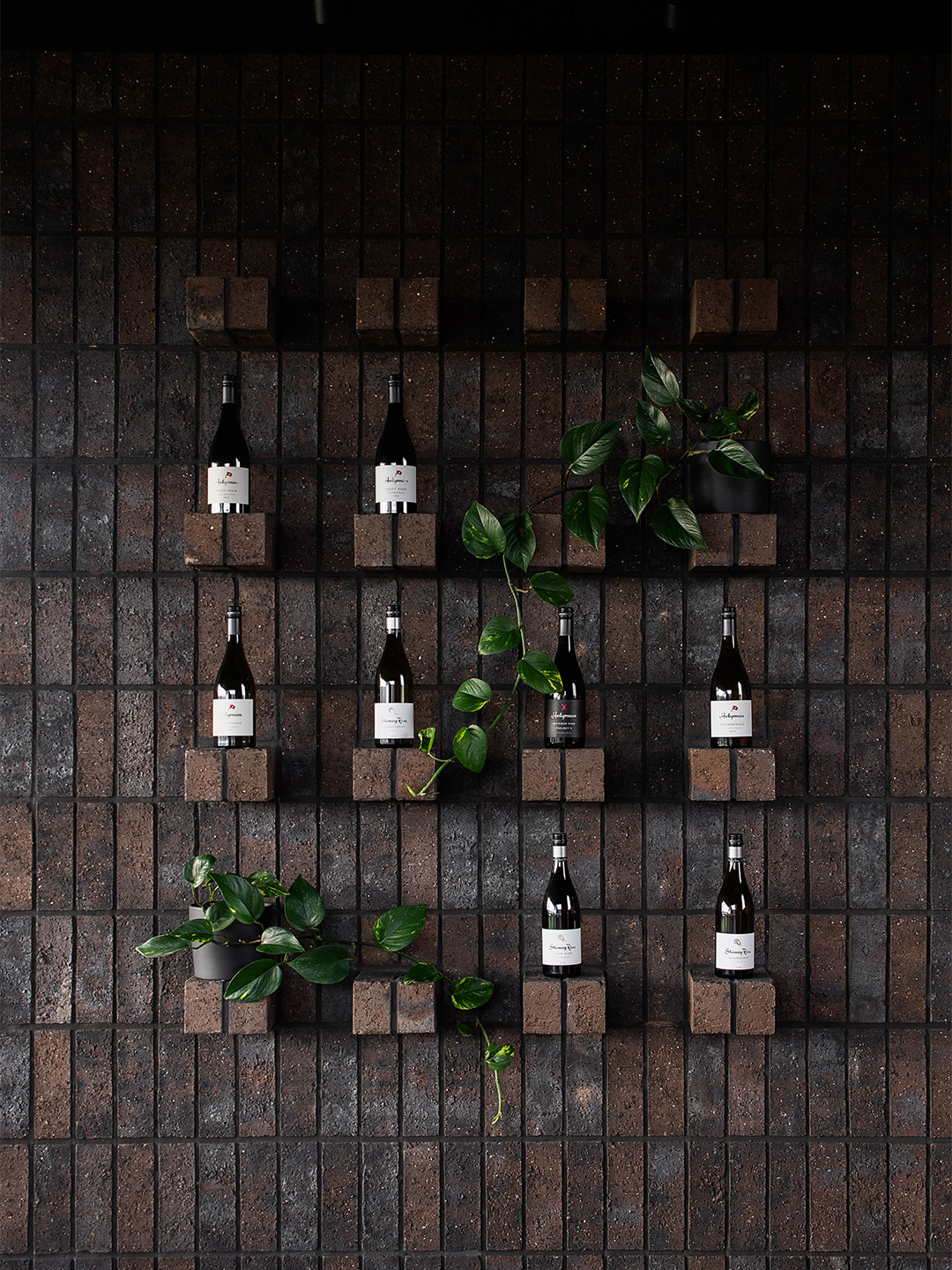
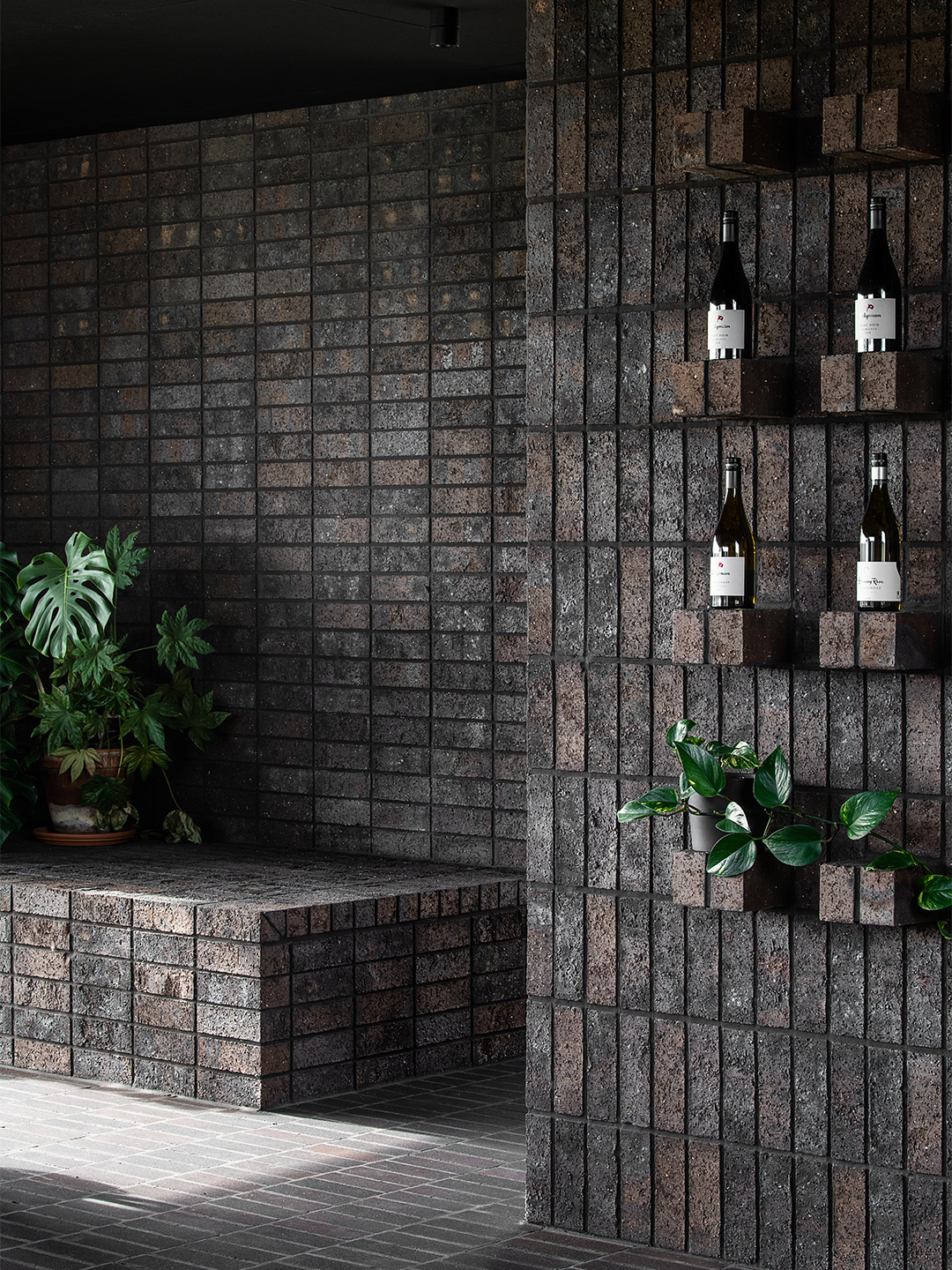
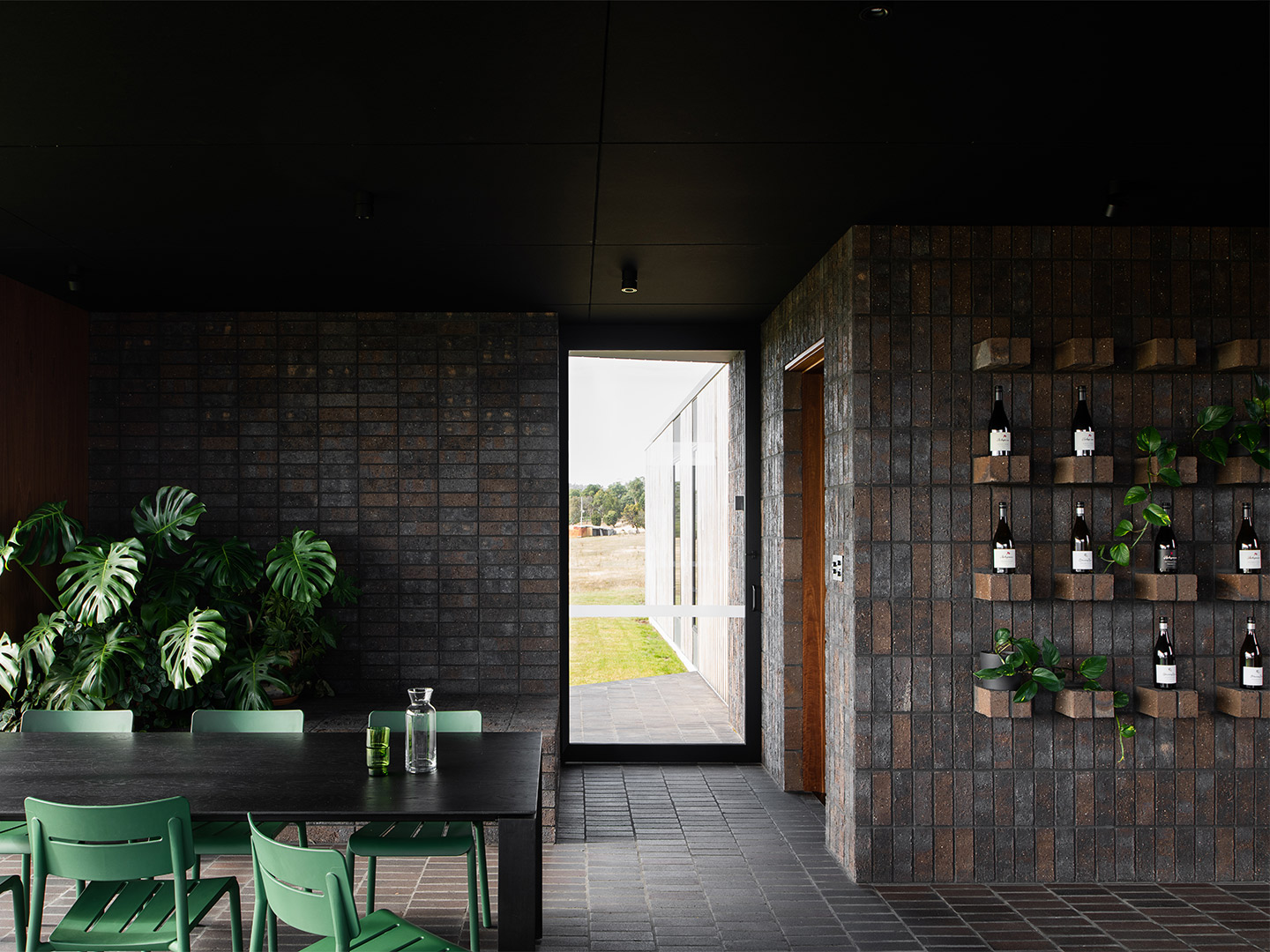
Cumulus Studio used brick in particularly creative ways that double as functional and sculptural gestures. An example of this is reflected in the laying pattern of the wall next to the bar, where extruding bricks act as small shelves, each perfectly displaying a Stoney Rise bottle of wine. Perpendicular to this, a low brick bench provides extra seating or a spot to perch indoor plants.
Outside, at the intersection where the two sections of the building meet, there is a small paved brick courtyard. This open-air space functions as a small entry foyer and sitting area, and a means of incorporating another geometric element to the project. The exterior brick features also include blade walls and a brick-framed fireplace, ideal for wine-tasting sessions in the winter months.
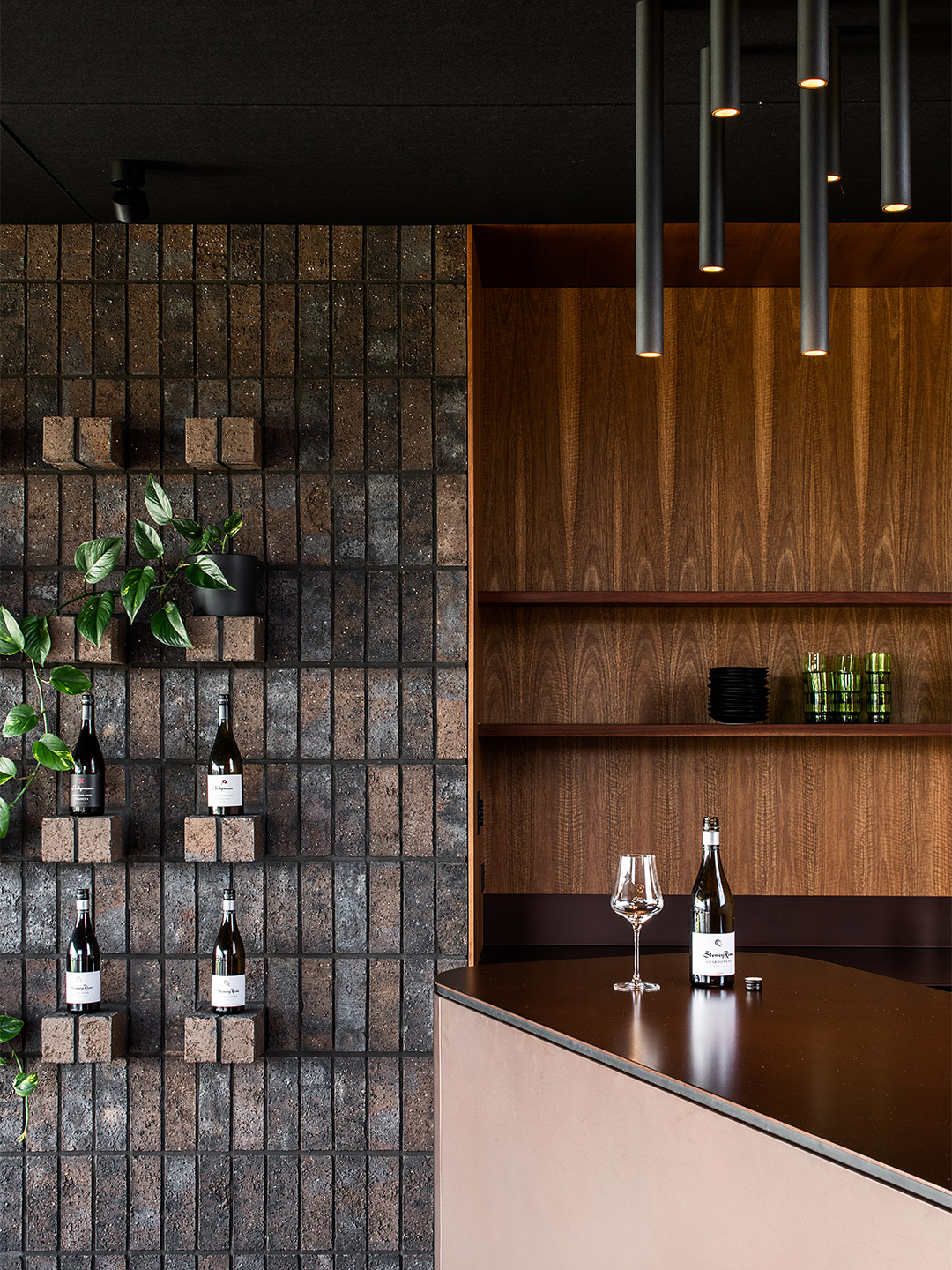
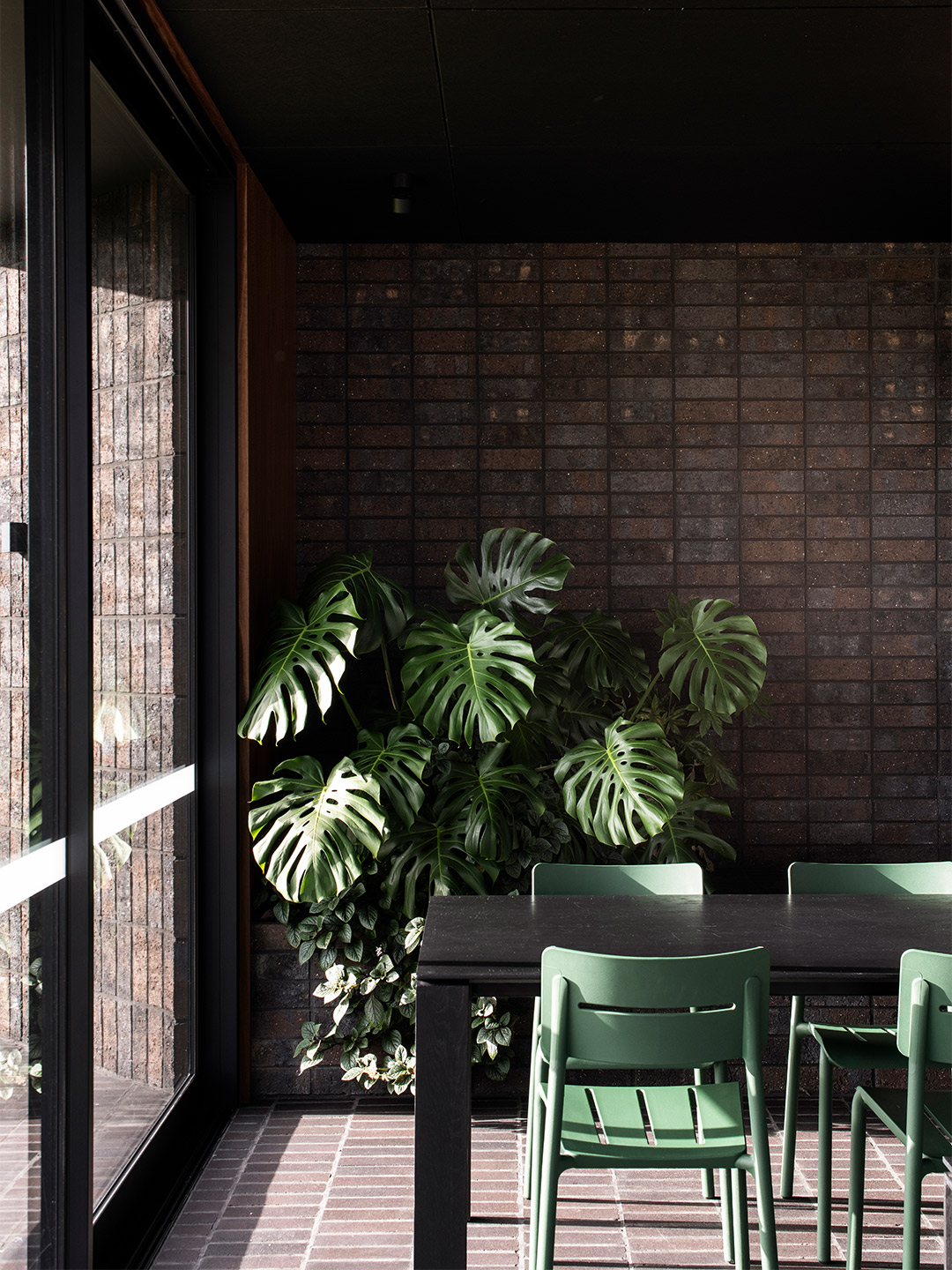
Creating continuity and making reference to the natural environment, renewable spotted gum timber wraps the building from the inside out, adding warmth to the interiors and creating an inviting environment. Inside, in the foyer and bar, Cumulus Studio chose a combination of both Bowral Blue bricks and locally sourced Daniel Robertson bricks.
This materiality grounds the building and offers a thermal mass, especially useful during the cooler Tasmanian winters. The untreated nature of the chosen materials creates an organic sensibility; the unrefined finish of the timber and the tiles on the walls pays homage to the natural milieu and the Tasmanian landscape.
The internal colour palette is moody, creating congruence with the dark ceilings and flooring, cocooning the guests inside and creating a warming atmosphere. The Bowral Blue bricks used for the internal flooring are smooth, both in texture and in colour, whereas the Daniel Robertson bricks that run along the walls are textural, with a mottled finish and rougher surface.
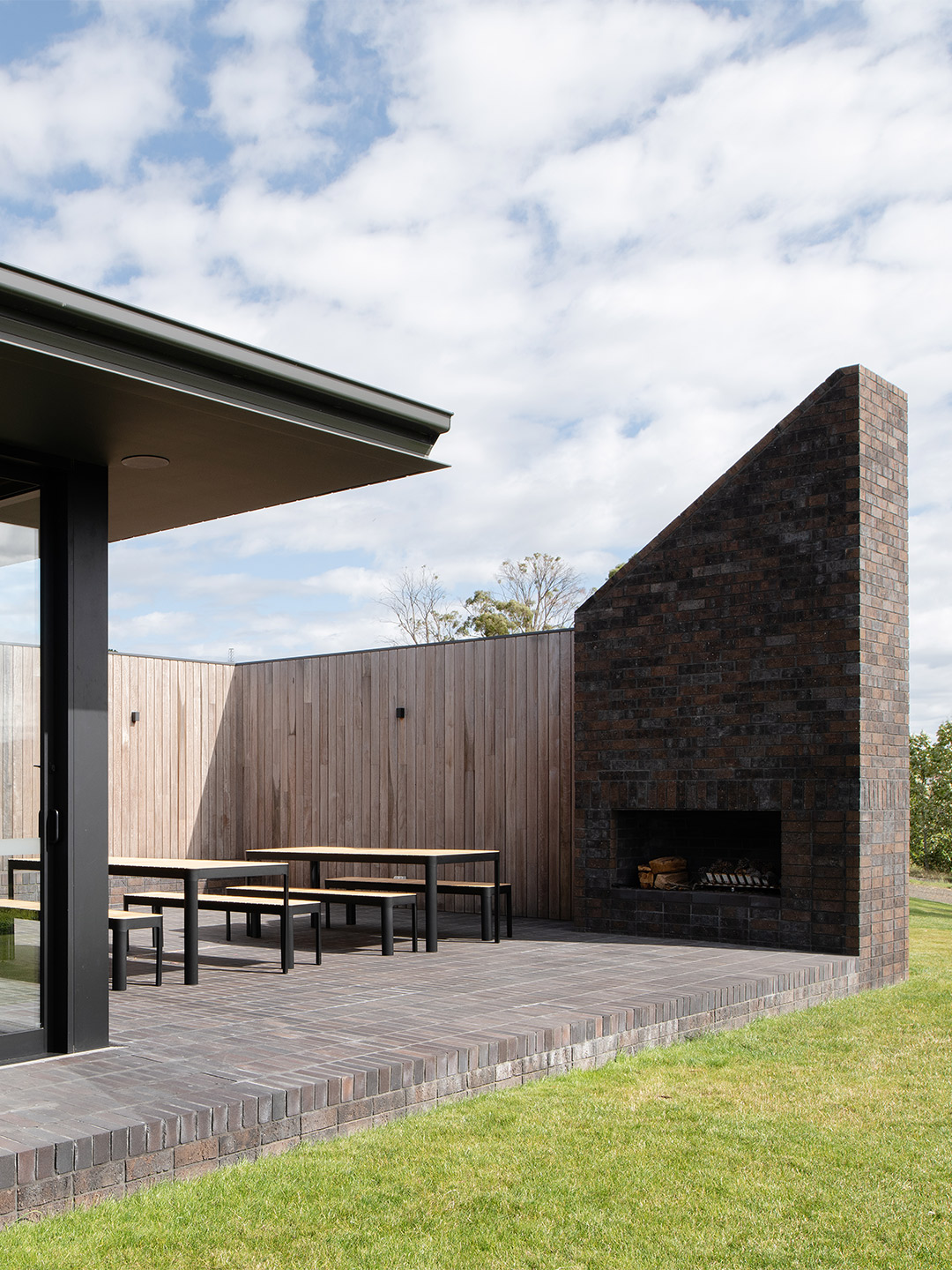
The continuity between the floor and ceiling can be seen as both an interior and an exterior feature. At the entrance to the building, the untreated timber in a washed-grey tone meets the smooth concrete, creating a juxtaposition of texture but a uniformity of colour.
Beyond materiality, a key desire for the client was to make the most of the small footprint, and the views of Kanamaluka to the east and the crop of Trousseau grapes to the west. The project was also led by practical requirements. The cellar door needed to be designed with the ability to be staffed by just one person, as well as having the capacity to host an array of functions in the day-to-day trading of the business.
cumulus.studio; stoneyrise.com
A prime example of creating a project that assimilates into the natural landscape, Stoney Rise Wine’s cellar door makes the most of the Tasmanian elements.
Catch up on more architecture, art and design highlights. Plus, subscribe to receive the Daily Architecture News e-letter direct to your inbox.
Related stories
- ‘The Apple tree’ by Foster + Partners blossoms in Bangkok.
- Carla Sozzani curates new colours for classic Arne Jacobsen chairs.
- Adam Goodrum stamps all-Australian style on new breezeblock design.
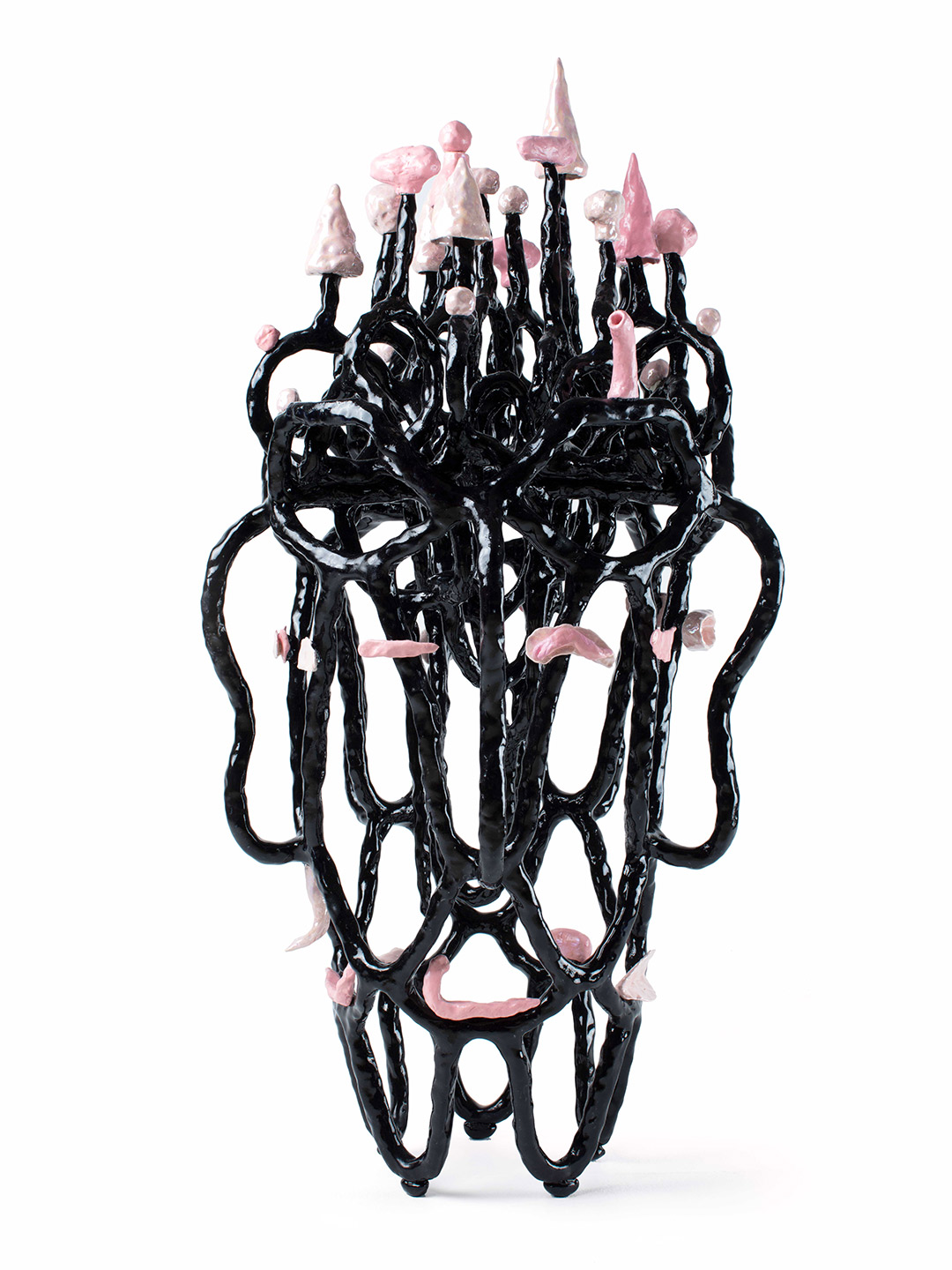
Proudly supported by Brickworks, a major exhibition charting 50 years of studio ceramic practice in Australia is planned to open at the Powerhouse Museum on August 20. Bringing together works from 168 Australian artists, ‘Clay Dynasty’ will celebrate local studio ceramics, as shaped by three generations of makers. The exhibition will present more than 450 works from the Powerhouse collection and spotlight 70 new commissions and acquisitions from Australian artists.
“The Powerhouse collection of Australian studio ceramics is the most significant in Australia,” says Lisa Havilah, chief executive of the Powerhouse Museum. “We are committed to continuing to support contemporary Australian artists and documenting this significant field of practice for future generations.”
The making of ‘Clay Dynasty’
The ‘Clay Dynasty’ exhibit will feature works by “pioneer” potters who profoundly changed the course of Australian studio ceramics in the 1960s. Led by the English potter Bernard Leach’s interest in pre-industrial ceramic traditions of Europe and East Asia, these makers produced a new kind of Australian object, using local materials and responding to the Australian environment.
Alongside the functional tradition, the exhibition will explore the quest for artistic expression. Objects from the 1970s will illustrate the impact of the American Funk art movement and popular culture in Australia, while works from the 1980s will reveal how Australian artists explored the vessel tradition through postmodern forms, colours and patterns.
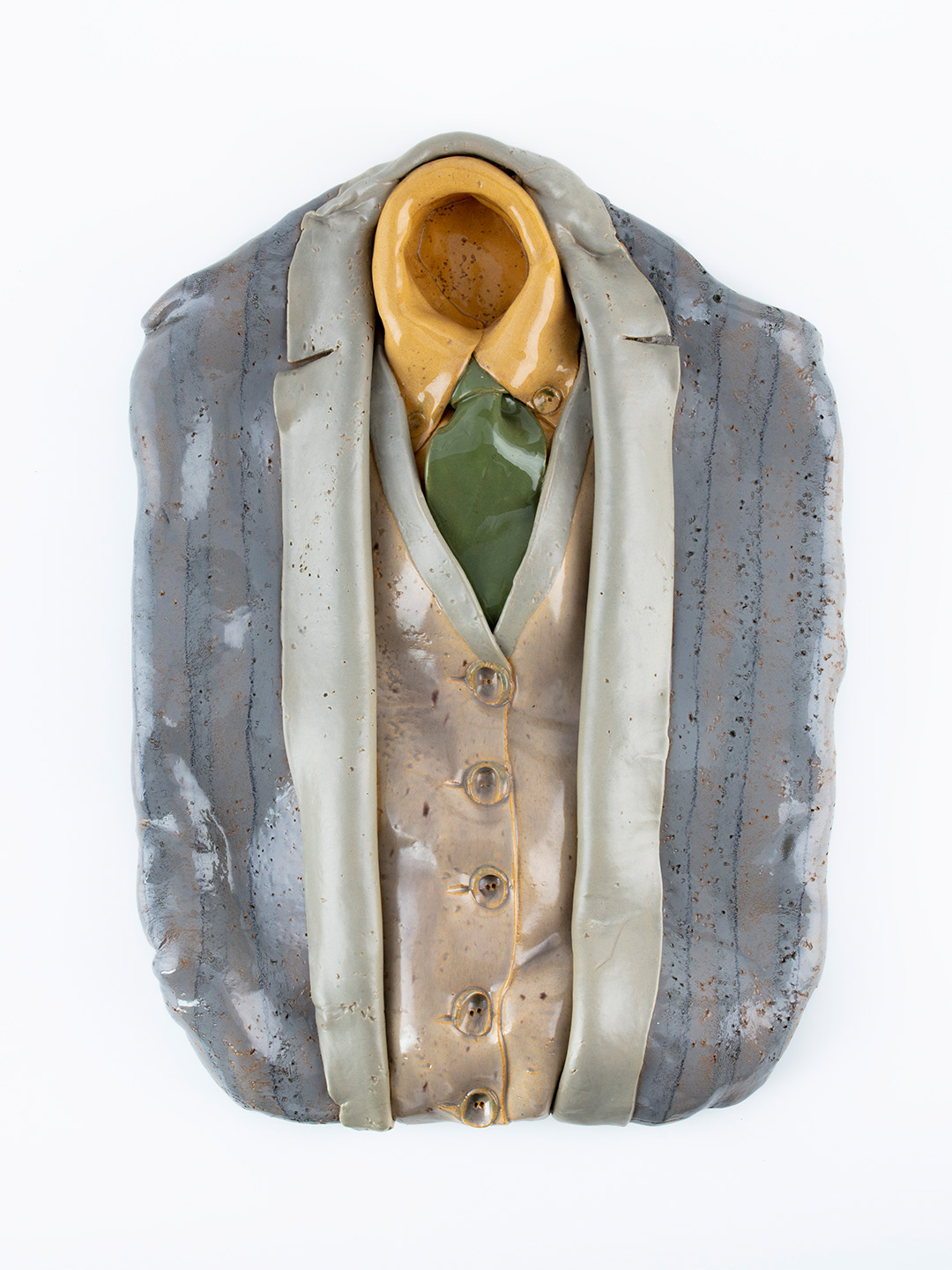
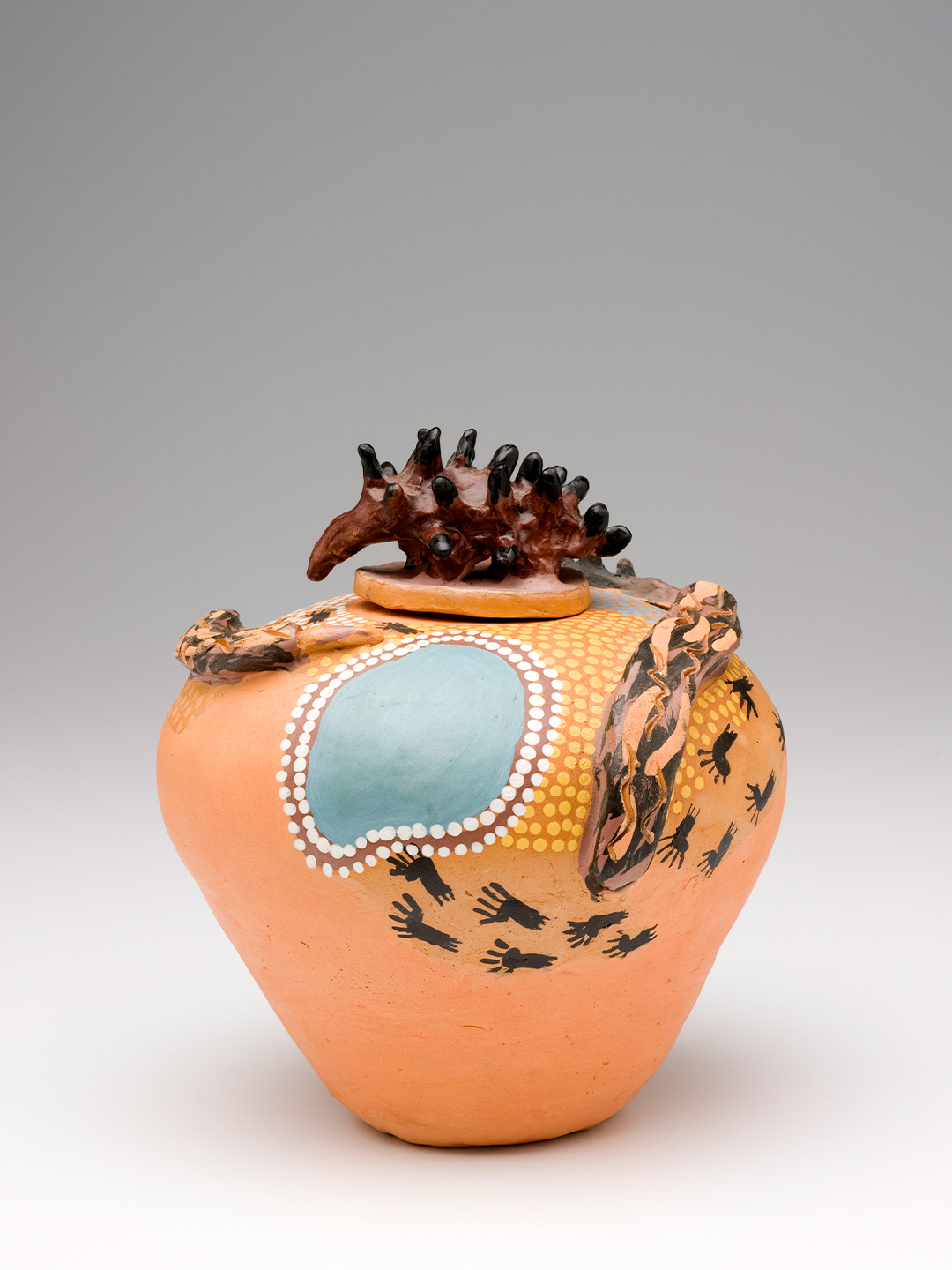
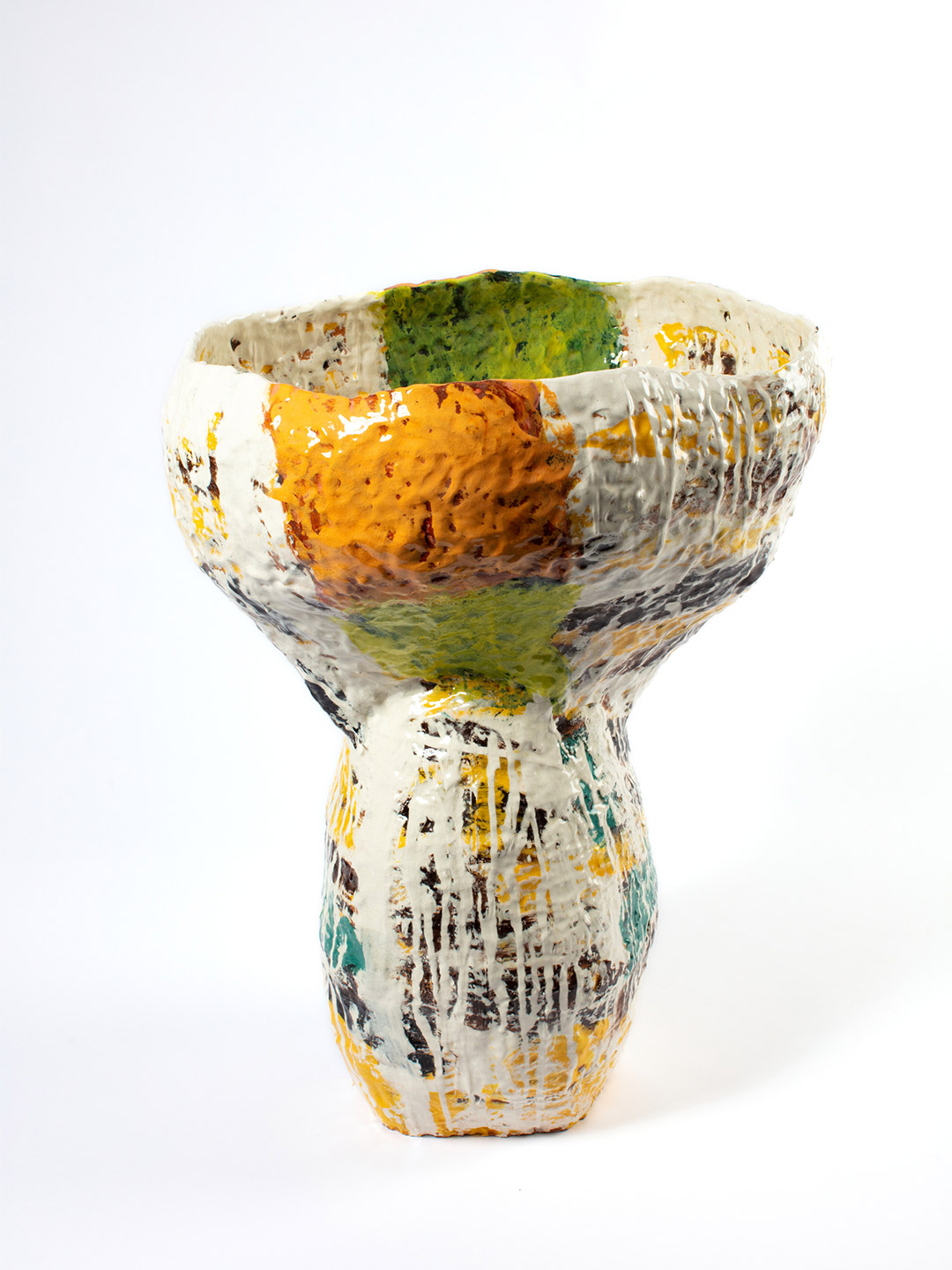
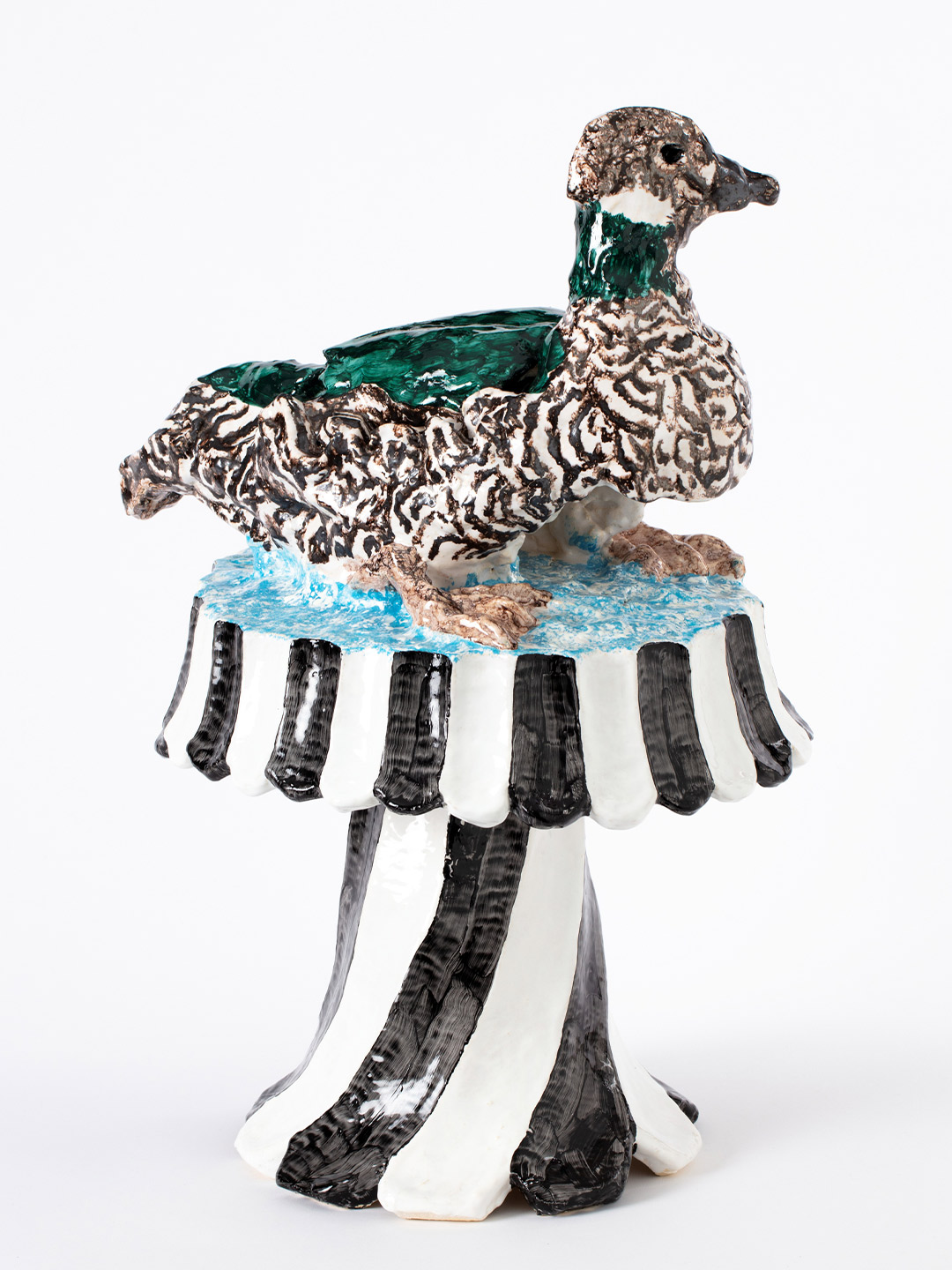
Left to right, from top: Portrait of a Father (1973) by Olive Bishop, Echidna is Looking for Food (1991) by Ida Enalanga, Wentworth Falls 4 (2004) by Peter Cooley, Small Green Goose (2020) by Peter Cooley.
Highlighting contemporary artists who are at the forefront of the medium today, ‘Clay Dynasty’ will showcase new works from across Australia. Commissioned by the Powerhouse Museum in 2020-21, these works see makers exploring historical and cultural traditions, pop-culture and current social issues to create contemporary works.
“As the first major exhibition exploring studio ceramic practice in Australia from the 1960s to now, ‘Clay Dynasty’ reveals a field of dedicated artists, teachers and communities,” says Eva Czernis-Ryl, curator of the exhibition. Continuing this legacy, the Powerhouse has partnered with local ceramic studios to develop a masterclass program that coincides with the exhibition, where guest artists will explore a range of ceramic techniques.
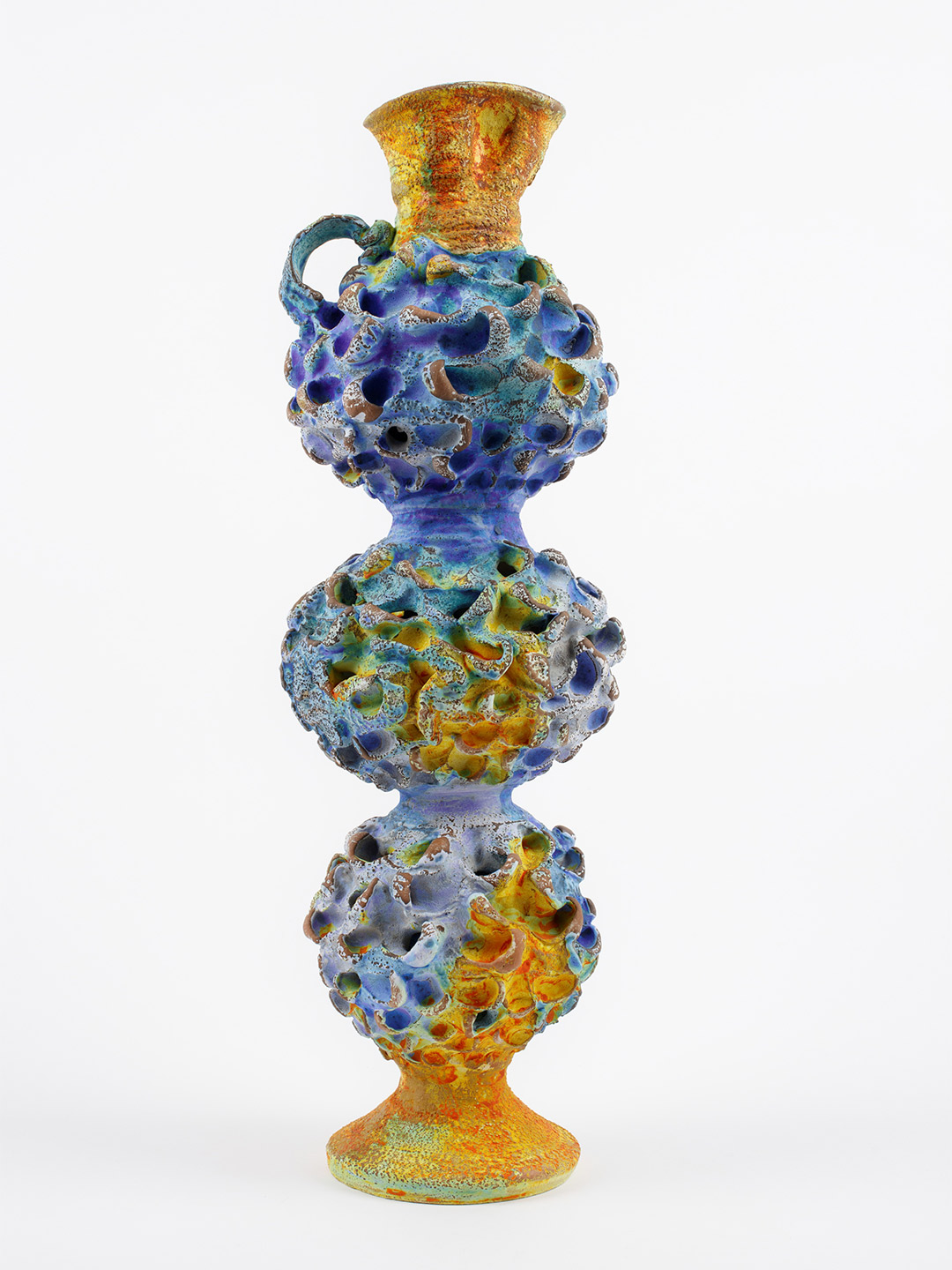
Trilogy (2018) by Simone Fraser.
‘Clay Dynasty’ – works on show
Artists presenting in ‘Clay Dynasty’ include Gamilaroi artist Penny Evans; South Australian artist Honor Freeman; Brisbane artist Nicolette Johnson; National Art School (Sydney) trained artist Juz Kitson; accomplished Tiwi ceramist and woodcarver Jock Puautjimi; National Art School lecturer Ebony Russell; London-based sculptor Renee So; Vipoo Srivilasa and Queensland-based artist Kenji Uranishi.
Alongside commissioned works, ‘Clay Dynasty’ will present works recently acquired by the Powerhouse, including works by internationally renowned Western Australian artist Pippin Drysdale; head of ceramics at the National Art School Lynda Draper; Luritja/Pintupi painter and ceramic artist Pepai Jangala Carroll; Sydney based artist Ramesh Mario Nithiyendran; Rona Panangka Rubuntja, award-winning artist and member of Hermannsburg Potters; Pitjanjatjara/Yankunytjatjara senior artist Carlene Thompson at Ernabella (Pukatja) Arts and contemporary potter Roswitha Wulff. Acclaimed artists Peter Cooley, Jeffery Mincham AM and Toni Warburton will also be featured.
Works from the Museum’s collection include ground-breaking pieces by Marea Gazzard AM, Gwyn Hanssen Pigott OAM, Margaret Dodd’s iconic Two blues Holden ceramic car which feminised the iconically macho FJ Holden of the 1970s; Joan Ground’s 1973 ceramic postal parcels and a rare collection of the earliest pottery made by Indigenous Australian makers in 1968–74 at the Bagot Pottery in Darwin, Northern Territory.
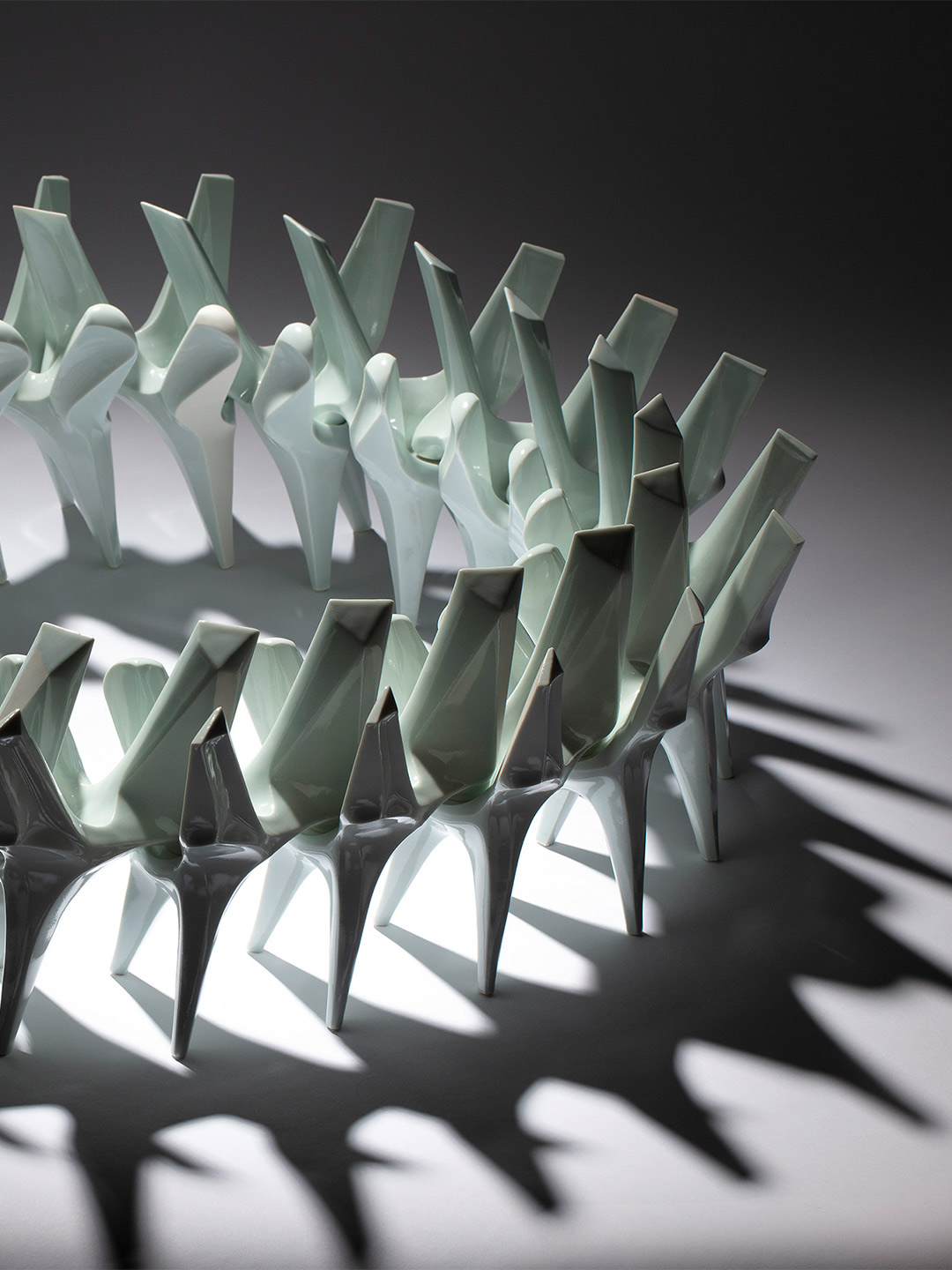
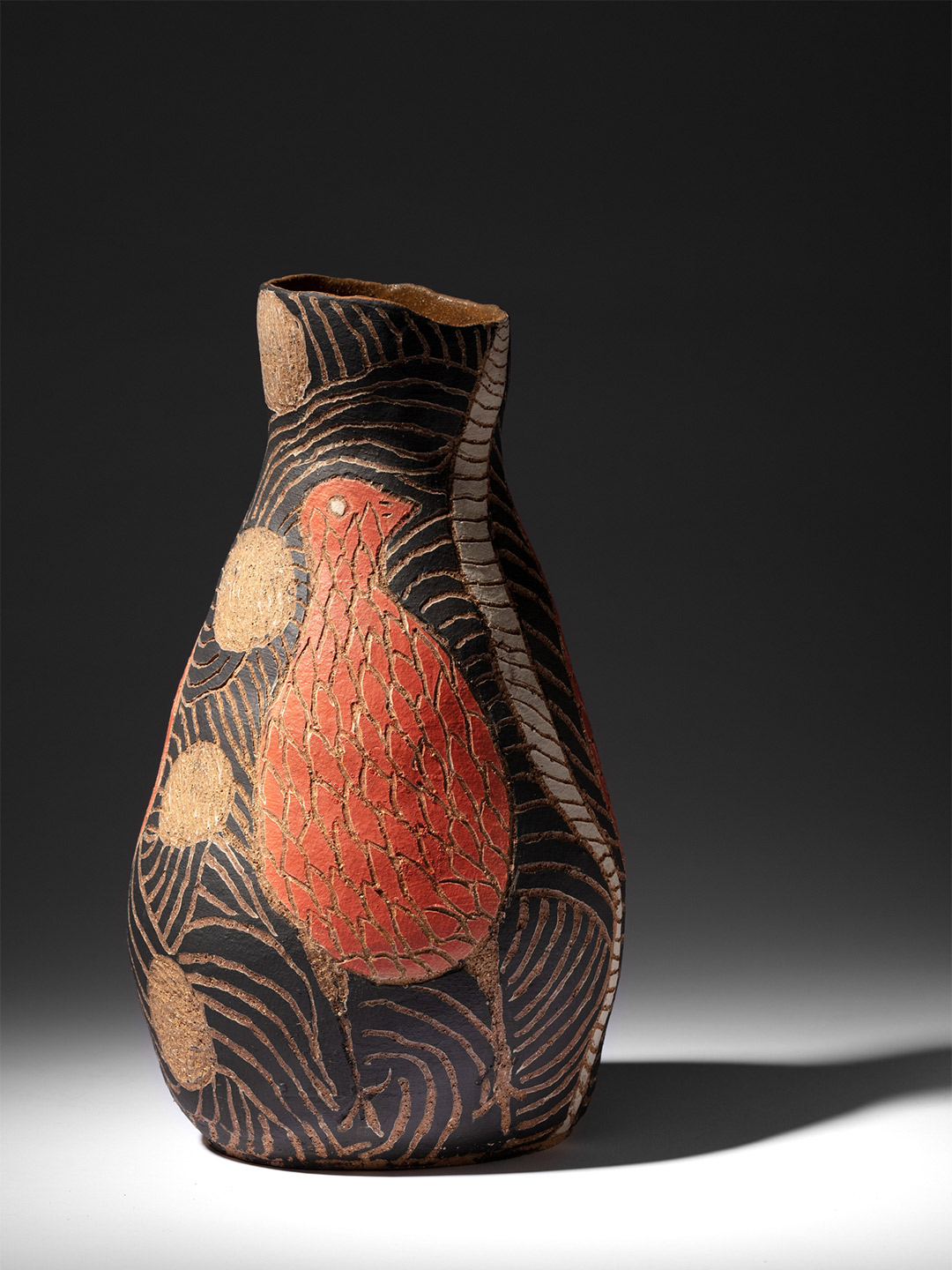
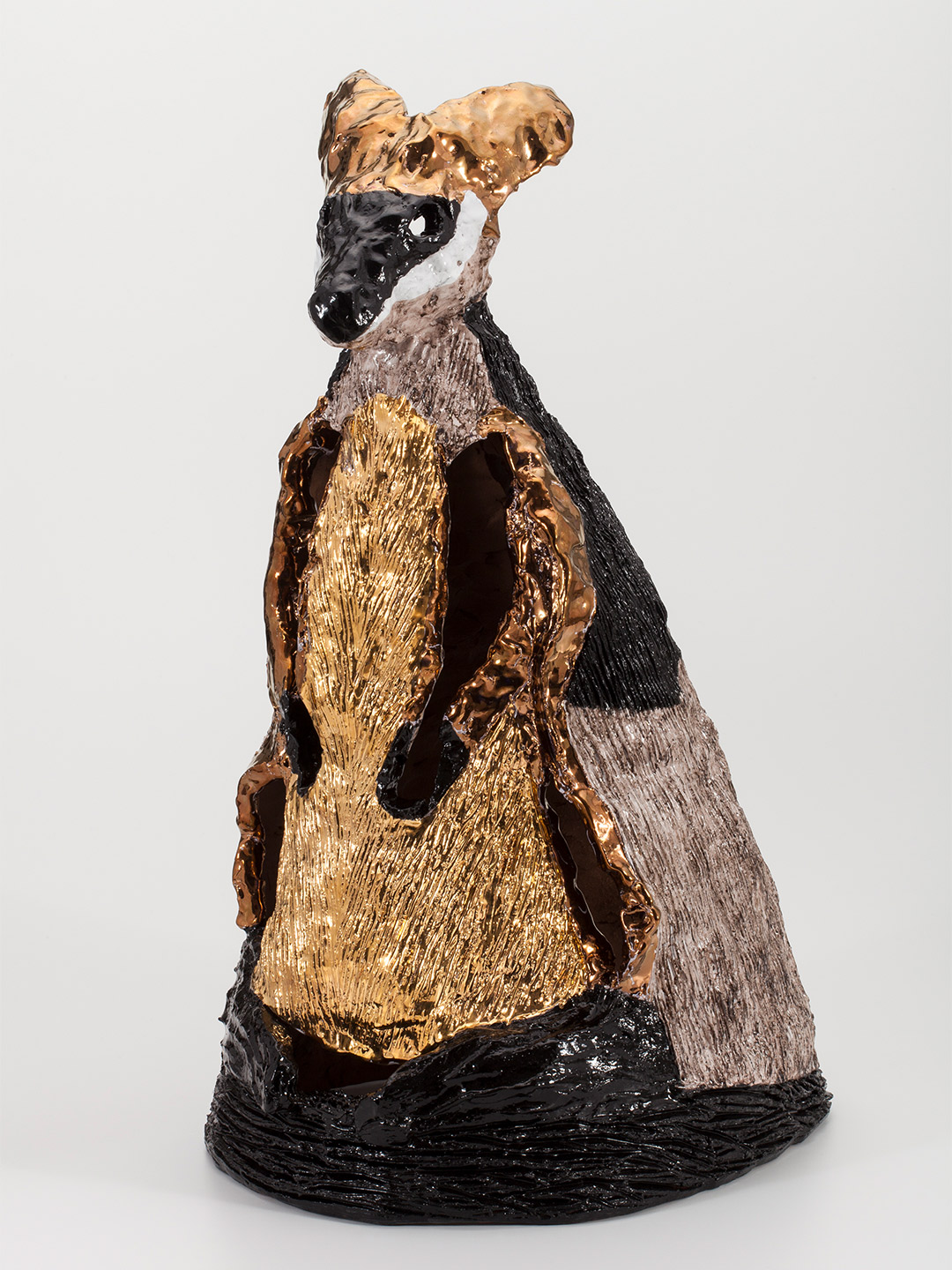
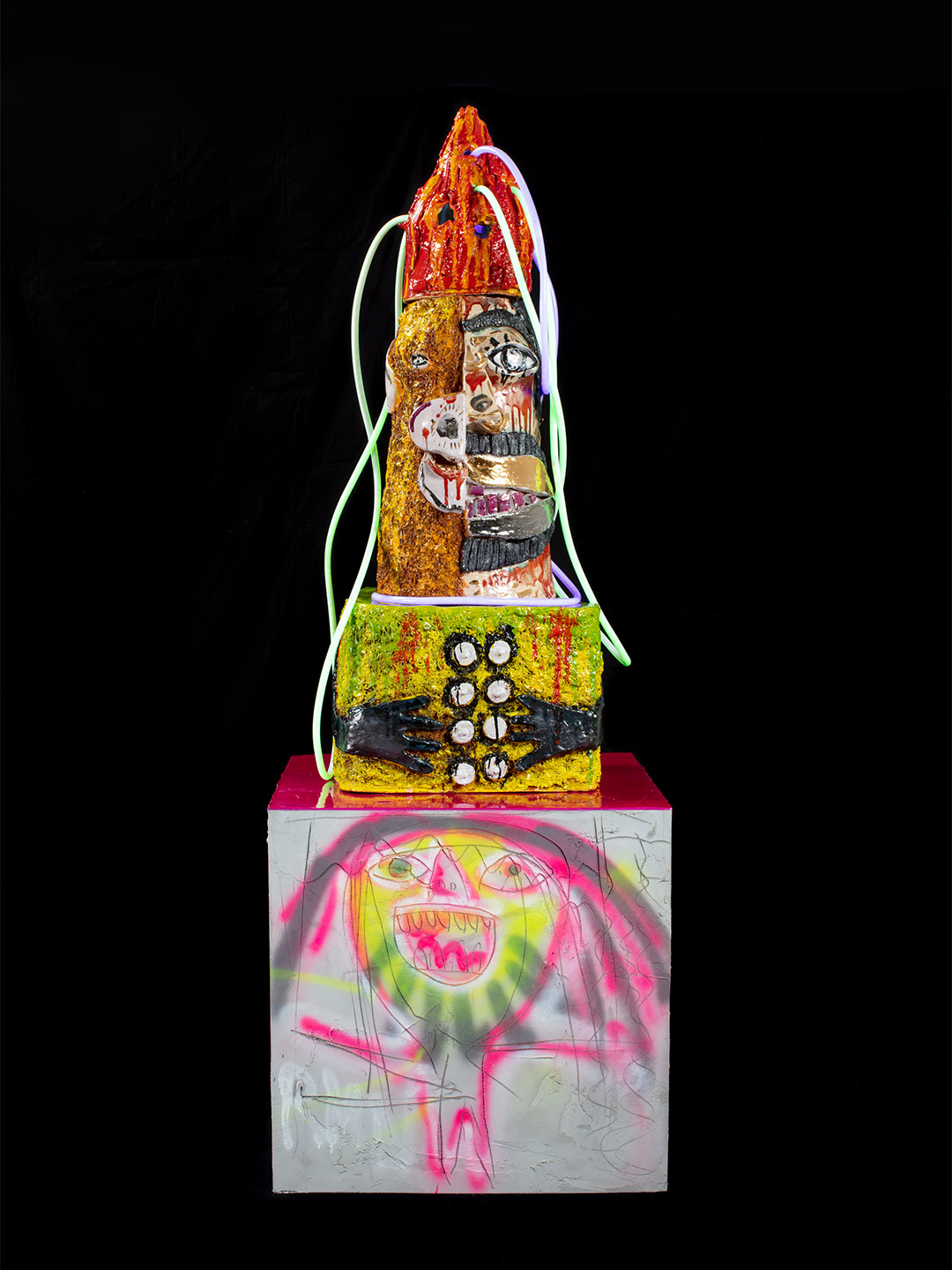
Left to right, from top: Walking in the Forest (2021) by Kenji Uranishi, Kalaya Ngura [Emu Country] (2020) by Carlene Thompson, Black Tailed Swamp Wallaby 9 (2015) by Peter Cooley, Hog/Human (2019) by Ramesh Mario Nithiyendran.
As the first major exhibition exploring studio ceramic practice in Australia from the 1960s to now, Clay Dynasty reveals a field of dedicated artists, teachers and communities.
Catch up on more architecture, art and design highlights. Plus, subscribe to receive the Daily Architecture News e-letter direct to your inbox.
Related stories
- ‘The Apple tree’ by Foster + Partners blossoms in Bangkok.
- Carla Sozzani curates new colours for classic Arne Jacobsen chairs.
- Adam Goodrum stamps all-Australian style on new breezeblock design.
Proudly supported by Brickworks, a major exhibition charting 50 years of studio ceramic practice in Australia is planned to open at the Powerhouse Museum on August 20. Bringing together works from 168 Australian artists, ‘Clay Dynasty’ will celebrate local studio ceramics, as shaped by three generations of makers. The exhibition will present more than 450 works from the Powerhouse collection and spotlight 70 new commissions and acquisitions from Australian artists.
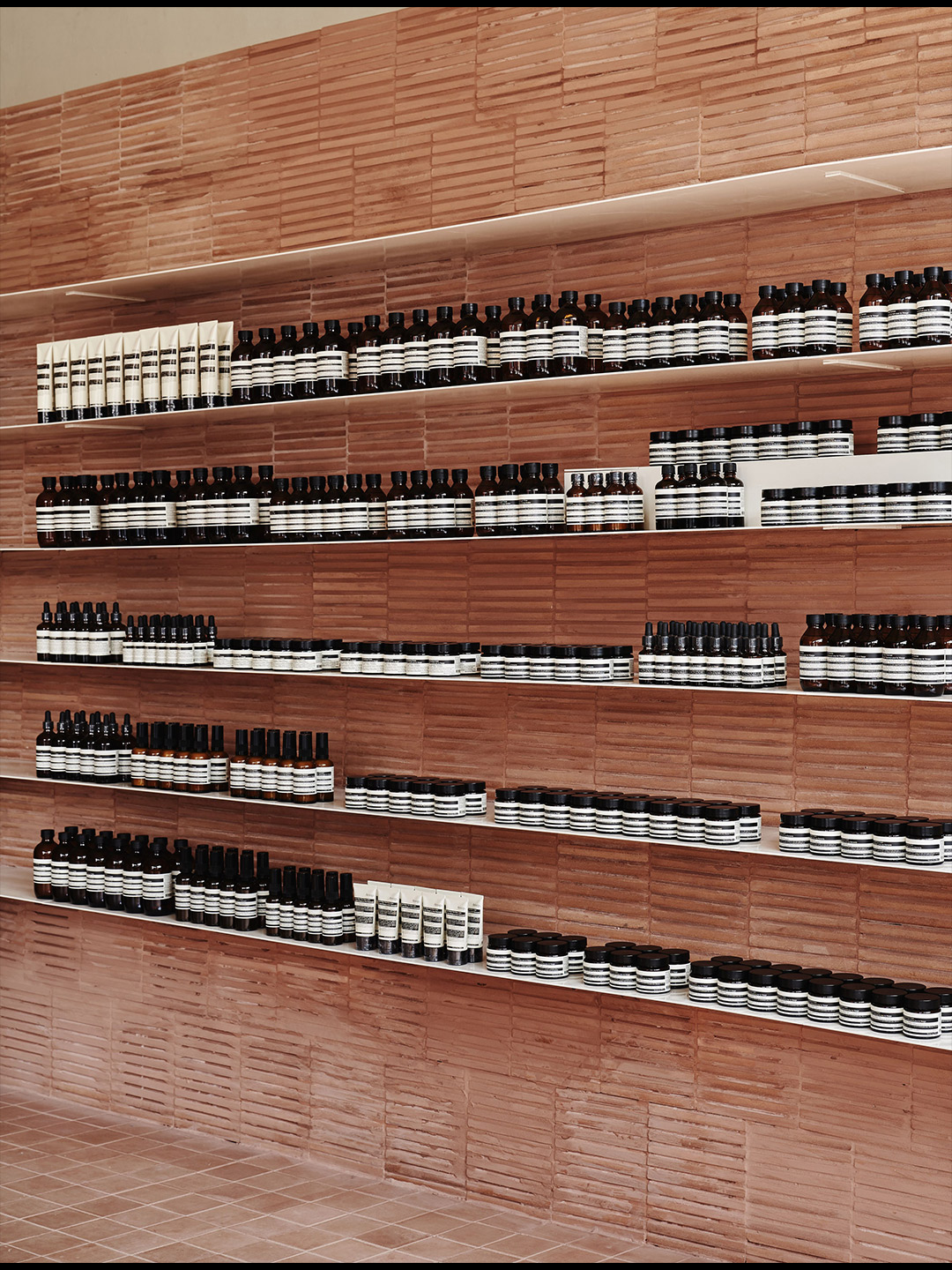
A corner entrance gives way to interior walls that weft in brownstone formation. Alcoves and corners emerge as areas of inhabitation and display; the negative space behind the walls becomes a place of repose for staff. In this way, the space’s choreography simulates the meandering experience of walking through the neighbourhood.
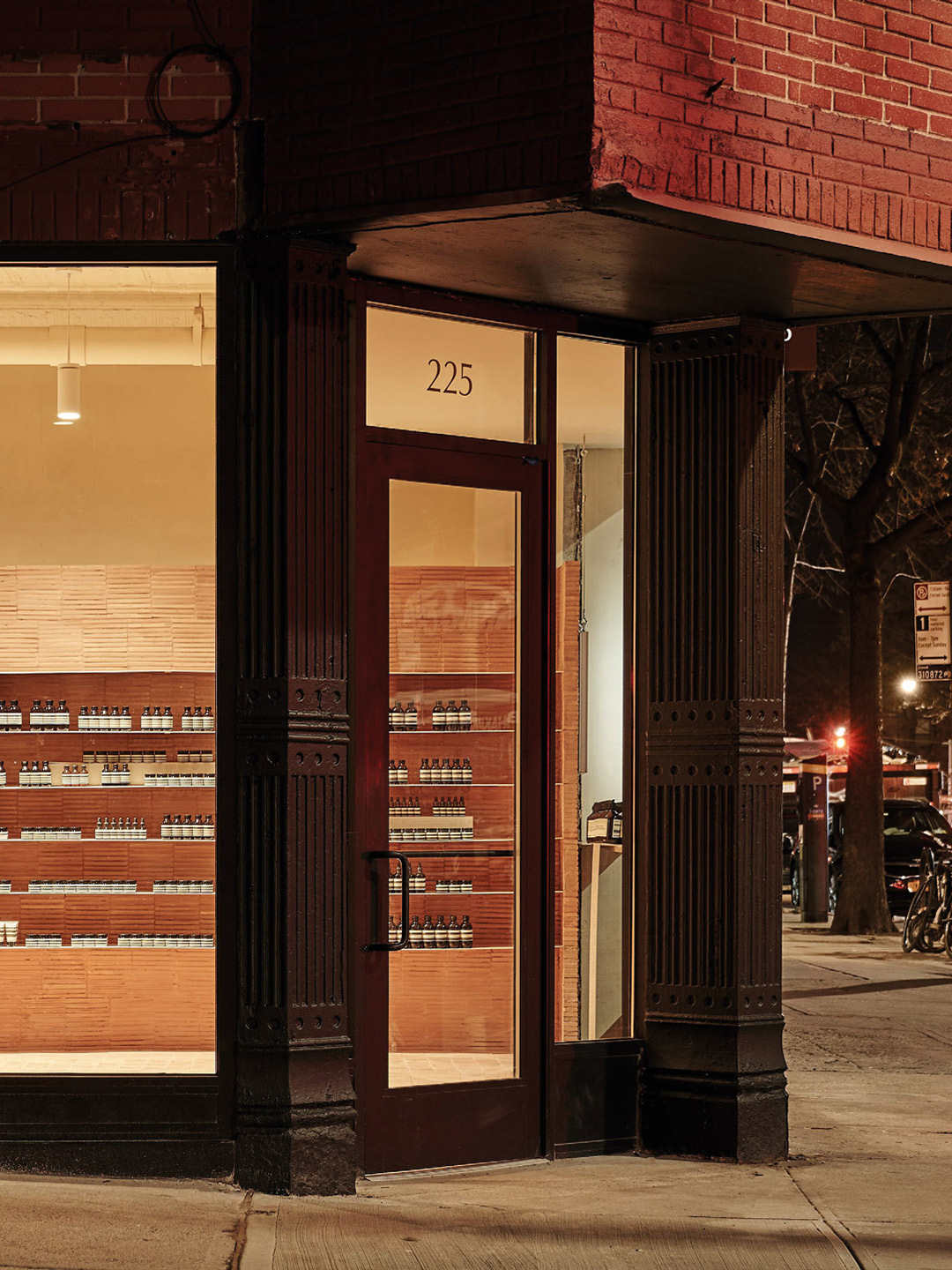
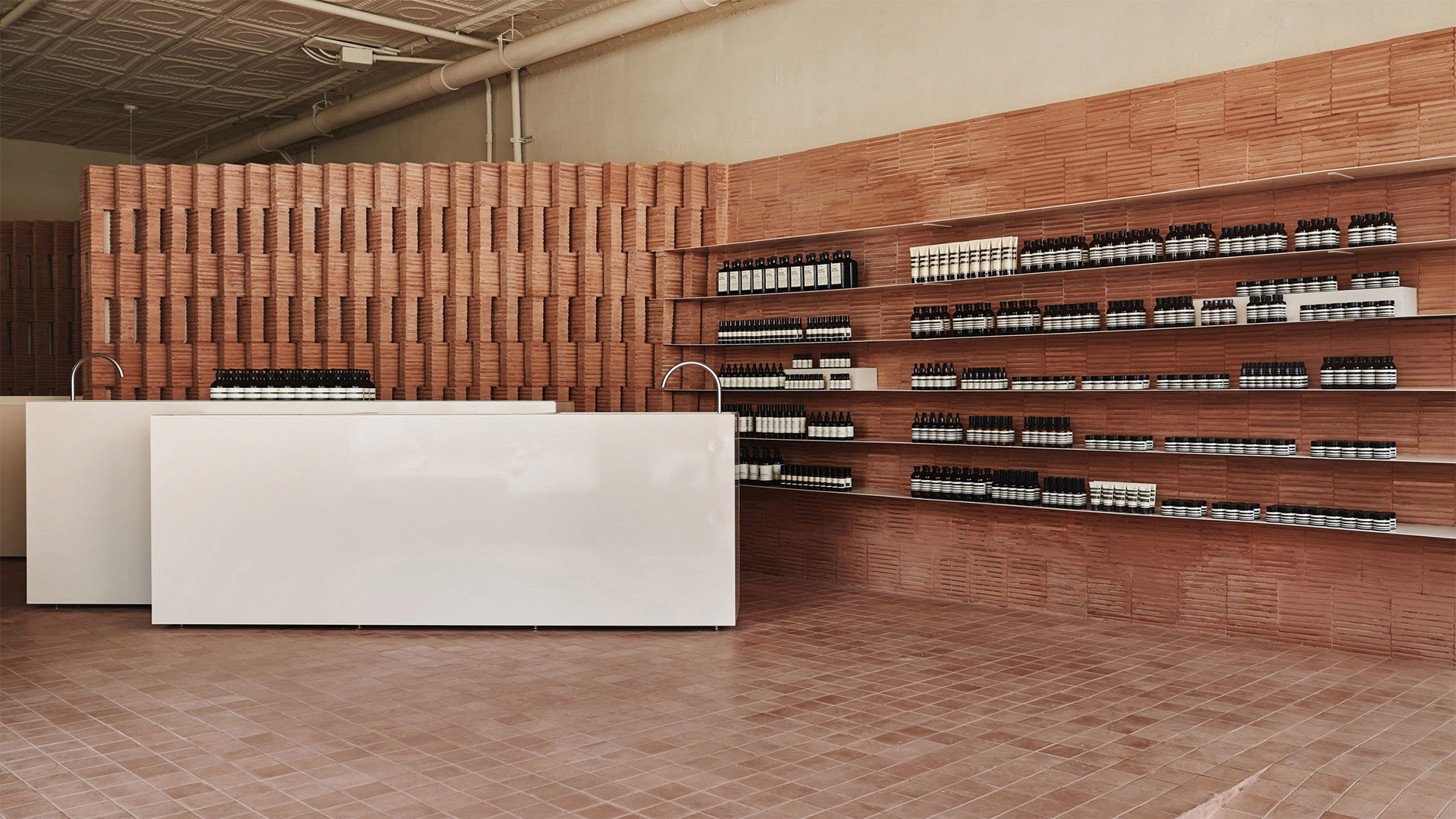
Aesop Park Slope store by Frida Escobedo
Location New York City, New York
Function Retail store
Client Aesop
Completion date 2019
Architect Frida Escobedo, taller de Arquitectura
Design team Frida Escobedo, José María Gómez De León
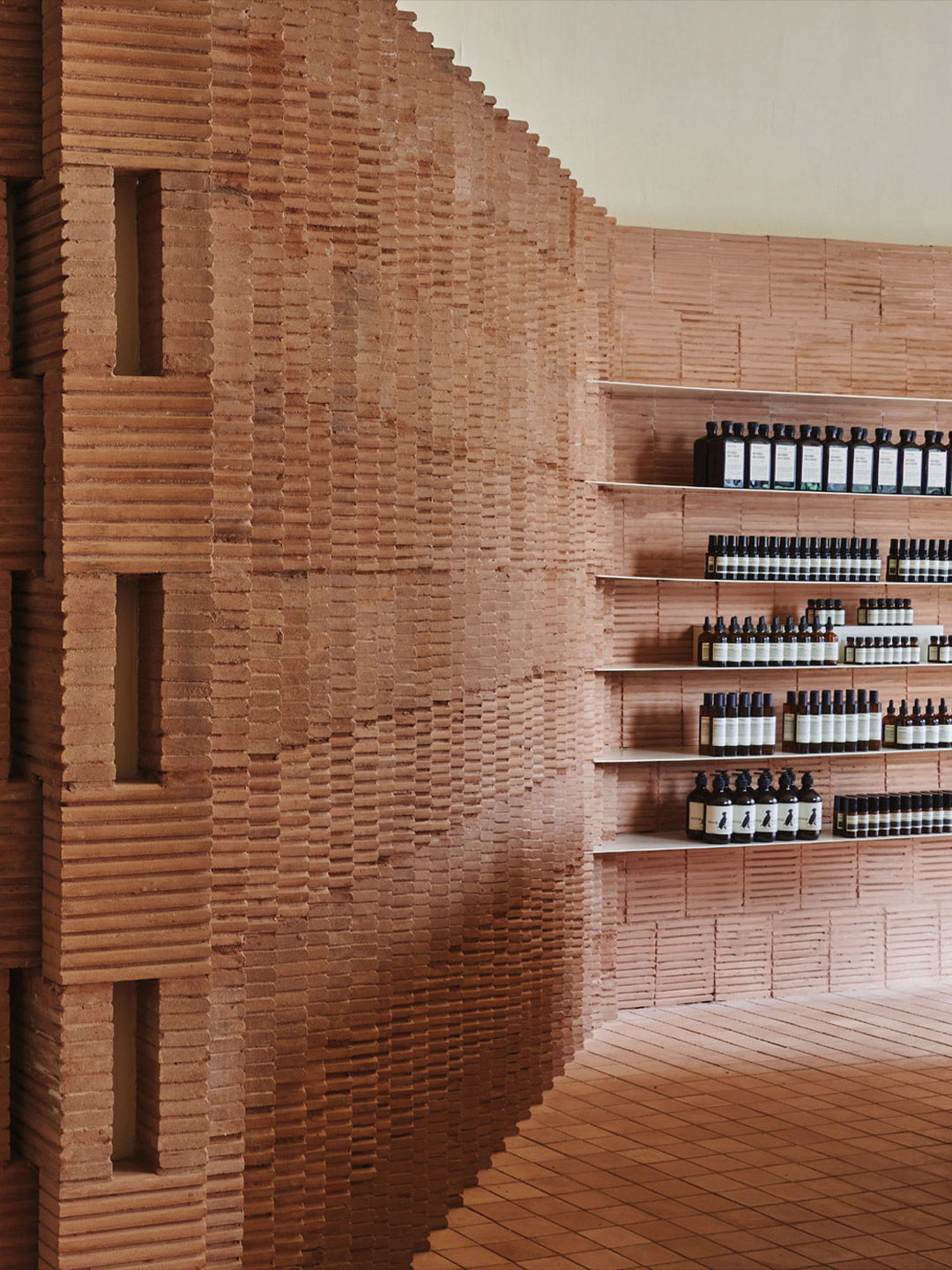
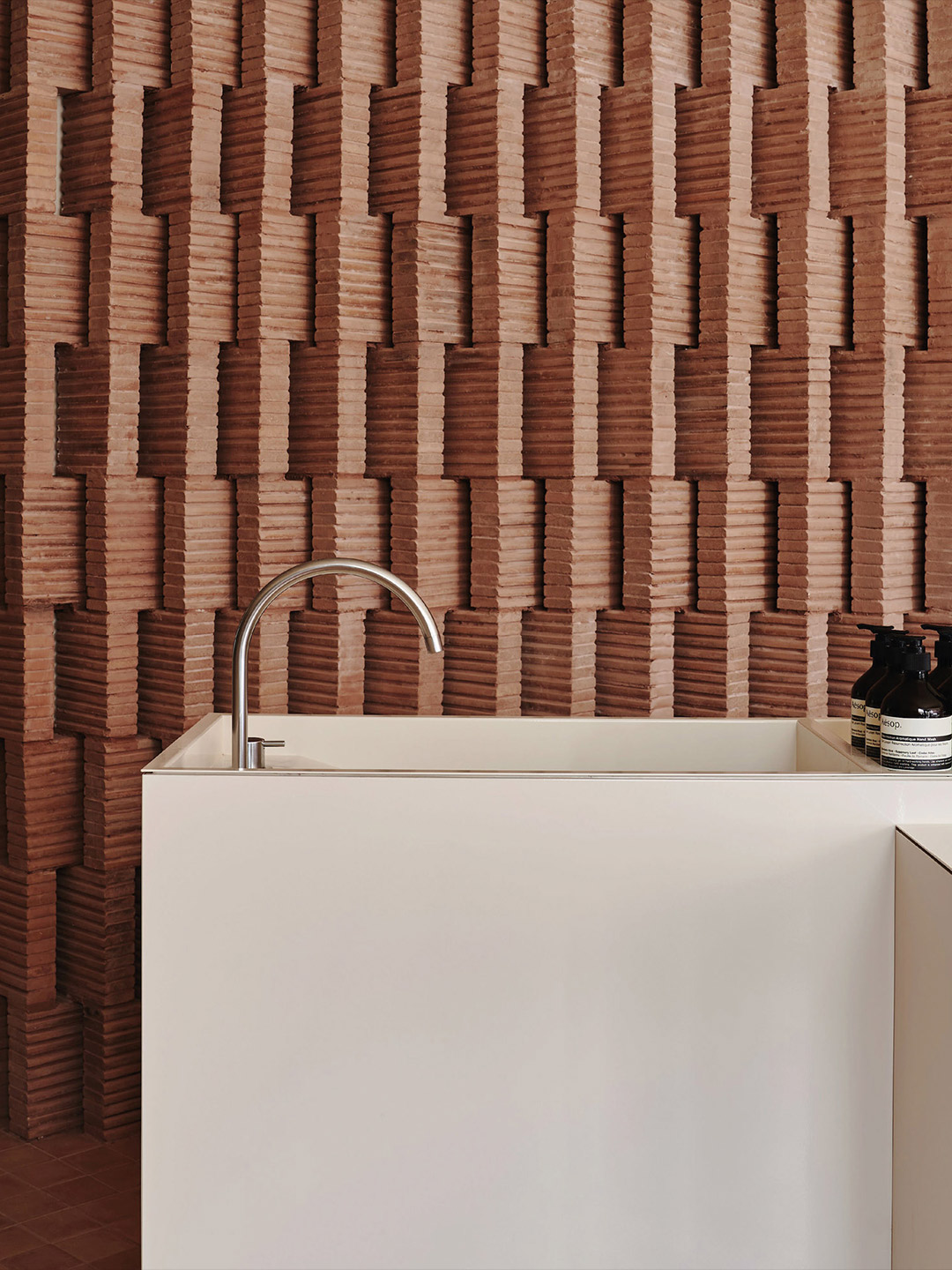
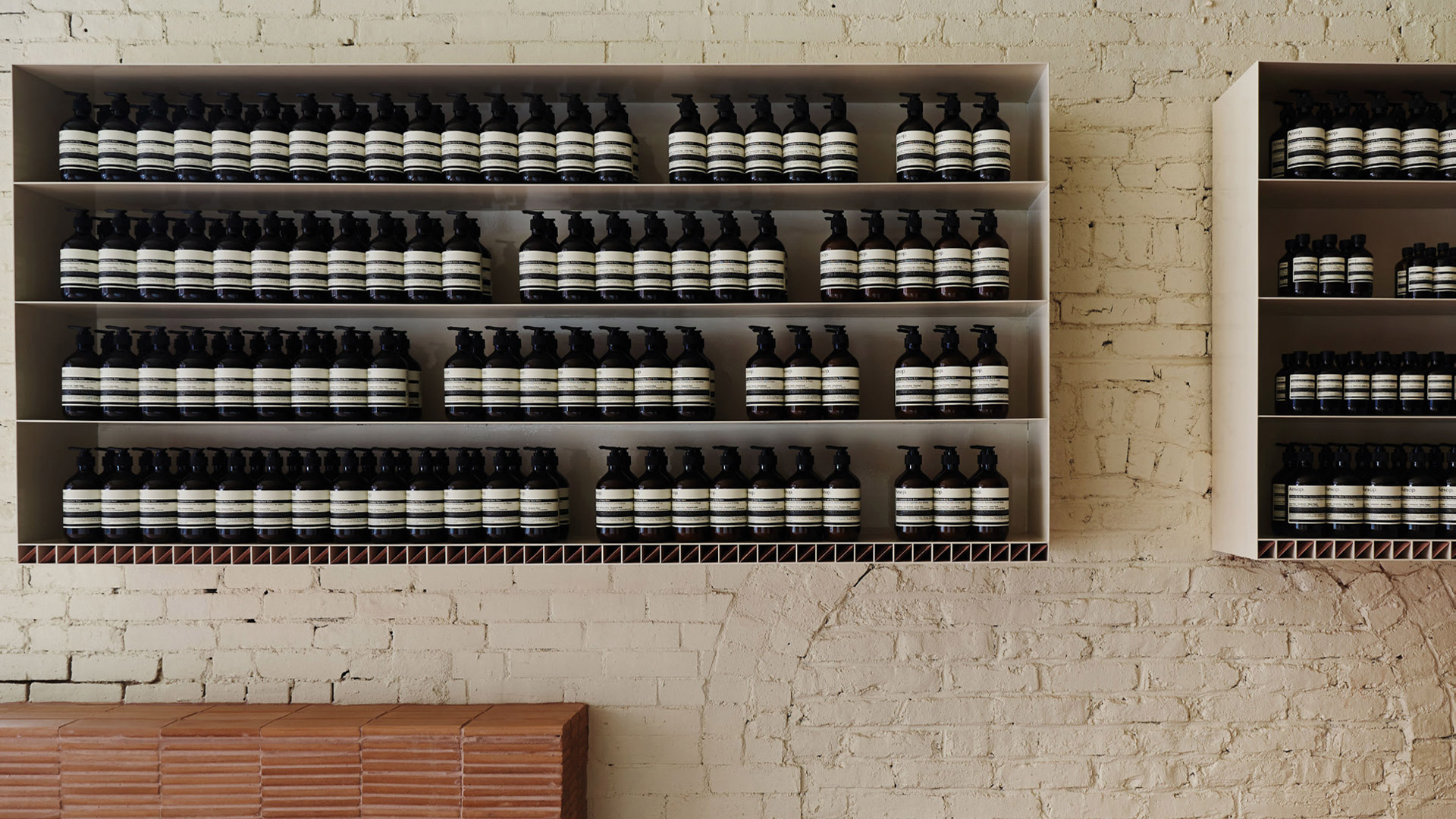
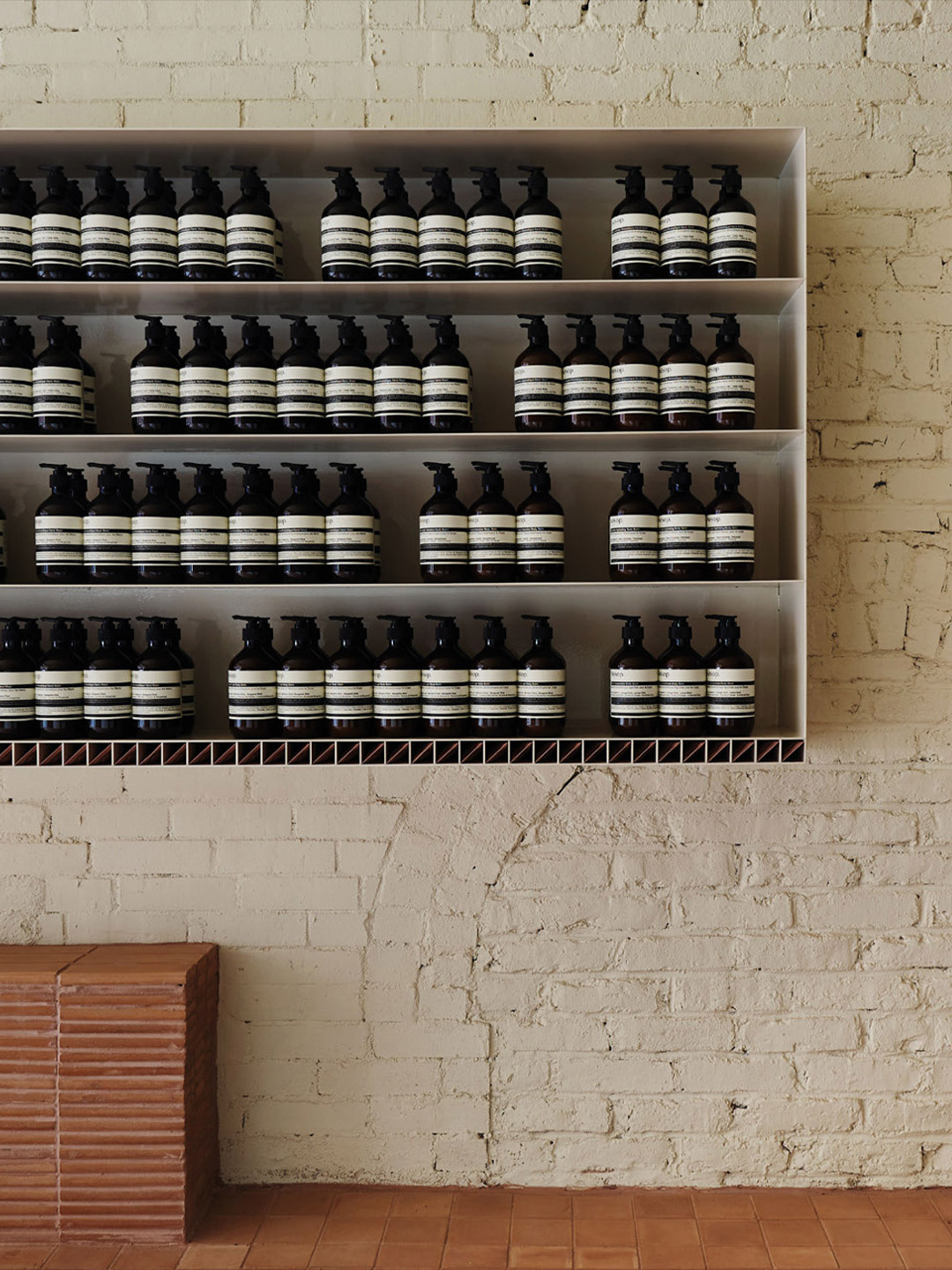
Rammed earth from Oaxaca in Mexico was handcrafted into auburn bricks with rich imperfections, variations of tone and texture. The bricks draw connections and contrasts between Mexico and Brooklyn, between the global and local. They tessellate in diagonal rows that reiterate, at a smaller scale, the angling brownstone streetscapes.
Frida Escobedo’s approach to design is driven by the conviction that architecture and design represent, above all, a crucial means to interrogate and comment on contemporary social, economic, and political phenomena. In this formulation, art (both contemporary and historical) serves as an indispensable touchstone. The studio’s creative output operates at a wide array of scales and mediums, encompassing buildings and experimental preservation projects, temporary installations and public sculpture, limited edition objects, publications and exhibition designs.
Informed by material sensibility and intuitive feeling for pattern, Escobedo’s work is undeniably architectural, yet frequently and intentionally blurs the boundary between architecture and art.
Aesop Park Slope by Frida Escobedo is just one on many projects featured in Materialty 2021, a free cloth-bound publication from Brickworks that explores the use of brick and concrete block in contemporary architecture. Register for your free copy.
Rammed earth from Oaxaca in Mexico was handcrafted into auburn bricks with rich imperfections, variations of tone and texture. They tessellate in diagonal rows that reiterate, at a smaller scale, the angling brownstone streetscapes.
This article is an edited extract from Materiality 2021, a publication by Brickworks Building Products. Catch up on more architecture highlights. Plus, subscribe to Daily Architecture News for weekly updates delivered directly to your inbox.
Related stories
- March Studio’s latest Aesop store sparkles in Hong Kong.
- The bar and restaurant at La Sastrería in Valencia by Masquespacio.
- Resa San Mamés student accommodation in Spain by Masquespacio.
- Kennedy Nolan’s ‘Workplace’ puts the cool back into water-cooler conversation.
Proudly supported by Brickworks, a major exhibition charting 50 years of studio ceramic practice in Australia is planned to open at the Powerhouse Museum on August 20. Bringing together works from 168 Australian artists, ‘Clay Dynasty’ will celebrate local studio ceramics, as shaped by three generations of makers. The exhibition will present more than 450 works from the Powerhouse collection and spotlight 70 new commissions and acquisitions from Australian artists.
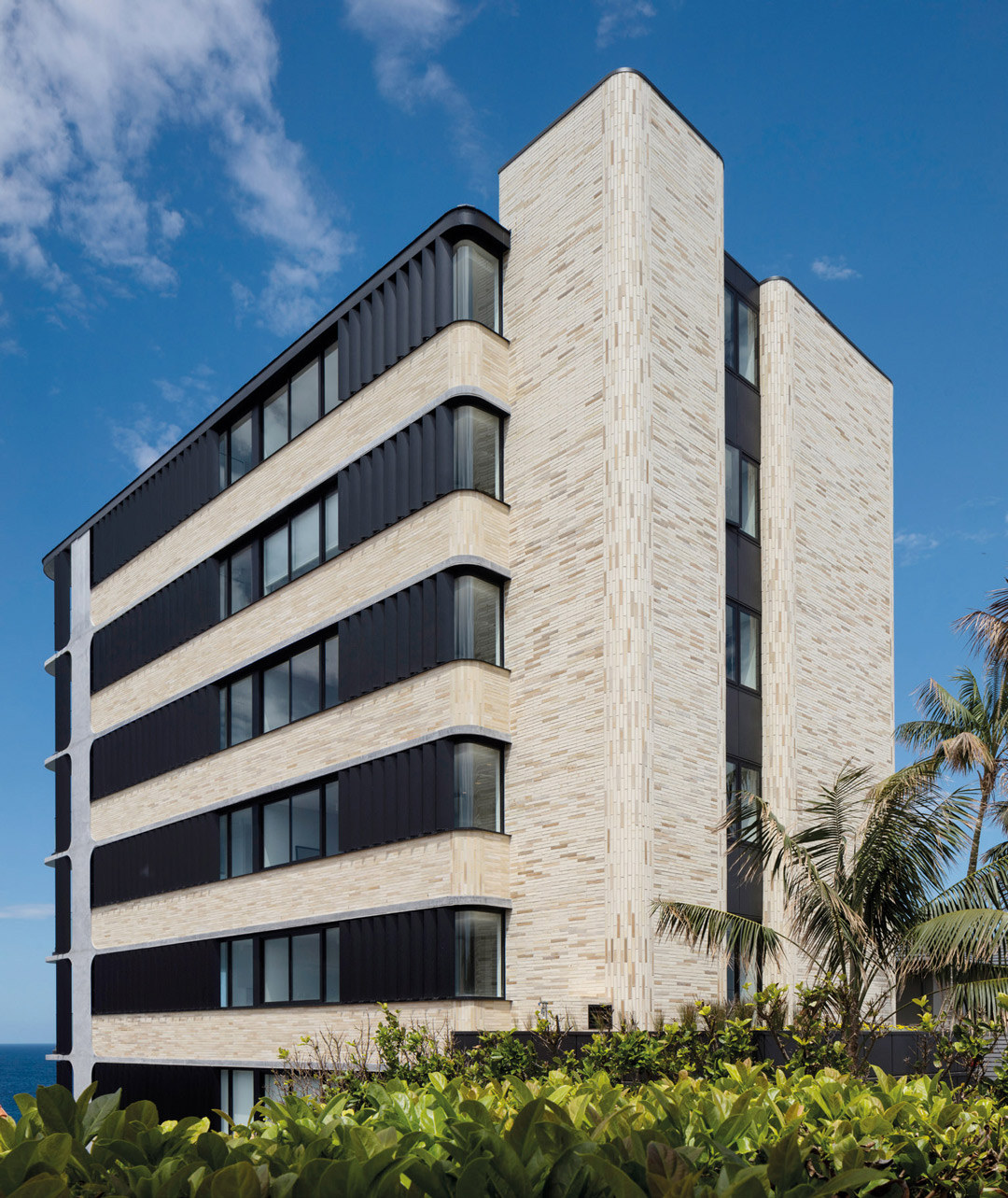
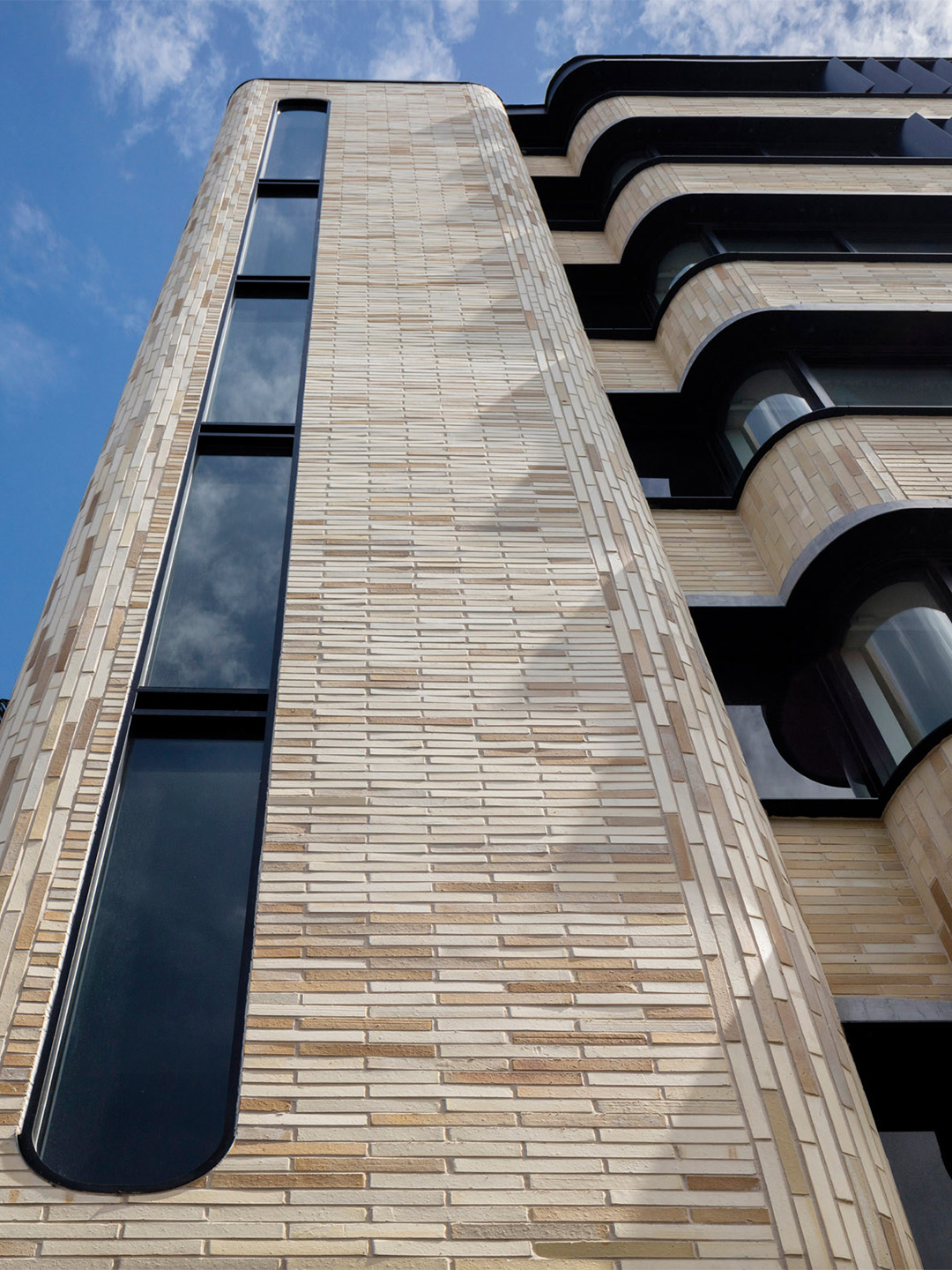
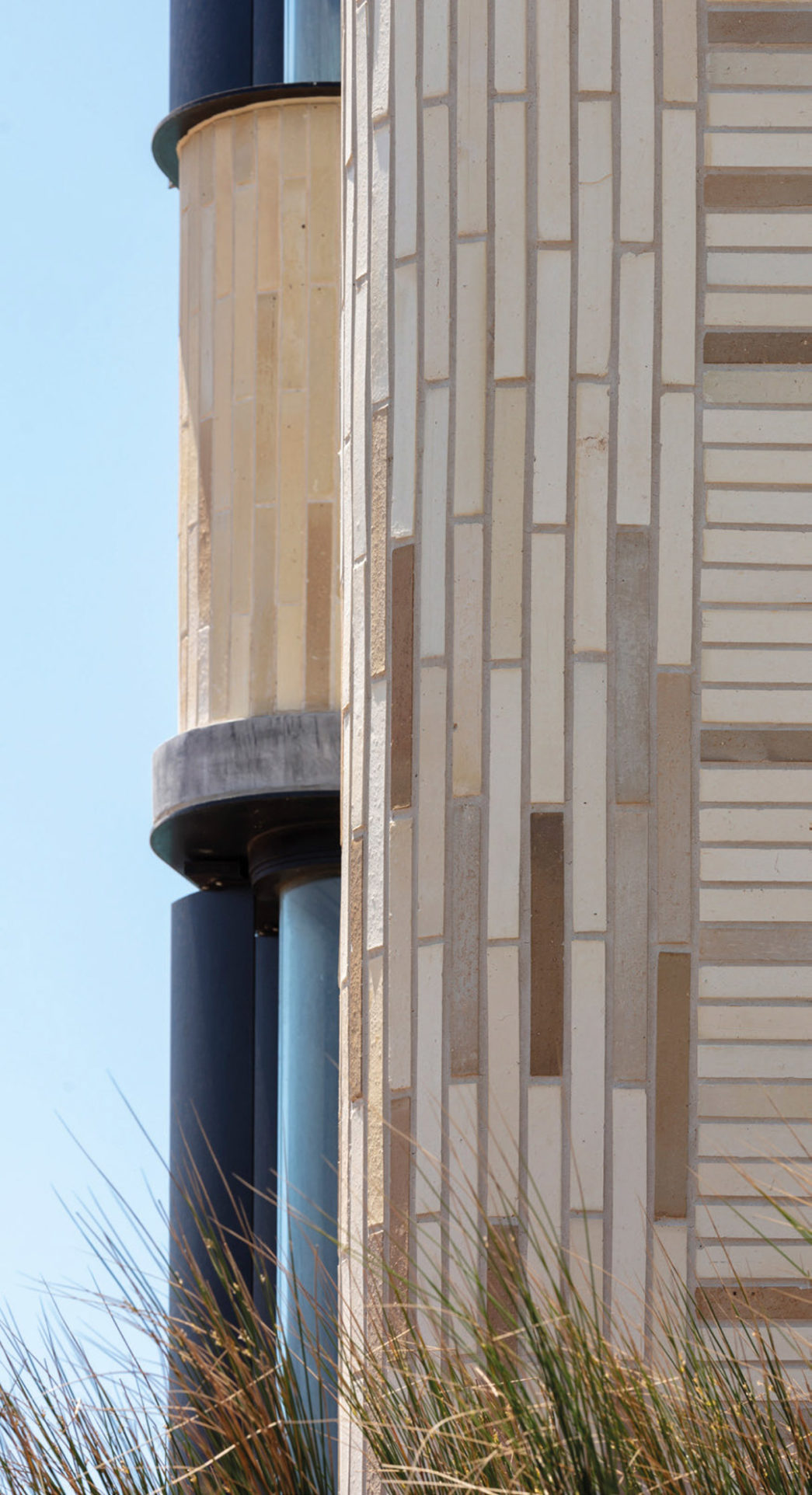
The beautiful colour and weathered texture of brick provided the ready (and obvious) answer to the client’s brief for a local material that could withstand exposure to coastal conditions. The ‘Emperor’ brick in Ghost from Krause Bricks was selected for its handmade variation in texture and array of colours, from warm blondes to violet hues, which recall the streaks of colour in the weathered sandstone cliffs below. Hand-mixed on site, the bricks were carefully installed to express the muddled colour variation, whilst evoking a familiarity of material with the brick walk-up apartment blocks in this iconic beach suburb.
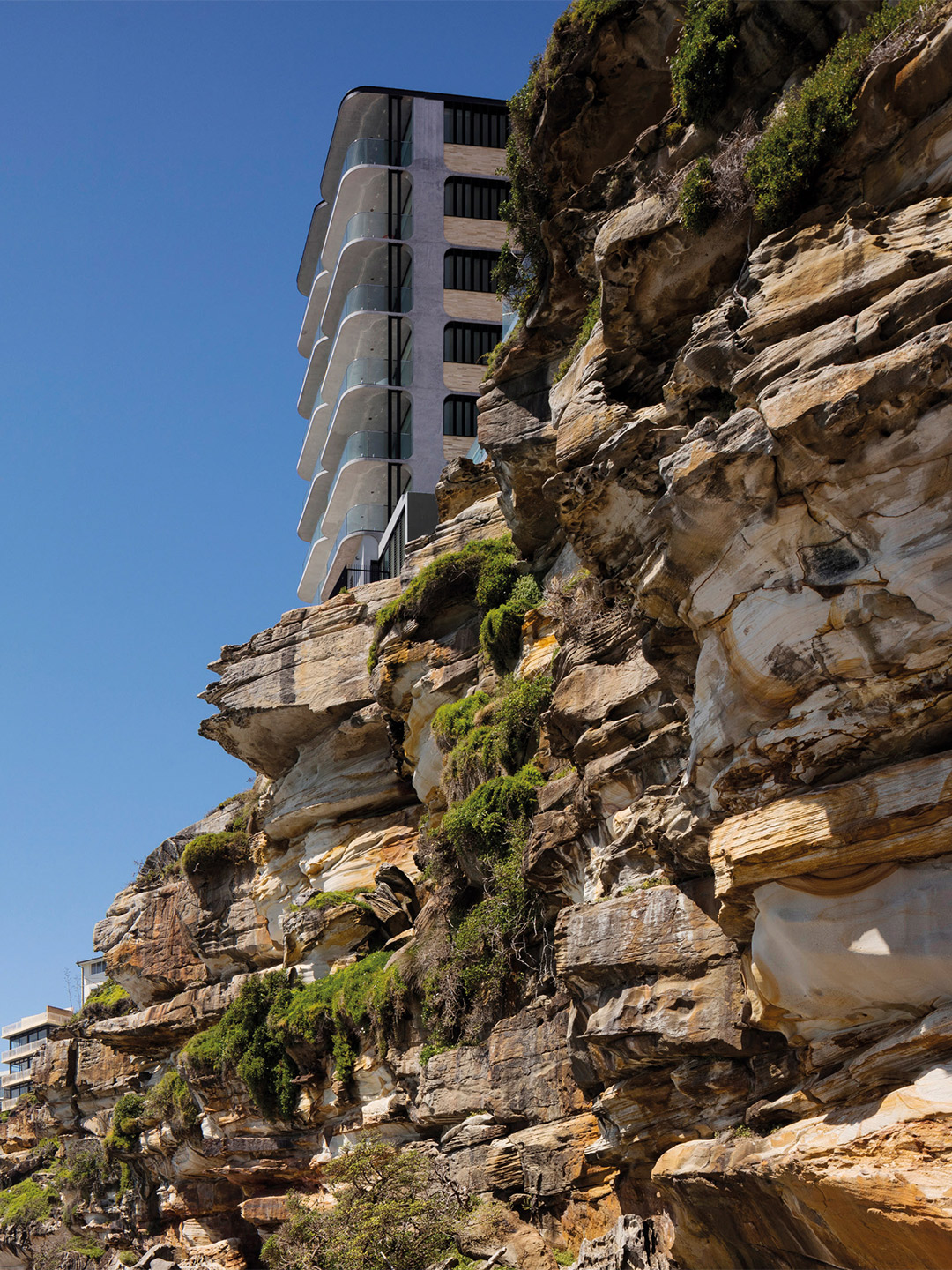
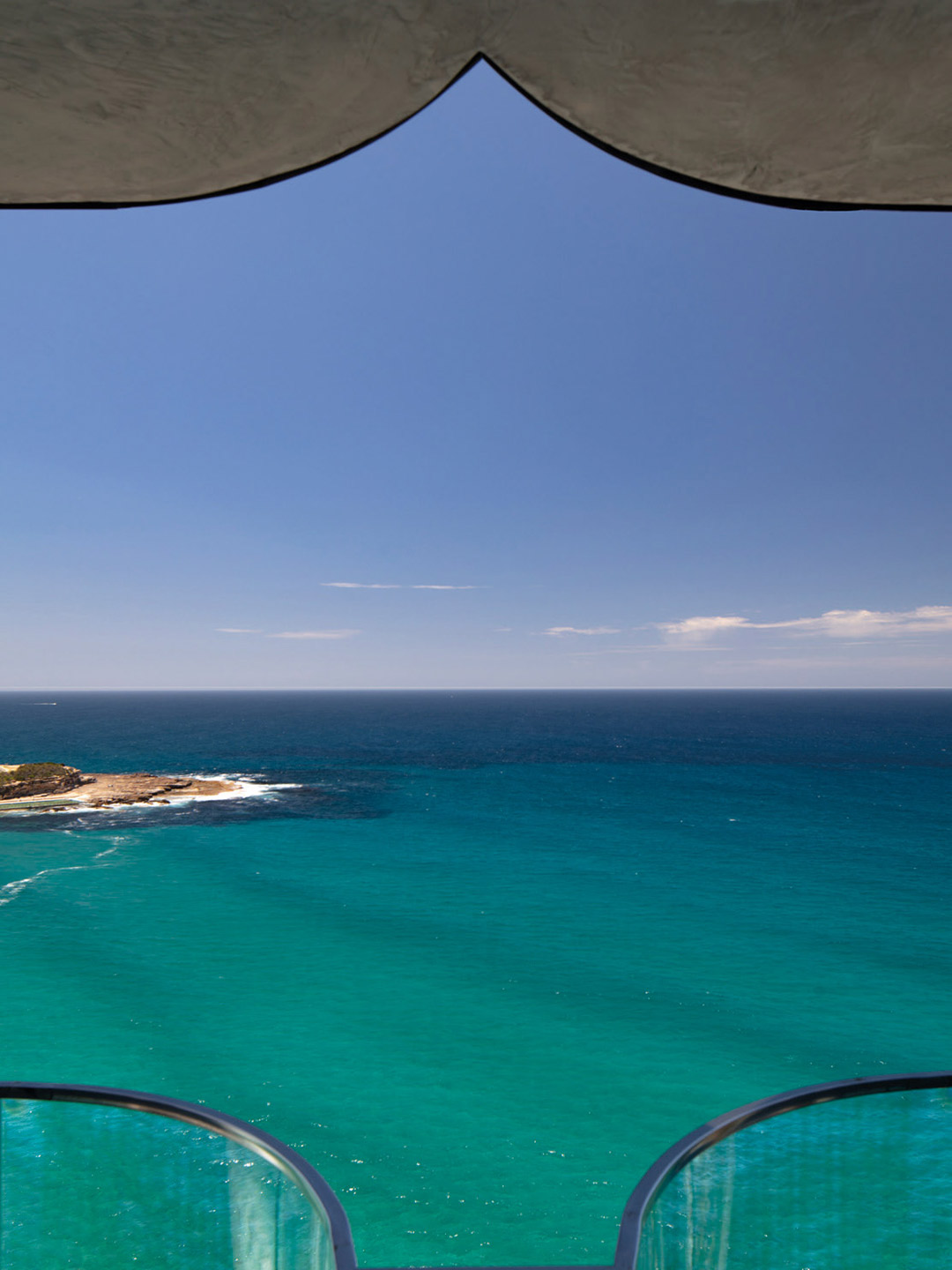
Pavilion Street residences in Queenscliff by SJB
Location Queenscliff, NSW
Function Apartments
Client DVB Projects
Architect SJB
Builder Impero Pacific Group Pty Ltd
Structural engineer Rincovitch Consultants
Services engineer EWFW Consulting Engineers
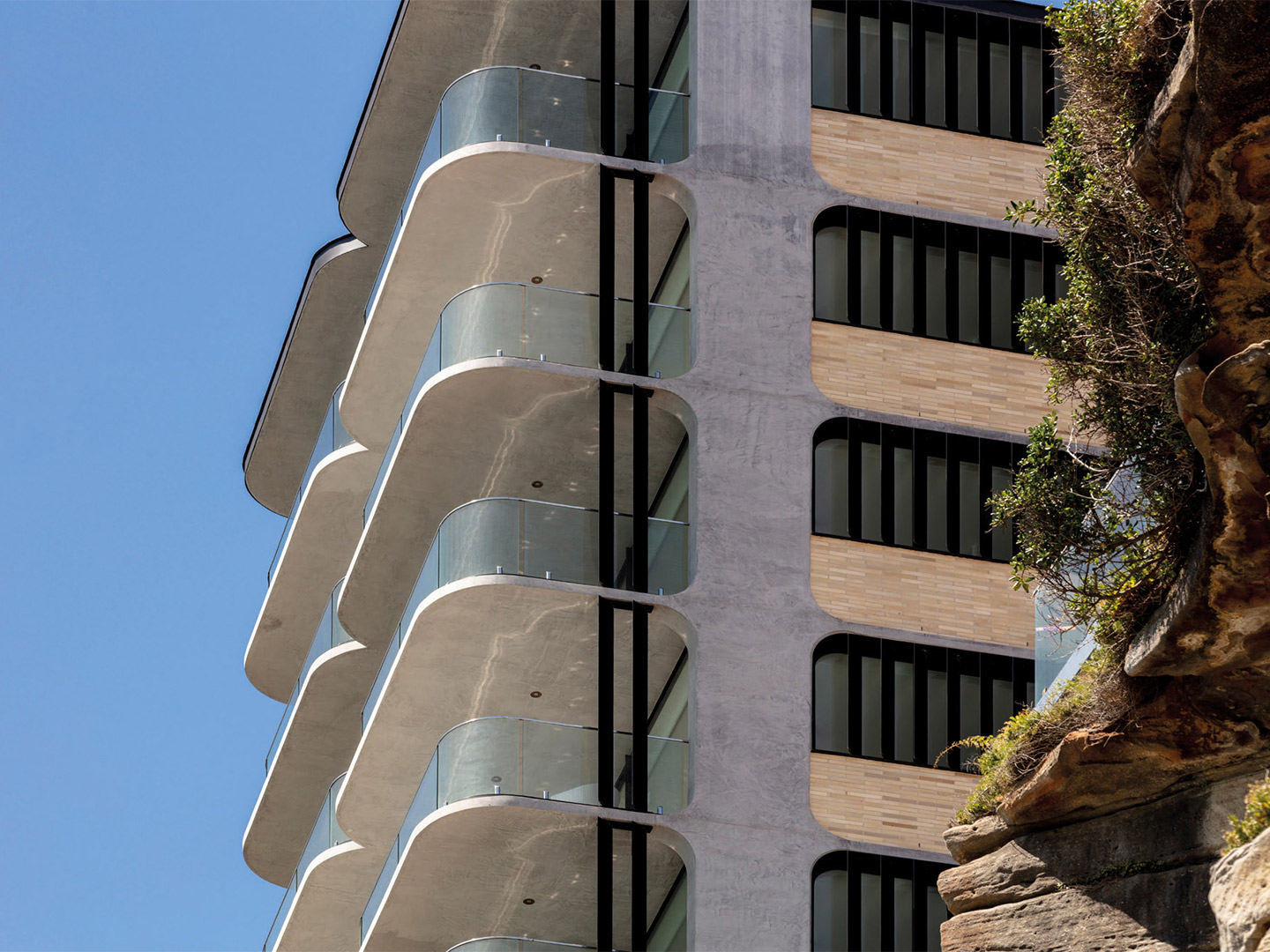
Expressed concrete slabs at the building’s edges tie the inset brick panels back into the rows of glazed windows along the north and south facades. These windows open out to the 180-degree views on offer to the residents. The demarcation between the apartment and the lift/stair zone was achieved with curved insets to the floor plate, further accentuated by the running board bond of the brickwork. Form design and materiality were chosen to animate the building yet also tone down its overwhelming scale, which typifies architecture of the 1950s.
Apartment residents enjoy large-scale uninterrupted views of Freshwater Beach, the South Pacific Ocean and Sydney city in the distance. The sandstone cliffs form a natural pedestal for this luxurious building, which puts it out and exposed in the open. This is offset by the subtle fine grain texture of the brickwork, creating comfort and a sense of shelter.
A refined and unique response to the site, Pavilion Street balances the individual need for retreat and privacy with a seamless connection to the vibrant surf culture of Sydney’s northern suburbs.
Pavilion Street residences by SJB is just one on many projects featured in Materialty 2021, a free cloth-bound publication from Brickworks that explores the use of brick and concrete block in contemporary architecture. Register for your free copy.
A refined and unique response to the site, Pavilion Street balances the individual need for retreat and privacy with a seamless connection to the vibrant surf culture of Sydney’s northern suburbs.
This article is an edited extract from Materiality 2021, a publication by Brickworks Building Products.
Catch up on more architecture highlights. Plus, subscribe to Daily Architecture News for weekly updates delivered directly to your inbox.
Related stories
- The bar and restaurant at La Sastrería in Valencia by Masquespacio.
- Resa San Mamés student accommodation in Spain by Masquespacio.
- Kennedy Nolan’s ‘Workplace’ puts the cool back into water-cooler conversation.
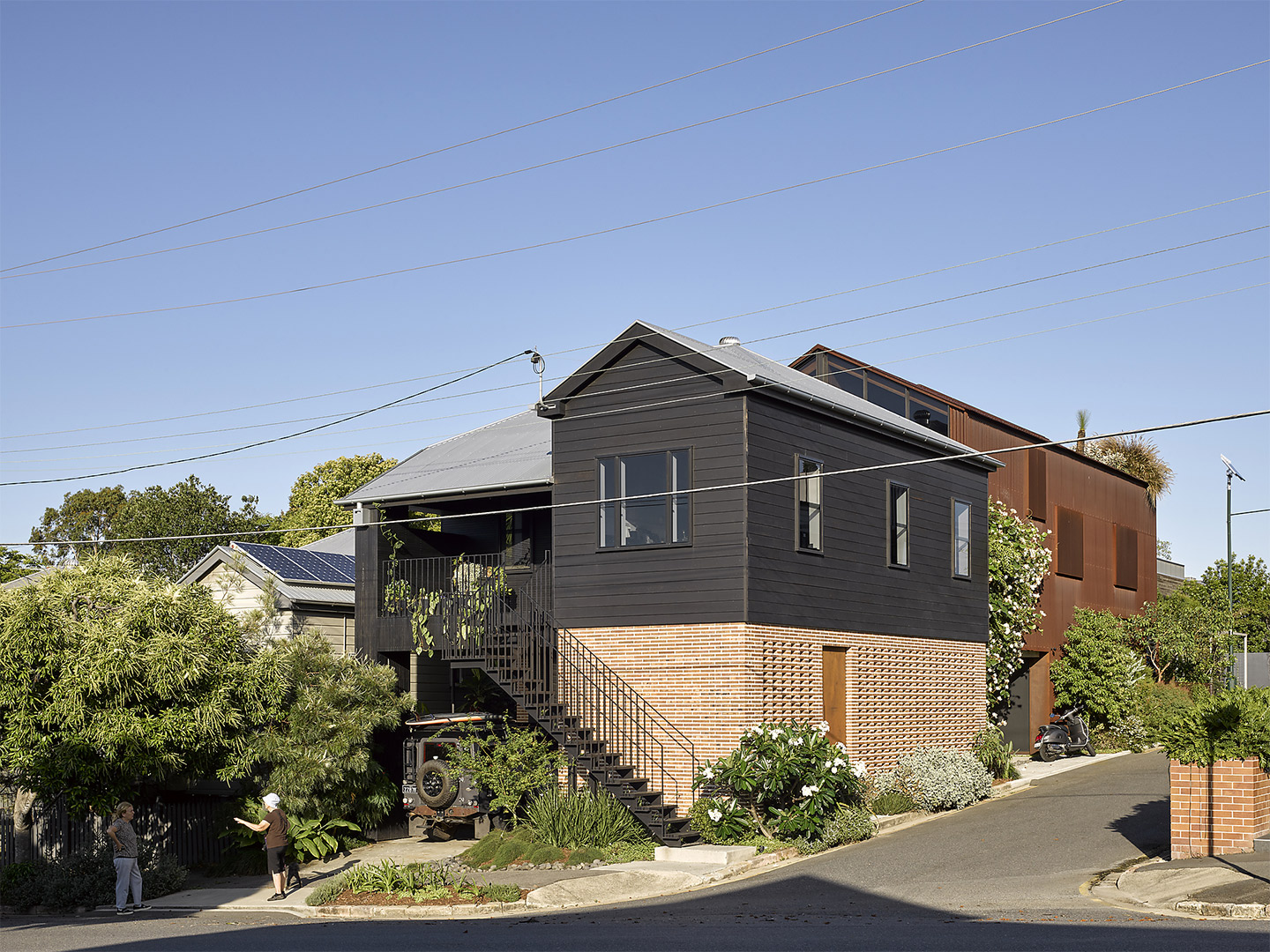
3 House by Channon Architects and Burton Architects explores the pragmatic versatility of masonry in medium density housing on small lots. Comprising an office, a granny flat and a family home, the project focusses on an adaptive plan, where the functions of its self-contained spaces can change when needed. Located on a corner block in New Farm, Brisbane, the site was already occupied by a four-room workers’ cottage. The reimagined cottage was the first dwelling to be developed, becoming an office with a granny flat and car park tucked underneath, followed by a separate 3-bedroom house with two-car garage constructed at the rear.
3 House by Channon Architects and Burton Architects
Location New Farm, Brisbane, Australia
Function Mixed residential
Client Owner-builder
Completion date 2020
Architects Channon Architects and Burton Architects
Builder Owner-builder
Landscape Owner
The owner-builders were intimately aware of the acoustic, fire and visual challenges of living on the street, and so they chose brick to mitigate these issues. Other benefits of brick include its low maintenance, sustainability and thermal performance. Furthermore, it addressed the contextual materiality of the area.
While cycling around the suburban outskirts, the bricklayers stumbled upon a small brickworks best known for their paving. After several visits and a test panel they ultimately produced a custom paver for the granny flat walls, with flash marks complementing the blackened timber of the upstairs workers’ cottage. The mortar is a lime-rich mix with a combination of several aggregates specifically developed by the bricklayers.
The owner-builders were intimately aware of the acoustic, fire and visual challenges of living on the street, and so they chose brick to mitigate these issues.
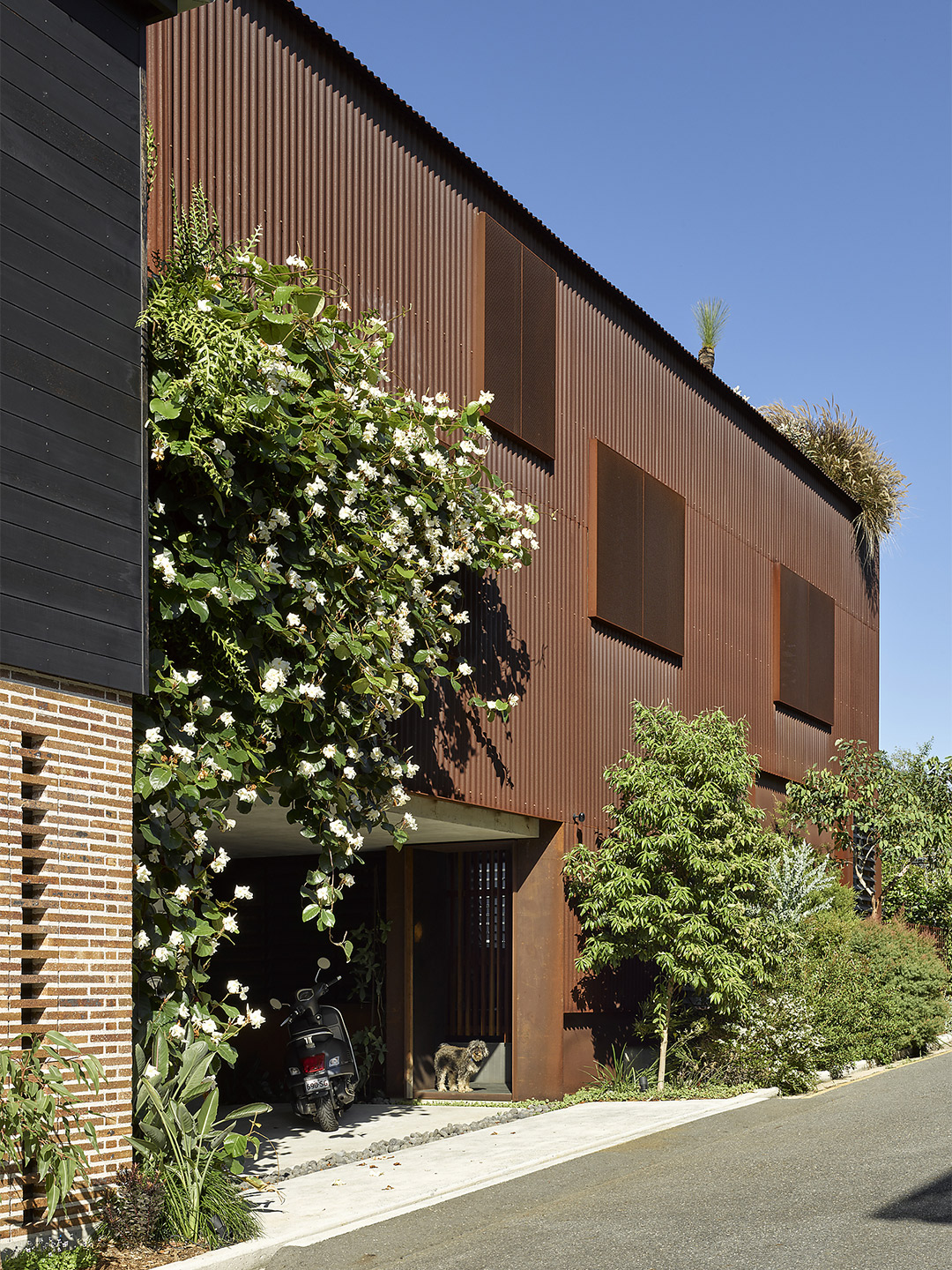
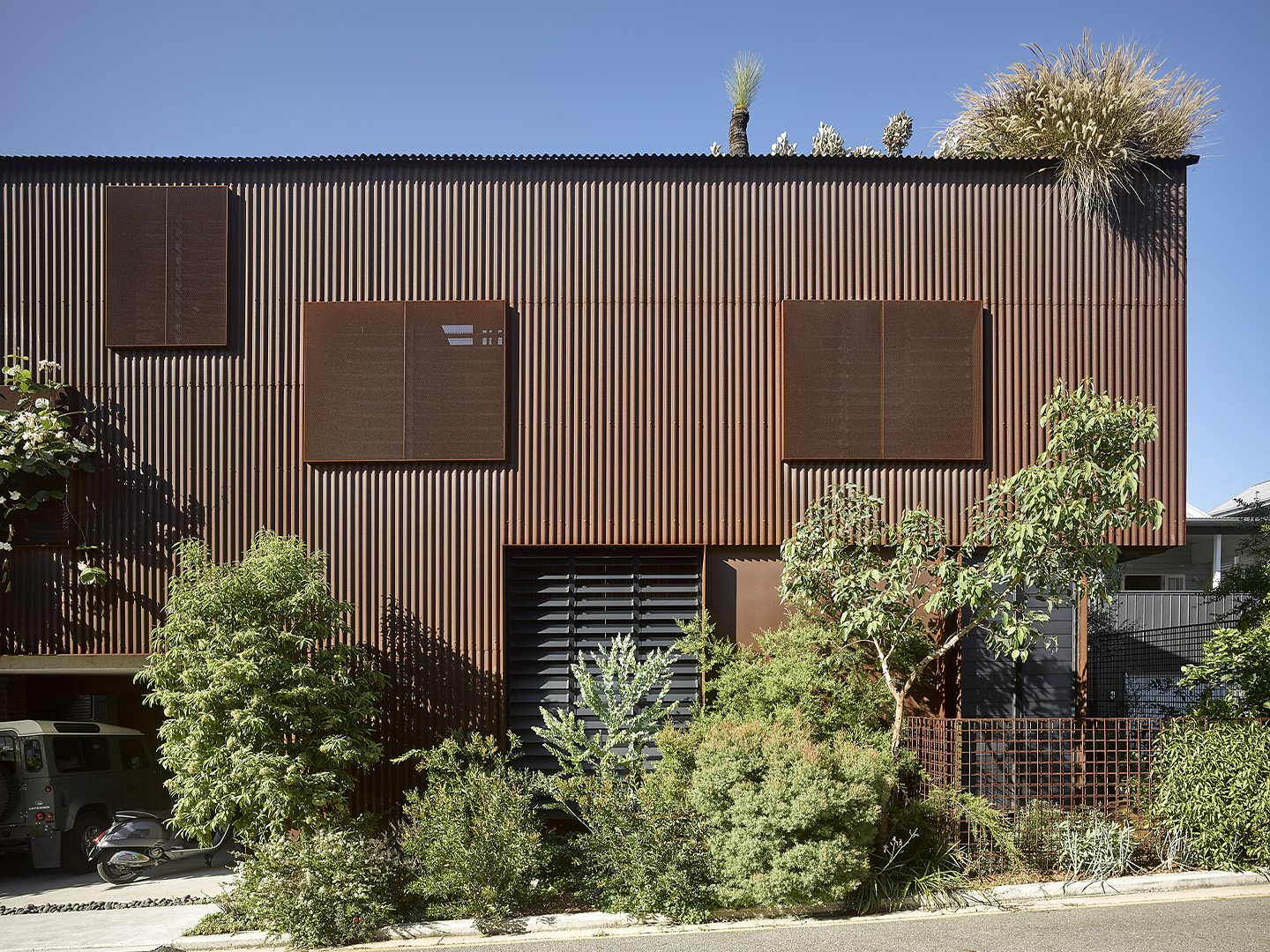
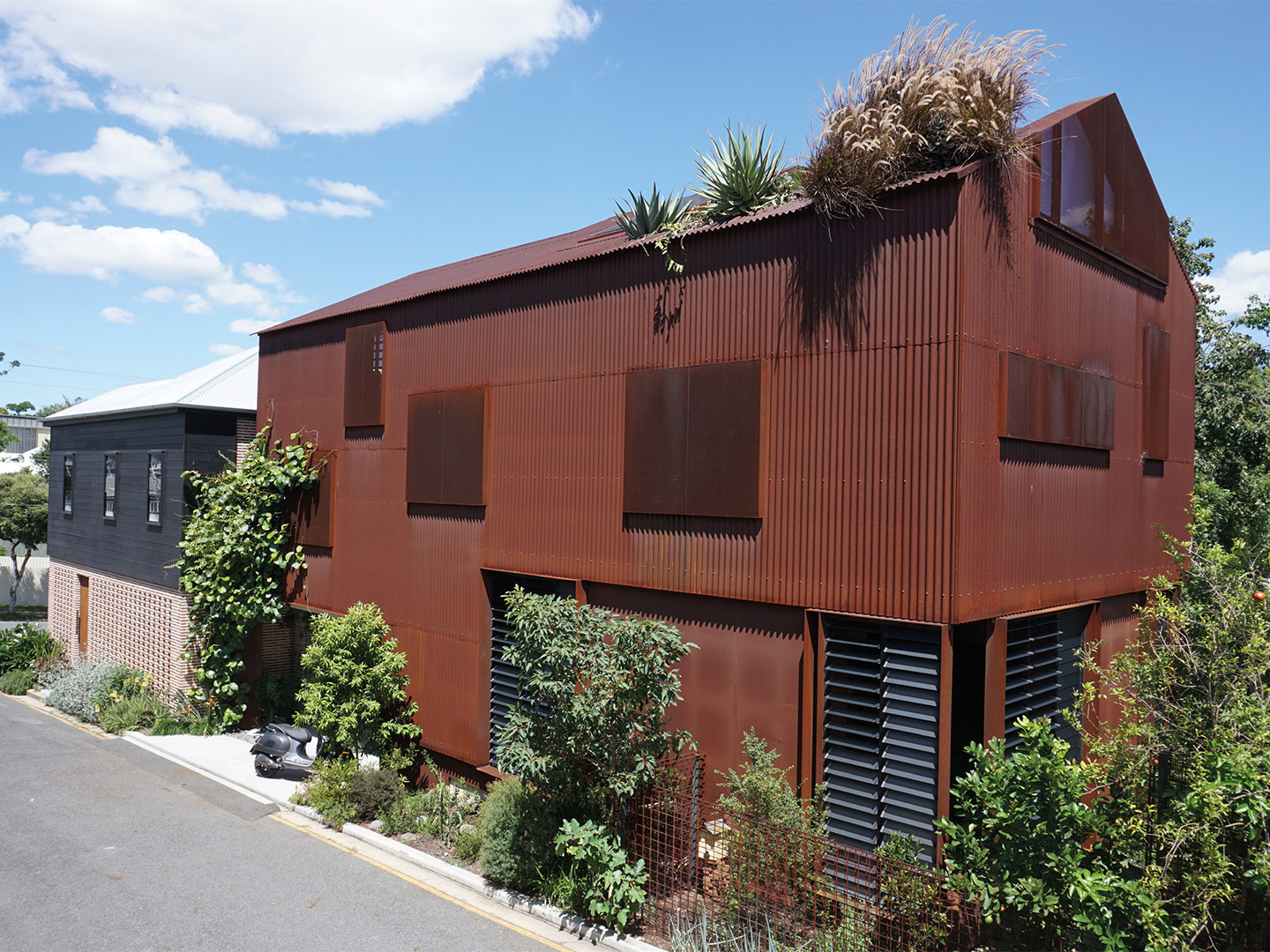
Thermal comfort was the design priority, as was sustainability through material longevity. Reverse block veneer was developed, and the initial idea to wrap the blockwork in a rain screen (to reduce thermal load) evolved into using custom weathered-steel cladding instead. The cladding is held off the blockwork with a layered frame of rigid insulation, creating a thermally stable “cold cave”.
With no air-conditioning, the architects have maximised cross-ventilation by utilising the blockwork and concrete to make oversized window openings. Privacy and safety issues are addressed with a combination of considered editing, custom double-etched louvre blades and expanded mesh screens. The combination of the rust-coloured cladding, grey translucent glass and rusted dragon-scale screens makes the building appear as a citadel.
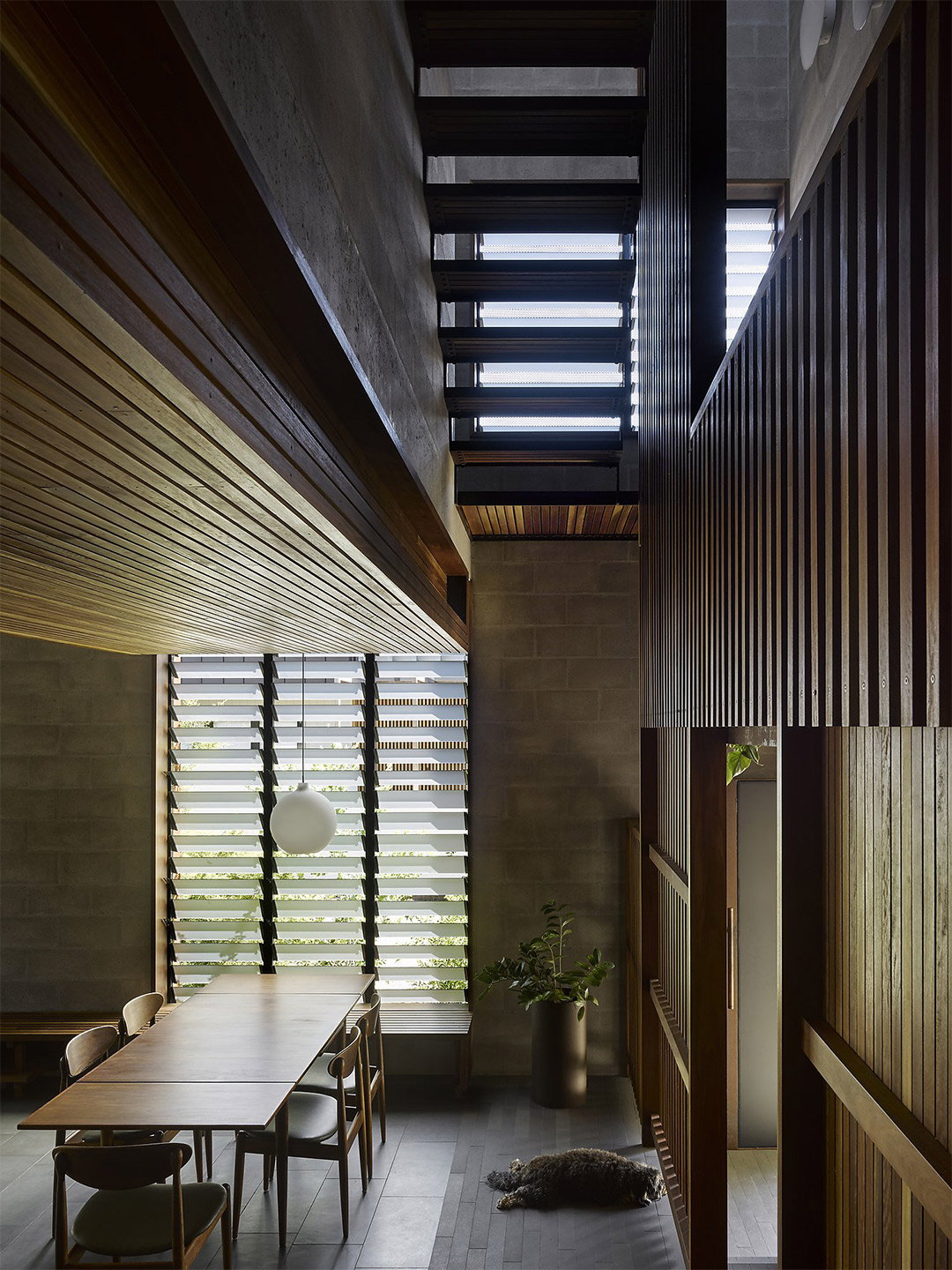
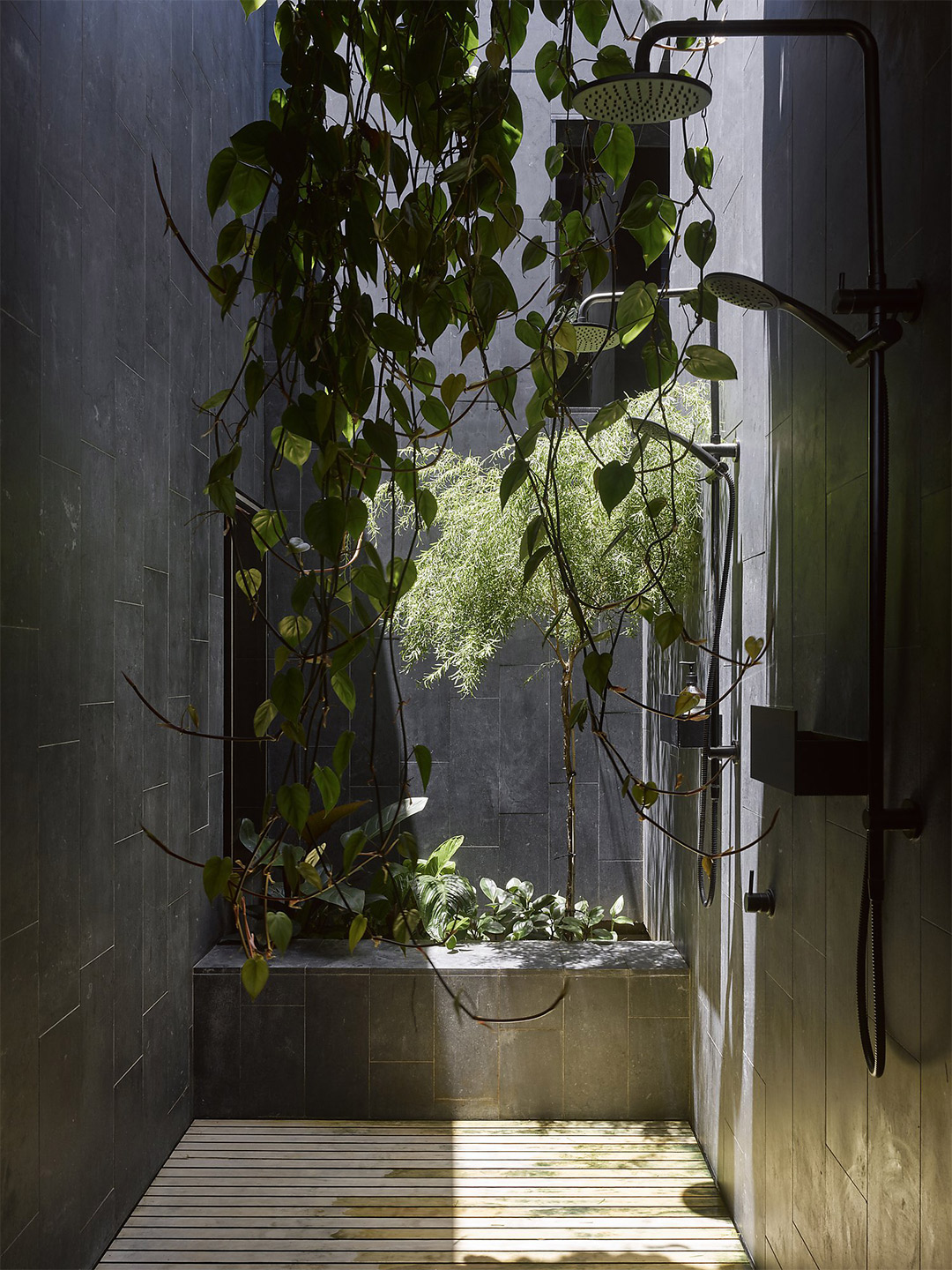
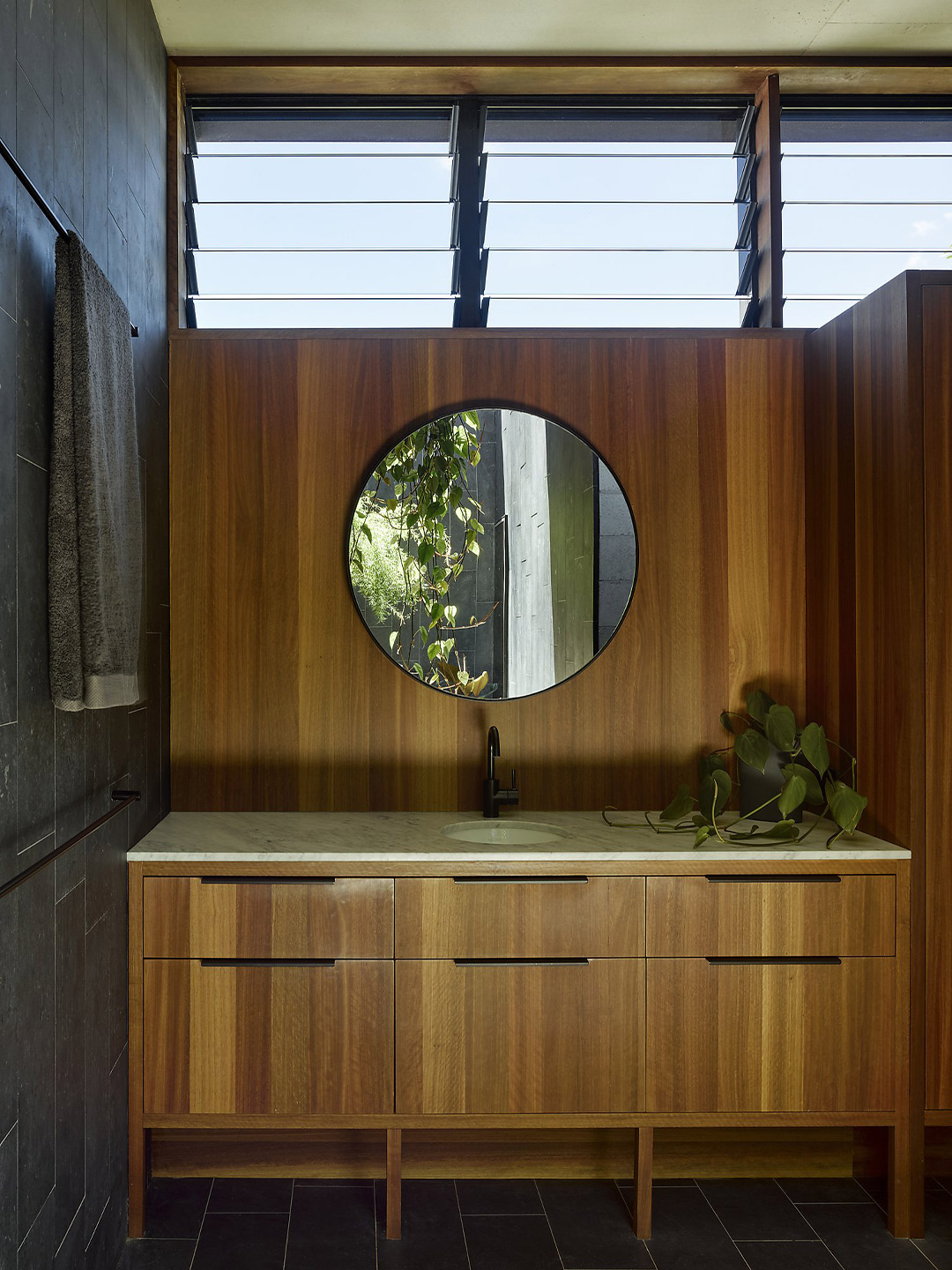
Inside, the oversized openings, etched glass and soft grey hand-honed blockwork walls create a cooling soft light. To reduce colour variation in the blockwork, all pieces were ordered from a single batch and as a single type. They were then modified to fit various desired formats. Blocks and block joints were processed to obtain a smooth face, with flecks of silica that glint in glancing light. As a finish, these blocks recede into the background, and serve as a foil to the deep richness of spotted gum timber used throughout the house.
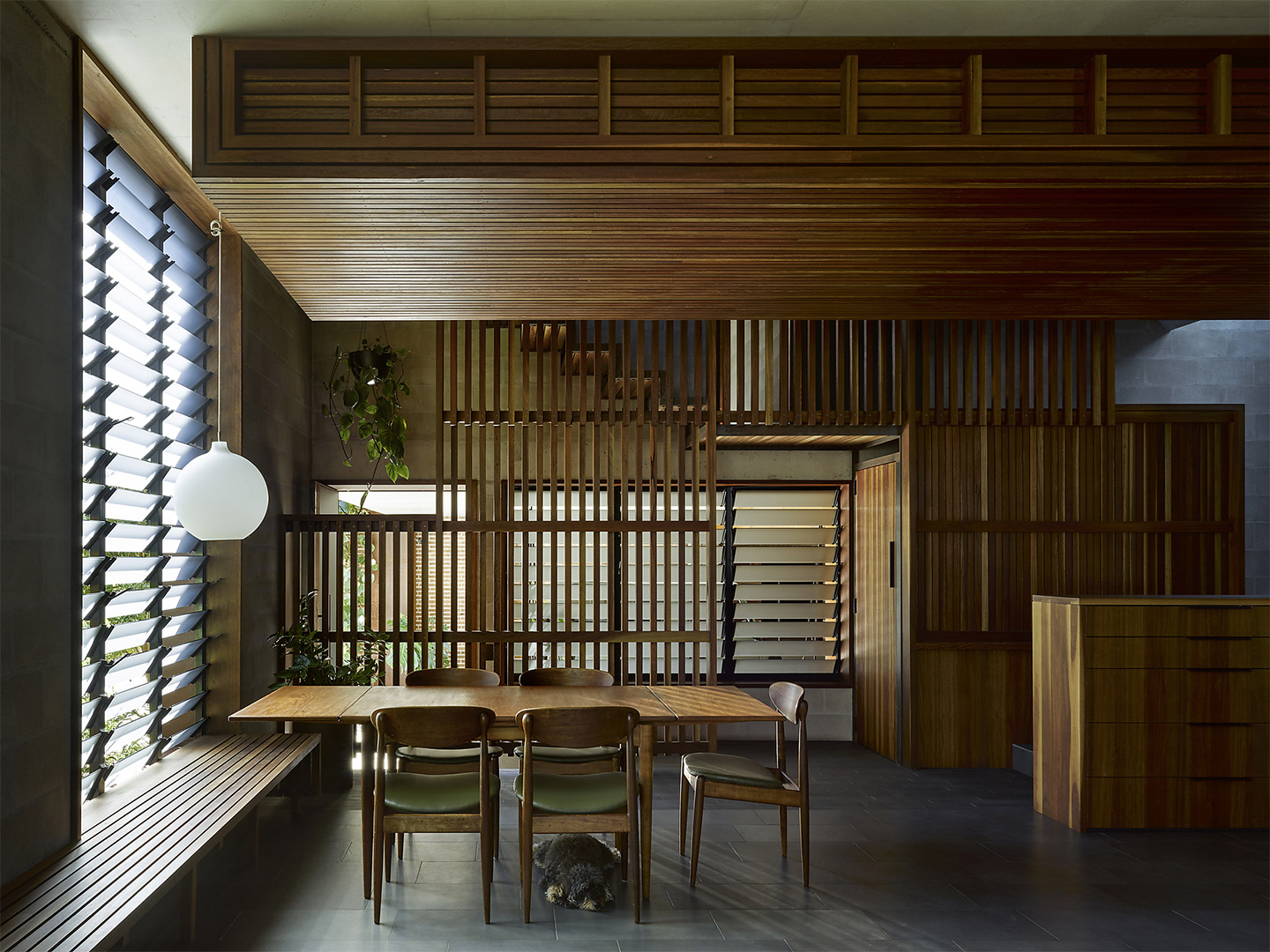
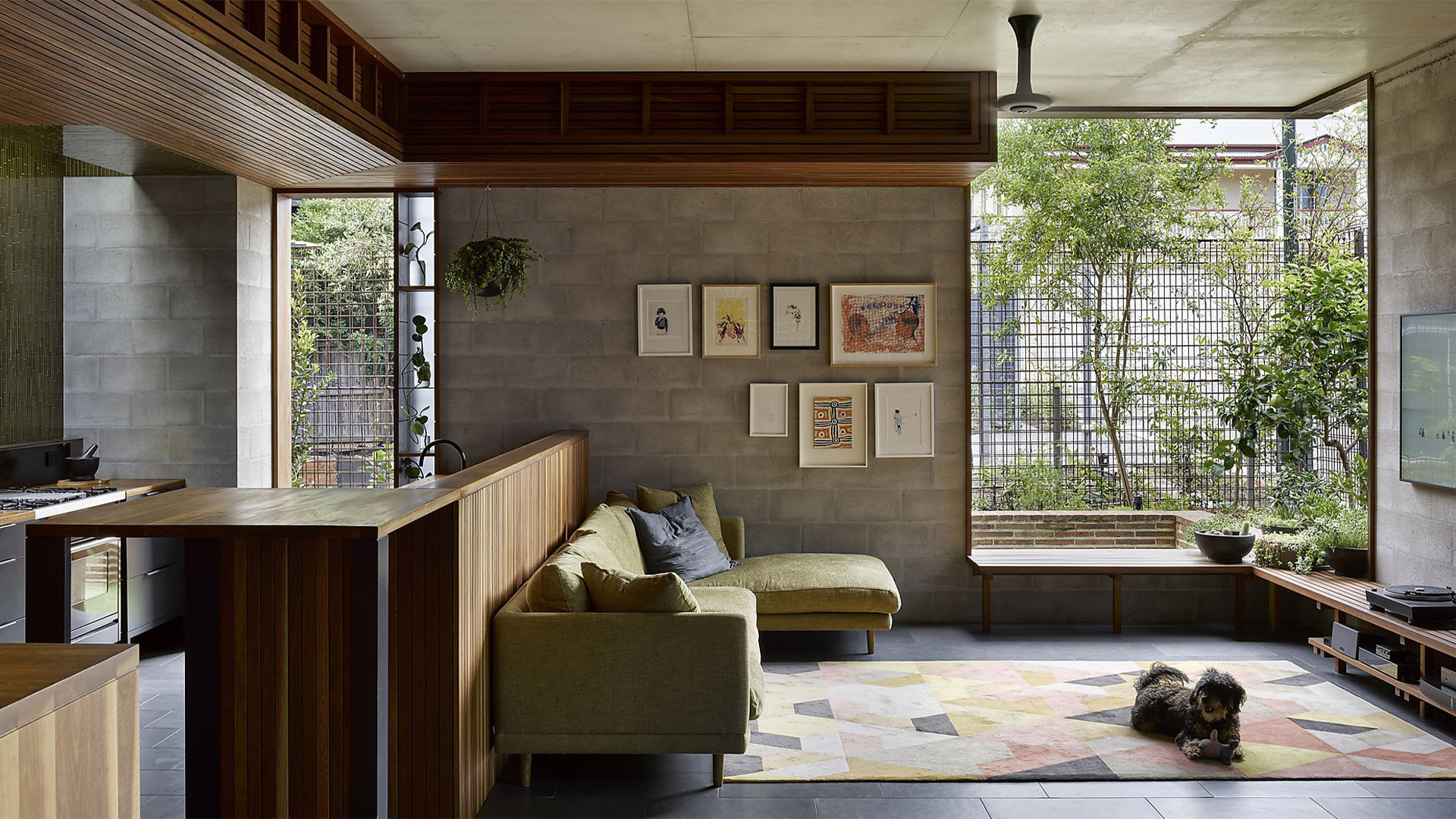
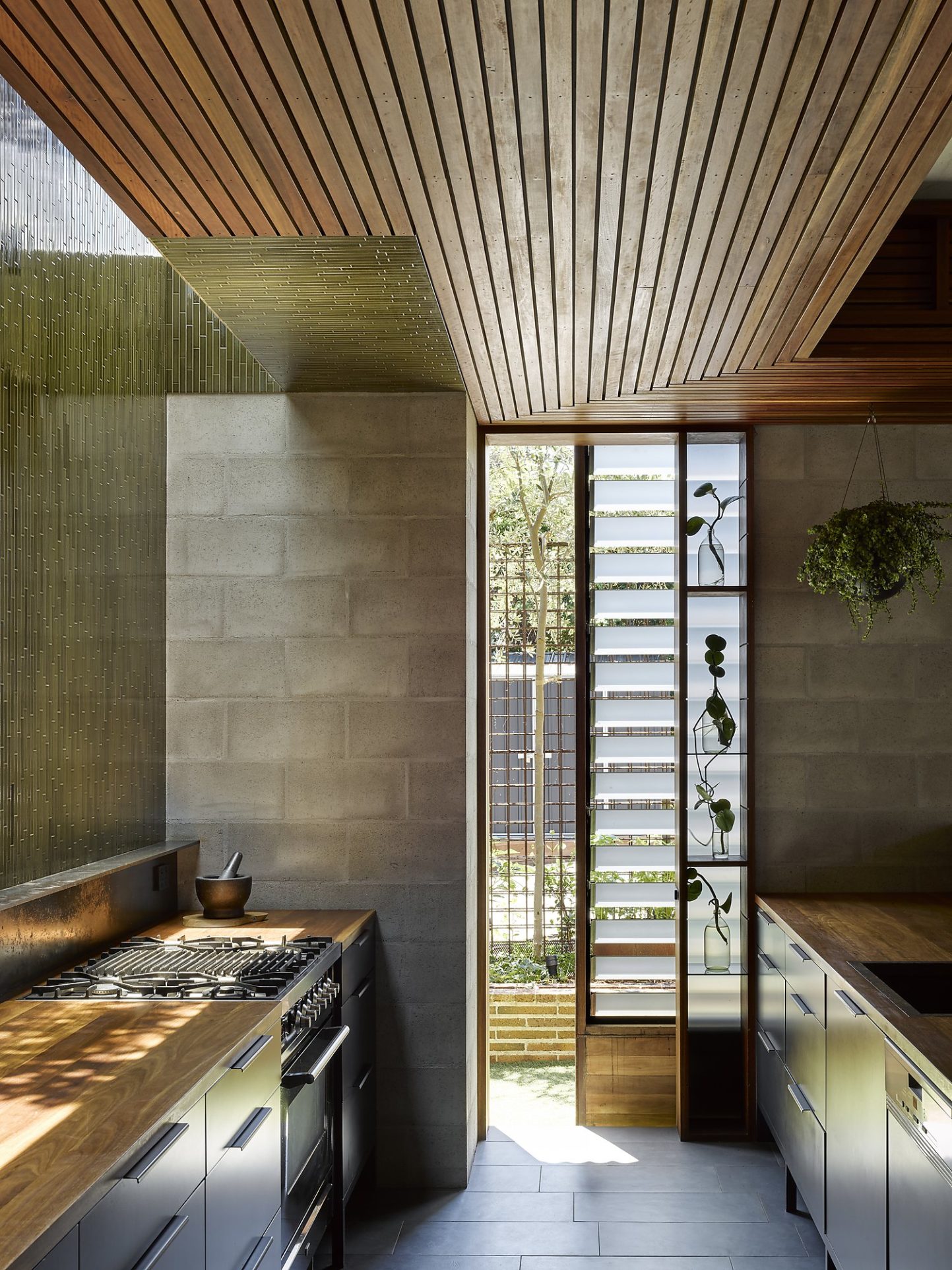
The new house at the rear was originally imagined as a double-skin brick structure with concrete floors, but this plan evolved to include the use of grey blocks. Careful consideration was then given to the versatility of both blockwork and concrete, as both structure and finish. It was built as two vertical wings and split over five levels – the cars, rumpus room and kids’ bedrooms on one side, and the living room, adults’ bedroom and roof terrace on the other.
The staircase is central to the layout and acts as a vertical corridor rising 6.8 metres to the roof terrace. To achieve council compliance with building heights, its uppermost landing has been detailed as a “thermal chimney” (since chimneys are not assessable for height). When opened, the effect is an instantaneous breeze that is drawn in and flows throughout the building. The steel framed stairs are hung from the blockwork, and have batten treads with gaps to maximise air flow associated with the chimney effect, also allowing filtered light to dapple the blockwork walls.
For the granny flat, its only opening is a masonry veil running the length of its north elevation, made of screen, cavity and double masonry wall with translucent glass. Although this wall tightens the already narrow room, it also gives the occupant control of privacy, light and ventilation. At night, the lit interior makes it the gatehouse for the lane, softly illuminating the street corner.
3 House by Channon Architects and Burton Architects is just one on many projects shortlisted in this year’s Houses Awards. It’s also featured in Materialty 2021, a free cloth-bound publication from Brickworks that explores the use of brick and concrete block in contemporary architecture. Register for your free copy.
channonarchitects.com.au; burtonarchitects.com.au; housesawards.com.au
This article is an edited extract from Materiality 2021, a publication by Brickworks Building Products.
Catch up on more architecture highlights. Plus, subscribe to Daily Architecture News for weekly updates delivered directly to your inbox.
Related stories
- The bar and restaurant at La Sastrería in Valencia by Masquespacio.
- Resa San Mamés student accommodation in Spain by Masquespacio.
- Kennedy Nolan’s ‘Workplace’ puts the cool back into water-cooler conversation.
3 House by Channon Architects and Burton Architects explores the pragmatic versatility of masonry in medium density housing on small lots. Comprising an office, a granny flat and a family home, the project focusses on an adaptive plan, where the functions of its self-contained spaces can change when needed. Located on a corner block in New Farm, Brisbane, the site was already occupied by a four-room workers’ cottage. The reimagined cottage was the first dwelling to be developed, becoming an office with a granny flat and car park tucked underneath, followed by a separate 3-bedroom house with two-car garage constructed at the rear.
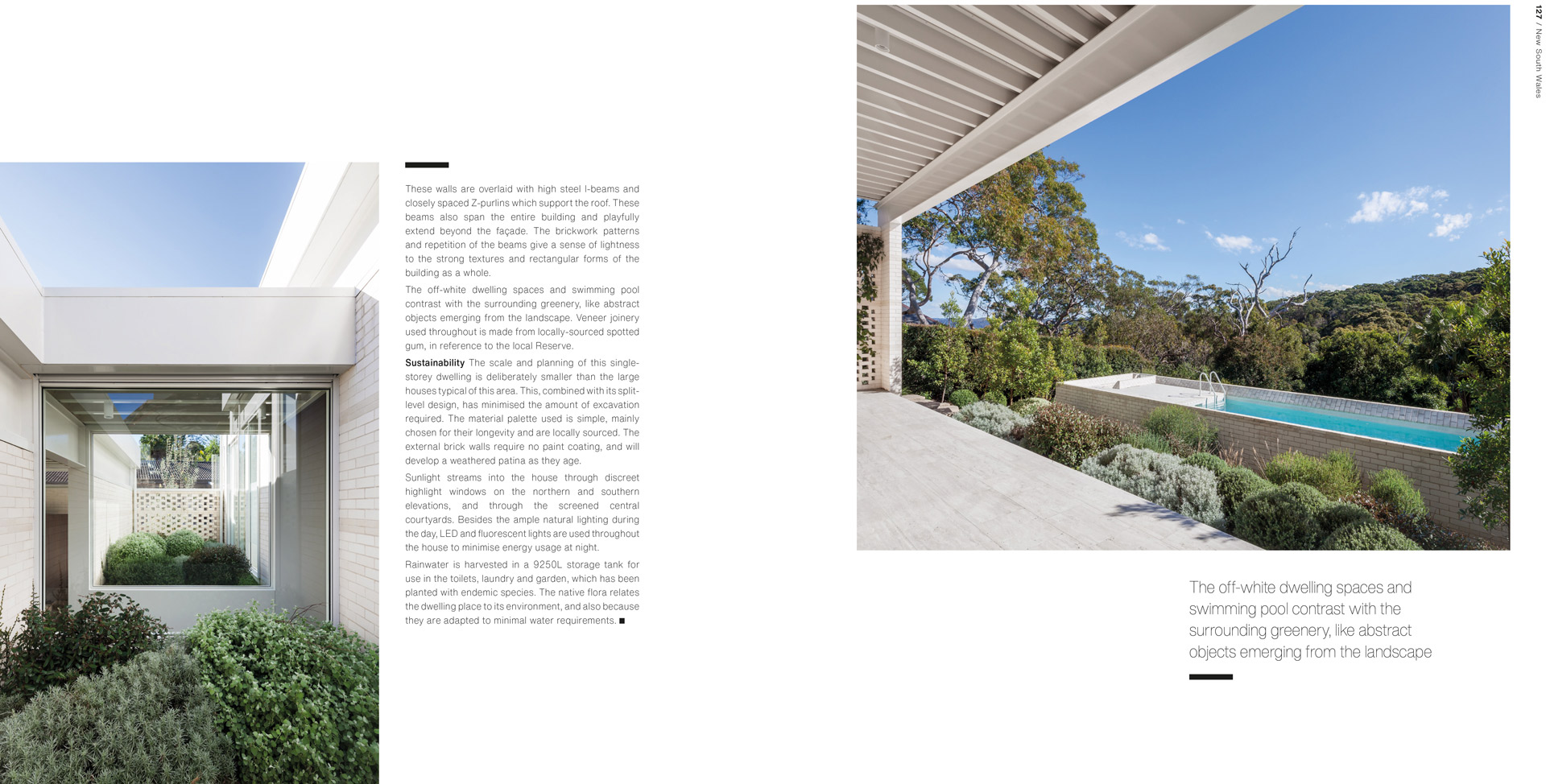
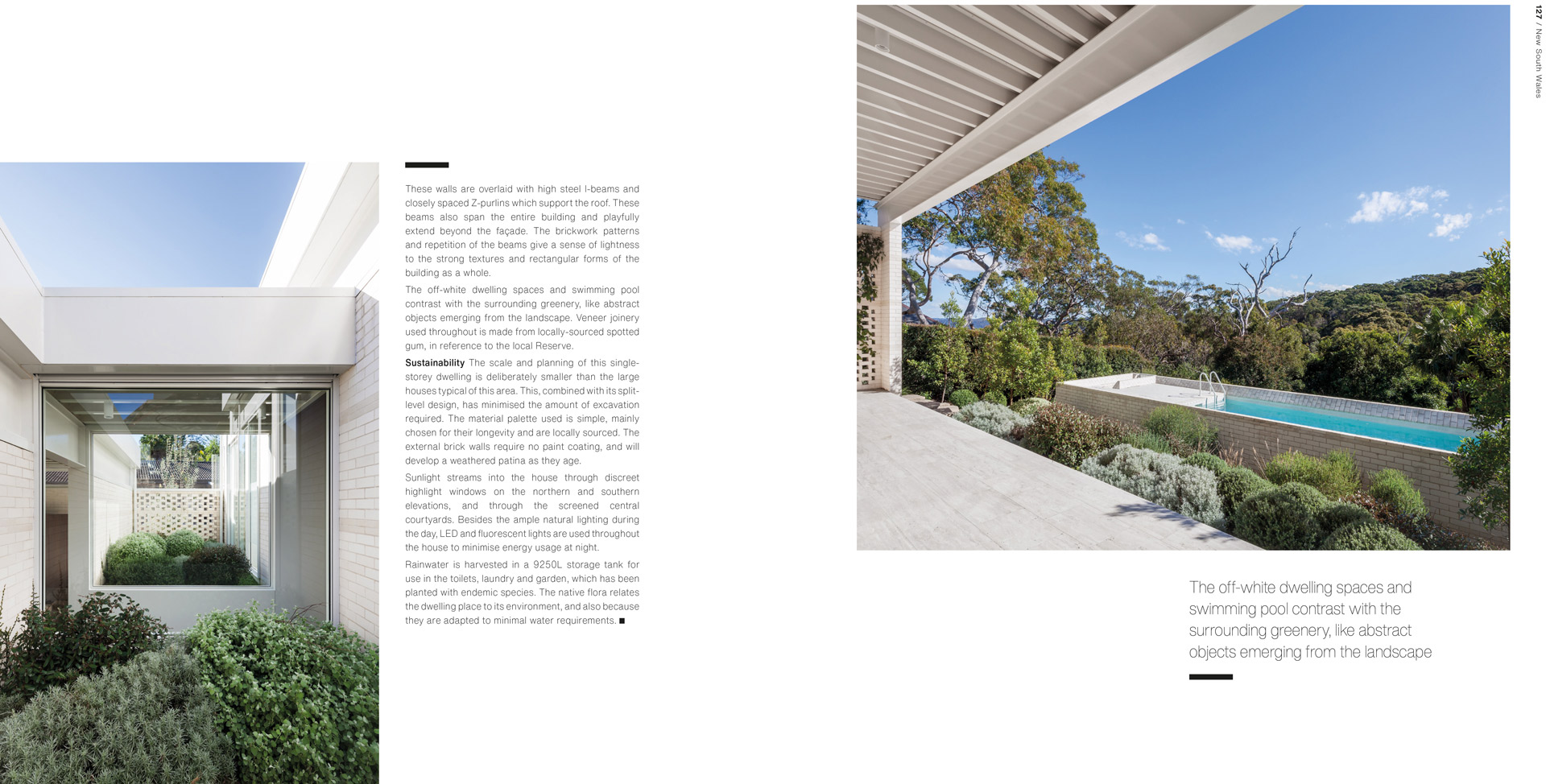
The house plan is arranged simply around a central corridor, with bedrooms to each side and an open living space at the rear overlooking the reserve. It is shaped as a series of textured rectilinear volumes, stepping down the sloping site in split levels. Inside, the feeling is of seclusion within its bush setting, despite its close proximity to neighbouring dwellings. The bedrooms have fans, and cross-ventilation comes from the central courtyards adjoining each of them.
Stewart House by Chenchow Little Architects
Location Palm Beach, Sydney
Function Residential
Client/owner Private
Completion date 2011
Architect Chenchow Little Architects
Builder Pacific Plus Constructions
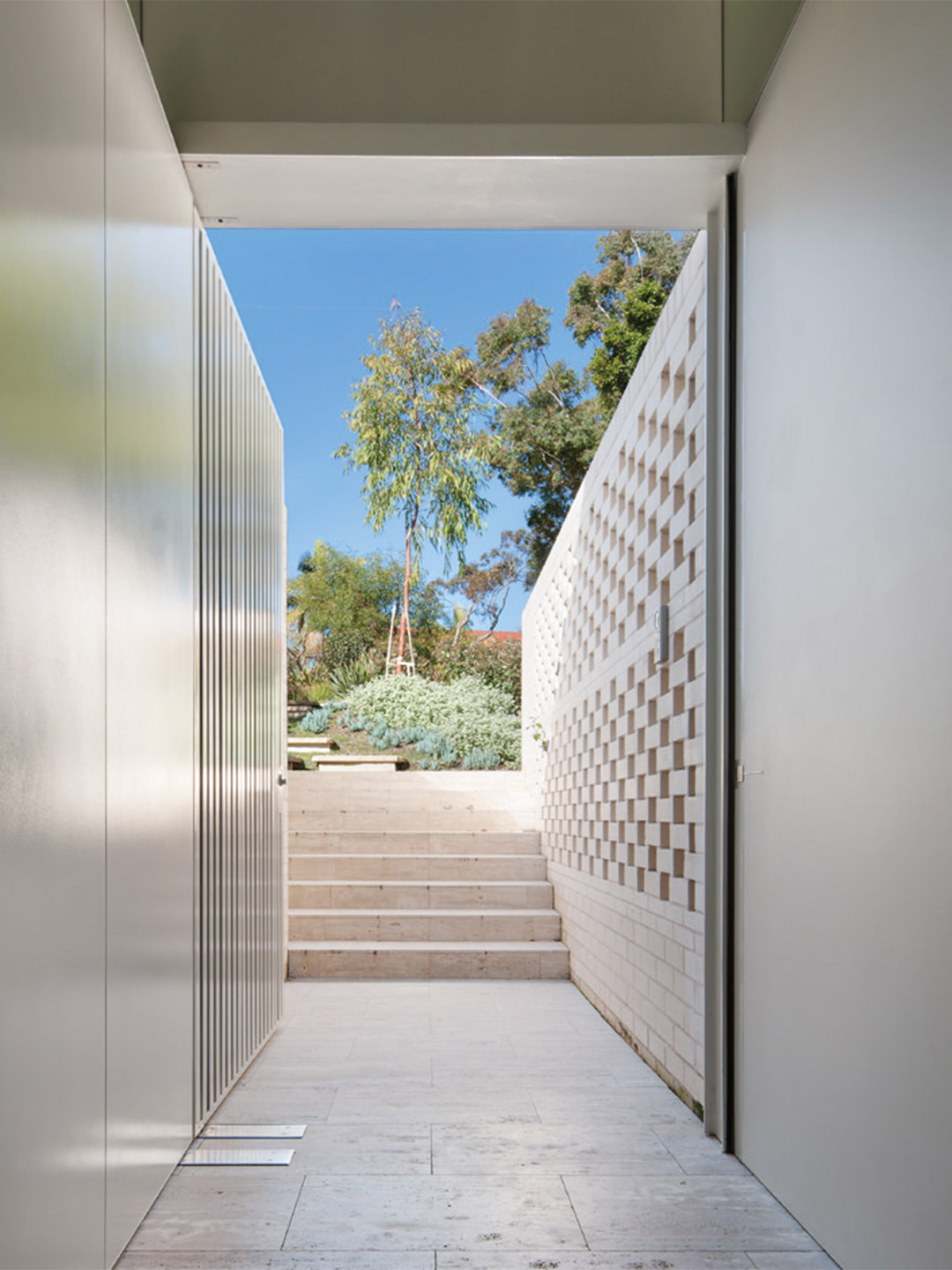
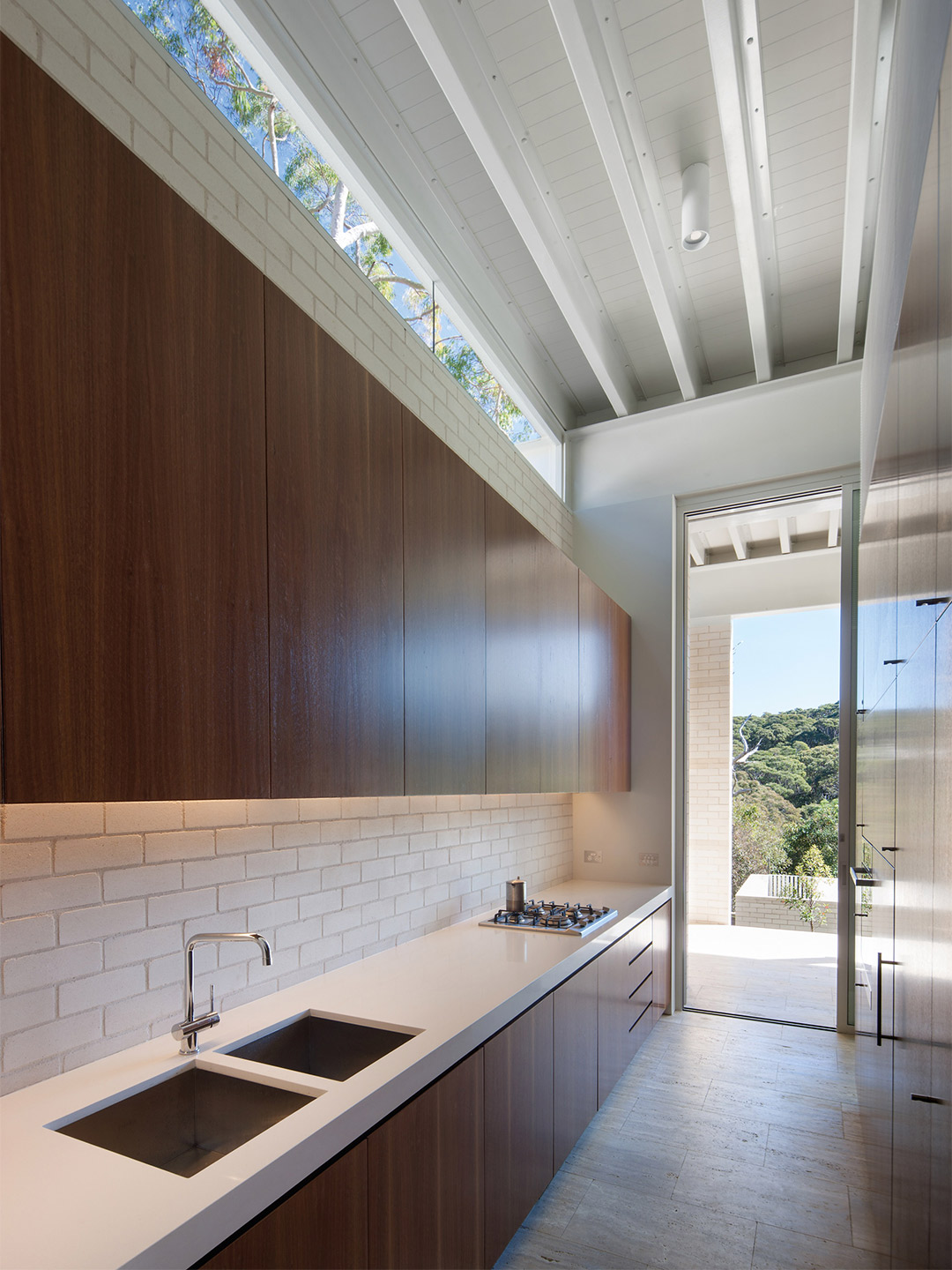
Materials were chosen based on their fire-resistance properties and thermal mass. The walls are made entirely of insulated face bricks, floors are stone tiles (travertine) on concrete slabs, and the roof is fire rated and well insulated. The external bushfire shutters also provide shade during the summer.
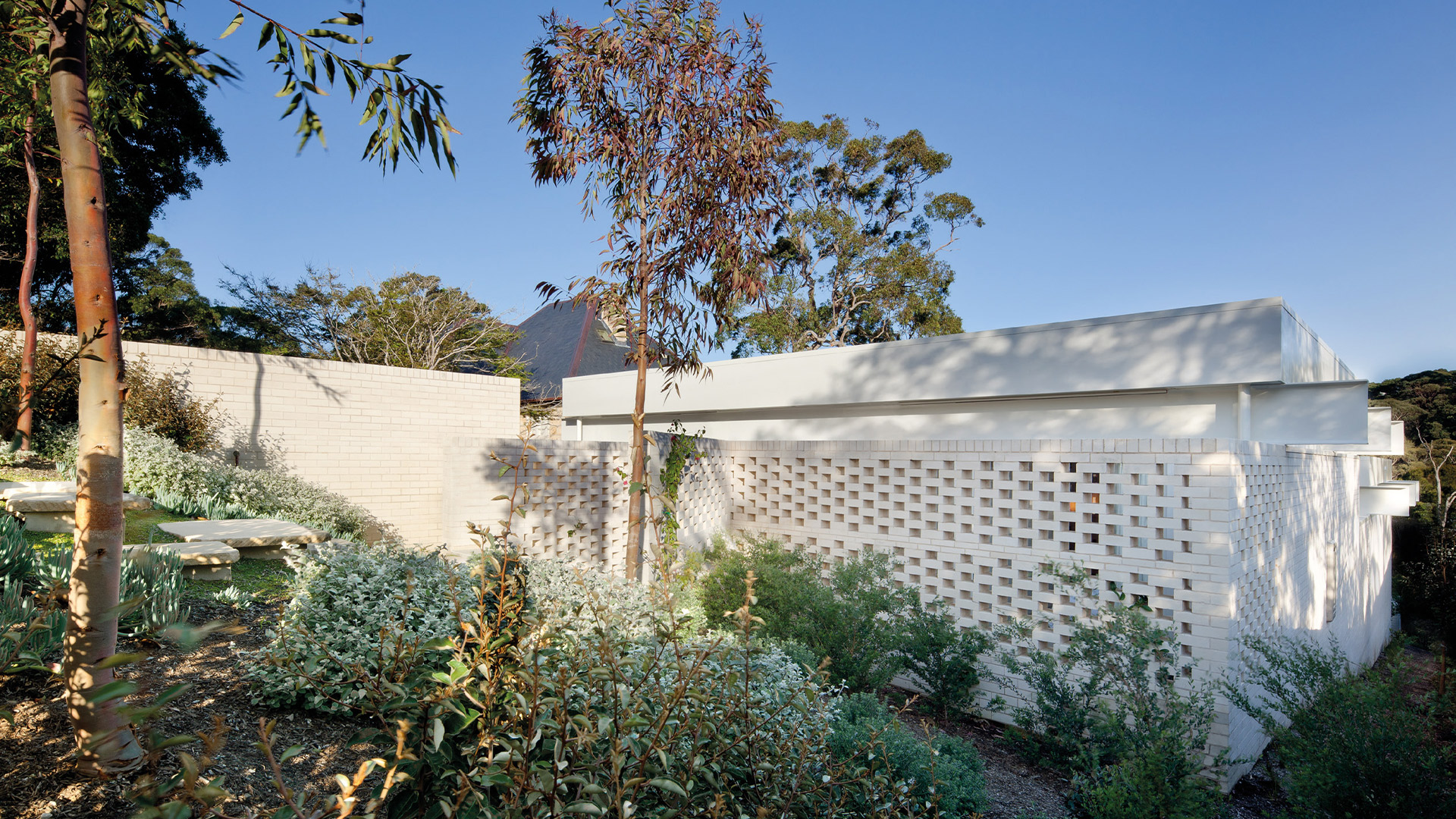
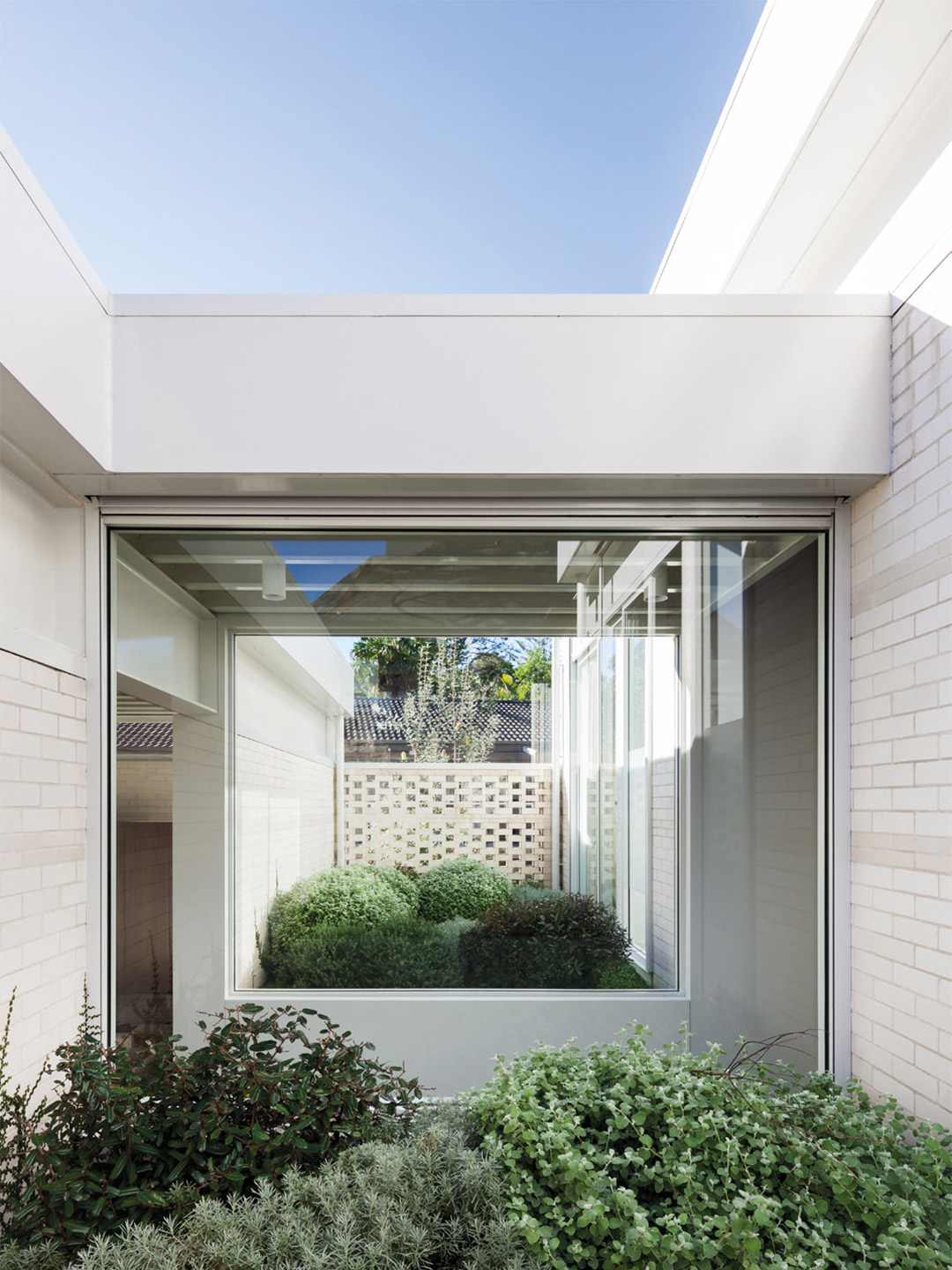
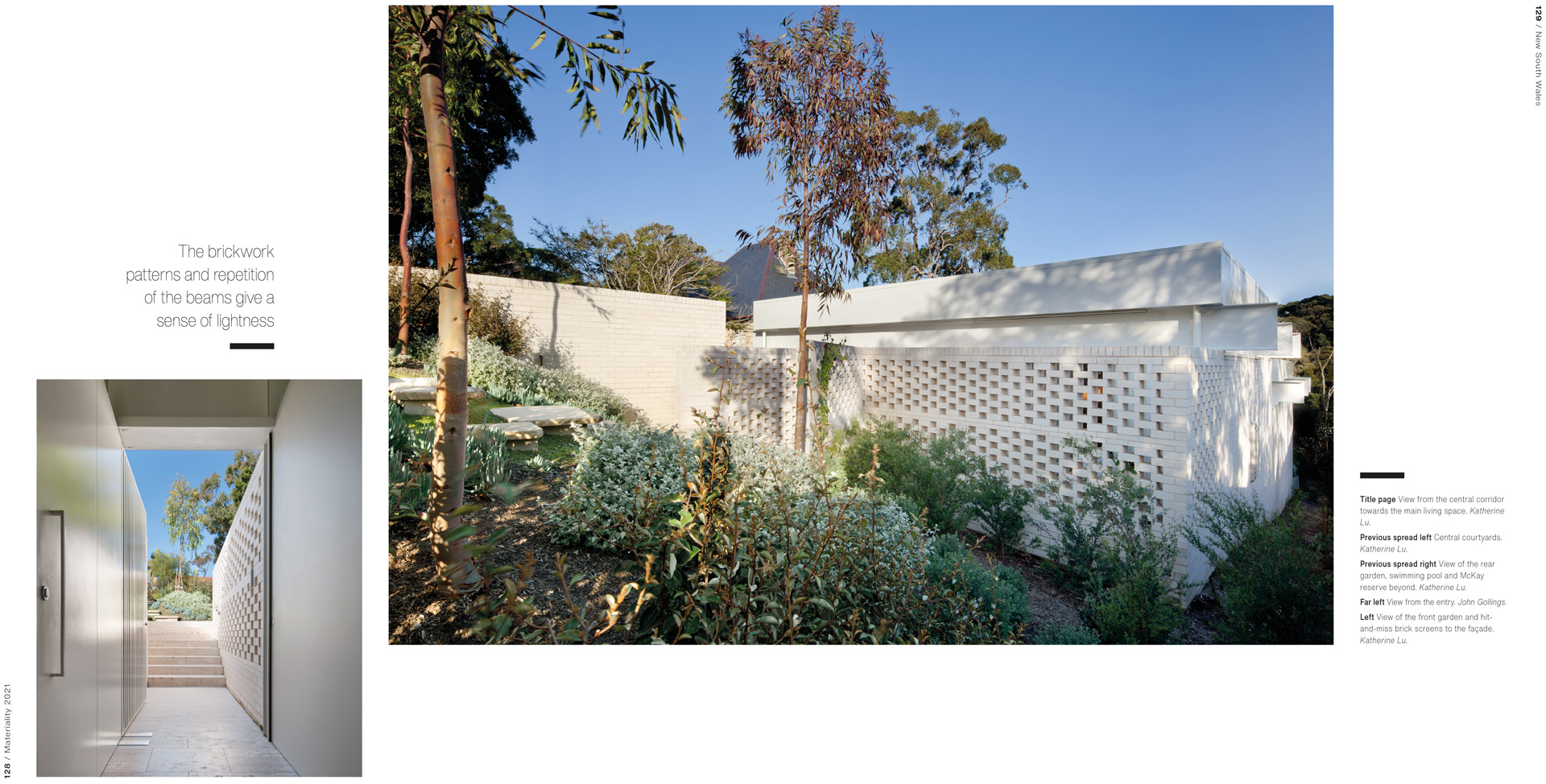
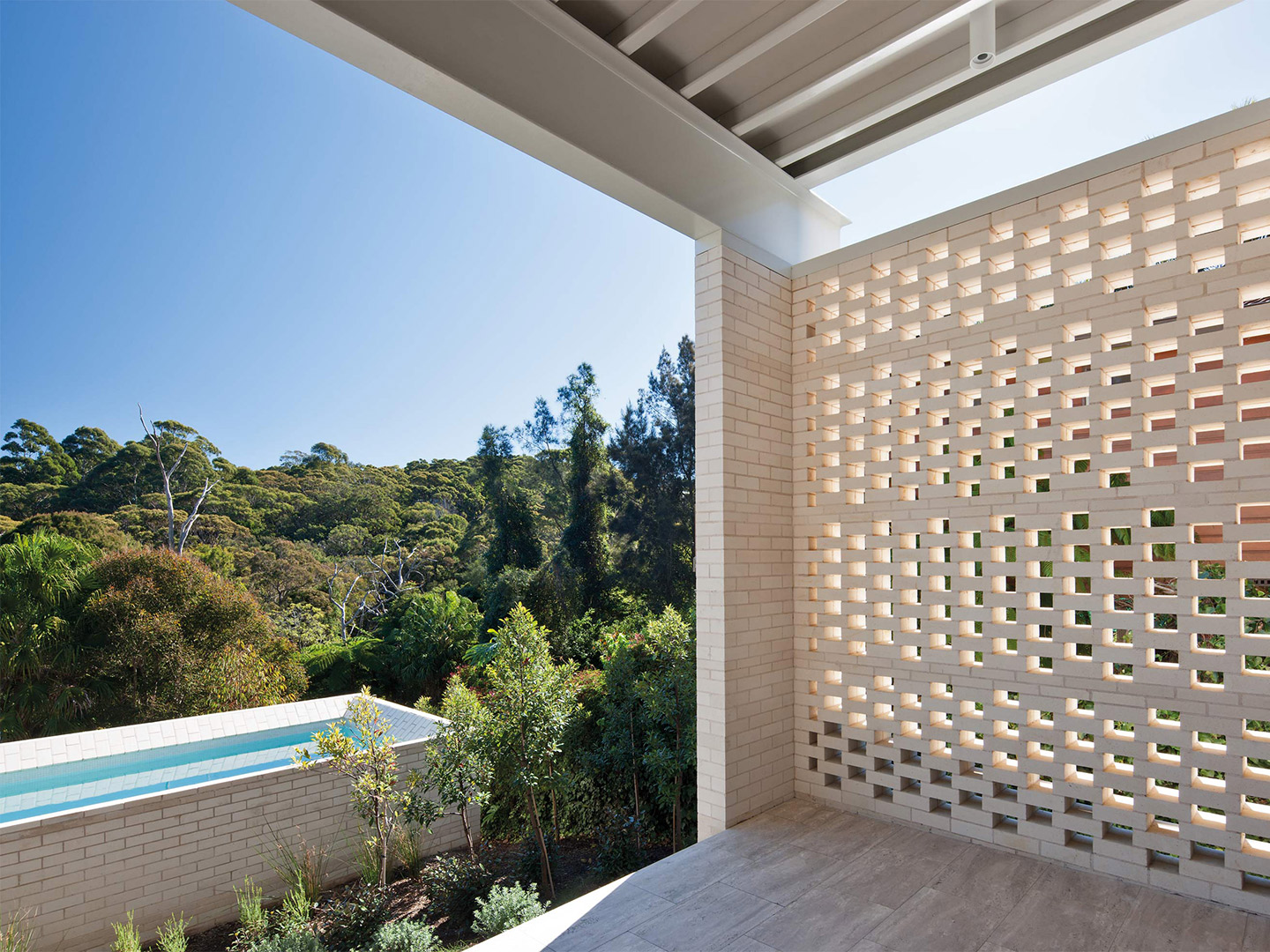
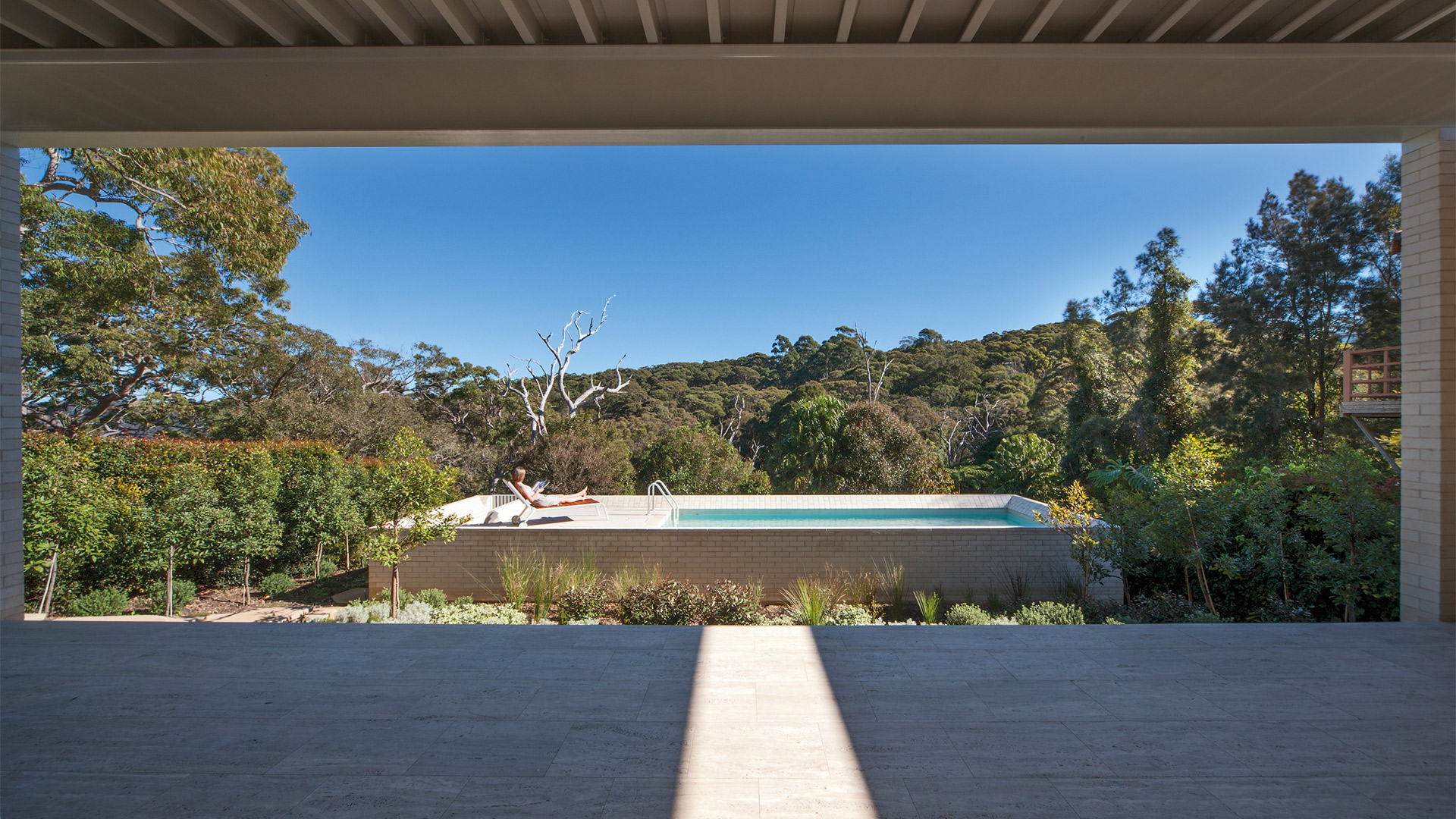
The brick walls incorporate horizontal bands of 50mm bricks, and a ‘hit- and-miss’ screen to the external courtyards and terraces. This provides privacy while still allowing the breeze to pass through. The walls for the swimming pool and its coping are made in the same way.
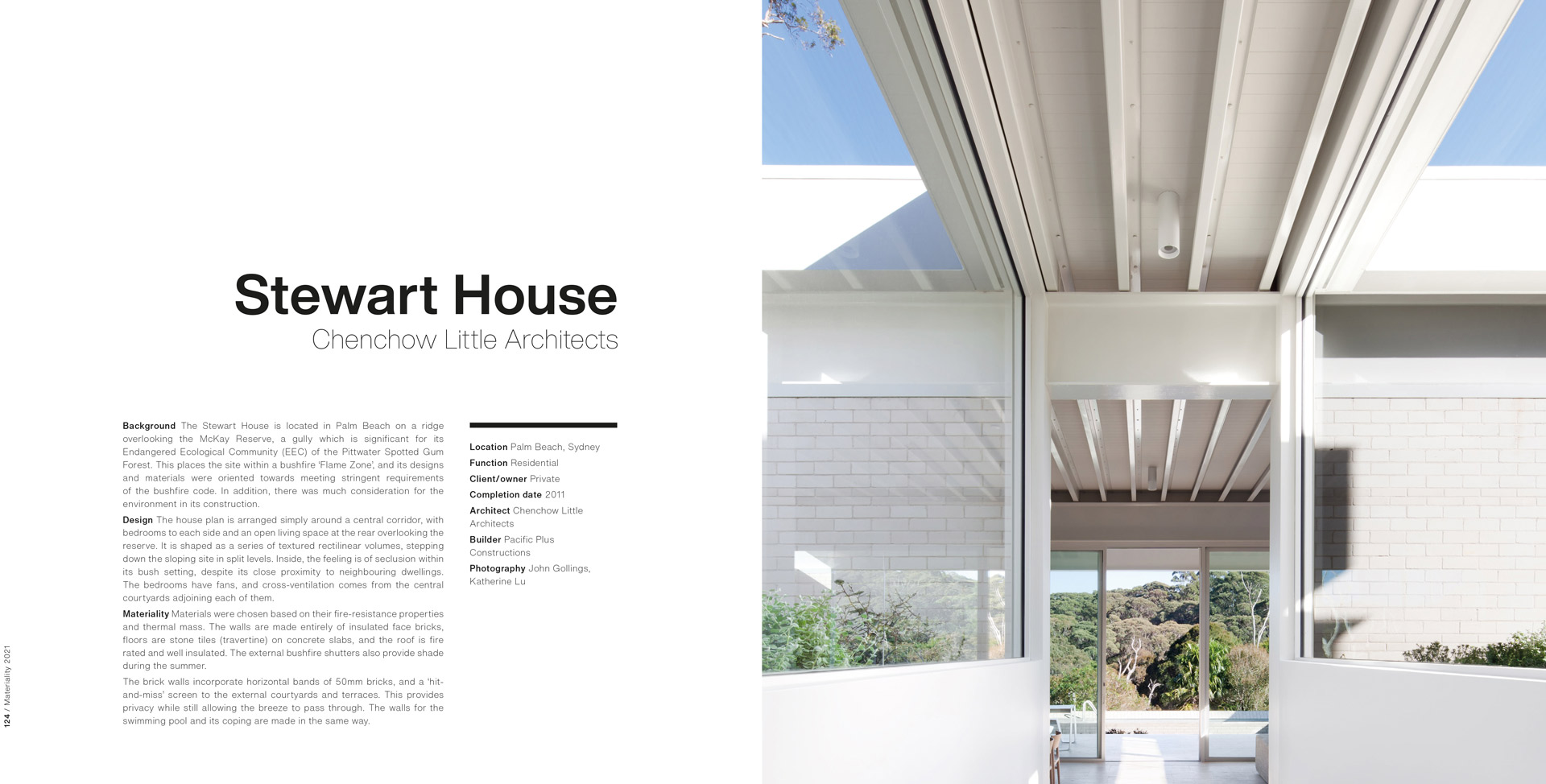
These walls are overlaid with high steel I-beams and closely spaced Z-purlins which support the roof. These beams also span the entire building and playfully extend beyond the facade. The brickwork patterns and repetition of the beams give a sense of lightness to the strong textures and rectangular forms of the building as a whole.
The off-white dwelling spaces and swimming pool contrast with the surrounding greenery, like abstract objects emerging from the landscape. Veneer joinery used throughout is made from locally sourced spotted gum, in reference to the local Reserve.
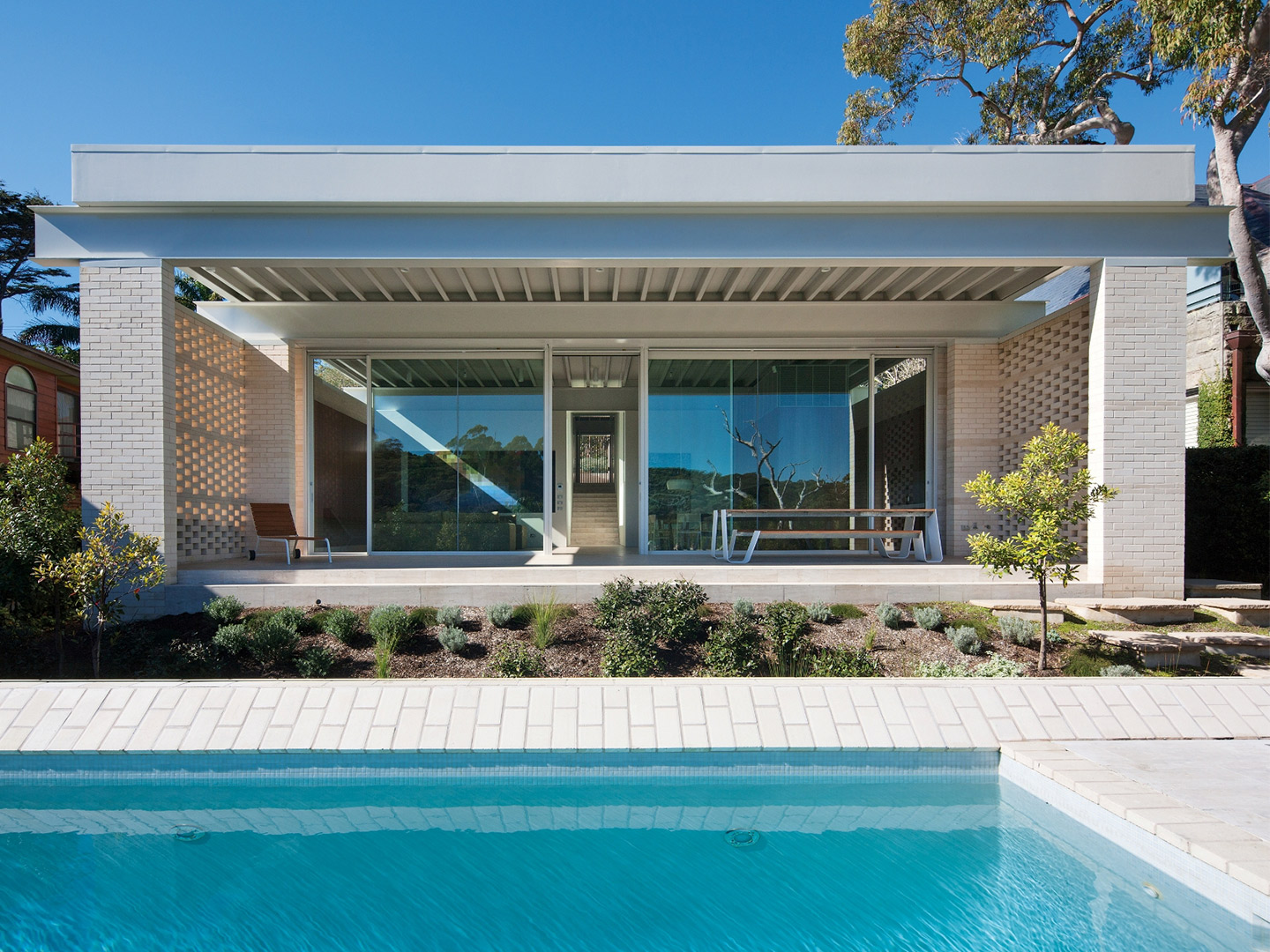
The off-white dwelling spaces and swimming pool contrast with the surrounding greenery, like abstract objects emerging from the landscape.
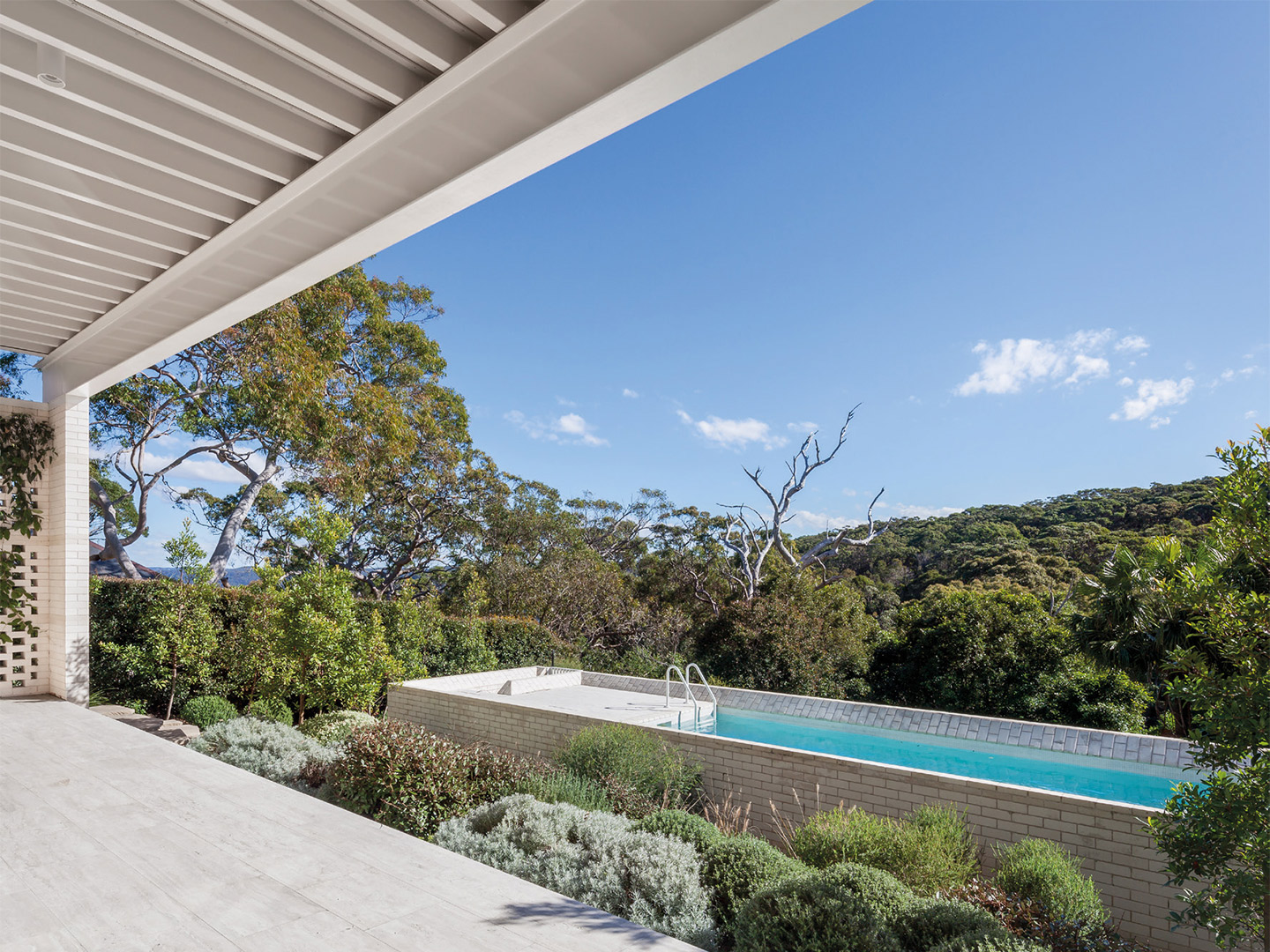
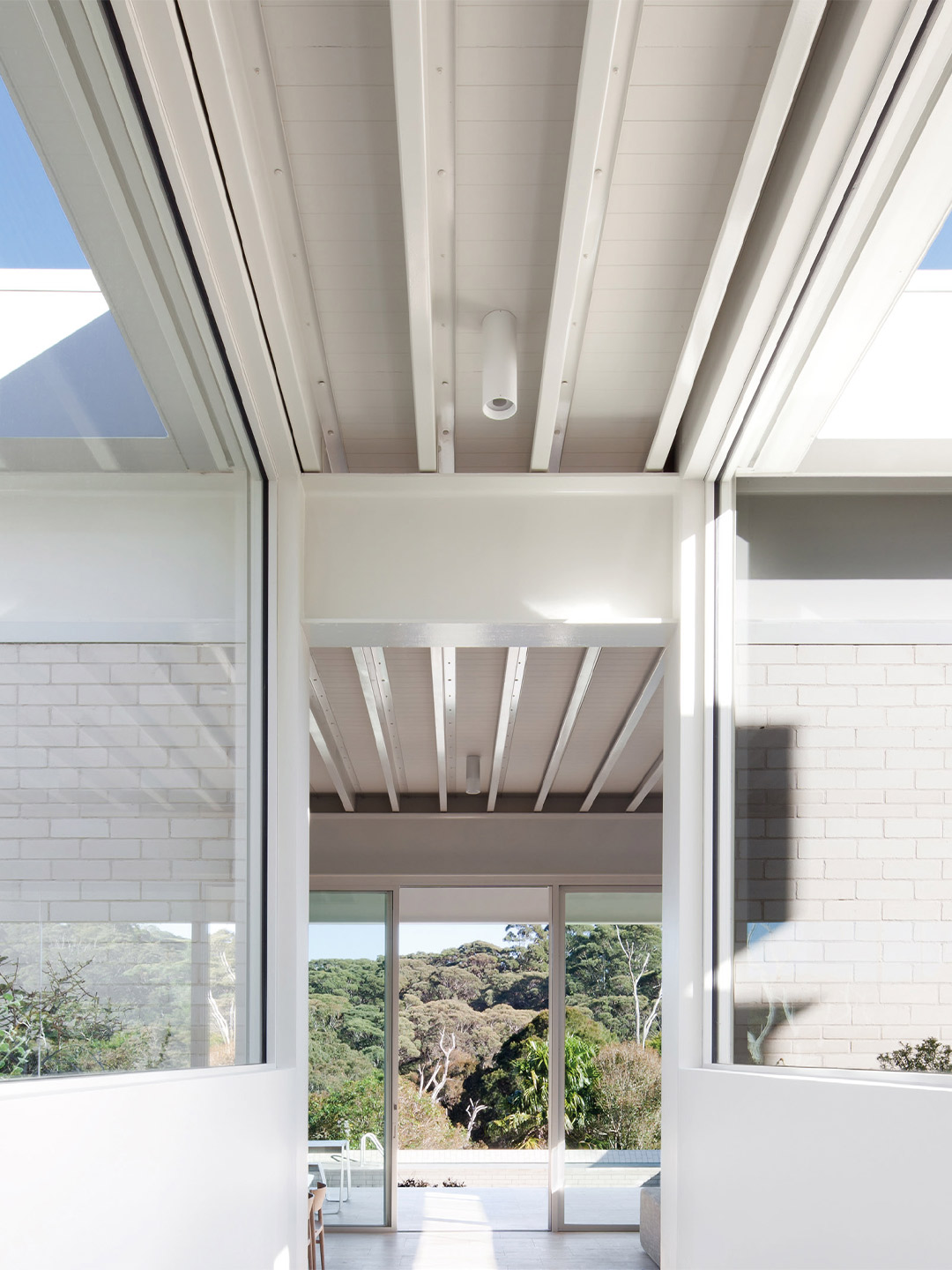
The scale and planning of this single-storey dwelling is deliberately smaller than the large houses typical of this area. This, combined with its split-level design, has minimised the amount of excavation required. The material palette used is simple, mainly chosen for their longevity and are locally sourced. The external brick walls require no paint coating, and will develop a weathered patina as they age.
Sunlight streams into the house through discreet highlight windows on the northern and southern elevations, and through the screened central courtyards. Besides the ample natural lighting during the day, LED and fluorescent lights are used throughout the house to minimise energy usage at night.
Rainwater is harvested in a 9250L storage tank for use in the toilets, laundry and garden, which has been planted with endemic species. The native flora relates the dwelling place to its environment, and also because they are adapted to minimal water requirements.
This feature is an extract from Materiality 2021, a new publication by Brickworks.
Register now for your free copy.
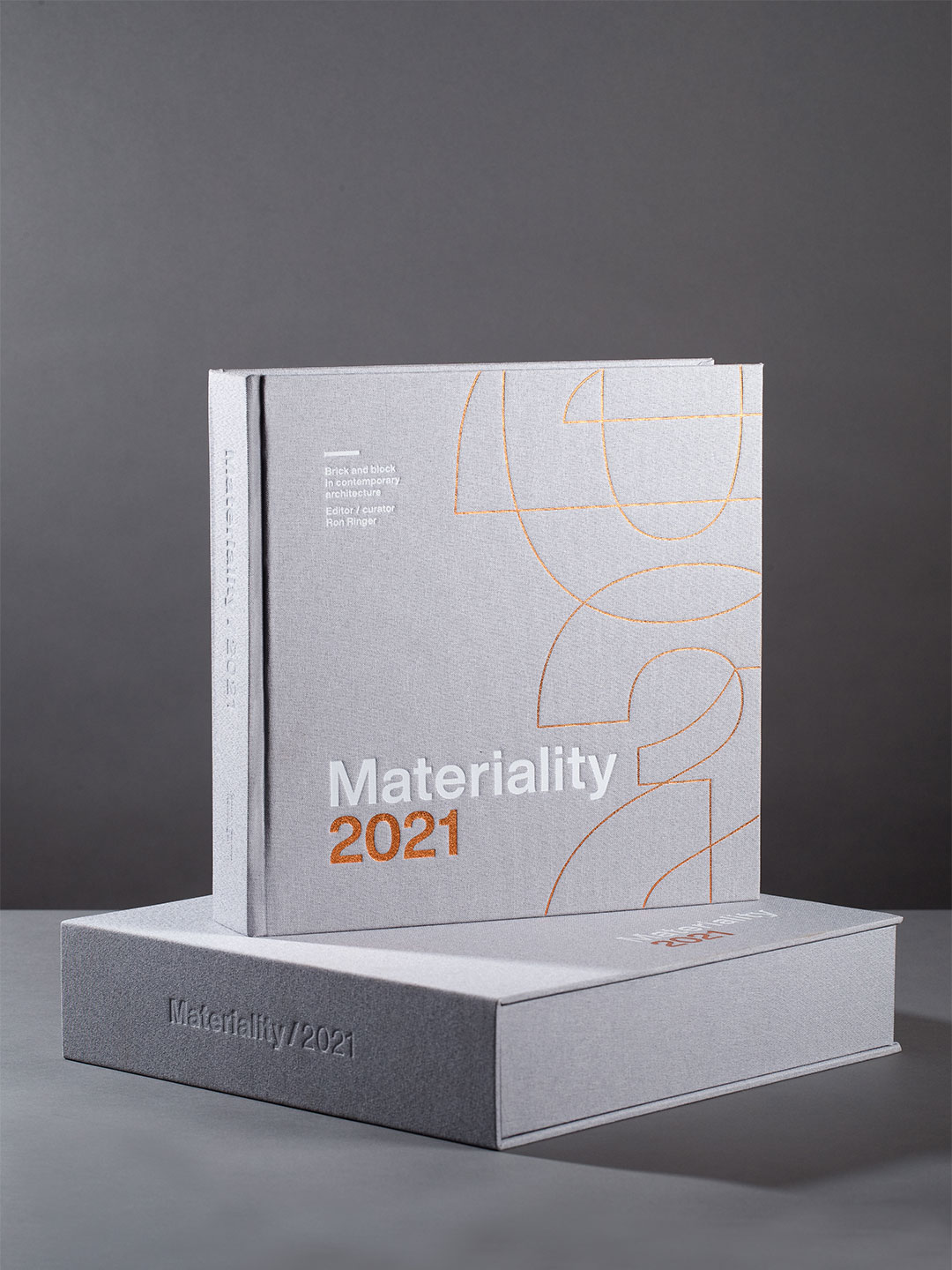
Materiality 2021 explores the use of brick and concrete block in contemporary architecture, as well as issues of urban density and design. In this latest volume, you will find a collection of peer-reviewed projects from some of the most highly respected architects in Australia and the USA, as well as commentary in the form of illustrated essays by architects and academics. This work is intended to provoke discussion and interest among those in the industry, the general reader, and students of architecture and design.
Catch up on more architecture highlights. Plus, subscribe to Daily Architecture News for weekly updates delivered directly to your inbox.
Related stories
- The bar and restaurant at La Sastrería in Valencia by Masquespacio.
- Resa San Mamés student accommodation in Spain by Masquespacio.
- Kennedy Nolan’s ‘Workplace’ puts the cool back into water-cooler conversation.
3 House by Channon Architects and Burton Architects explores the pragmatic versatility of masonry in medium density housing on small lots. Comprising an office, a granny flat and a family home, the project focusses on an adaptive plan, where the functions of its self-contained spaces can change when needed. Located on a corner block in New Farm, Brisbane, the site was already occupied by a four-room workers’ cottage. The reimagined cottage was the first dwelling to be developed, becoming an office with a granny flat and car park tucked underneath, followed by a separate 3-bedroom house with two-car garage constructed at the rear.
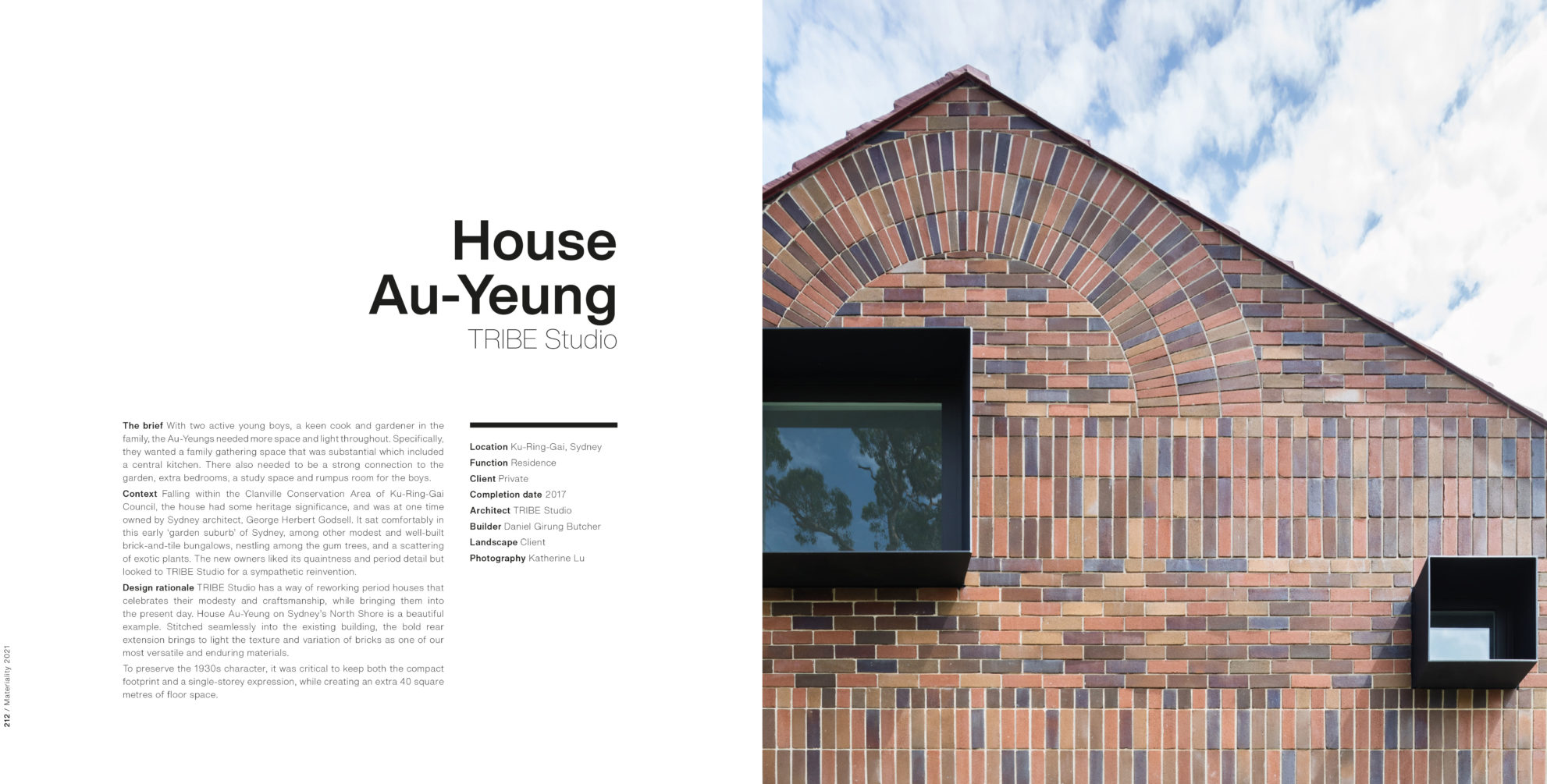
Falling within the Clanville Conservation Area of Ku-Ring-Gai Council, the house had some heritage significance, and was at one time owned by Sydney architect, George Herbert Godsell. It sat comfortably in this early ‘garden suburb’ of Sydney, among other modest and well-built brick-and-tile bungalows, nestling among the gum trees, and a scattering of exotic plants. The new owners liked its quaintness and period detail but looked to TRIBE Studio for a sympathetic reinvention.
House Au-Yeung by TRIBE Studio
Location Ku-Ring-Gai, Sydney
Function Residence
Client Private
Completion date 2017
Architect TRIBE Studio
Builder Daniel Girung Butcher
Landscape Client
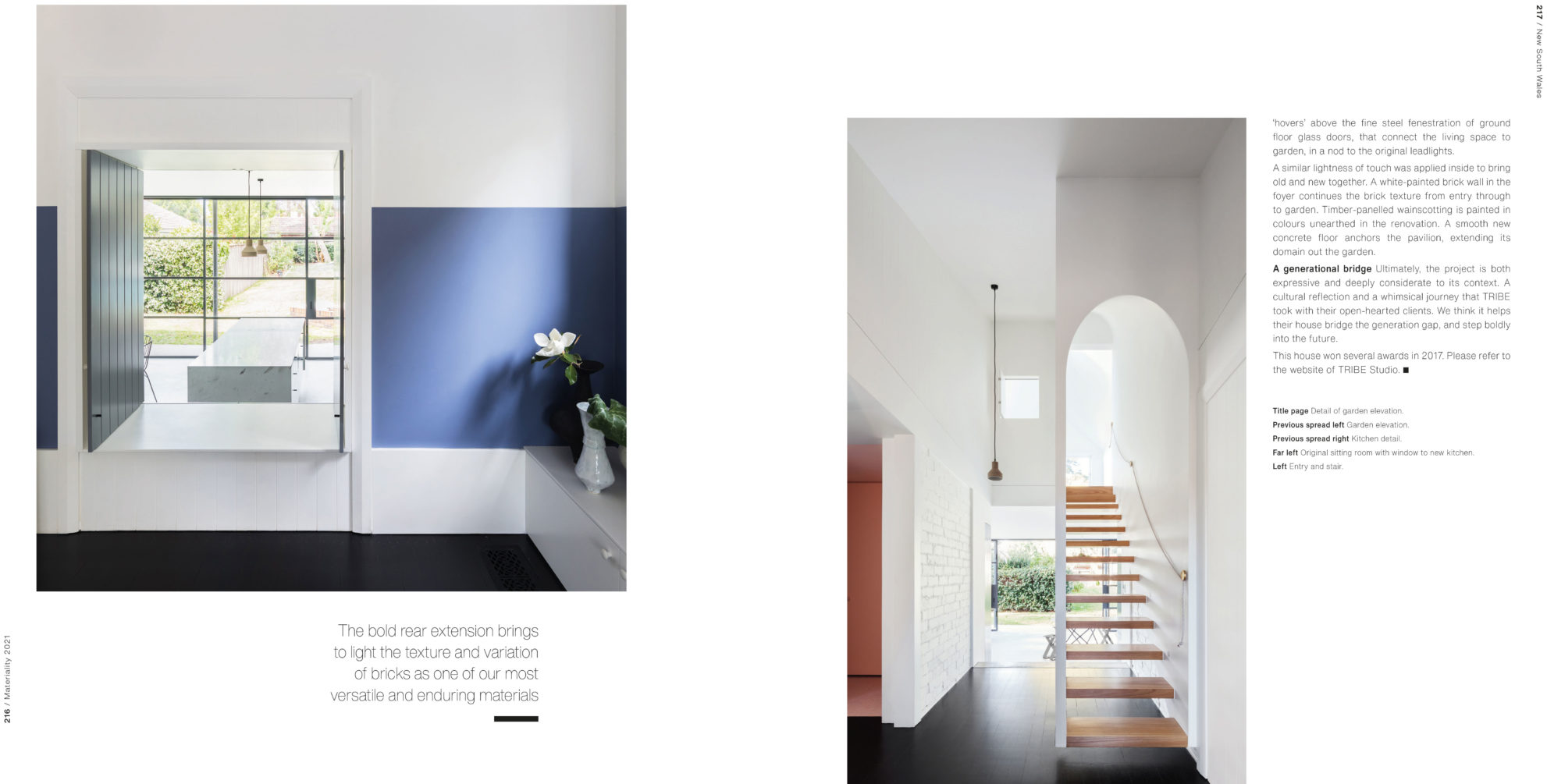
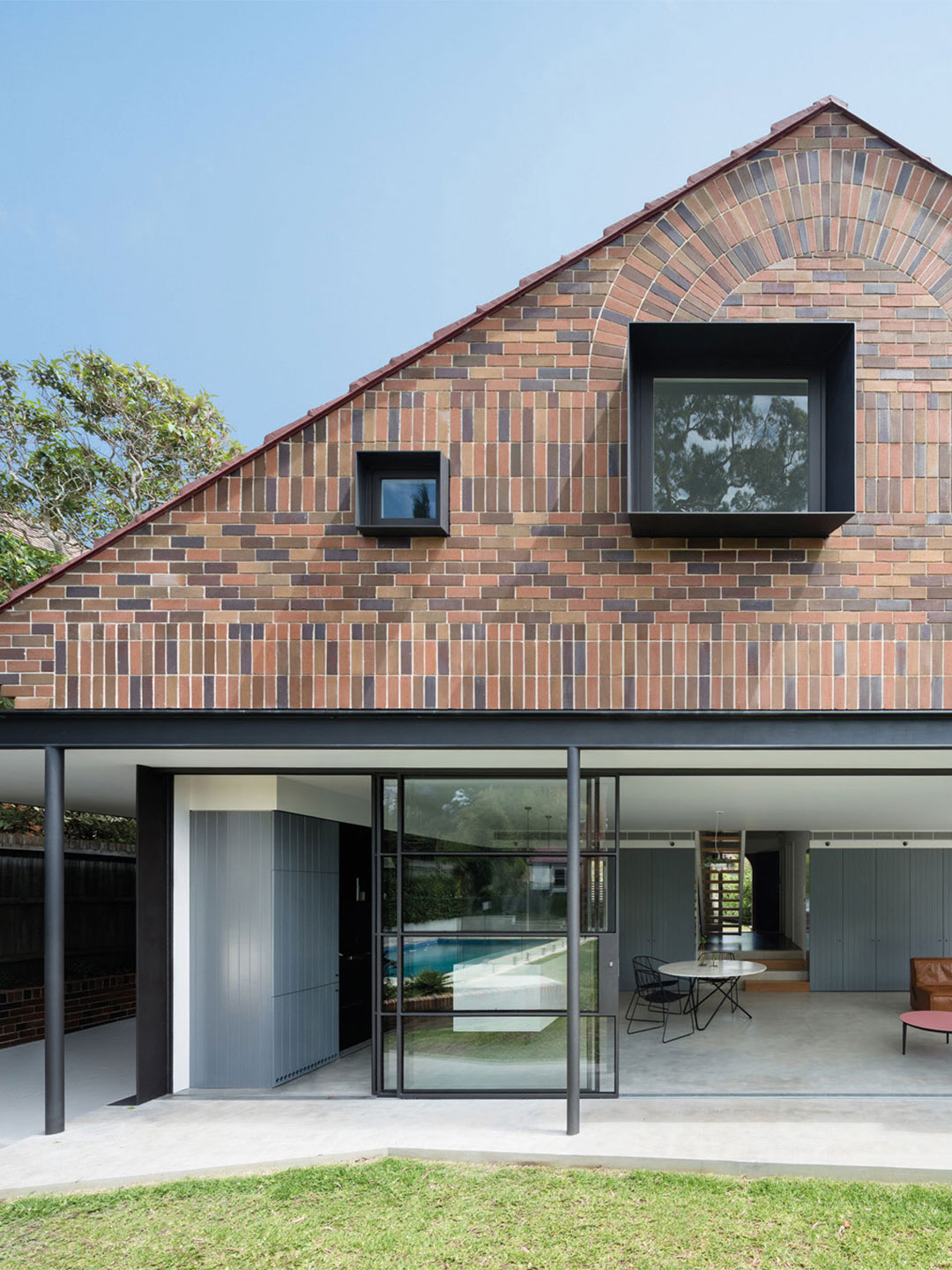
TRIBE Studio has a way of reworking period houses that celebrates their modesty and craftsmanship, while bringing them into the present day. House Au-Yeung on Sydney’s North Shore is a beautiful example. Stitched seamlessly into the existing building, the bold rear extension brings to light the texture and variation of bricks as one of our most versatile and enduring materials.
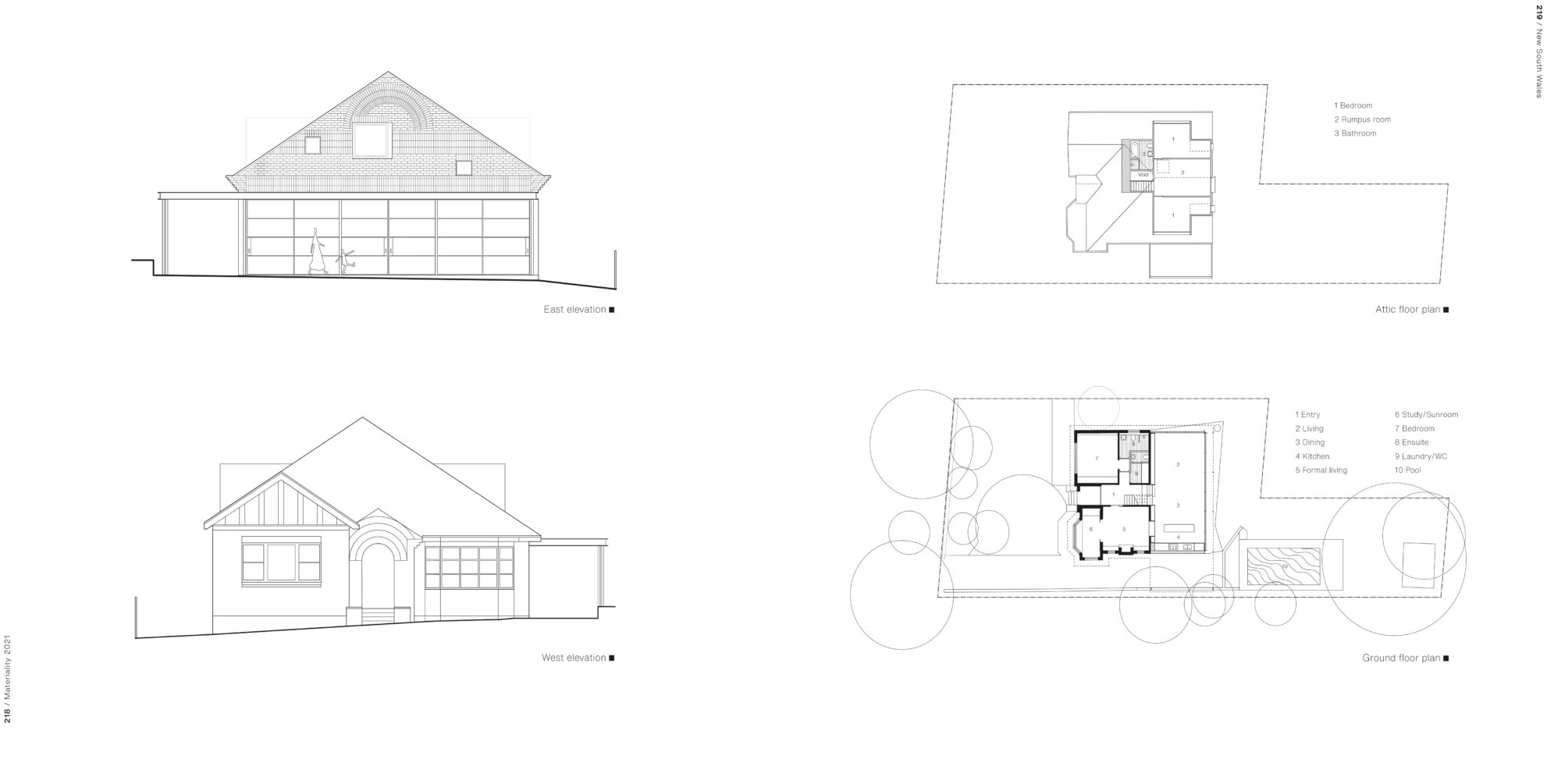
To preserve the 1930s character, it was critical to keep both the compact footprint and a single-storey expression, while creating an extra 40 square metres of floor space.
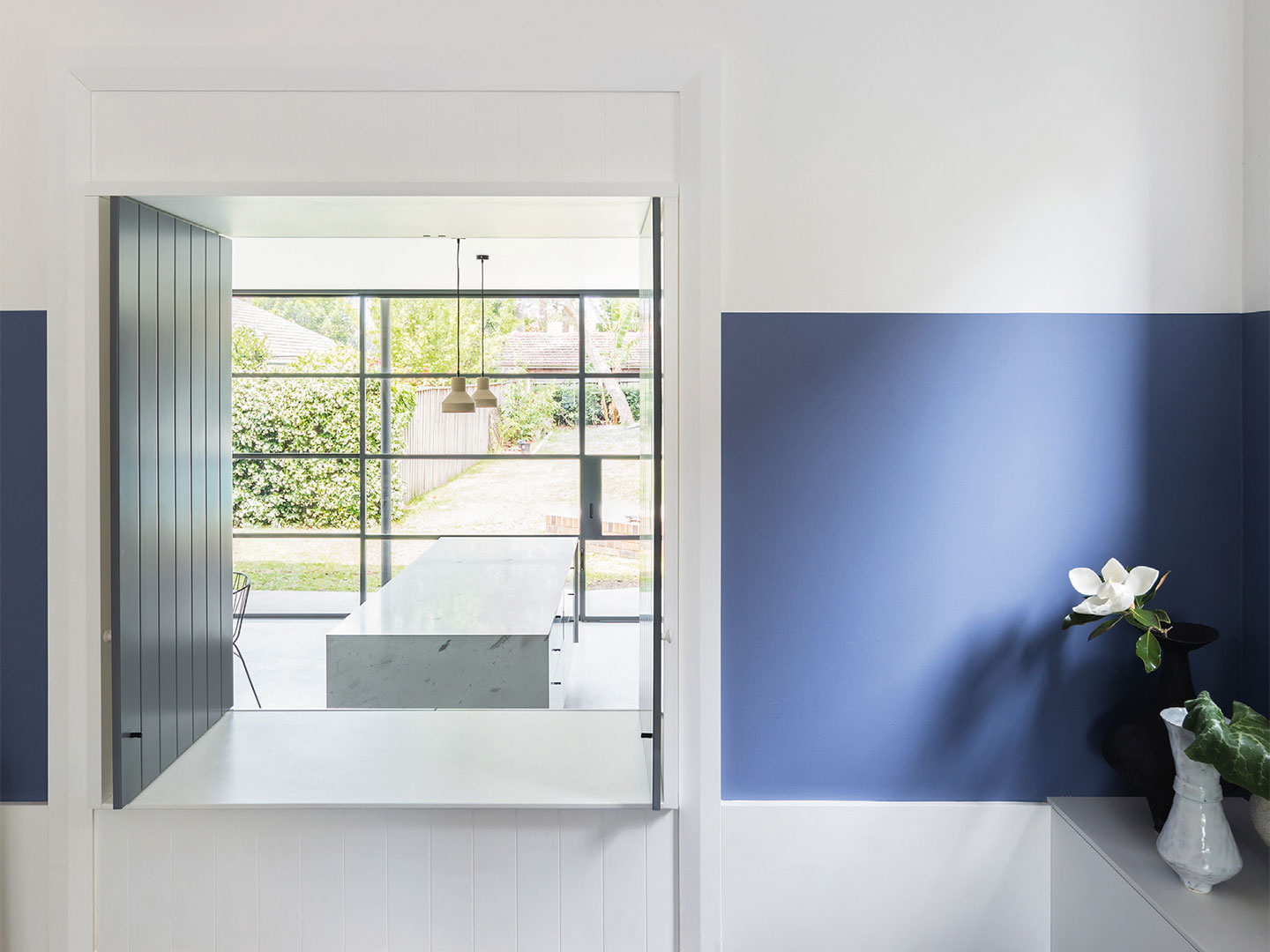
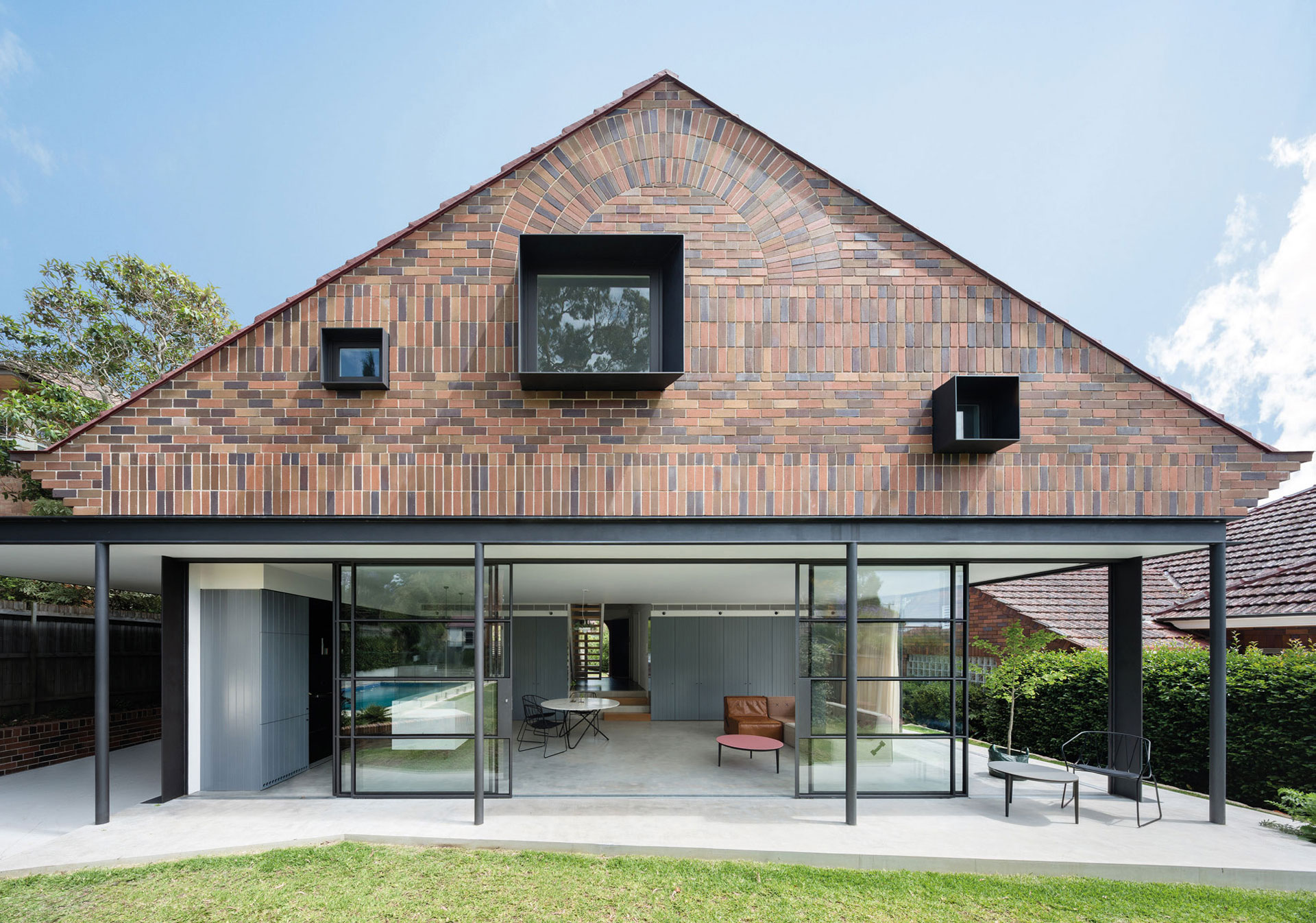
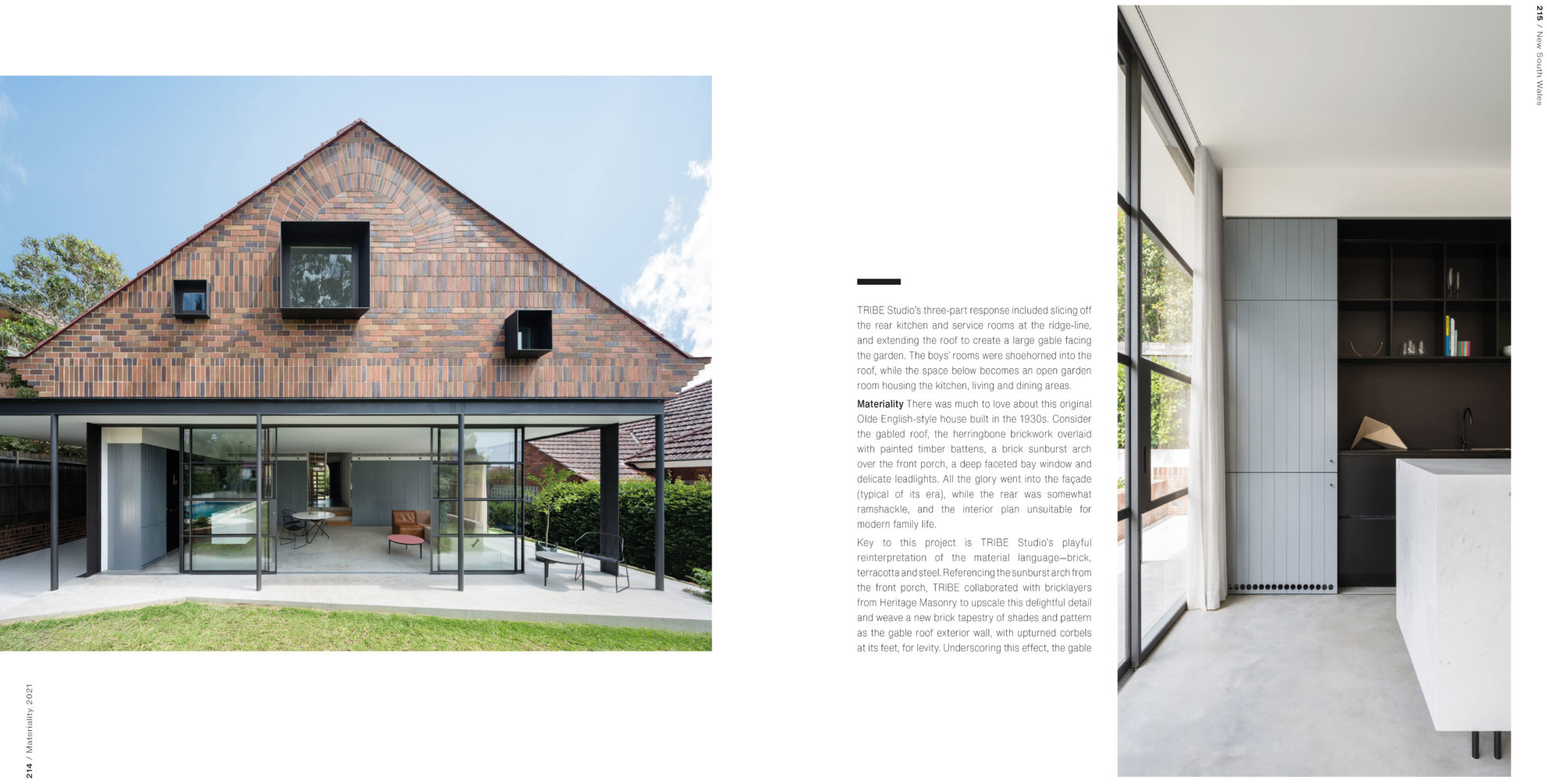
TRIBE Studio’s three-part response included slicing off the rear kitchen and service rooms at the ridge-line, and extending the roof to create a large gable facing the garden. The boys’ rooms were shoehorned into the roof, while the space below becomes an open garden room housing the kitchen, living and dining areas.
There was much to love about this original Olde English-style house built in the 1930s. Consider the gabled roof, the herringbone brickwork overlaid with painted timber battens, a brick sunburst arch over the front porch, a deep faceted bay window and delicate leadlights. All the glory went into the façade (typical of its era), while the rear was somewhat ramshackle, and the interior plan unsuitable for modern family life.
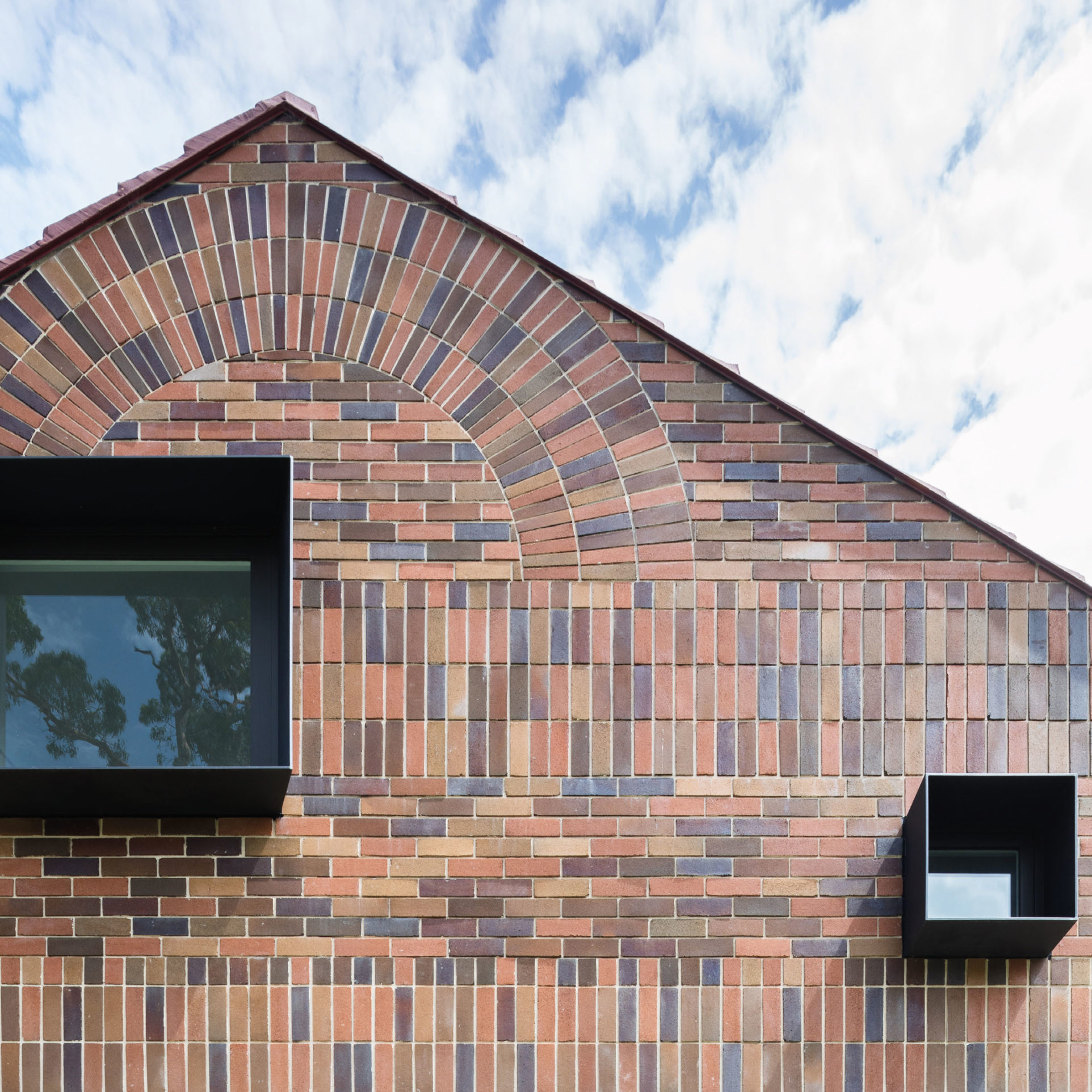
Key to this project is TRIBE Studio’s playful reinterpretation of the material language—brick, terracotta and steel. Referencing the sunburst arch from the front porch, TRIBE collaborated with bricklayers from Heritage Masonry to upscale this delightful detail and weave a new brick tapestry of shades and pattern as the gable roof exterior wall, with upturned corbels at its feet, for levity. Underscoring this effect, the gable ‘hovers’ above the fine steel fenestration of ground floor glass doors, that connect the living space to garden, in a nod to the original leadlights.
The bold rear extension brings to light the texture and variation of bricks as one of our most versatile and enduring materials.
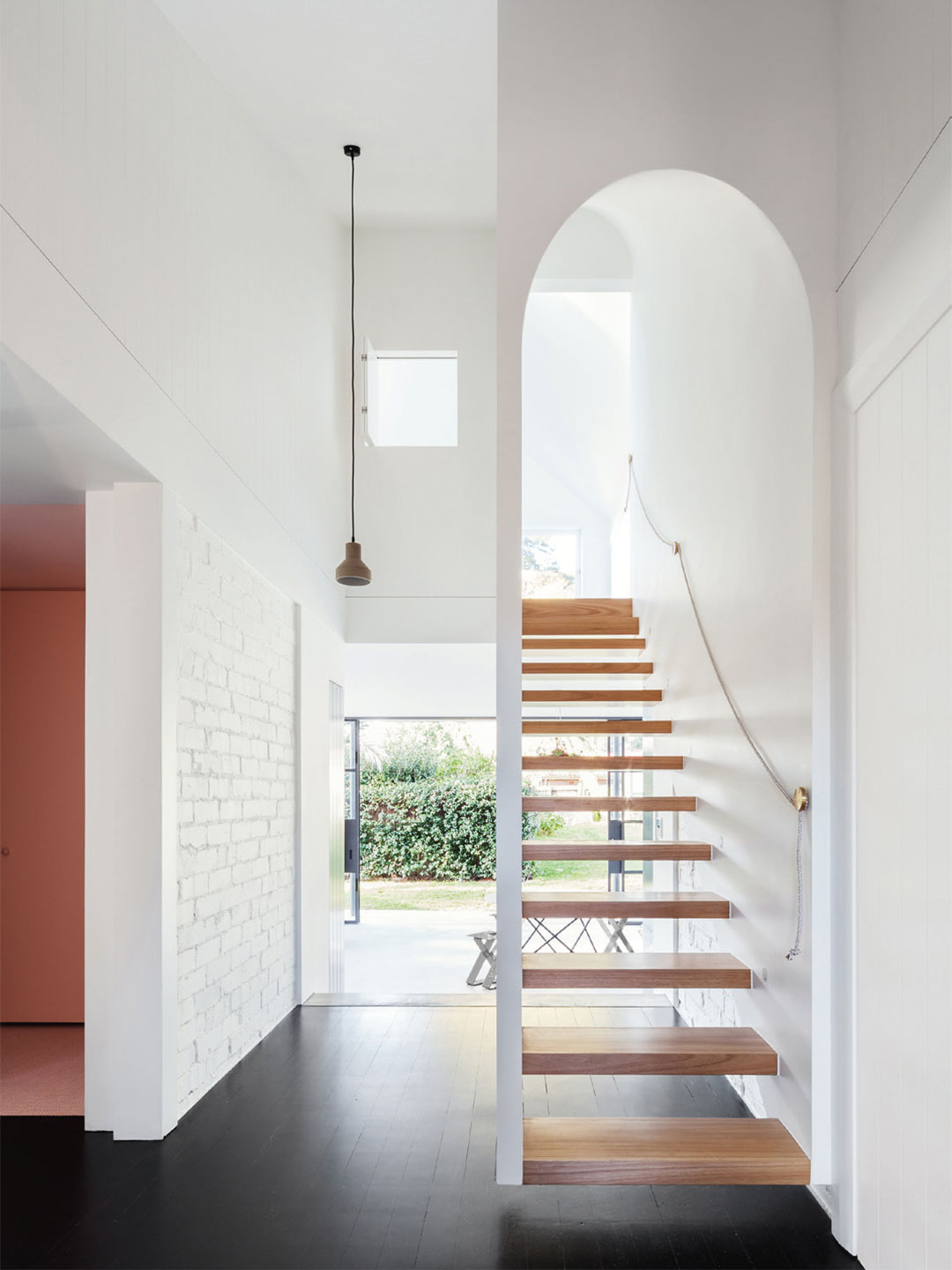
A similar lightness of touch was applied inside to bring old and new together. A white-painted brick wall in the foyer continues the brick texture from entry through to garden. Timber-panelled wainscotting is painted in colours unearthed in the renovation. A smooth new concrete floor anchors the pavilion, extending its domain out the garden.
Ultimately, the project is both expressive and deeply considerate to its context. A cultural reflection and a whimsical journey that TRIBE took with their open-hearted clients. We think it helps their house bridge the generation gap, and step boldly into the future.
This feature is an extract from Materiality 2021, a new publication by Brickworks.
Register now for your free copy.
Materiality 2021 explores the use of brick and concrete block in contemporary architecture, as well as issues of urban density and design. In this latest volume, you will find a collection of peer-reviewed projects from some of the most highly respected architects in Australia and the USA, as well as commentary in the form of illustrated essays by architects and academics. This work is intended to provoke discussion and interest among those in the industry, the general reader, and students of architecture and design.
Catch up on more architecture highlights. Plus, subscribe to Daily Architecture News for weekly updates delivered directly to your inbox.
Related stories
- The bar and restaurant at La Sastrería in Valencia by Masquespacio.
- Resa San Mamés student accommodation in Spain by Masquespacio.
- Kennedy Nolan’s ‘Workplace’ puts the cool back into water-cooler conversation.
3 House by Channon Architects and Burton Architects explores the pragmatic versatility of masonry in medium density housing on small lots. Comprising an office, a granny flat and a family home, the project focusses on an adaptive plan, where the functions of its self-contained spaces can change when needed. Located on a corner block in New Farm, Brisbane, the site was already occupied by a four-room workers’ cottage. The reimagined cottage was the first dwelling to be developed, becoming an office with a granny flat and car park tucked underneath, followed by a separate 3-bedroom house with two-car garage constructed at the rear.
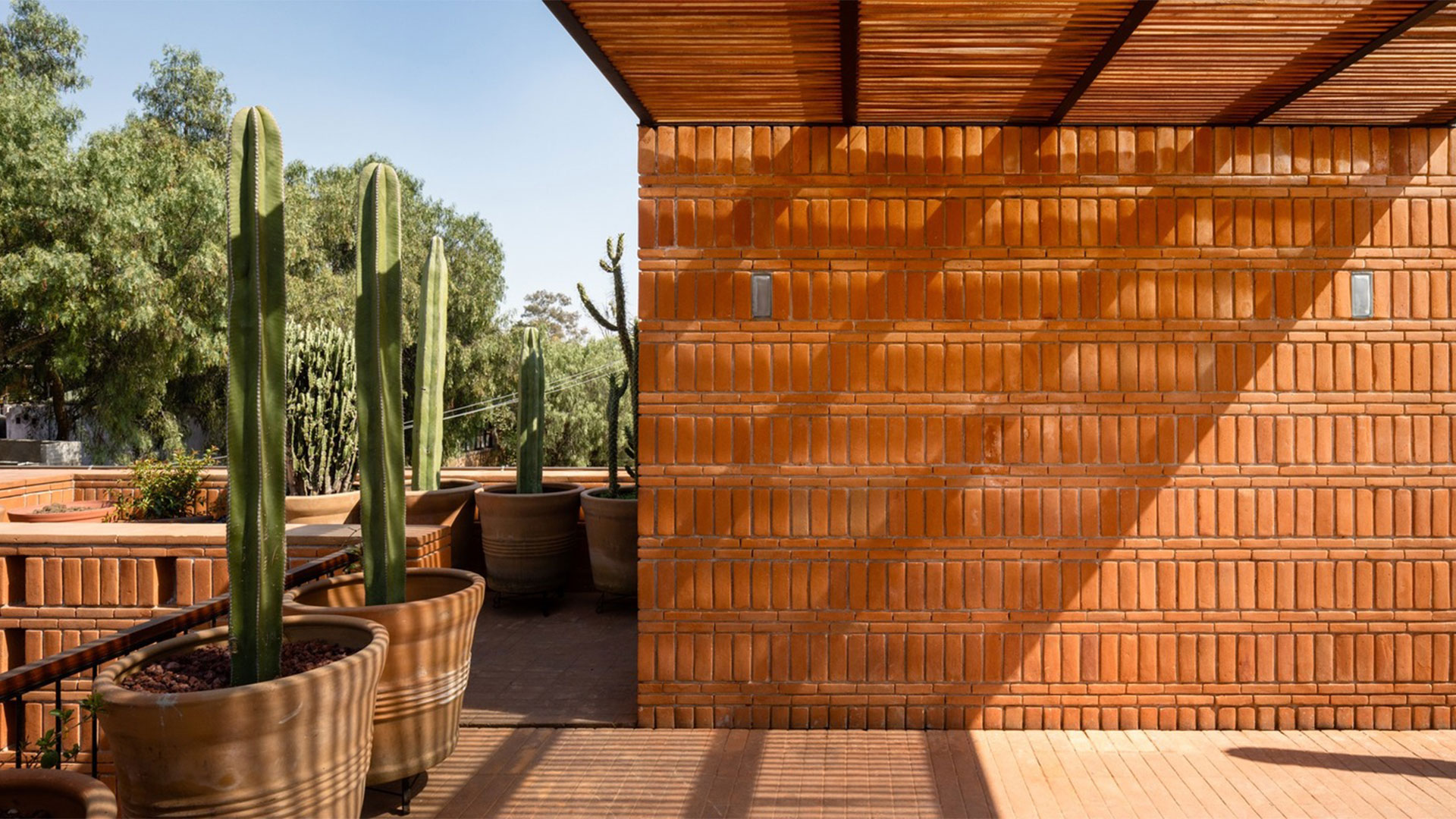
“Brick is a common material and very connected to certain areas of the country and especially to the city of Mexico. There have always been brickyards and the buildings have always been made out of bricks,” says Mauricio. “[At Iturbide Studio] it was important to us to investigate, to de-construct traditional brickwork, and transform it into contemporary brickwork.”
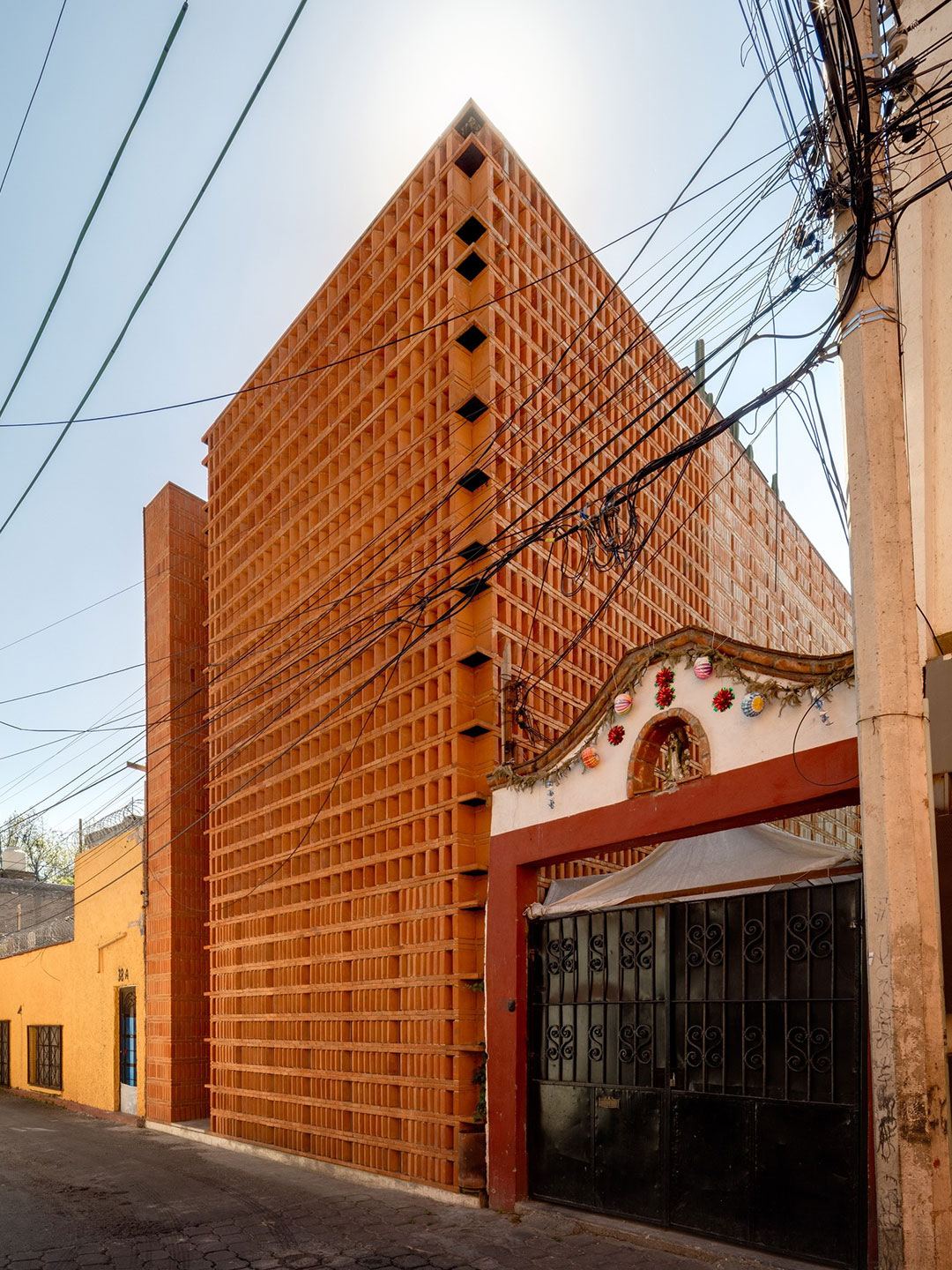
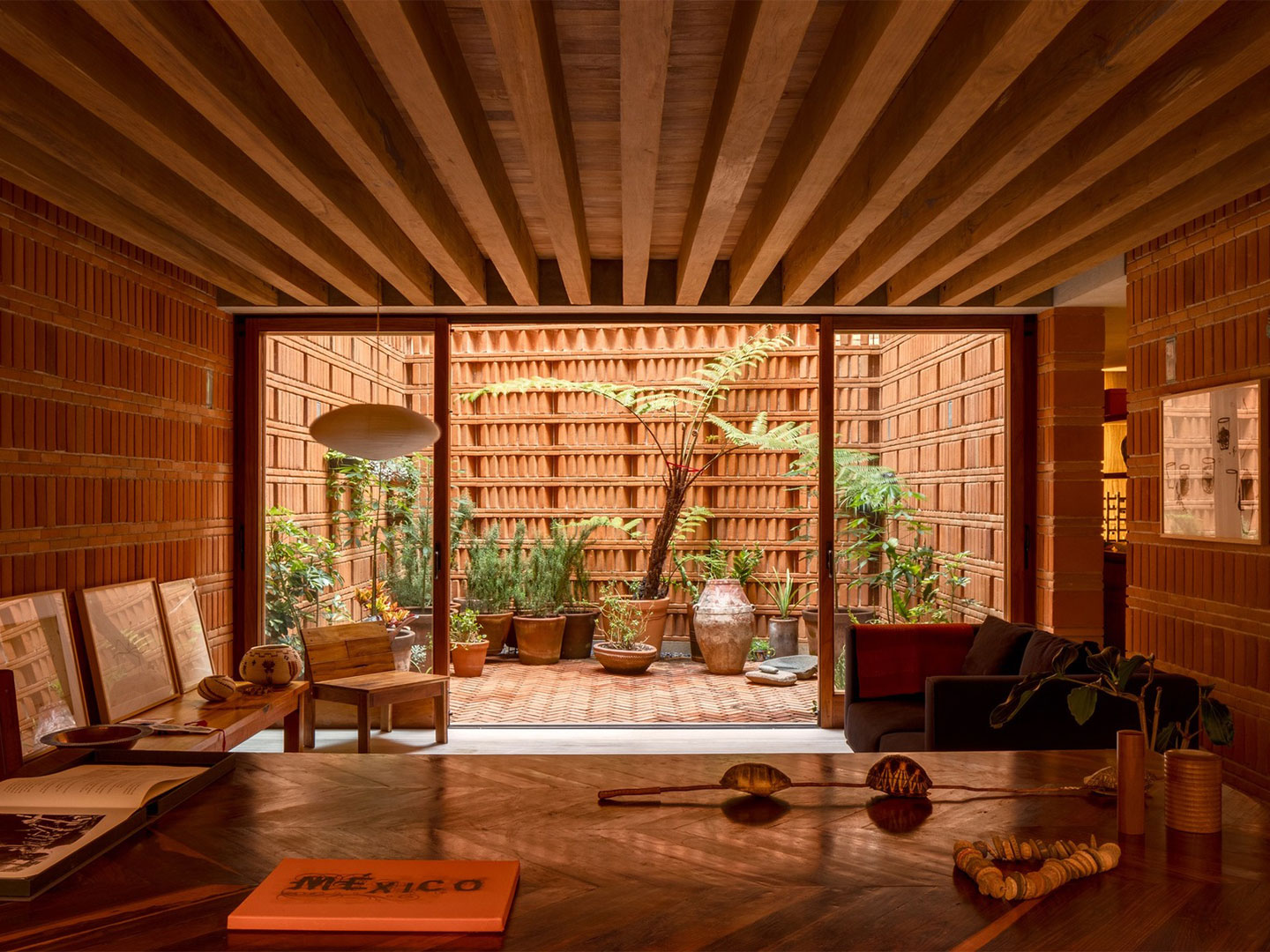
Iturbide Studio in Mexico City by Taller de Arquitectura Mauricio Rocha
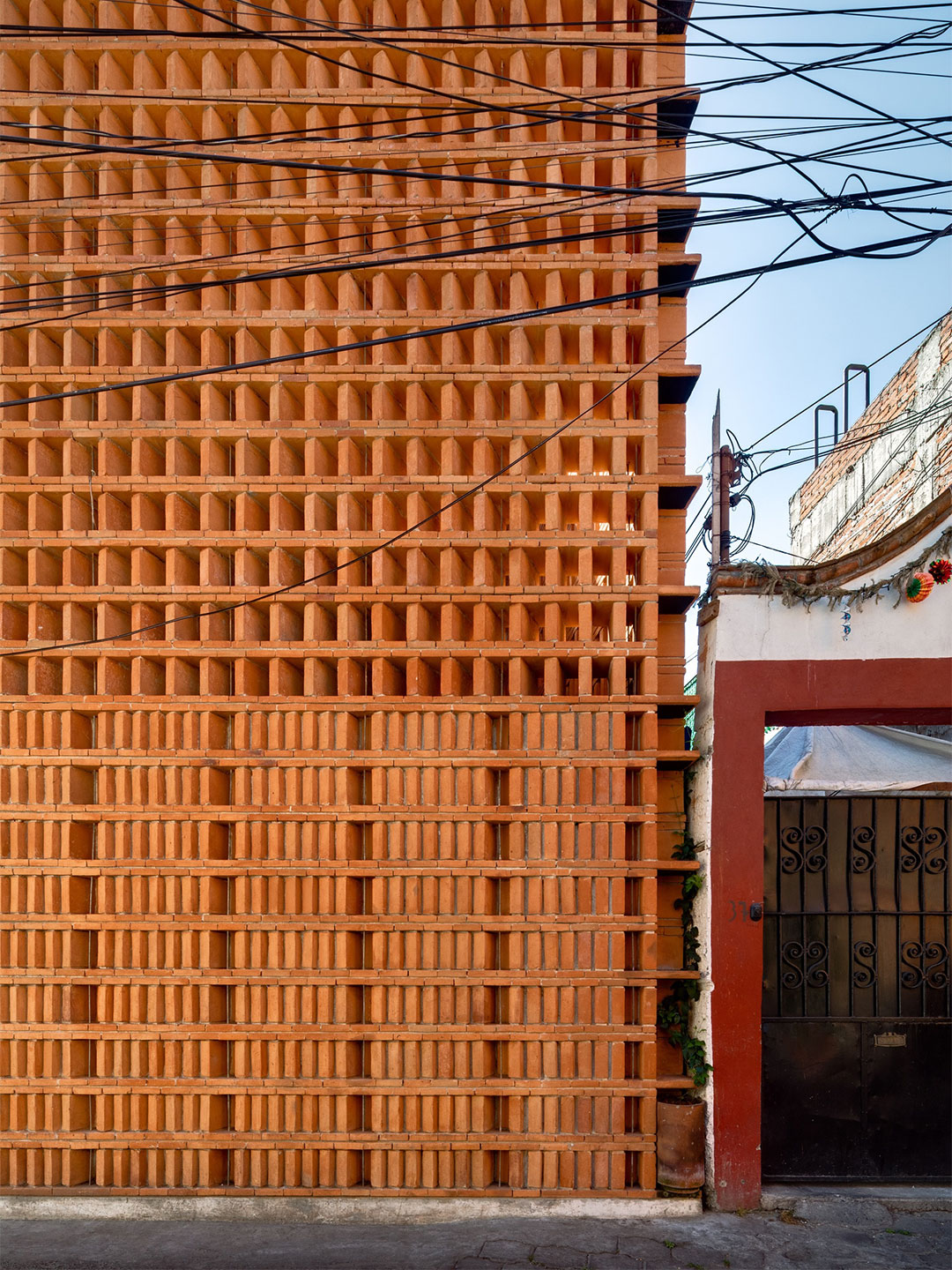
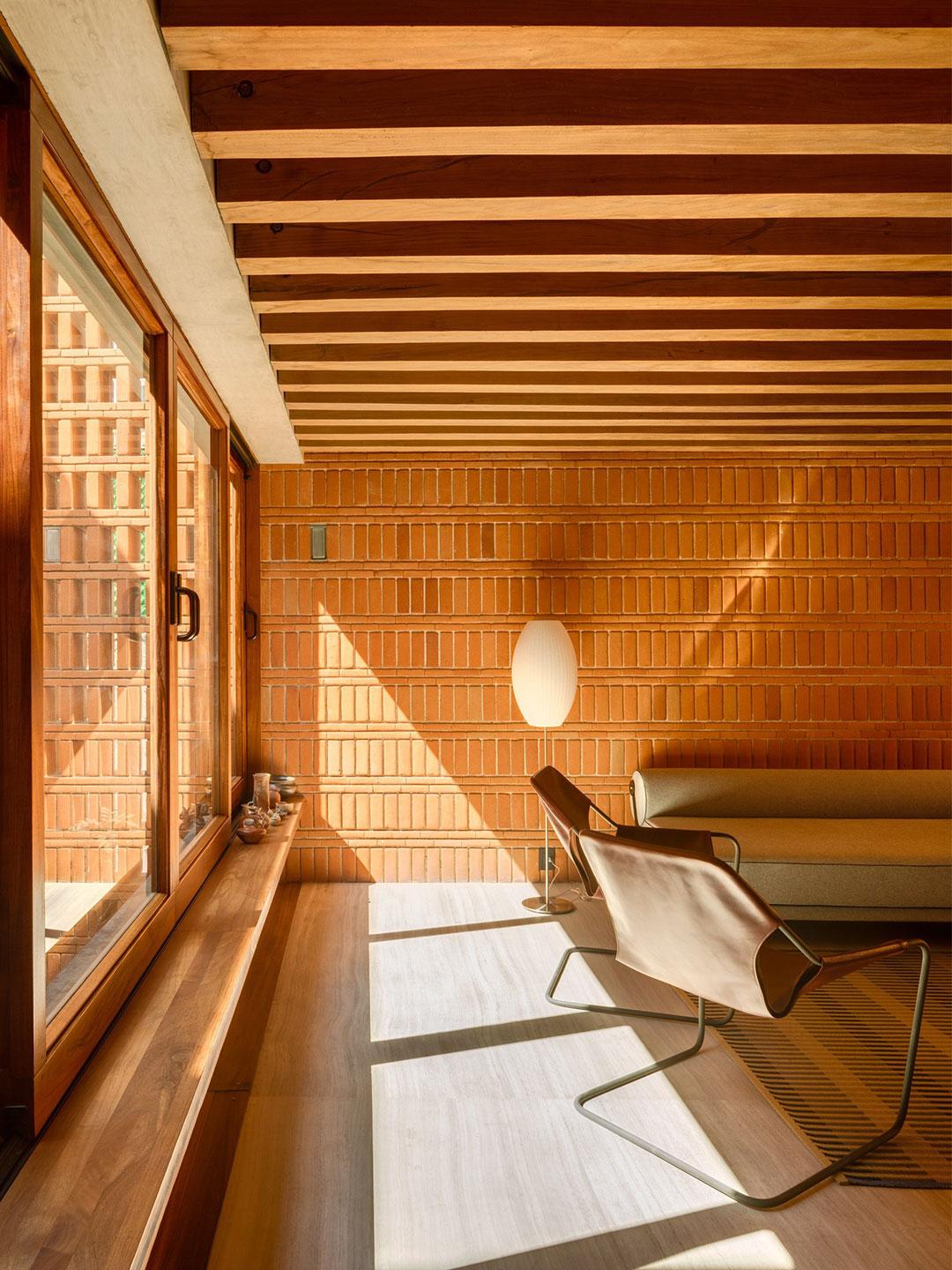
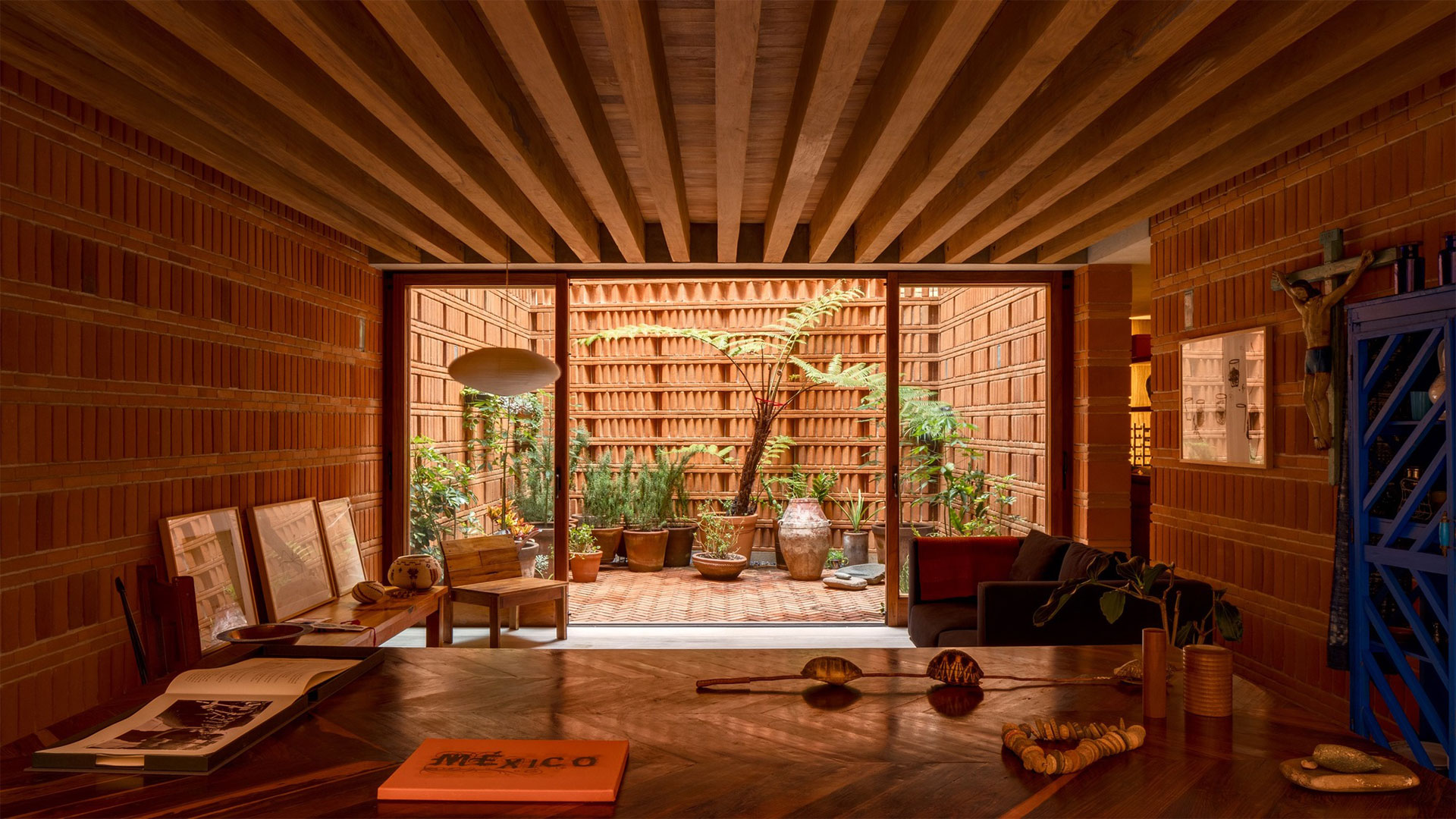
Two years in the making, the now-completed Iturbide Studio is affectionately called Graciela’s “small factory of bricks”: a compact, three-storey building that rises monument-like from a plot of only 7 x 14 metres. Behind the textured brick facade which glows in the afternoon light – as if to reflect the joy of its owner – three planes of timber, concrete and marble appear stretched from one end of the site to the other, flanked to the north and south by a pair of towering walled patios.
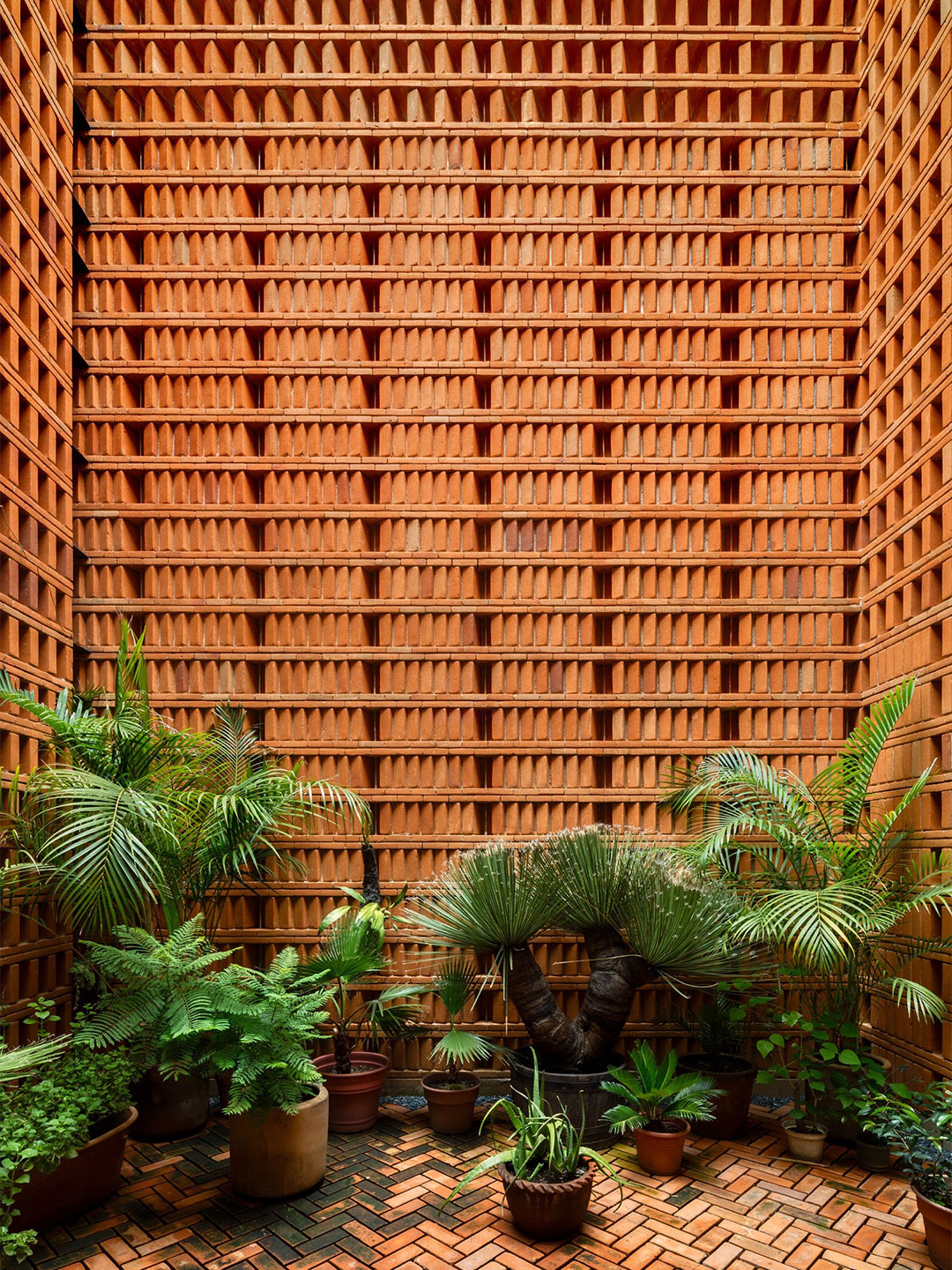
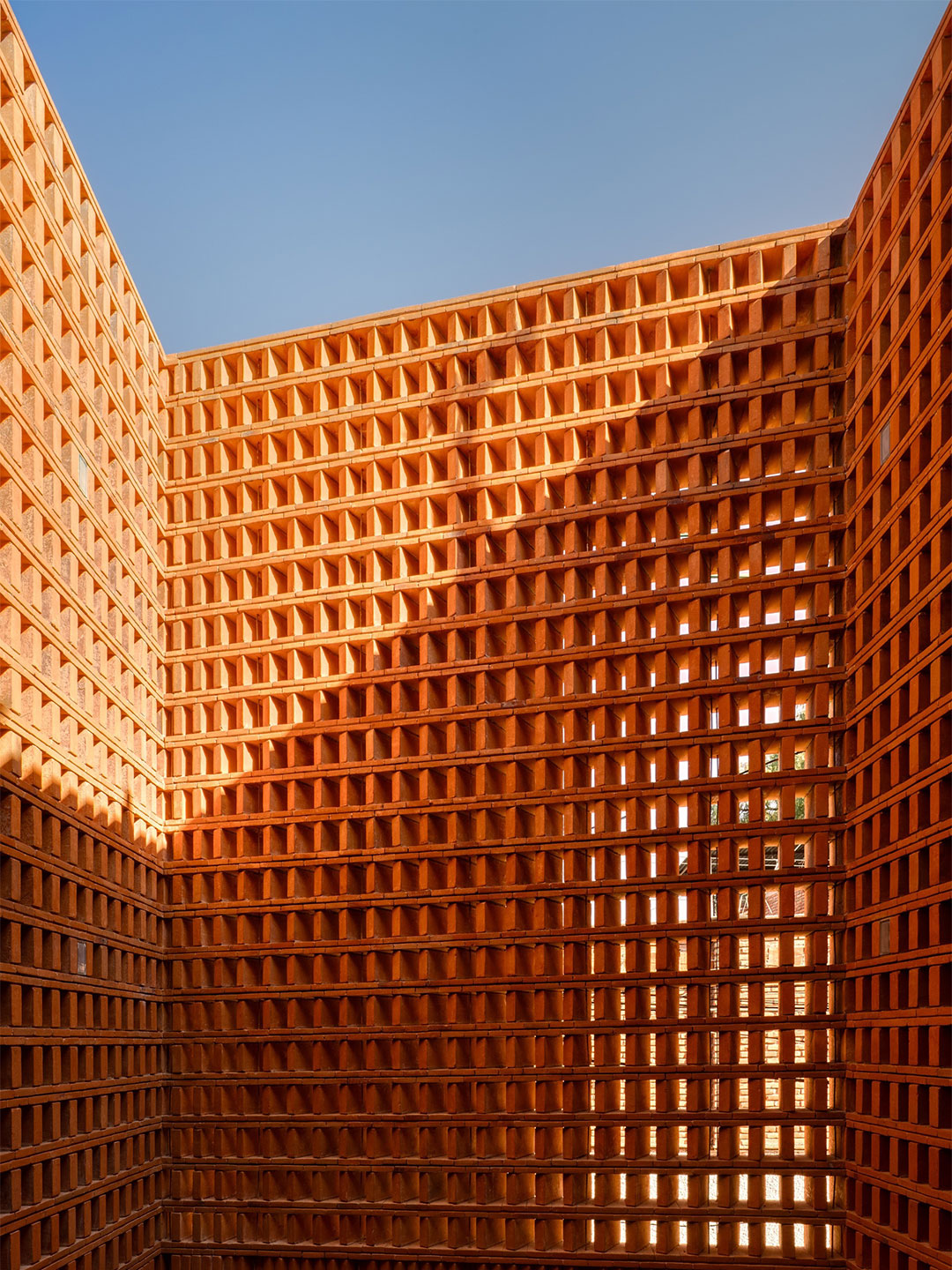
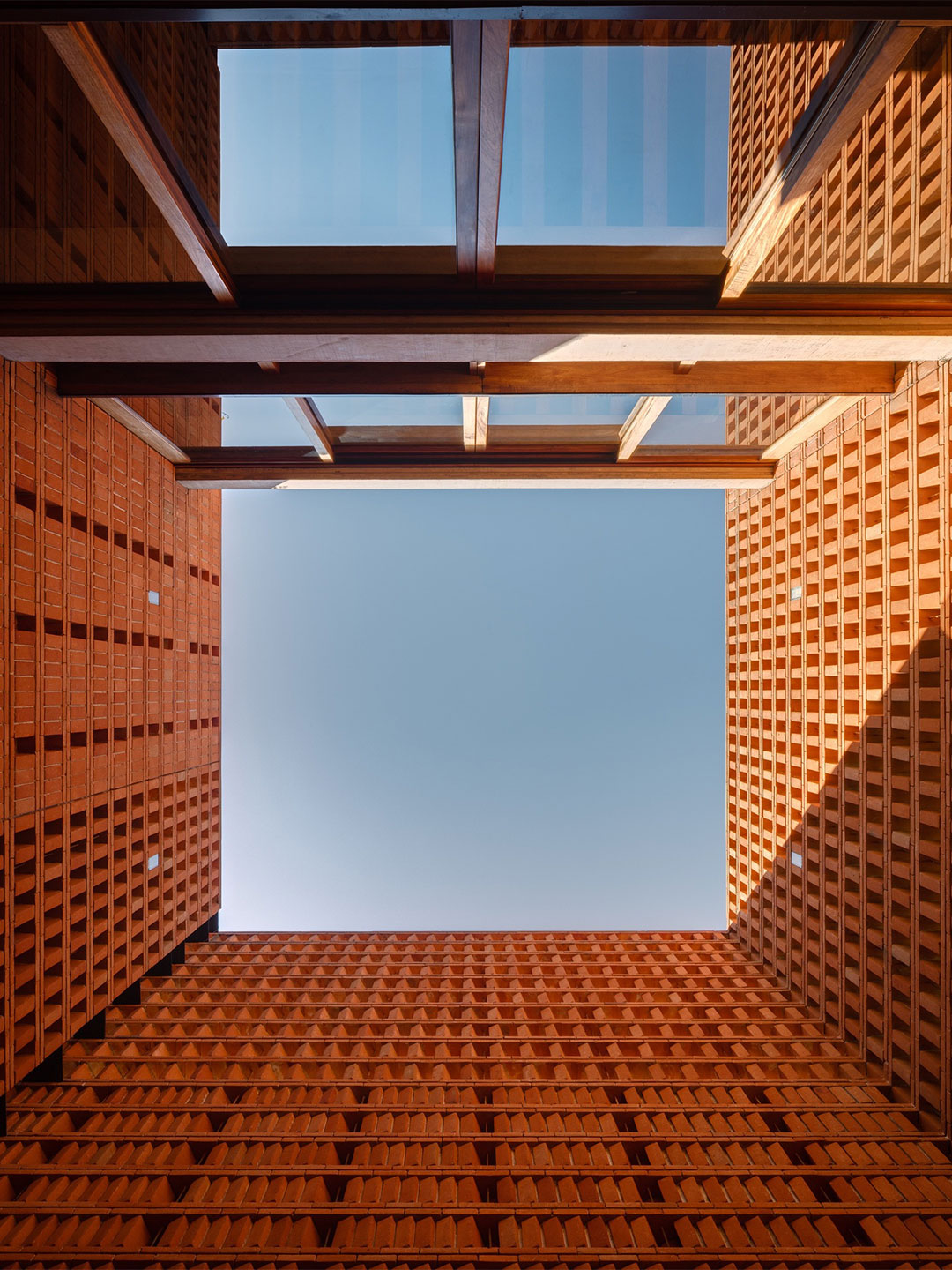
The patio walls feature four different custom-made bricks, sourced from Puebla, where special attention was given to the brick-laying techniques. The delicate balance of privacy and ventilation was achieved by the way in which bricks were angled to reduce sightlines yet encourage airflow, resulting in vertical planes of mesmerising brickwork. Now, as the sun moves overhead, the patio walls seemingly come alive in the background, presenting the occupants with a visual feast of light and shadow that imbues the interior spaces with soul-soothing mood.
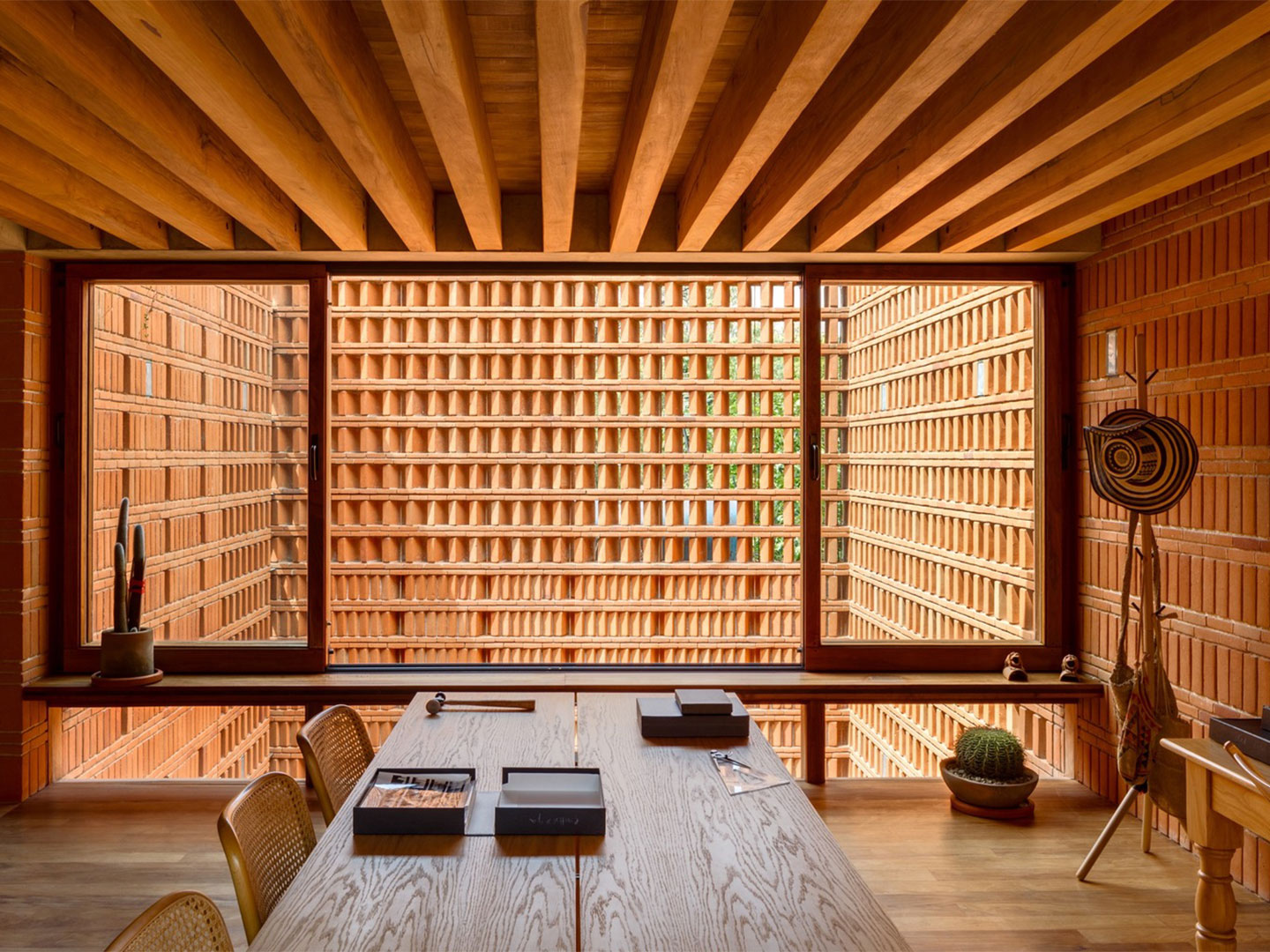
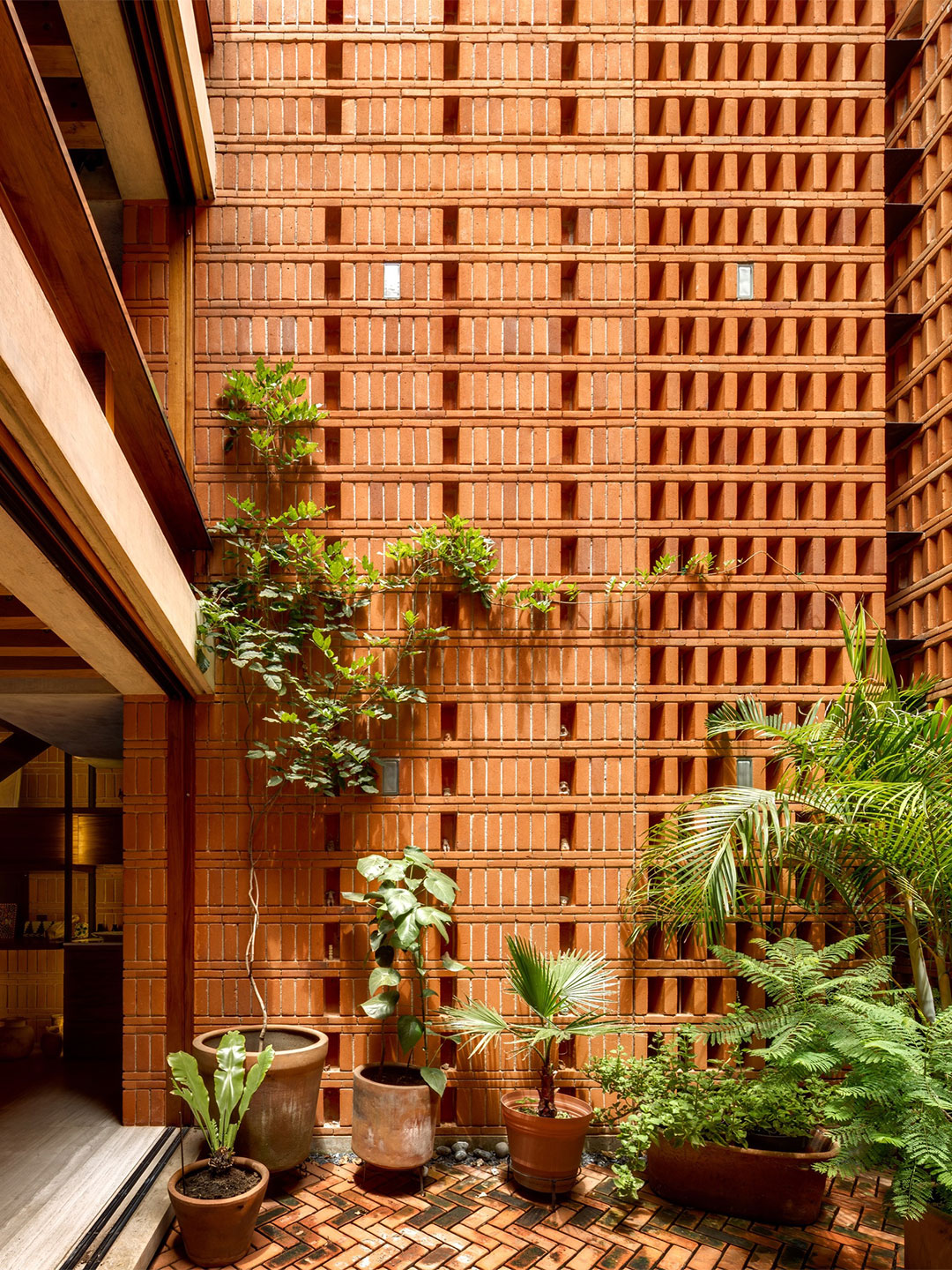
It was important to us to investigate, to de-construct traditional brickwork, and transform it into contemporary brickwork.
“It appears to me today that my mother lives in the building in an extraordinary way. I knew beforehand that she would place her objects, which she has been collecting throughout the past, that she would place plants and decorate the space with great taste,” says Mauricio. “The greatest challenge was that the architecture wouldn’t impose itself on the living space. That it would evolve into an instrument that can create atmosphere in which the client’s life is what matters most.”
Anchored to the long eastern wall, the studio’s staircases, bathroom and kitchen ammenities form the top stroke of a stacked T-shaped floor plan, making way in the body of the building for the service area, the circulation spaces and the large bookcase – “a vertical element that is integrated into the container walls to practically disappear and only give body to the volume,” explains Mauricio.
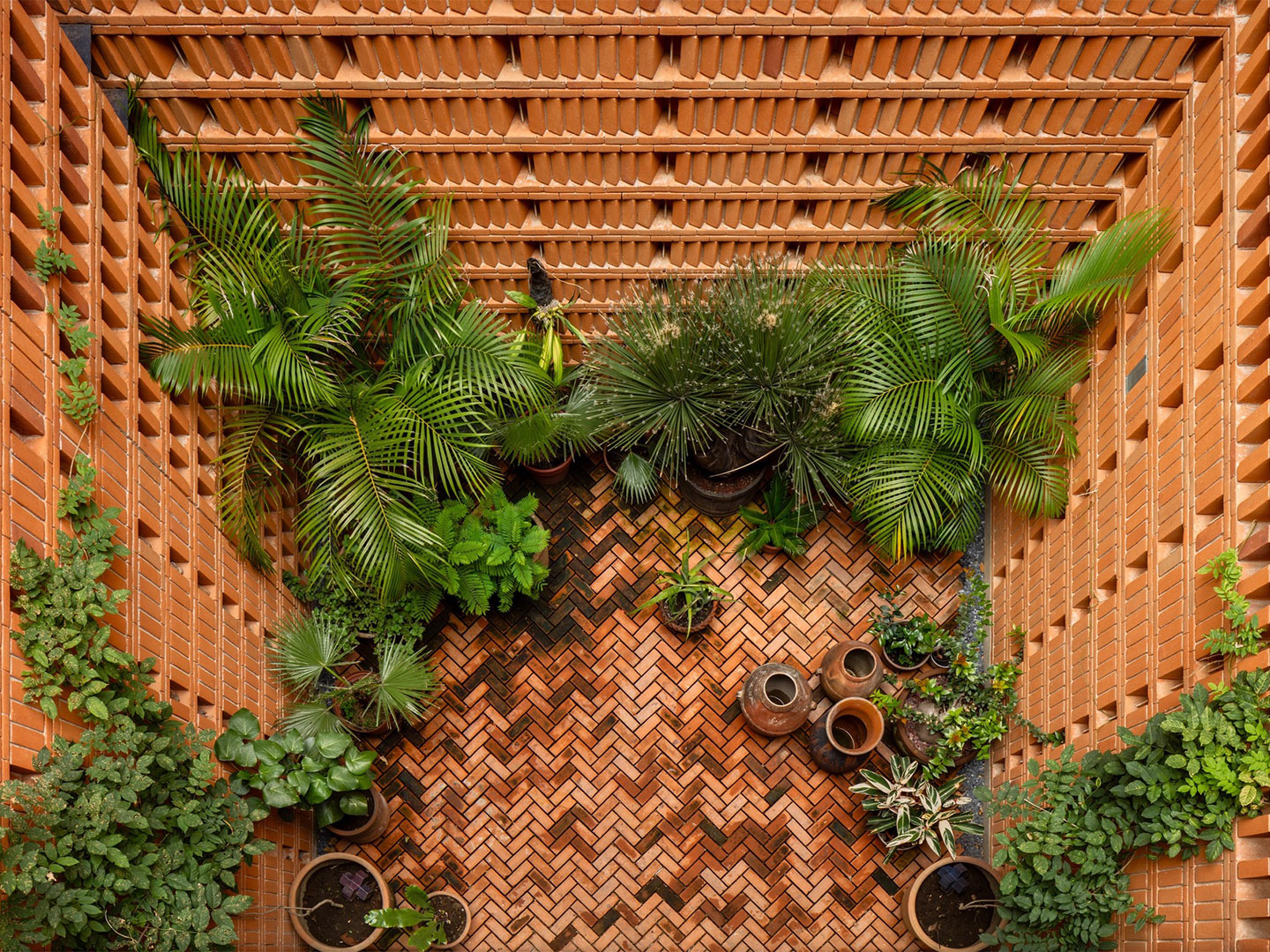
Fuelled by the desire to create the illusion of a brick-only building, the architects engaged the services of structural engineer Gerson Huerta to test-out various earthquake-proof solutions where brick could appear as the hero material. The landing point was a model where the brick facade is stabilised by invisible steel rods and plates with reinforced concrete framing the two upper levels and the eastern wall.
Above all else, the project “seeks silence and synthesis through the continuous, repetitive and almost obsessive use of a single material,” says Mauricio. An obsession which saw Taller de Arquitectura receive a prestigious Brick Award in late 2020: a tribute to the practice’s pursuits for high-quality brick architecture.
tallerdearquitectura.com.mx; brickaward.com
Catch up on more of the architecture highlights. Plus, subscribe to Daily Architecture News for weekly updates delivered direct to your inbox.
Related stories
- The bar and restaurant at La Sastrería in Valencia by Masquespacio.
- Resa San Mamés student accommodation in Spain by Masquespacio.
- Kennedy Nolan’s ‘Workplace’ puts the cool back into water-cooler conversation.
In this week’s architecture and design video round-up (above), pull up a pew at the bar of Kink in Berlin, illuminated by the gentle glow of a tangled neon rope sculpture by Swiss artist Kerim Seiler.
Burn up calories and enjoy a favourite brew at Lisbon’s Members Club. Designed by Studio Gameiro, the well-rounded establishment delivers its members a welcoming and inspiring place to fulfill fitness and social needs.
Fresh from its launch at Stockholm Design Week, take a look at British designer’s latest accessories collection called Cloud.
And finally this week, make a diary note for February 25 – the next instalment of inDETAIL, an architect speaker series by Brickworks, will be broadcast live from 6.30pm (AEDT) with special guest Camilla Block.
For more information on each of these stories, see below.
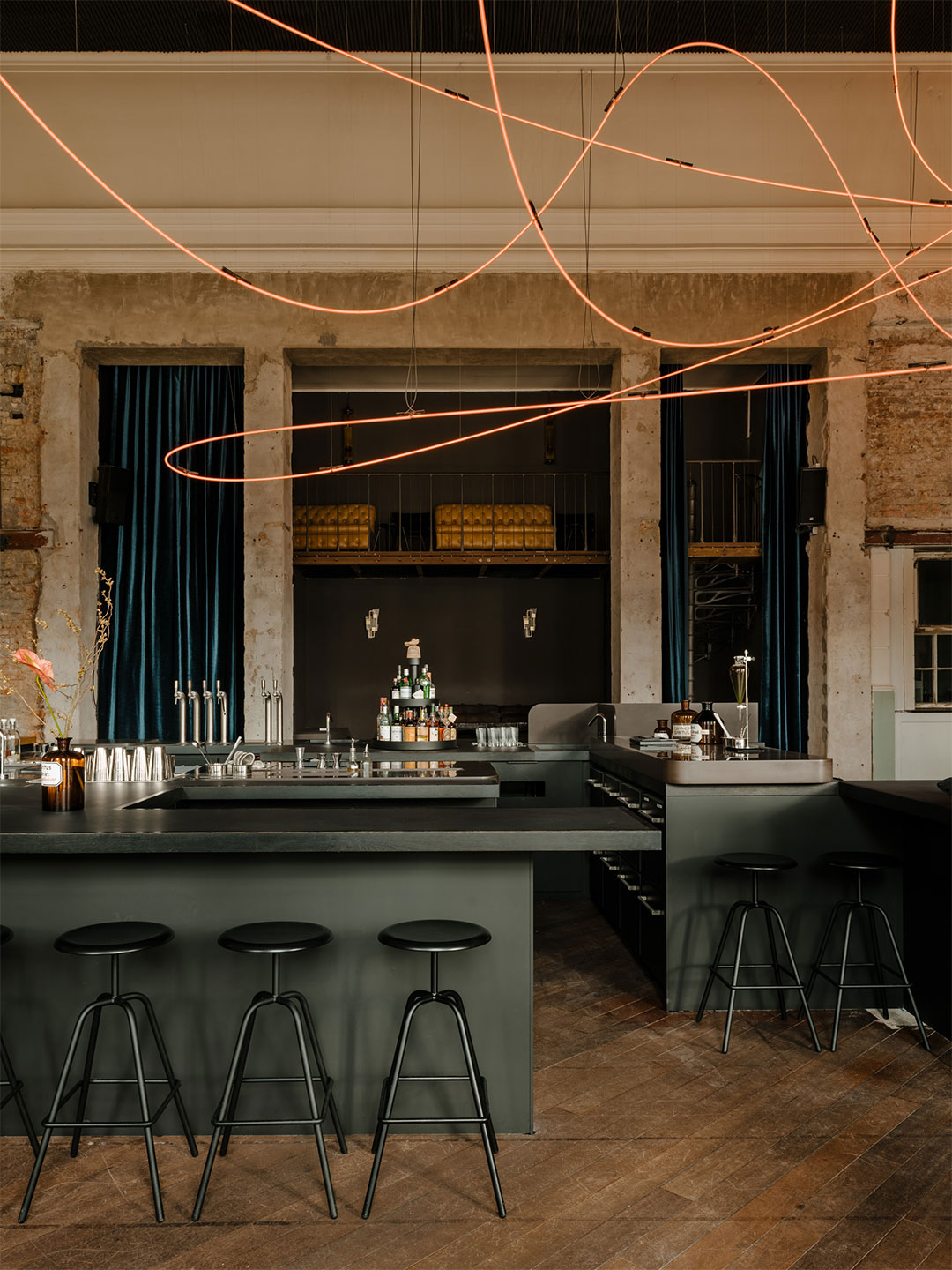
- Kink bar and restaurant: For the founders of Kink – an effortlessly edgy bolthole in Berlin – the objective was to create a cohesive drink-and-dine destination where art and design forms its beating heart. Read more.
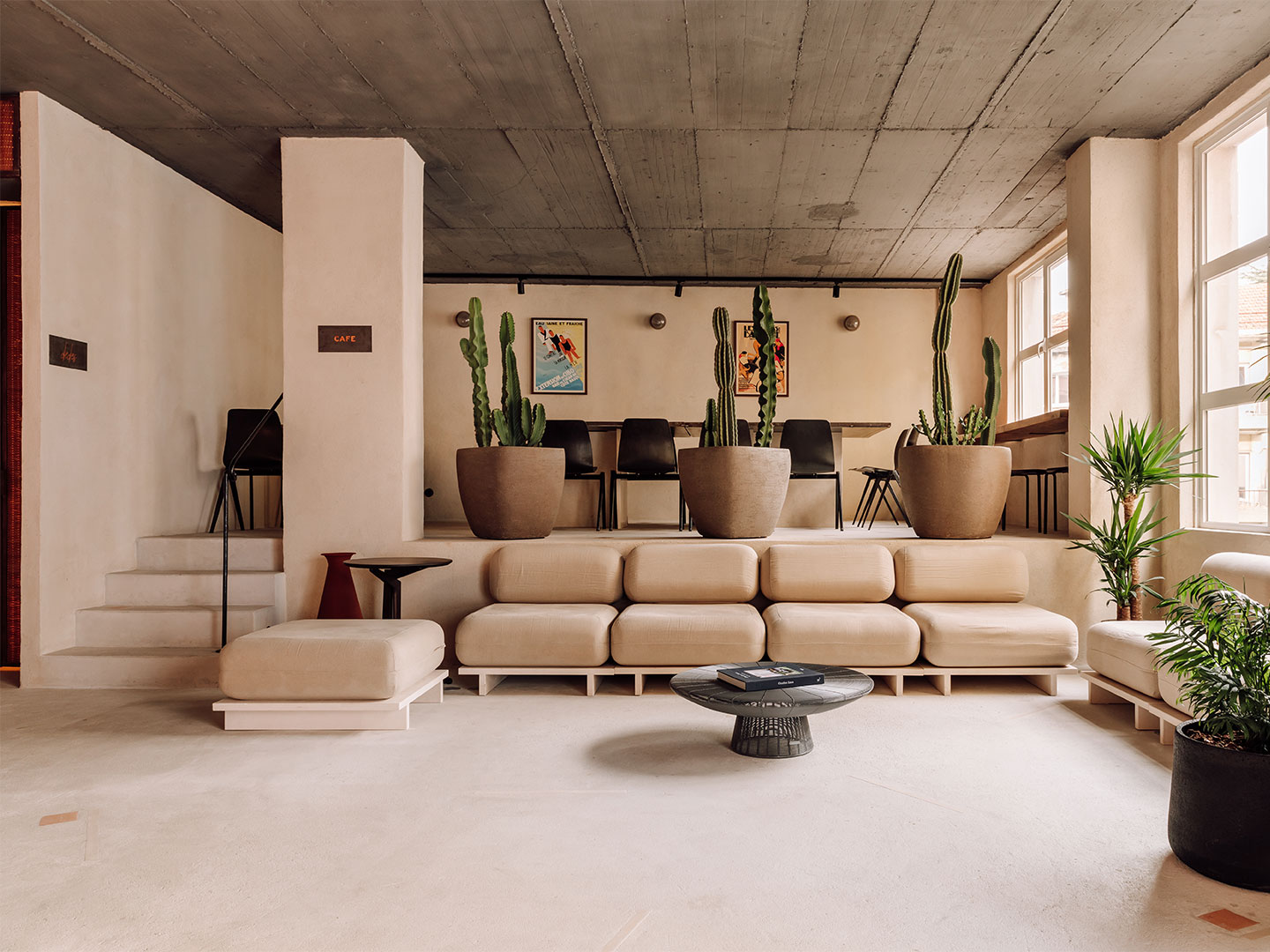
- Wellness Club by Studio Gameiro: A commercial space in Lisbon has undergone the ultimate 40-week transformation, revealing itself as a sophisticated wellness club where fitness facilities rub shoulders with a private bar and lounge. Read more.
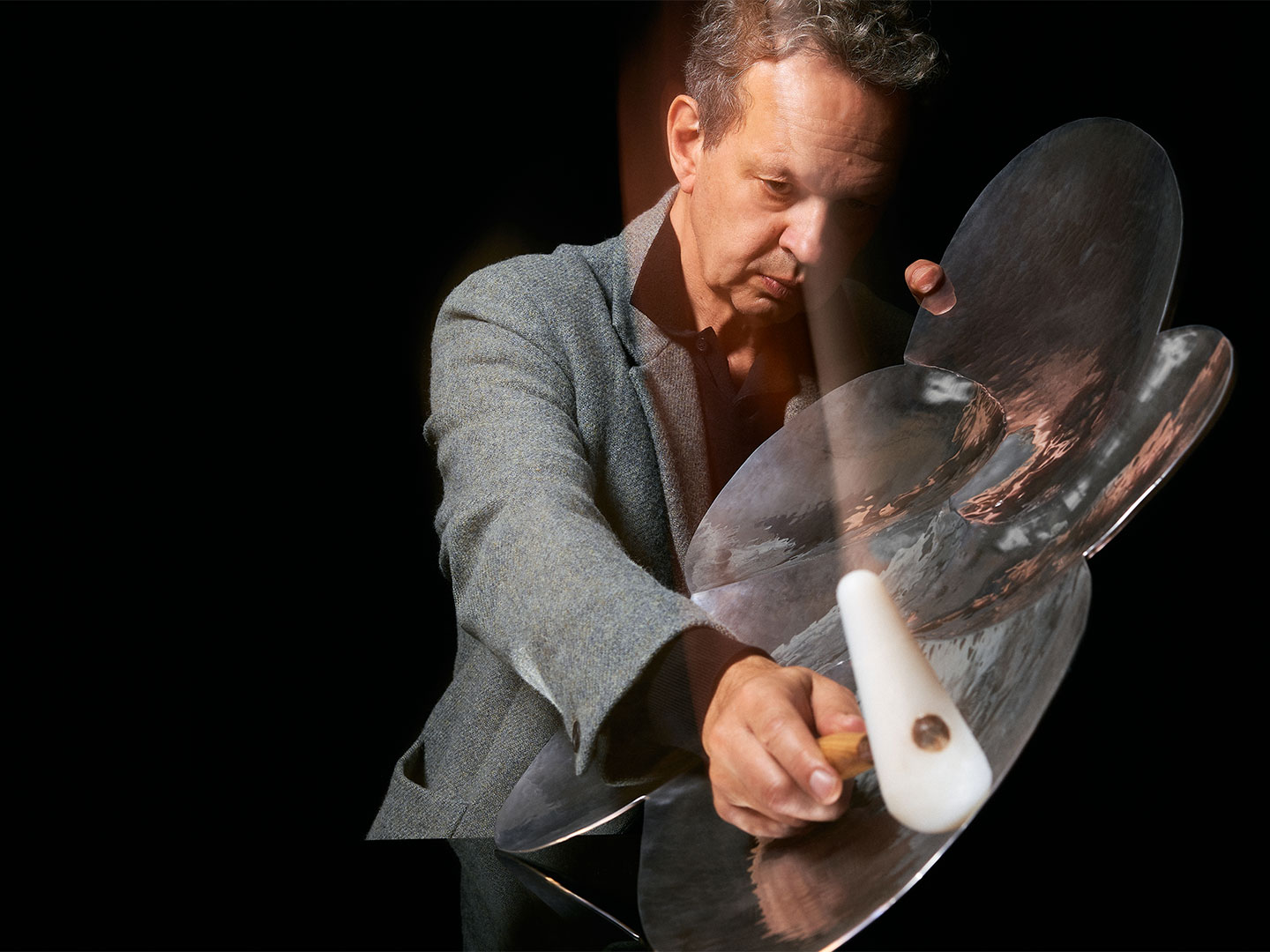
- Cloud by Tom Dixon: Appearing via hologram at Stockholm Design Week, British designer Tom Dixon has launched Cloud – a collection of high-shine accessories that mirror floating cumulus formations. Read more.
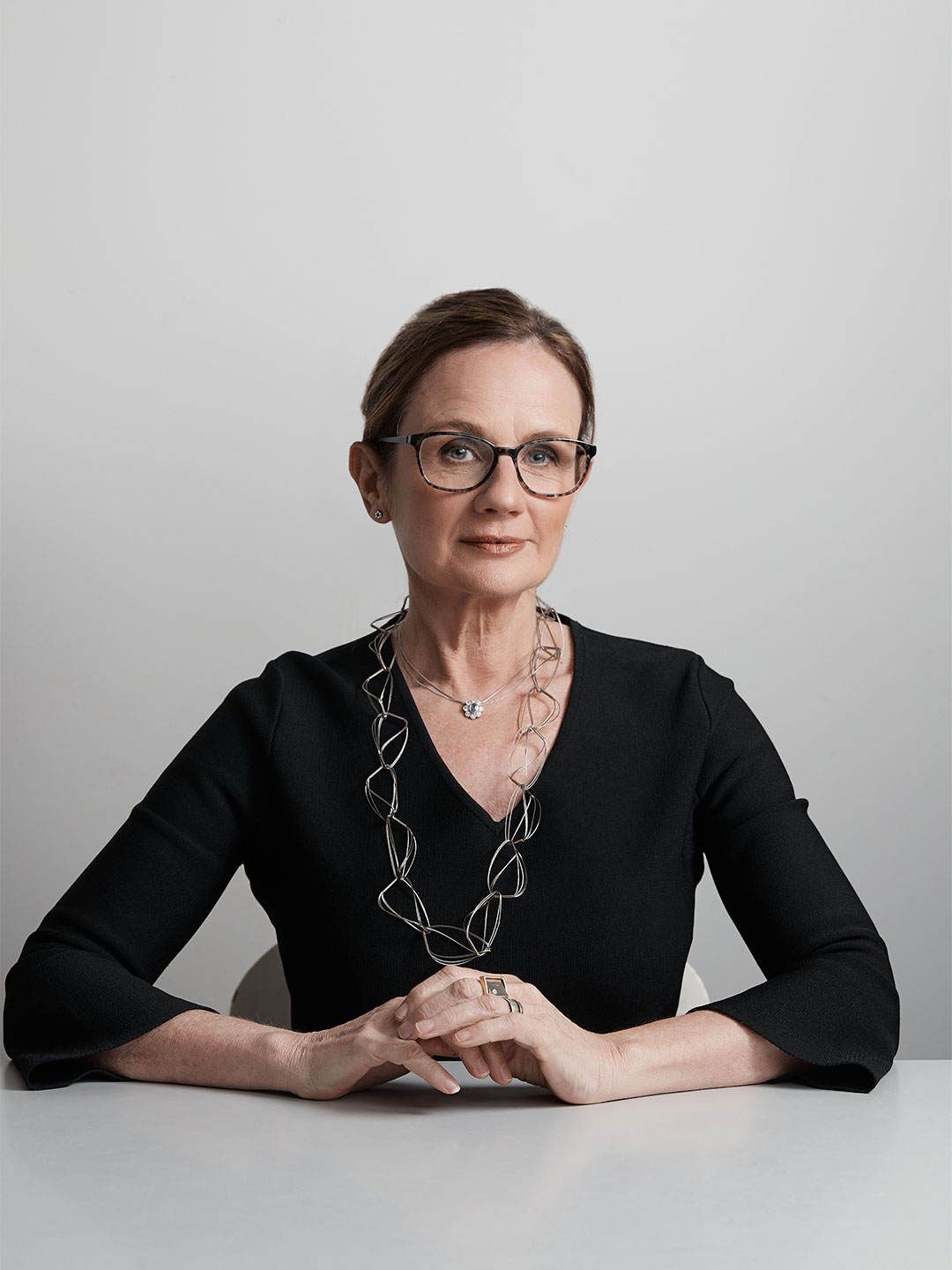
- inDETAIL x Camilla Block: For the fourth live-streamed episode of inDETAIL, an architect speaker series by Brickworks, host Stephen Varady will be joined by Camilla Block of Durbach Block Jaggers (pictured). Read more.
Work up a glow at Lisbon’s Wellness Club and serve up style with Cloud by Tom Dixon.
Related stories
In this week’s architecture and design video round-up (above), pull up a pew at the bar of Kink in Berlin, illuminated by the gentle glow of a tangled neon rope sculpture by Swiss artist Kerim Seiler.
Inspired by Paris’ archetypal Haussmann style, Australian architect Daniel Boddam has created an astonishing virtual apartment in which to display his latest collection of furniture. Armadillo’s new Nook collection of ravishing rugs features scaled-down mat sizes that cater specifically to smaller interior spaces.
And finally, add the latest instalment of inDETAIL to your weekend watch-list. Featuring architect Jayson Blight of Blight Rayner alongside host Cameron Bruhn, the episode is now available for catch-up viewing.
For more information on each of these stories, see below.
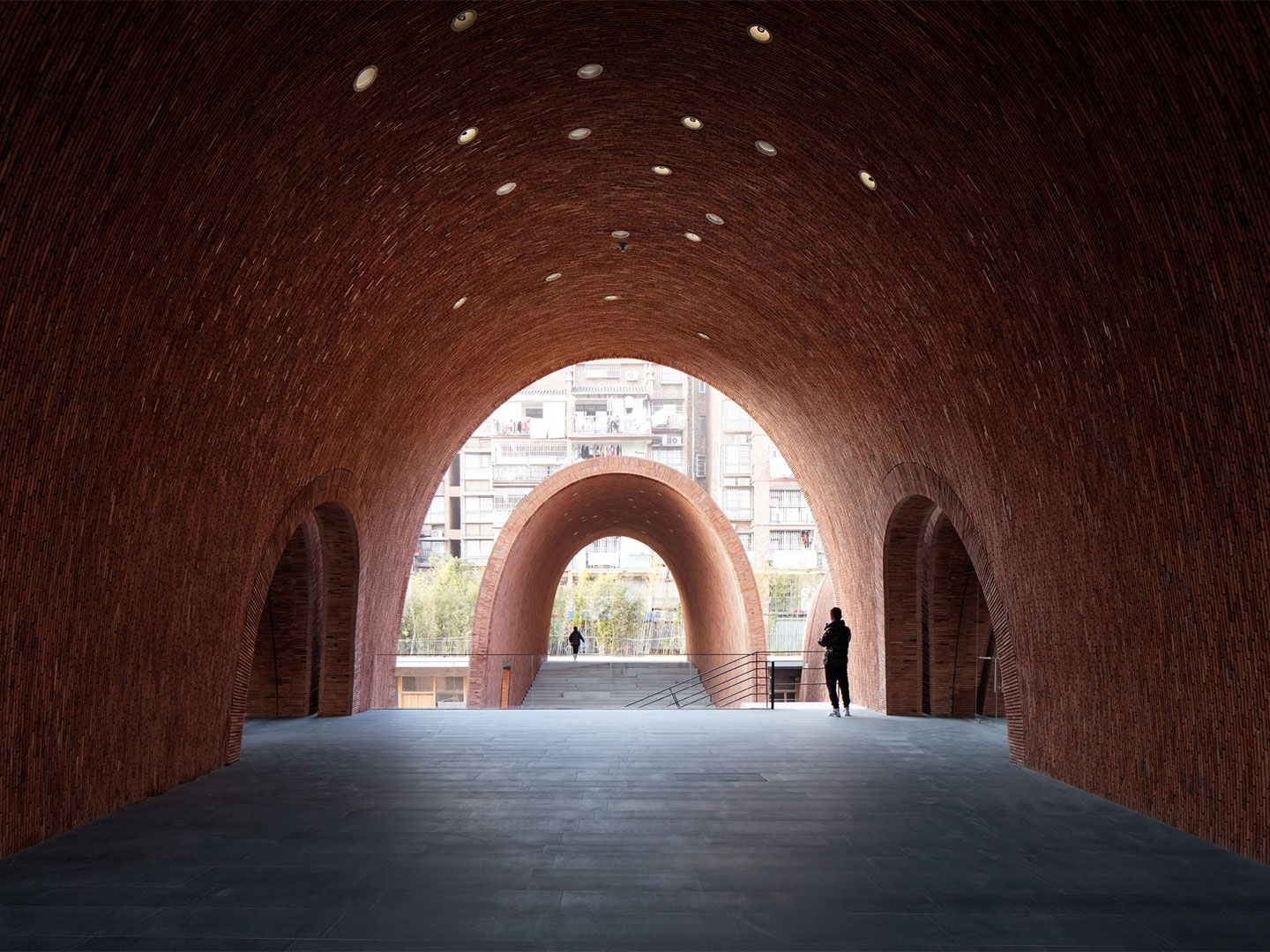
- The Imperial Kiln Museum: Designed by Beijing-based Studio Zhu-Pei, the vaulted brick-lined buildings of the Imperial Kiln Museum were formed using the same traditional construction method as the ancient kilns they memorialise. Read more.
- Nook by Armadillo: Continuing Armadillo’s unwavering commitment to ethics and aesthetics, the Nook collection of sustainability-led rugs features scaled-down mat sizes that cater specifically to smaller interior spaces. Read more.
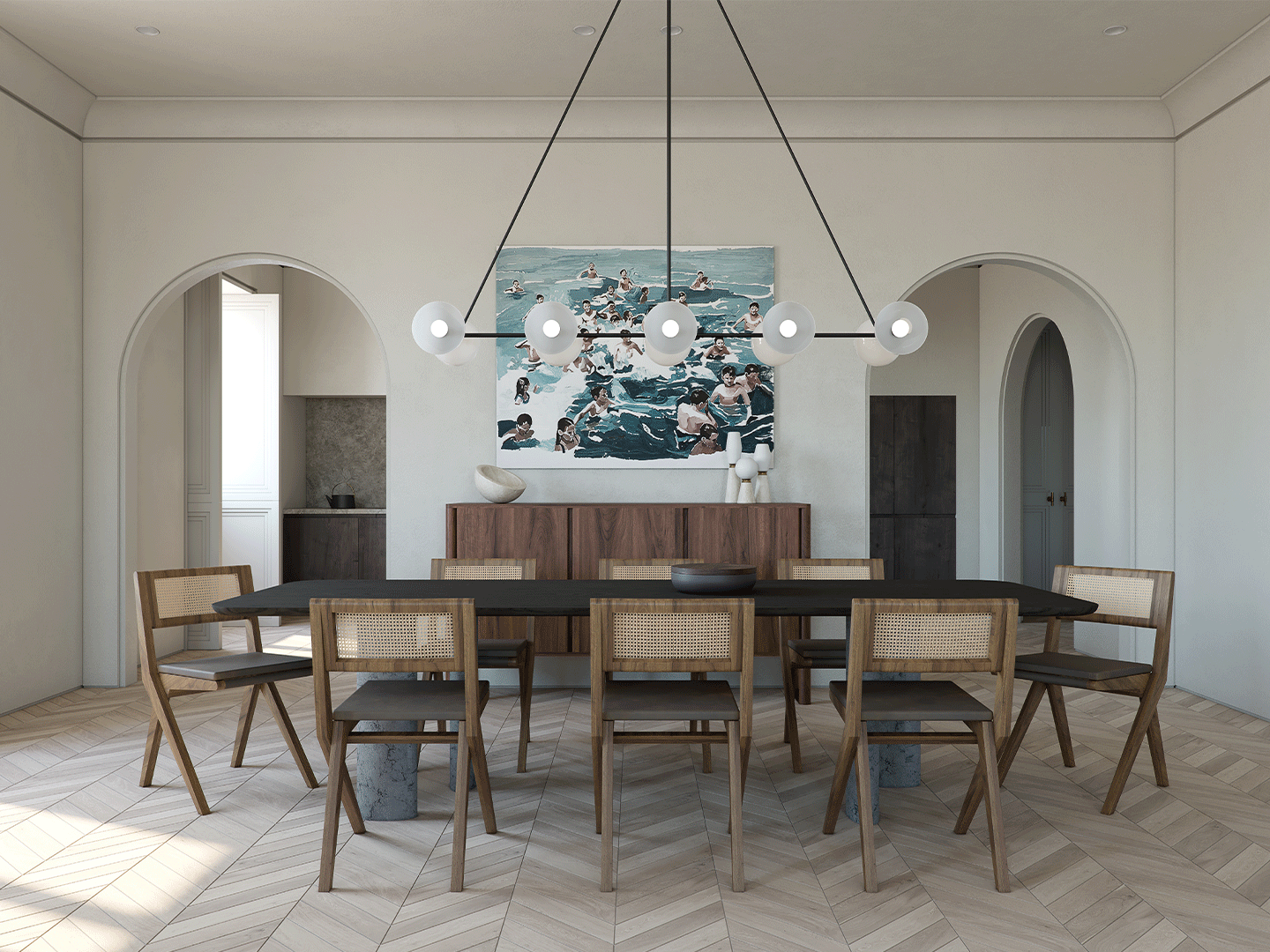
- Daniel Boddam furniture: Chic, elegant, unreal – the virtual abode created by Australian architect Adam Boddam celebrates Parisian-inspired simplicity while serving as the backdrop to the designer’s latest furniture release. Read more.

- Jayson Blight x inDETAIL: Architect Jayson Blight of Blight Rayner joins host Cameron Bruhn in the third instalment of inDETAIL, the all-new architecture and design series presented by Brickworks. Read more.
Stroll the grounds of China’s Imperial Kiln Museum and be transported to Paris via virtual reality.
Related stories
Propelled to rockstar status during the peak of mid-century home design, the breezeblock has endured somewhat of a legendary existence. Since the 1950s, or thereabouts, the extruded building blocks have either thrived or just survived through several waves of coming-in and going-out of favour, teetering between feelings of love and loathing by those who encounter them.
Ever the comeback queen, the breezeblock is making yet another debut in 2020 thanks to the nostalgia-led restylings of Adam Goodrum. “Growing up in Western Australia, I was surrounded by houses of the fifties and sixties where breezeblocks were a prominent feature,” Adam told Daily Architecture News. “I see them as a symbol of Australia’s love of the outdoors and the way we embrace indoor-outoor living.”
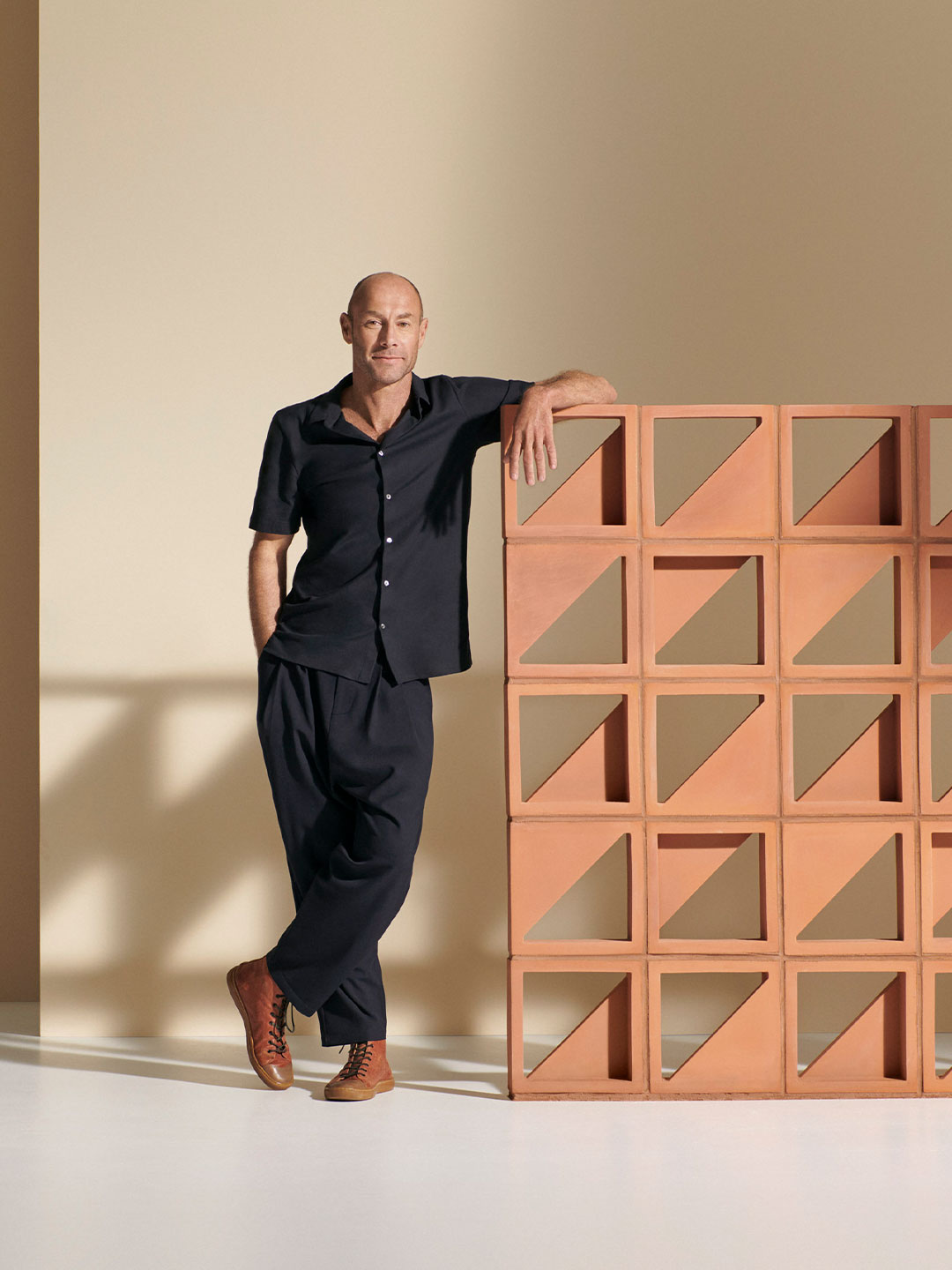
The Australian industrial designer has partnered up with building product pioneers Brickworks to release ‘Kite Breeze’, a completely new interpretation of the ubiquitous block that retains all the characteristics expected of such a product: lightness, the ability for breeze to pass through its core – hence its generic name – and, crucially for the designer, the capacity to facilitate a bold manipulation of light and shade. “One of the most poetic aspects of the breezeblock is its ability to create ambience via the interplay of light and shadow,” says Adam.
Manufactured from an Italian clay base in San Selmo, Italy, and informed by the rugged landscape of Adam’s beloved Western Australia, ‘Kite Breeze’ is available in three timeless iterations: glazed White, and the earth-toned Dune and Terracotta blocks, both of which are delivered in a natural finish as if to represent the escarpment from which they were inspired.
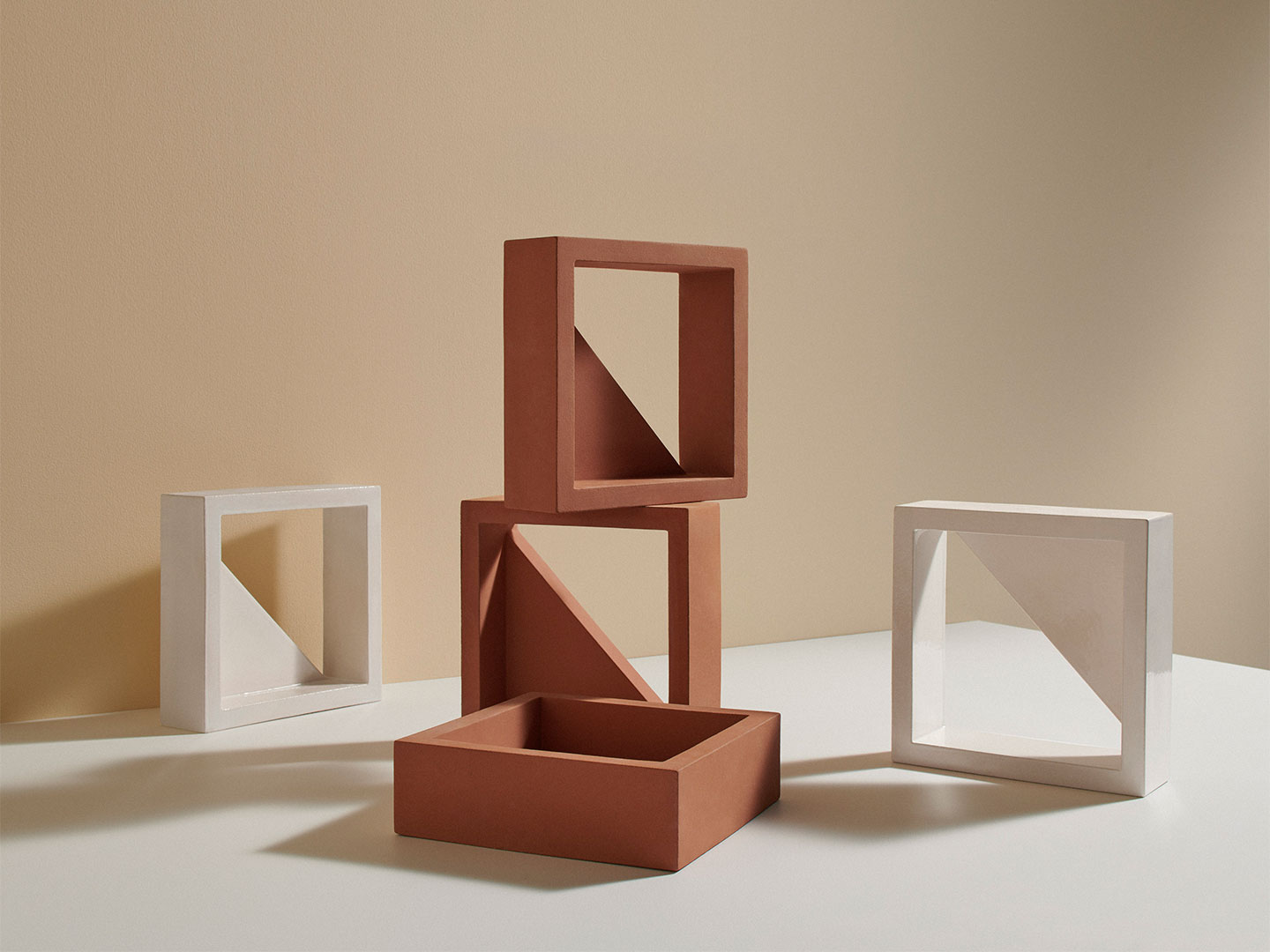
Simple in appearance yet deceptively complex from an engineering and manufacturing standpoint, ‘Kite Breeze’ is given its distinctive look by a triangle-shaped – perhaps kite-like – panel that sits flush with one corner face of the block’s frame. For designer Adam, the possibilities provided by the triangular dividers are seemingly endless and exciting in equal measure. “From just one single block there are an abundance of configurations, patterns and arrangements to design with,” he says. “I’m intrigued to see how architects, designers and homeowners can play with ‘Kite’ to help bring their designs to life.”
‘Kite Breeze’ is available through Austral Masonry, a subsidiary of Brickworks Building Products, the owner of this masthead.
adamgoodrum.com; brickworks.com
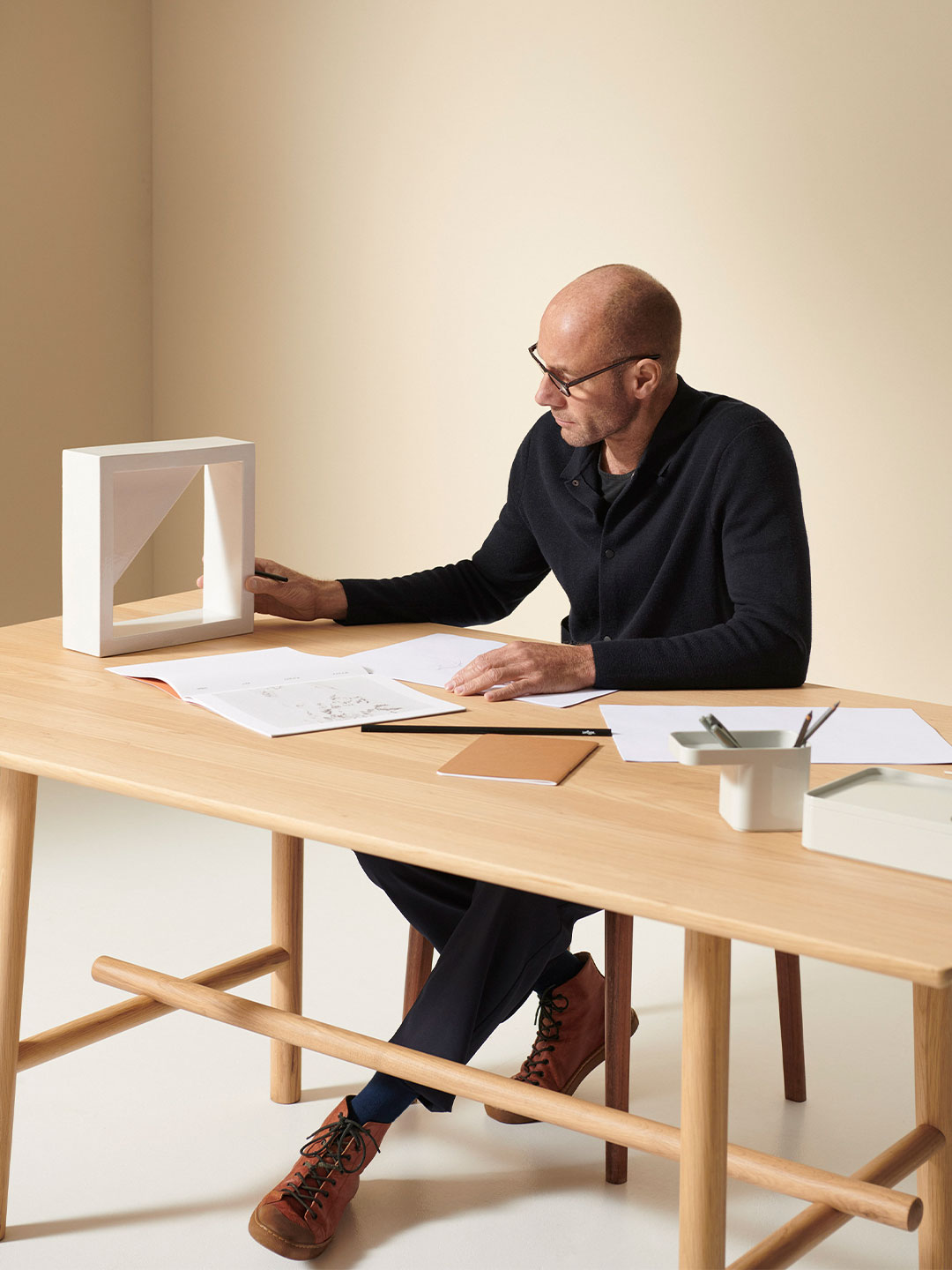
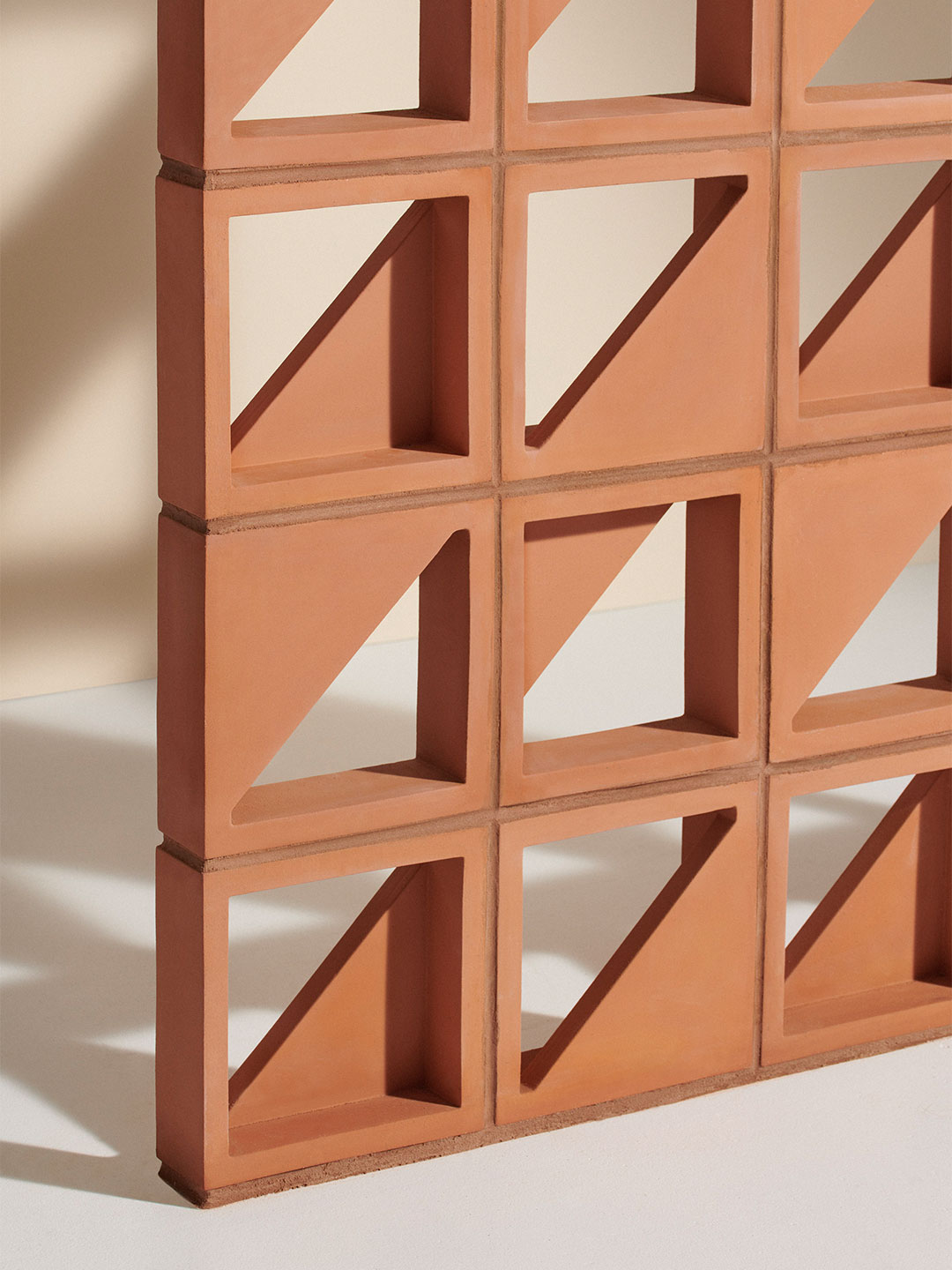
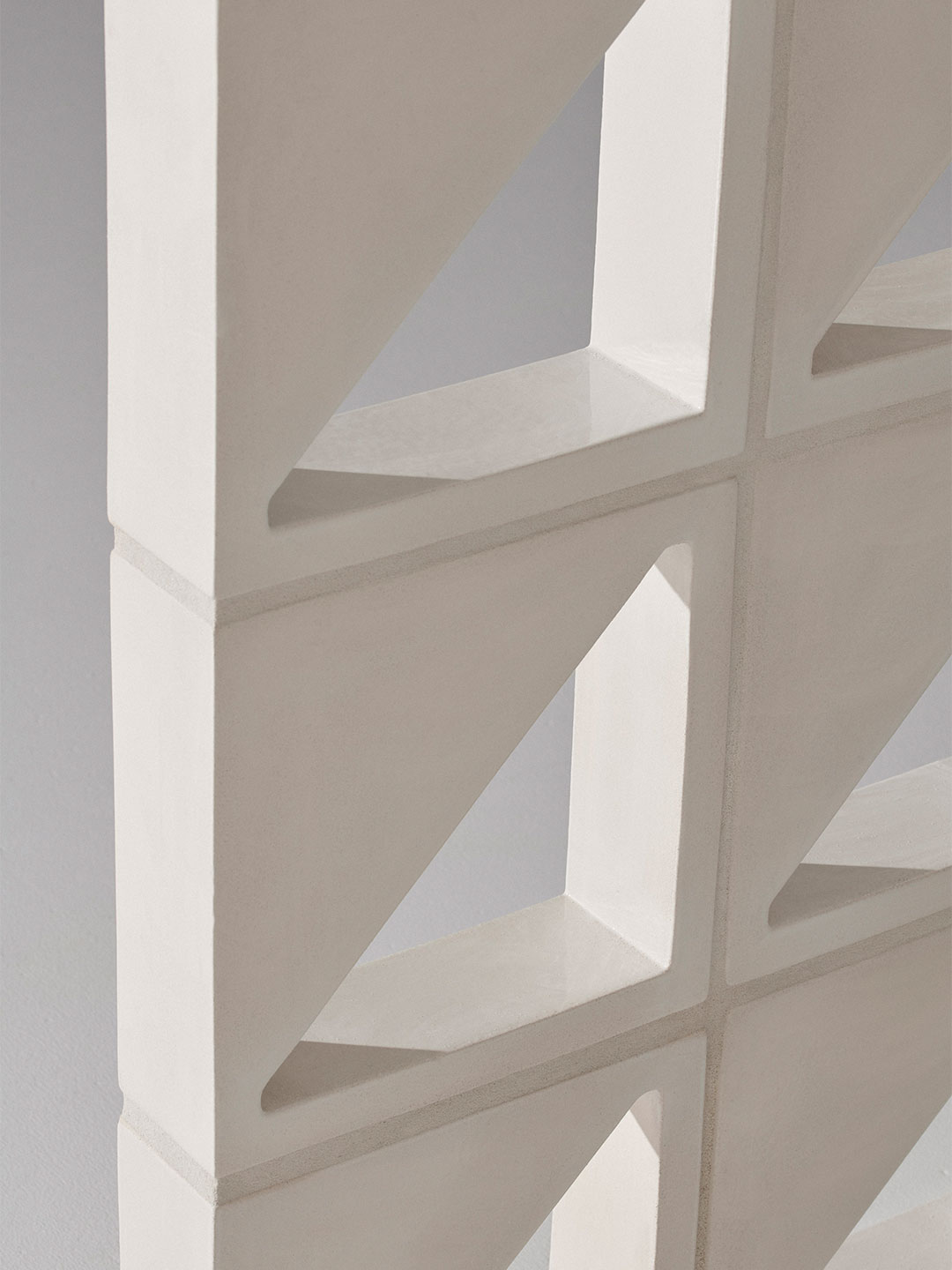
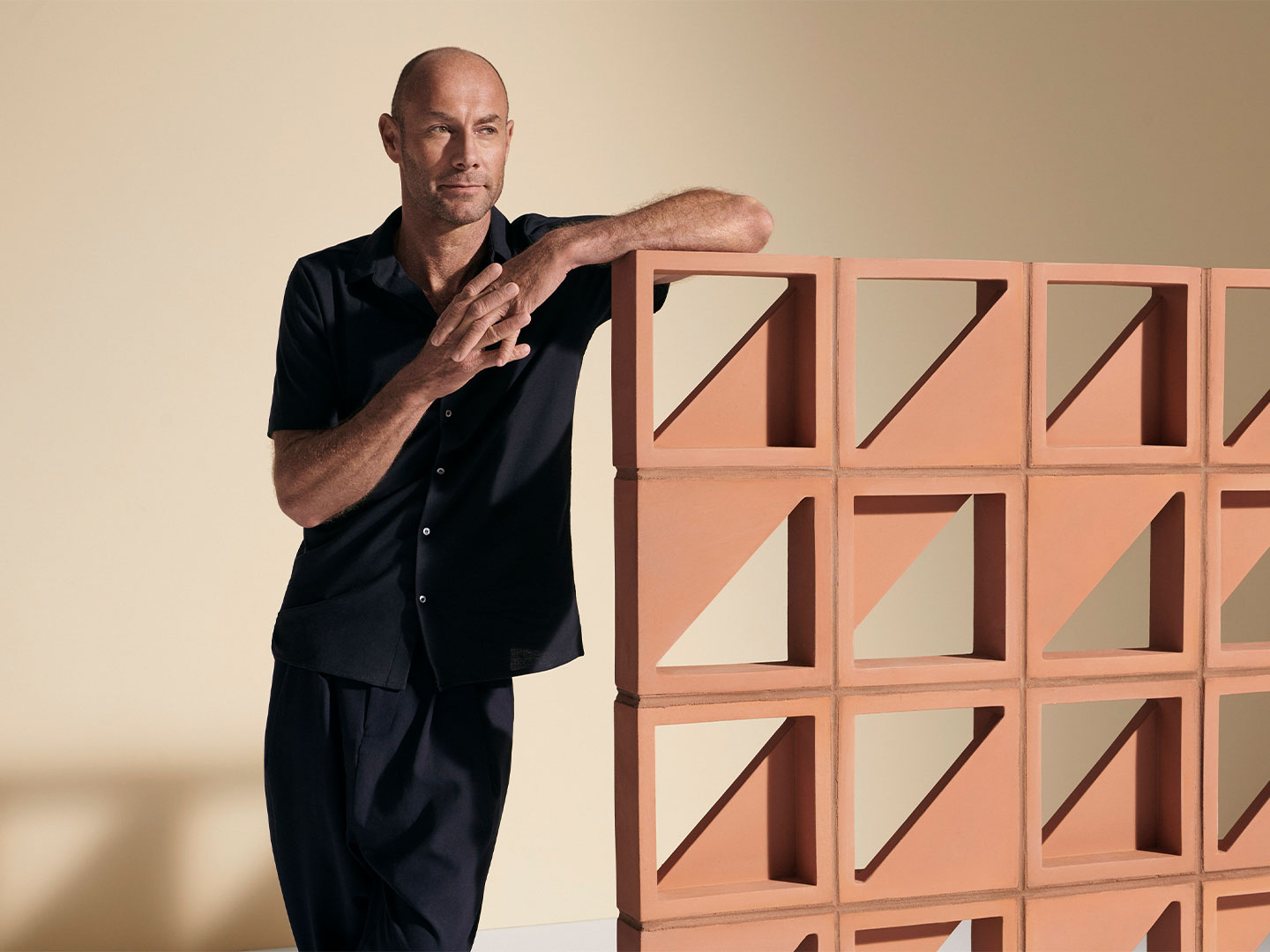
One of the most poetic aspects of the breezeblock is its ability to create ambience via the interplay of light and shadow.
Related stories
- Kvadrat’s ‘Knit!’ exhibition corrals 28 designers including Adam Goodrum and Benja Harney.
- Home tour: Couldrey House in sub-tropical Queensland by architect Peter Besley.
In this week’s architecture and design video round-up (above), pull up a pew at the bar of Kink in Berlin, illuminated by the gentle glow of a tangled neon rope sculpture by Swiss artist Kerim Seiler.
With light-filled interiors by famed American designer Kelly Wearstler, Santa Monica Proper has already become a smash-hit in Los Angeles’ bustling ‘Silicon Beach’. Step inside the glamorous coastal hotel.
Kyiv-based architecture and interiors firm Balbek Bureau has recently completed the Mama Manana restaurant, a four-level establishment in Ukraine that showcases generous Georgian hospitality. And finally this week, B20 has unveiled the latest collection from Brickworks – over 100 new and innovative products, each destined to influence the future of the built environment.
For more information on each of this week’s stories, see below.
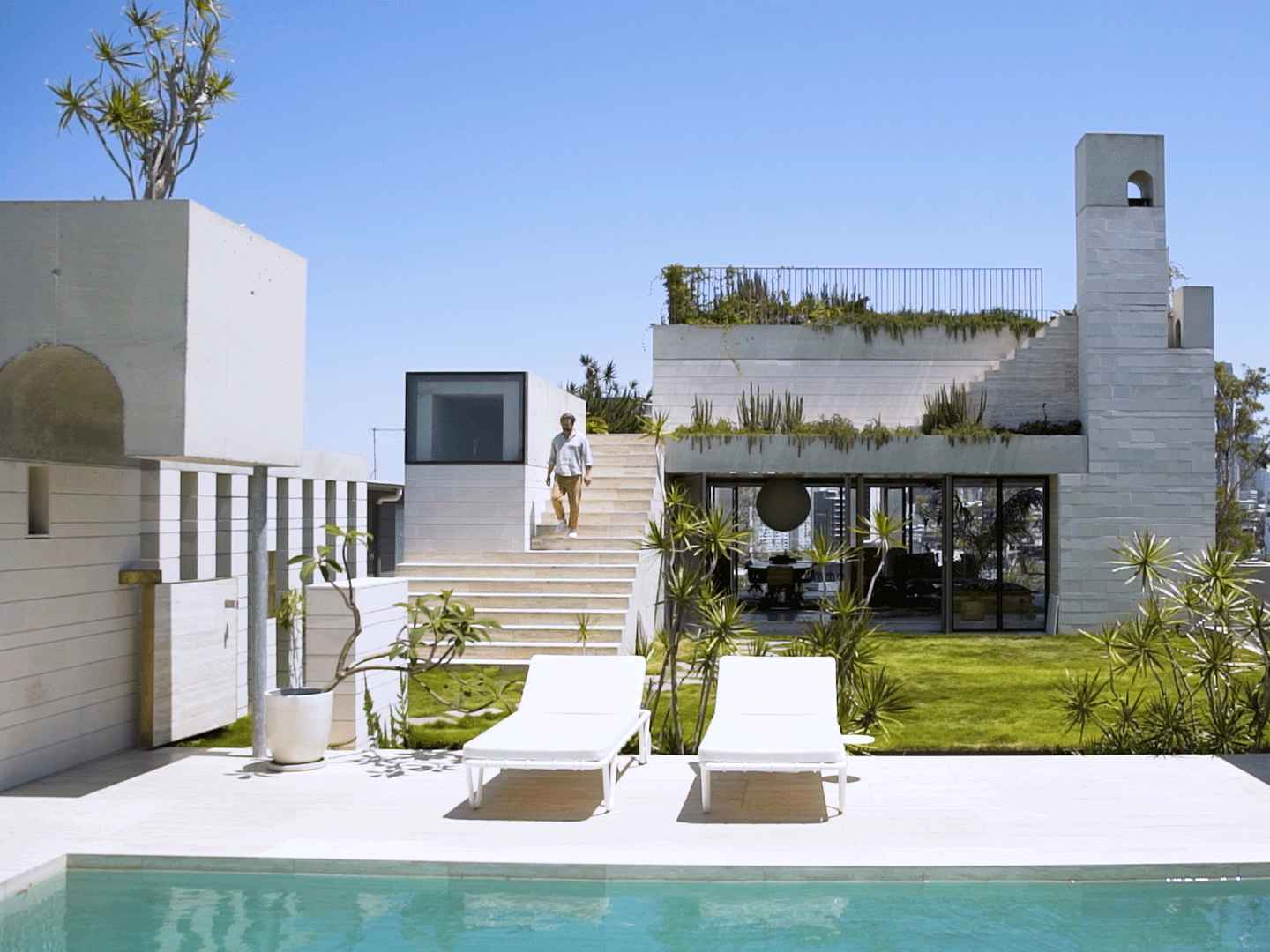
- La Scala by Richards and Spence: The private residence of architects Ingrid Richards and Adrian Spence, La Scala is the culmination of four years of ideas where the outdoor space acts solidly as its centrepiece. Read more.
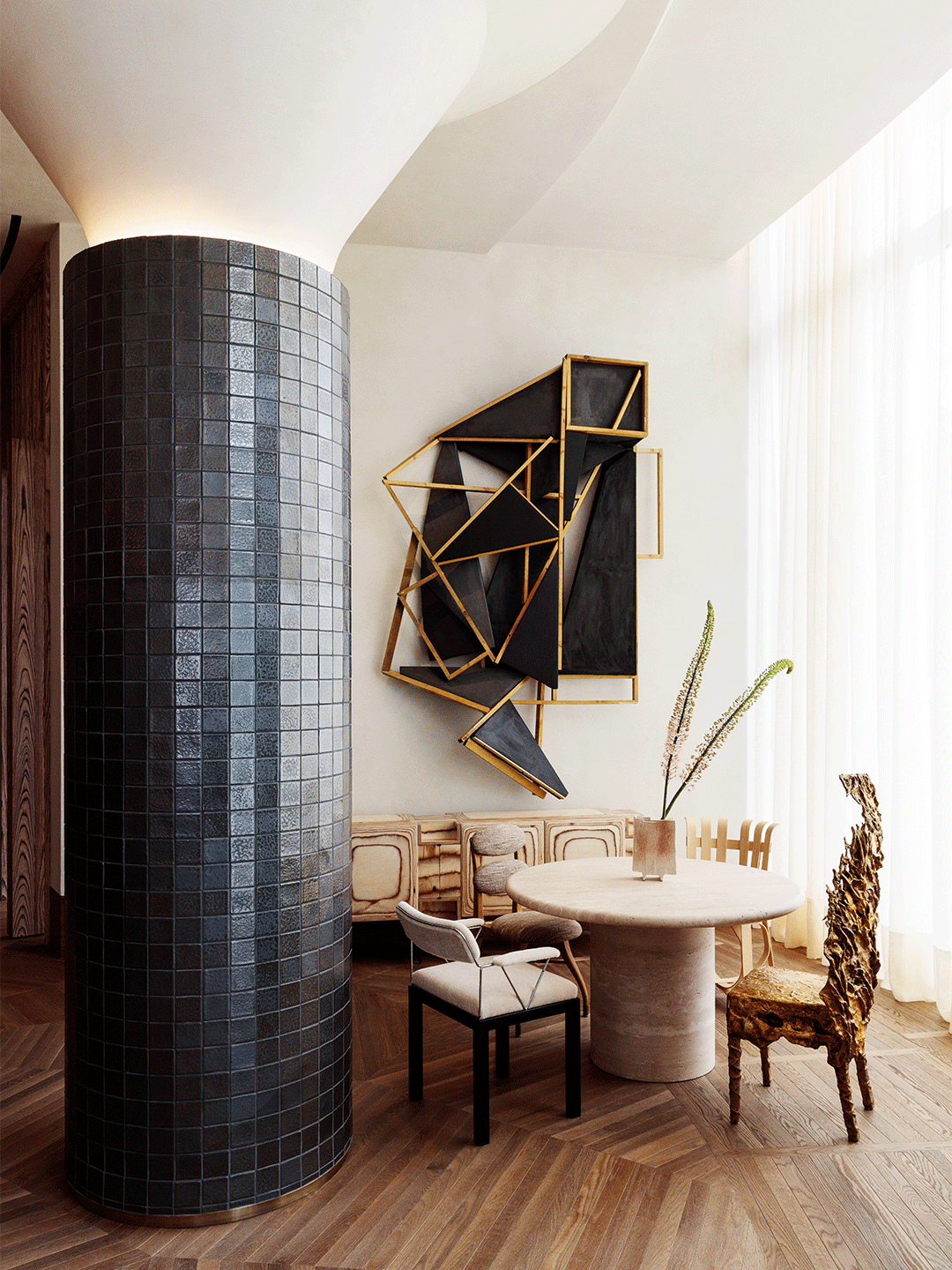
- Santa Monica Proper: With light-filled interiors by famed American designer Kelly Wearstler, Santa Monica Proper has already become a smash-hit with visitors and locals alike. Read more.
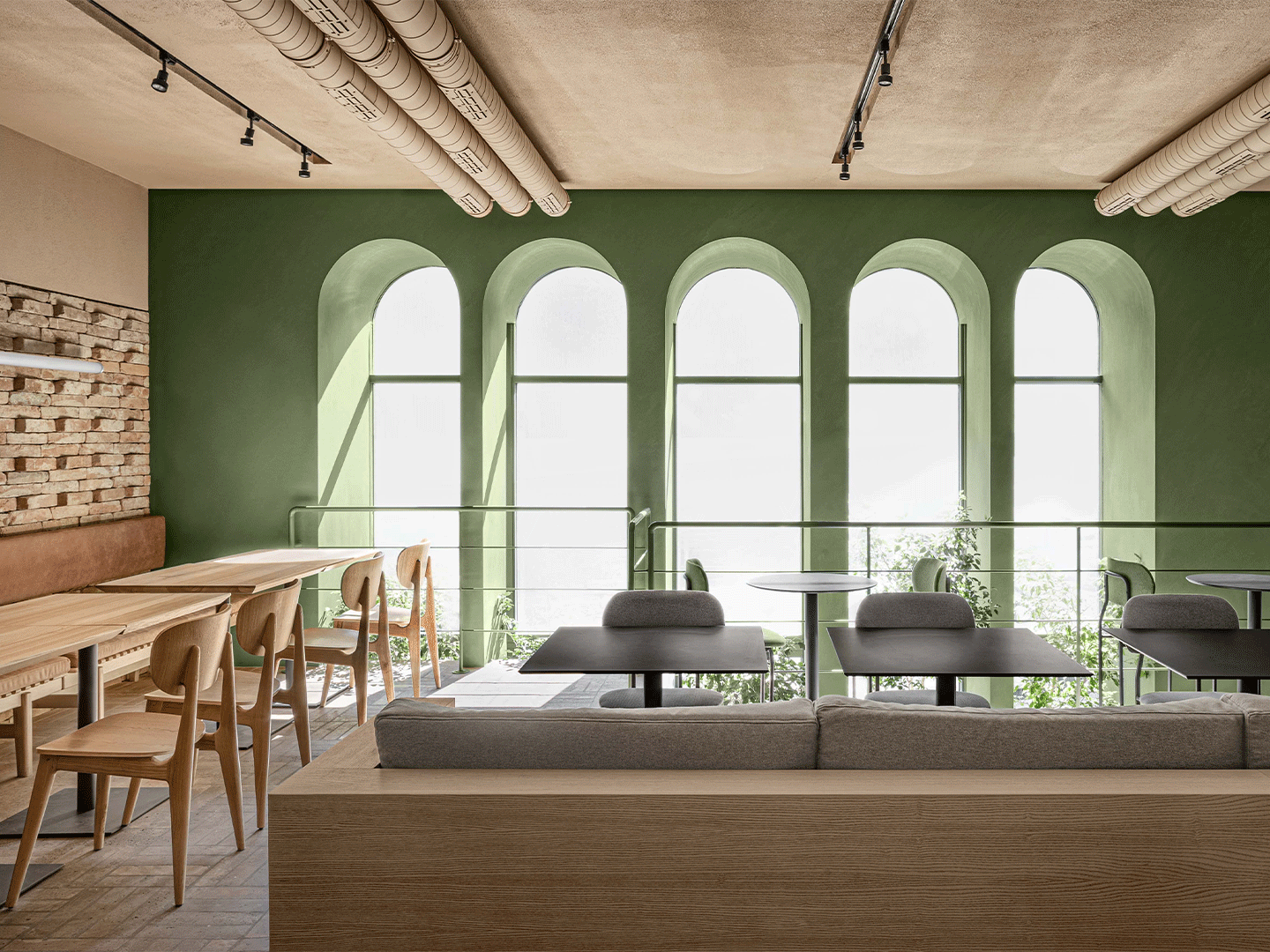
- Mana Manana restaurant: Kyiv-based architecture and interiors firm Balbek Bureau harnessed the spirit of Georgian hospitality when designing Mana Manana restaurant in Ukraine. Read more.
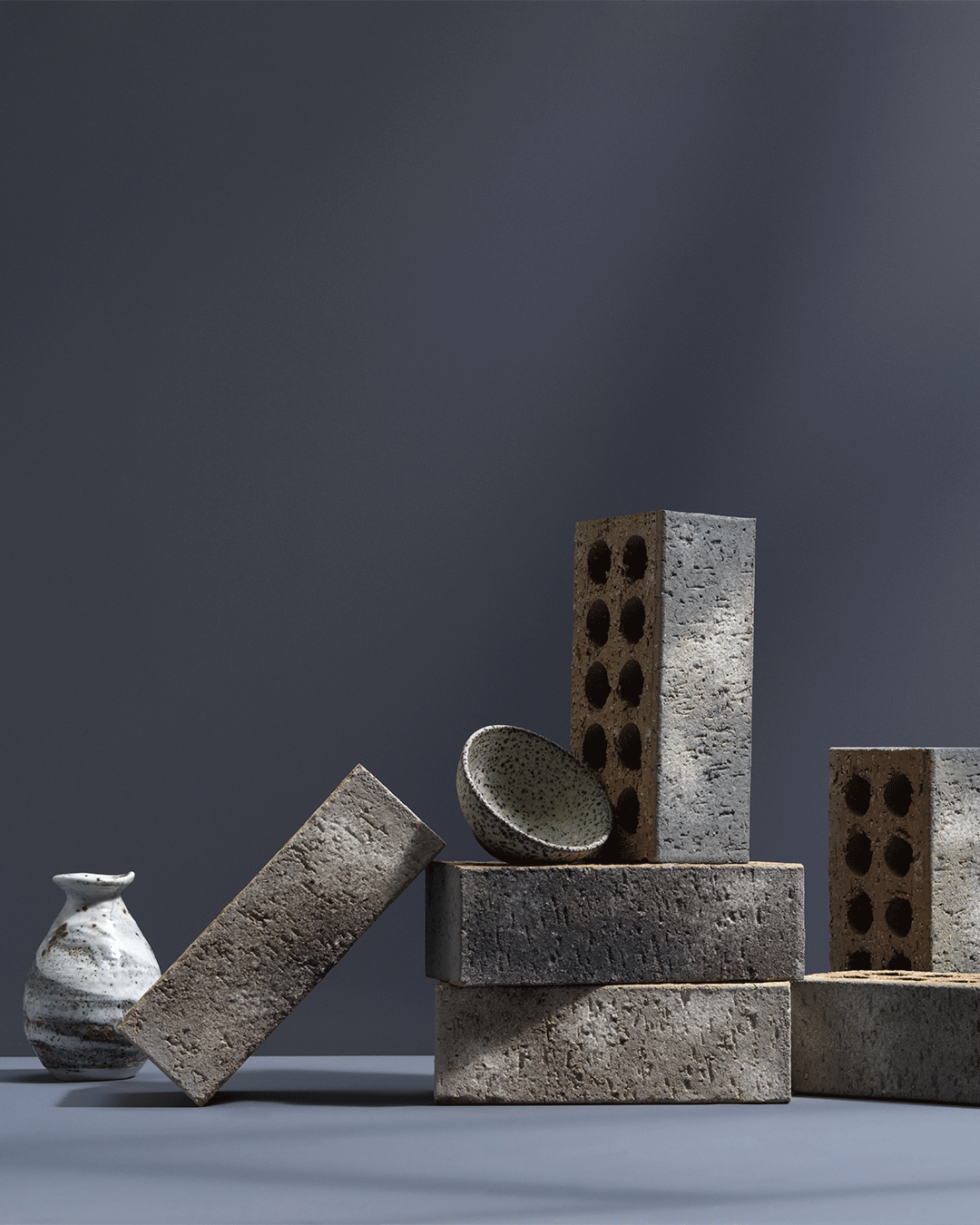
- B20 by Brickworks: Created in collaboration with experts from around the globe, the new Brickworks collection launched during B20 is destined to inspire, excite and endure. Read more.
From a residence in sunny Queensland to a four-storey restaurant in the heart of historic Kyiv.
Related stories
3 House by Channon Architects and Burton Architects explores the pragmatic versatility of masonry in medium density housing on small lots. Comprising an office, a granny flat and a family home, the project focusses on an adaptive plan, where the functions of its self-contained spaces can change when needed. Located on a corner block in New Farm, Brisbane, the site was already occupied by a four-room workers’ cottage. The reimagined cottage was the first dwelling to be developed, becoming an office with a granny flat and car park tucked underneath, followed by a separate 3-bedroom house with two-car garage constructed at the rear.
During a year when online streaming has rapidly become the new way for brands to connect with audiences, B20 by Brickworks shone the spotlight on inspiring new collections from the company’s immense portfolio of bricks, concrete, masonry and roof tiles. A raft of impressive products that when combined with Brickworks’ ongoing work in the field is destined to influence the future of the built environment.
“Our team has been hard at work exploring technologies and testing innovation to bring a new range of dynamic building materials to the market,” says Brett Ward, Brickworks’ general manager international marketing. “B20 demonstrates our commitment to new advancements.”
Hosted by Dana Tomic Hughes, founder of Yellowtrace, in collaboration with industry experts including industrial designer Adam Goodrum and trend forecaster Kim Chadwick, B20 celebrated the reinvention of classic building materials, driven by global architecture trends and a fresh Australian perspective.
View details of the full collection here. For a selection of highlights from B20, see below.
WATCH: BRICKWORKS PRESENTS B20
Our team has been hard at work exploring technologies and testing innovation to bring a new range of dynamic building materials to the market.
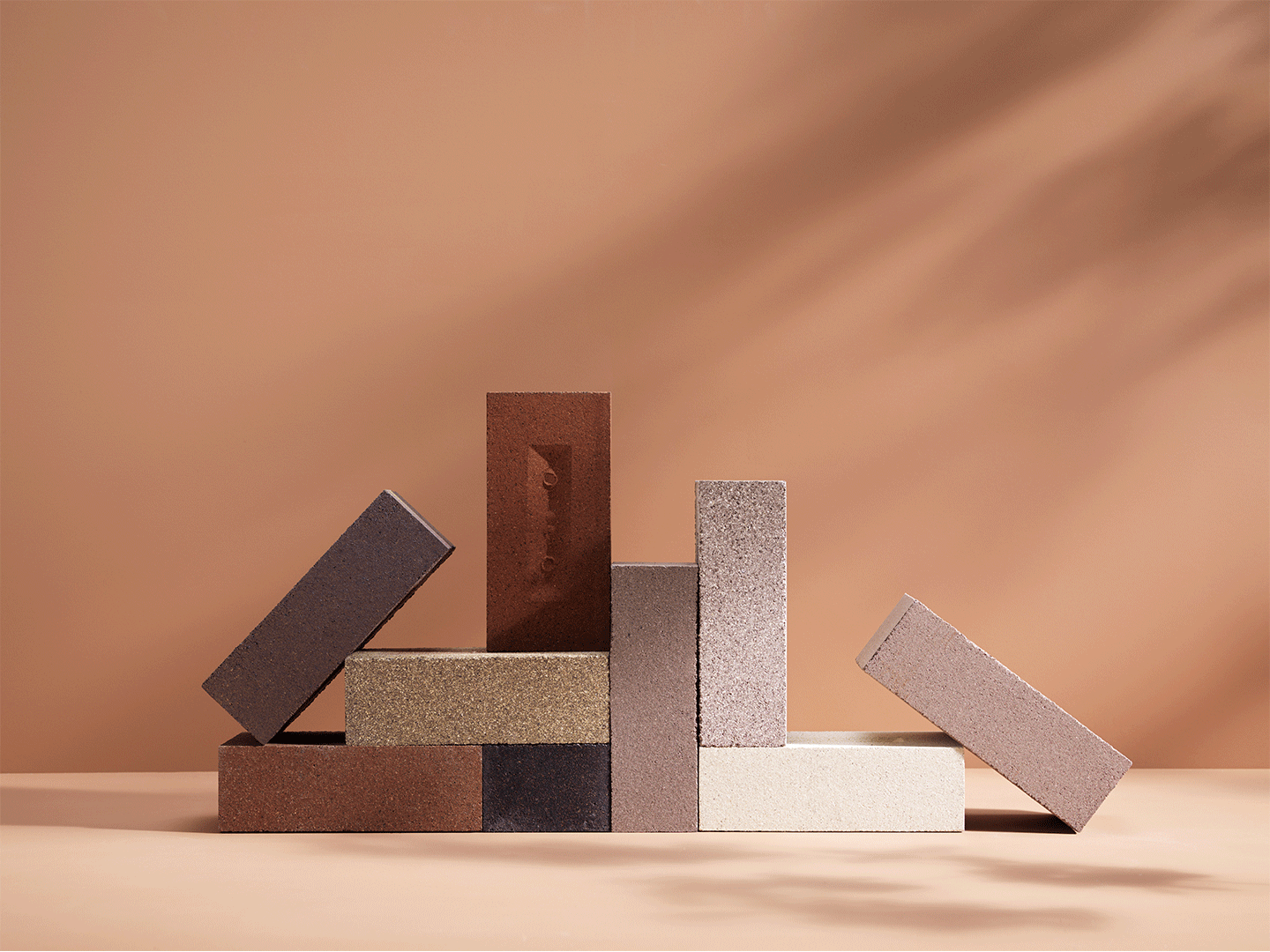
Bowral Blends by Bowral Bricks.
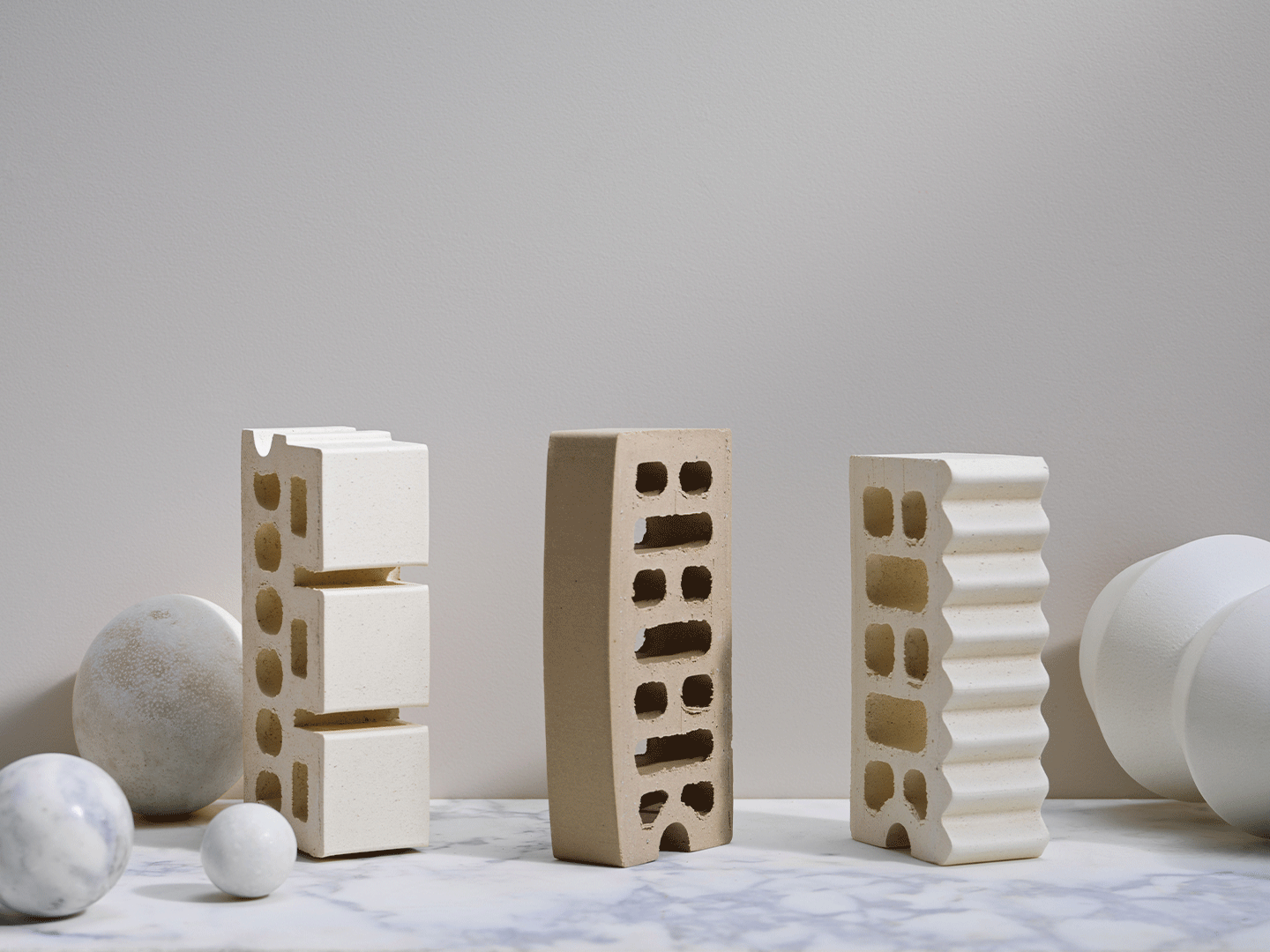
La Paloma by Austral Bricks.
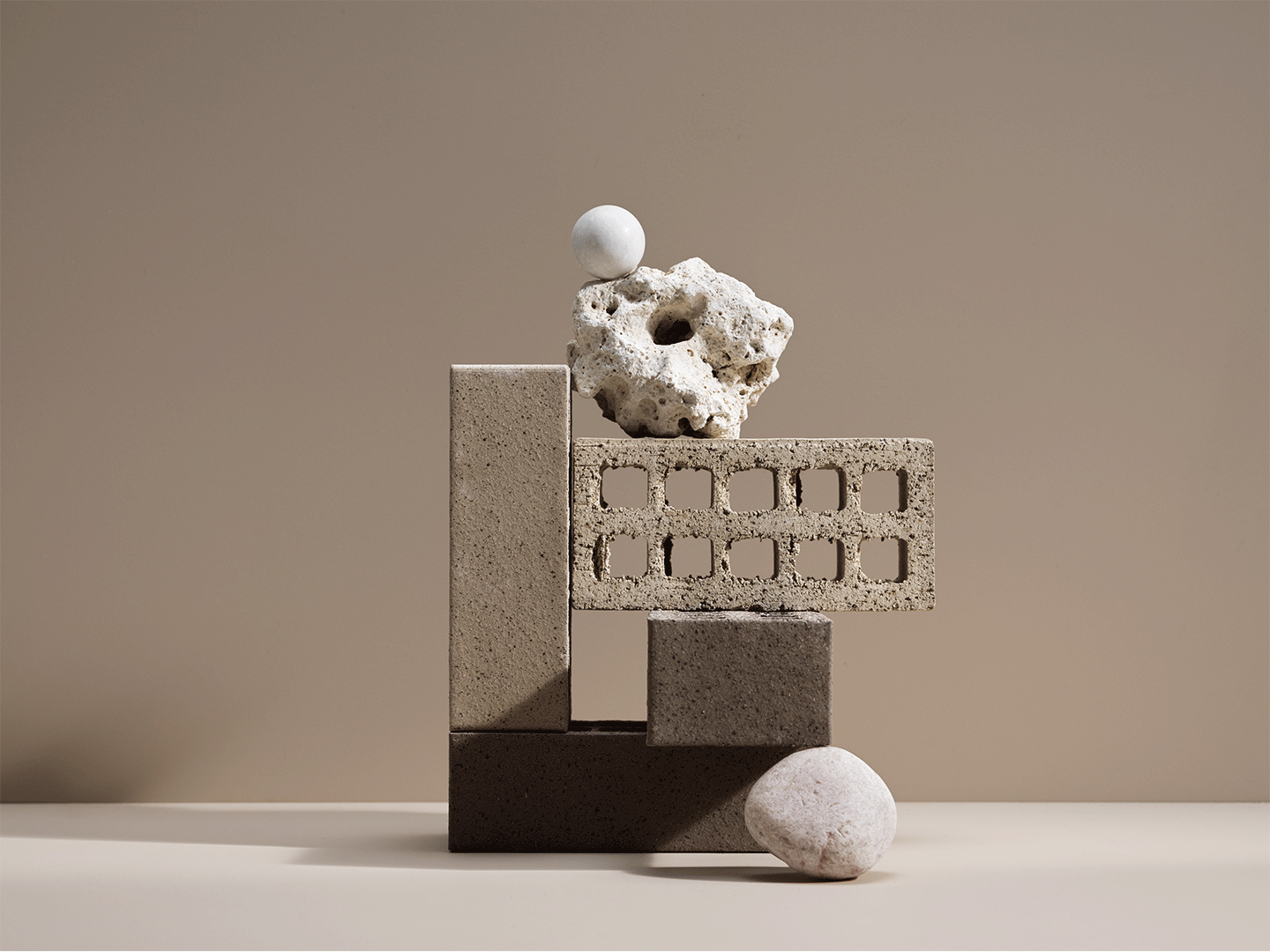
Mineral Contours by Austral Bricks.
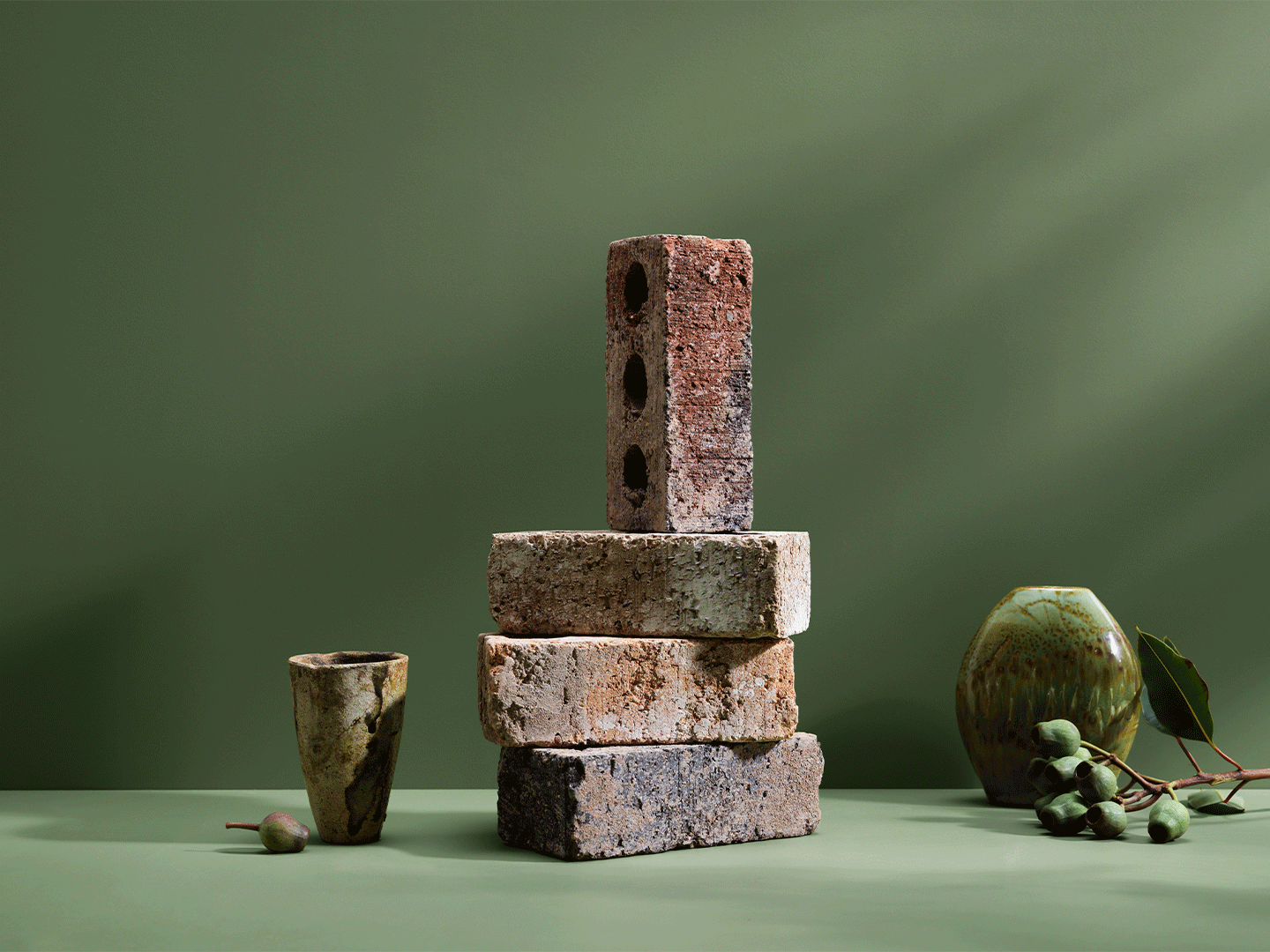
Overland by Daniel Robertson.
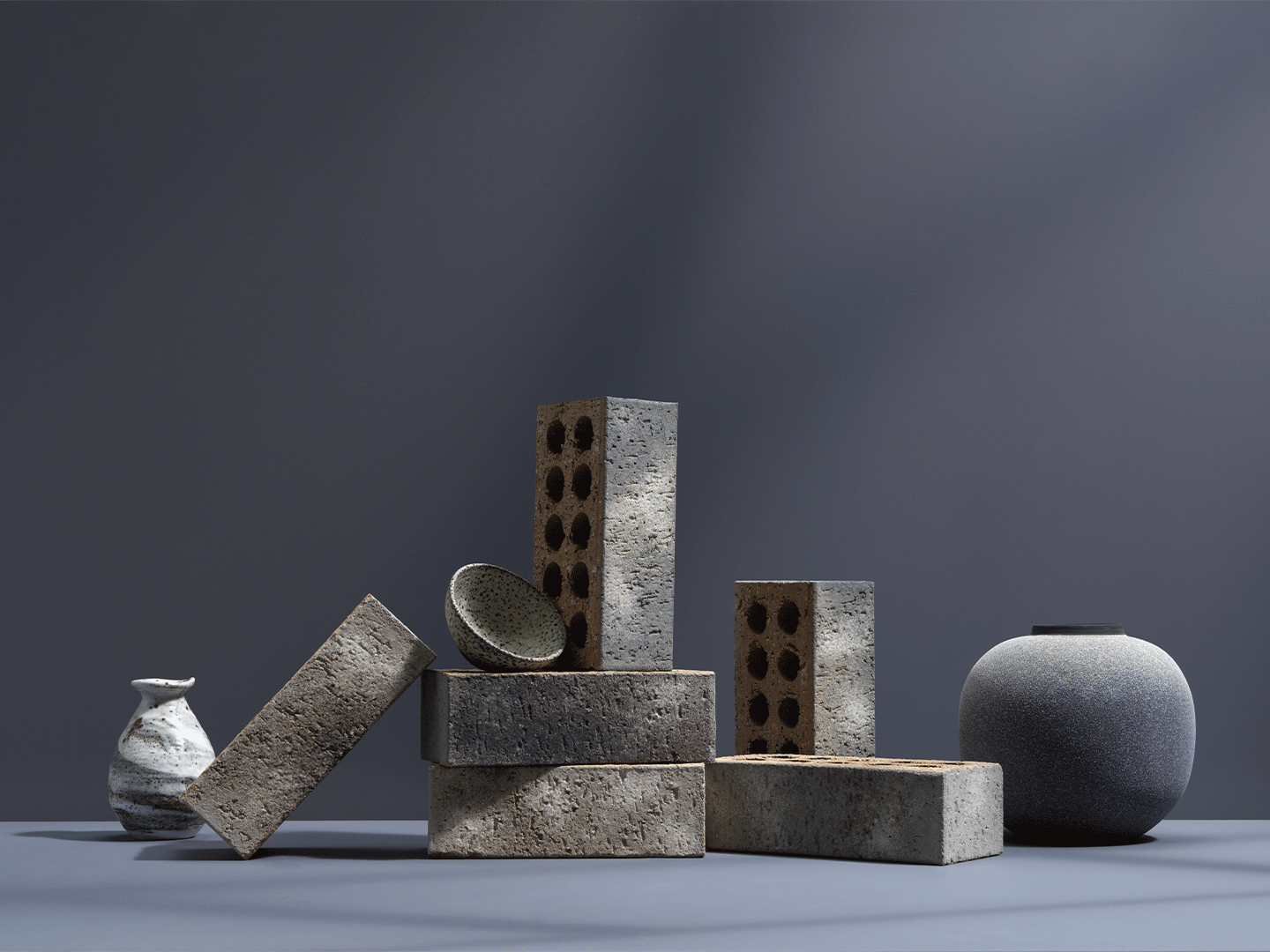
Stratos Series by Austral Bricks.
Related stories
- Bricks and mortar go digital with B20 product launch.
- Architect Fabrizio Barozzi joins inDETAIL speaker series.
- Watch: Alec Tzannes is the first guest in the all-new inDETAIL architecture series.
3 House by Channon Architects and Burton Architects explores the pragmatic versatility of masonry in medium density housing on small lots. Comprising an office, a granny flat and a family home, the project focusses on an adaptive plan, where the functions of its self-contained spaces can change when needed. Located on a corner block in New Farm, Brisbane, the site was already occupied by a four-room workers’ cottage. The reimagined cottage was the first dwelling to be developed, becoming an office with a granny flat and car park tucked underneath, followed by a separate 3-bedroom house with two-car garage constructed at the rear.
Featuring a line-up of engaging presenters, including Brickworks managing director Lindsay Partridge AM, Yellowtrace founder and editor Dana Tomic Hughes and Kim Chadwick, director Australian Trend Forecast, the dynamic digital event is set to announce new and game-changing innovations.
The most anticipated unveiling is a collaboration between Brickworks and Australian industrial designer Adam Goodrum.
Register for the event here.
WATCH: BRICKWORKS PRESENTS B20 ON OCTOBER 29
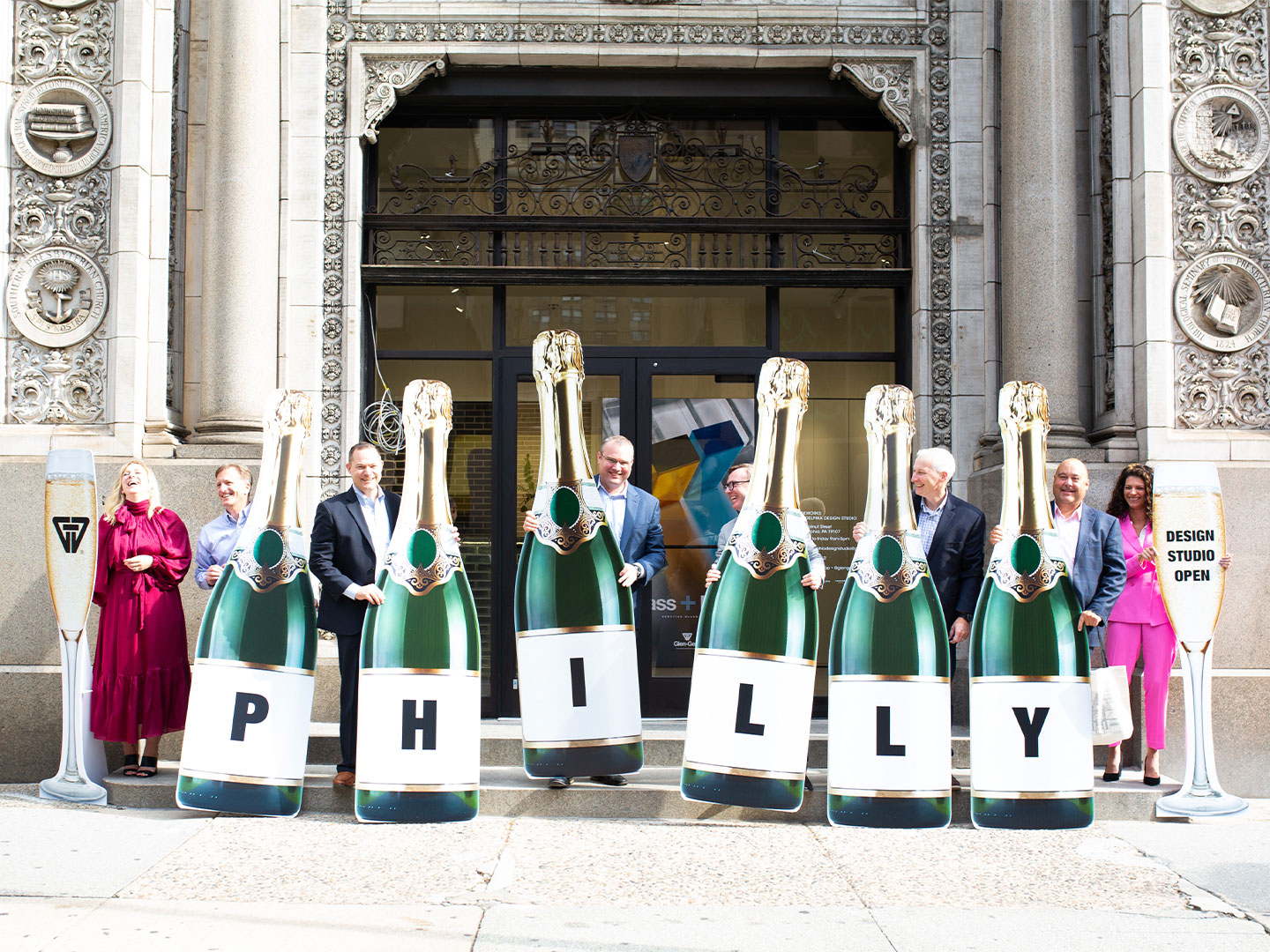
B20 comes off the back of the first Brickworks studio to open in North America.
Located on the first floor of the Witherspoon building in Philadelphia, the impressive studio offers the local architecture and design community a premium design-led experience – a place where they can collaborate on projects, select high-end products and attend leading industry events.
Inspired by Philadelphia’s old-world charm, the retail space also features products that are synonymous with the city, including authentic handmade brick and Cushwa premium wood-moulded brick.
Local to Philly? Read more about the studio here.
Related stories
3 House by Channon Architects and Burton Architects explores the pragmatic versatility of masonry in medium density housing on small lots. Comprising an office, a granny flat and a family home, the project focusses on an adaptive plan, where the functions of its self-contained spaces can change when needed. Located on a corner block in New Farm, Brisbane, the site was already occupied by a four-room workers’ cottage. The reimagined cottage was the first dwelling to be developed, becoming an office with a granny flat and car park tucked underneath, followed by a separate 3-bedroom house with two-car garage constructed at the rear.
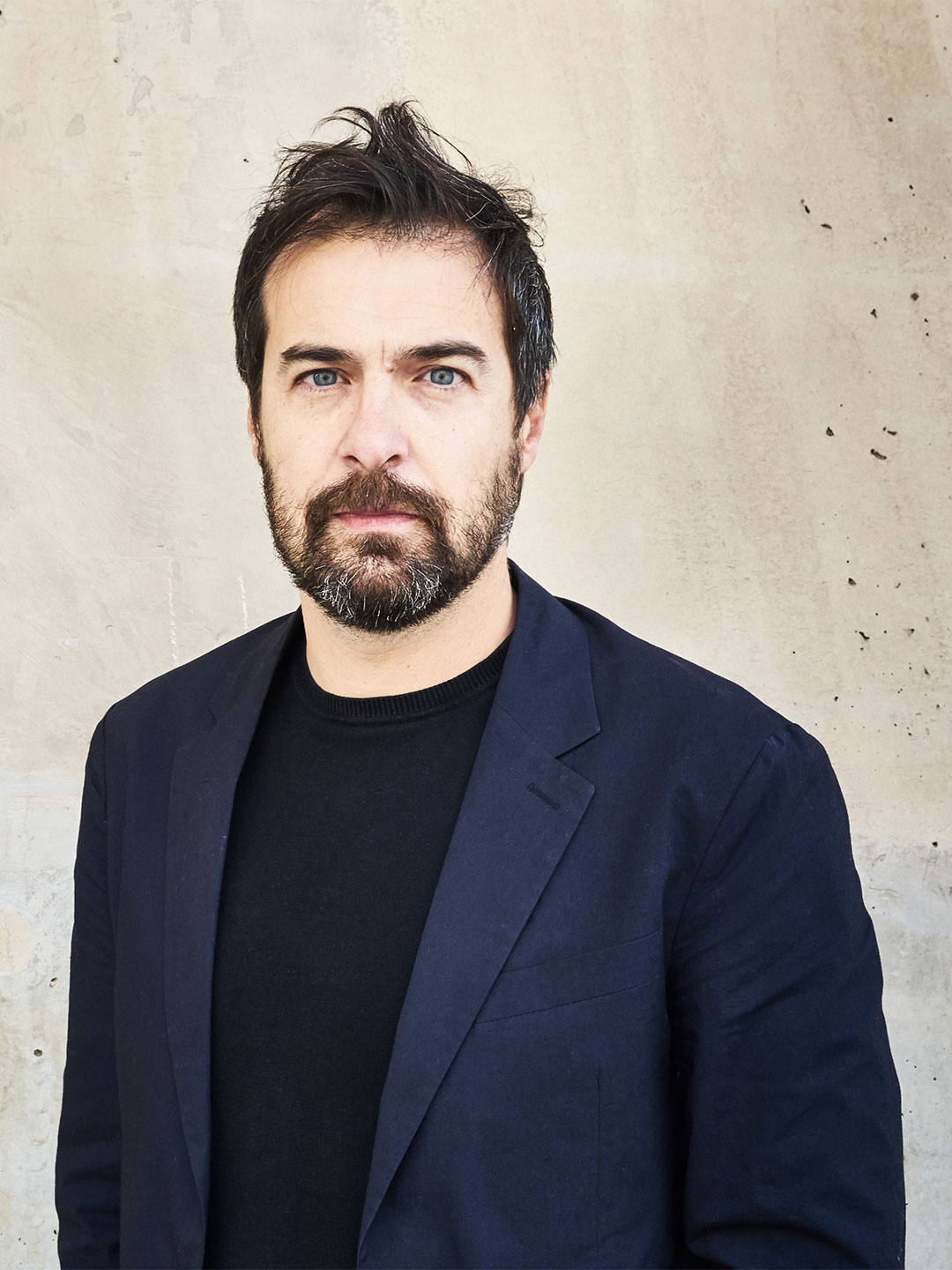
Barozzi Veiga was founded in Barcelona by Fabrizio Barozzi and Alberto Veiga in 2004. The firm has since worked internationally in public and private projects receiving several prestigious distinctions. Barozzi Veiga’s work, which mainly includes cultural and educational buildings, is characterised by the intention to arrive at solutions that are rooted in place; architecture that can be perceived over time and that has an emotional content.
About Barozzi Veiga
Barozzi Veiga was founded in Barcelona by Fabrizio Barozzi and Alberto Veiga in 2004. The practice has since worked internationally in public and private projects receiving several prestigious distinctions. Barozzi Veiga’s work, which mainly includes cultural and educational buildings, is characterised by the intention to arrive at solutions that are rooted in place, architectures that can be perceived over time and that have an emotional content. Concepts and ideas which are able to create particular atmospheres, that are architecturally clear and expressive, and able to have a meaning by itself.
Barozzi Veiga won numerous prizes in national and international competitions. Its built work includes the Ribera del Duero Headquarter (2011), the Auditorium Infanta Elena in Águilas (2011), the Szczecin Philarmonic Hall (2014), the Ragenhaus Musikschule in Bruneck (2018) and the Bündner Kunstmuseum in Chur (2018). The most recently completed projects are the Musée cantonal des Beaux-Arts Lausanne (2019) and the Tanzhaus Zürich (2019).
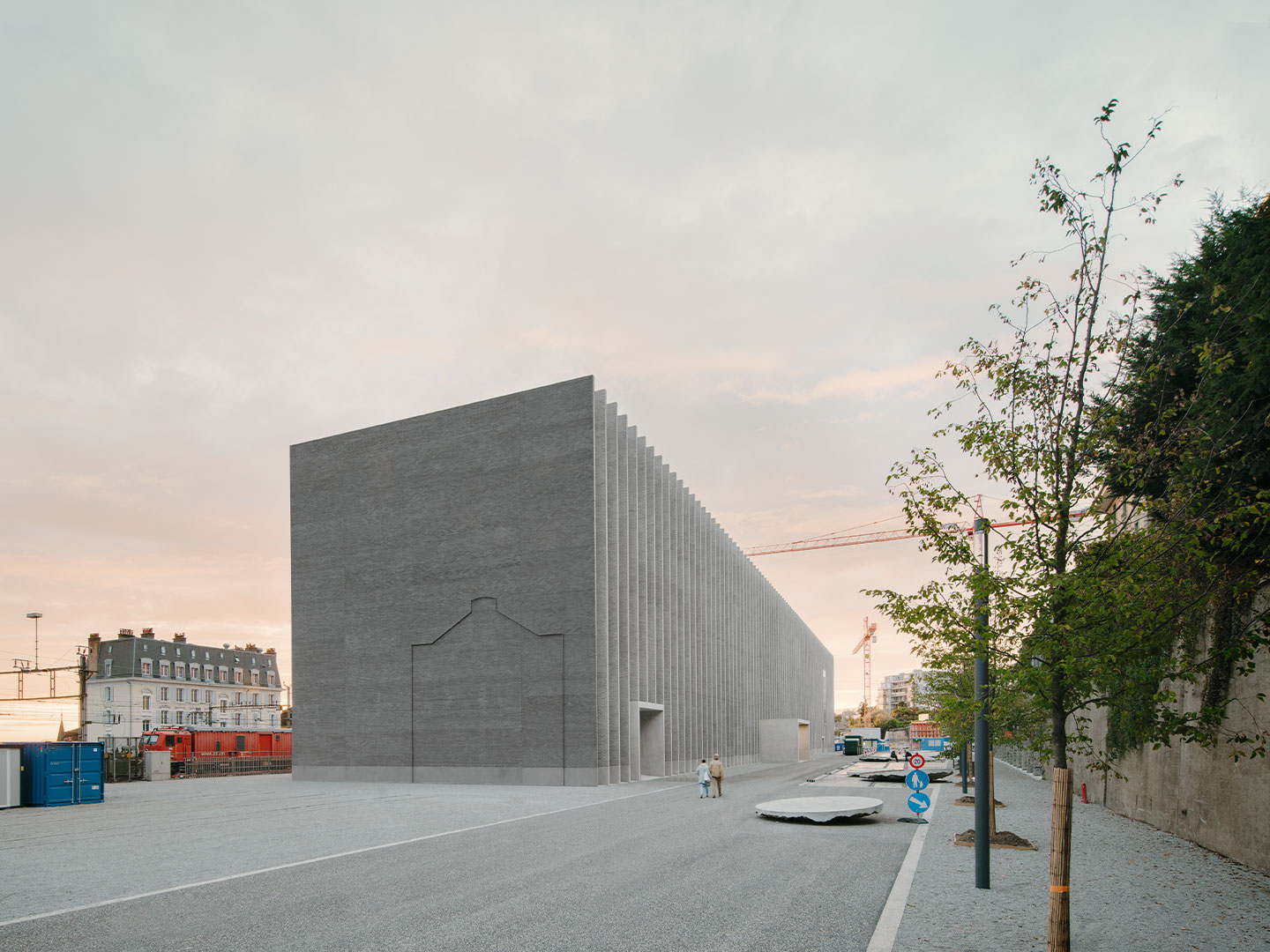
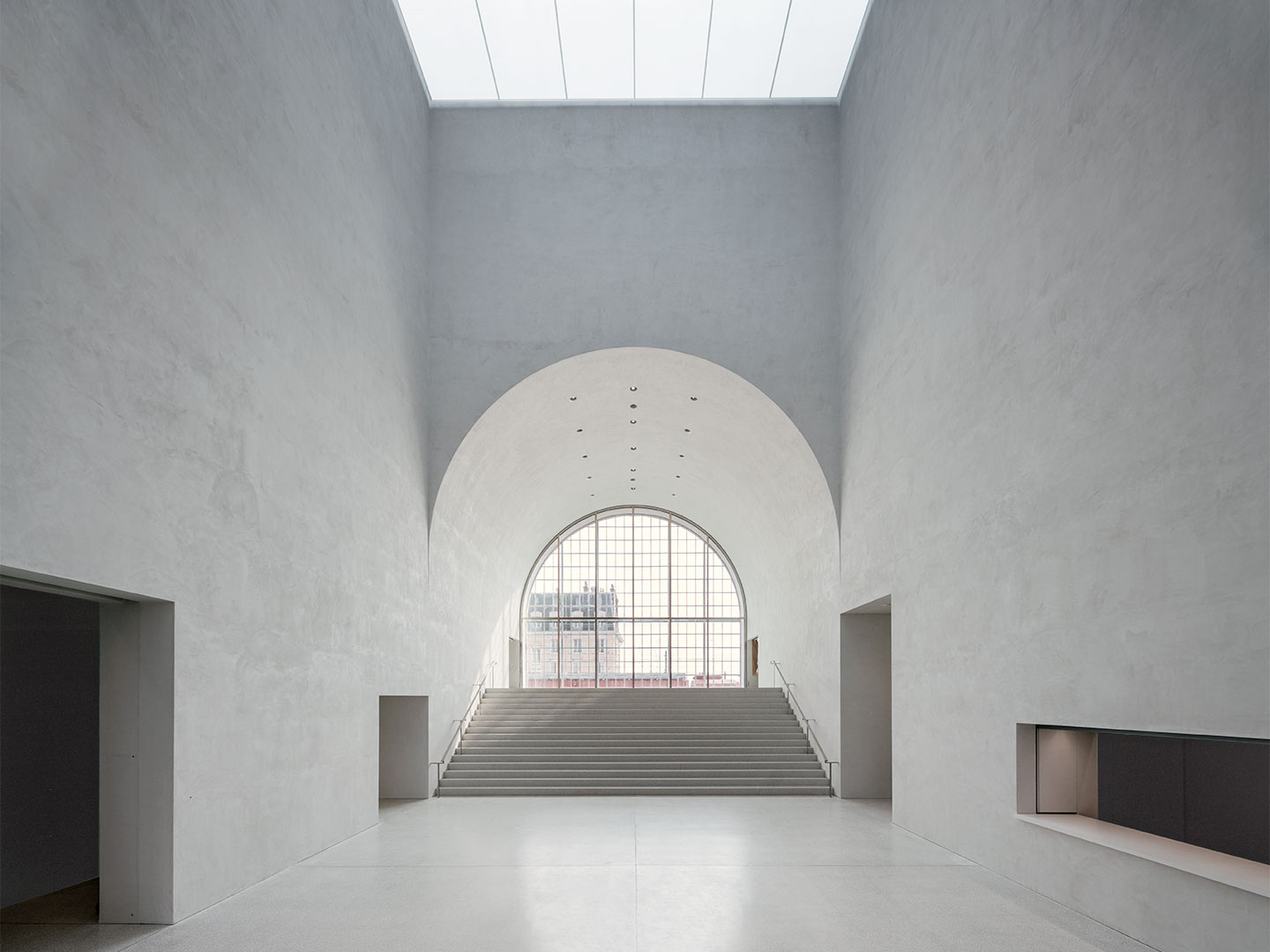
Between the important prizes, Barozzi Veiga has been distinguished with the Ajac Young Catalan Architect Award (2007) and the Barbara Cappochin International Architecture Award (2011). In 2012 the Ribera del Duero Headquarter, Barozzi Veiga’s first built work, was awarded with the Gold Medal for Italian Architecture for the Best Debut Work 2012.
In 2015 the project for the Szczecin Philharmonic received the prestigious Mies van der Rohe Award for European Architecture and the International FAD Award. In 2018 the Bündner Kunstmuseum in Chur, Switzerland, was awarded with the RIBA Award for International Excellence, which distinguished the best 20 buildings constructed worldwide during the last three years.
More recently, Barozzi Veiga has been granted the Chicago Atheneum International Award (2019), the Best Architects 20 Award (2019) and the AD Award for Architects of the Year (2019).
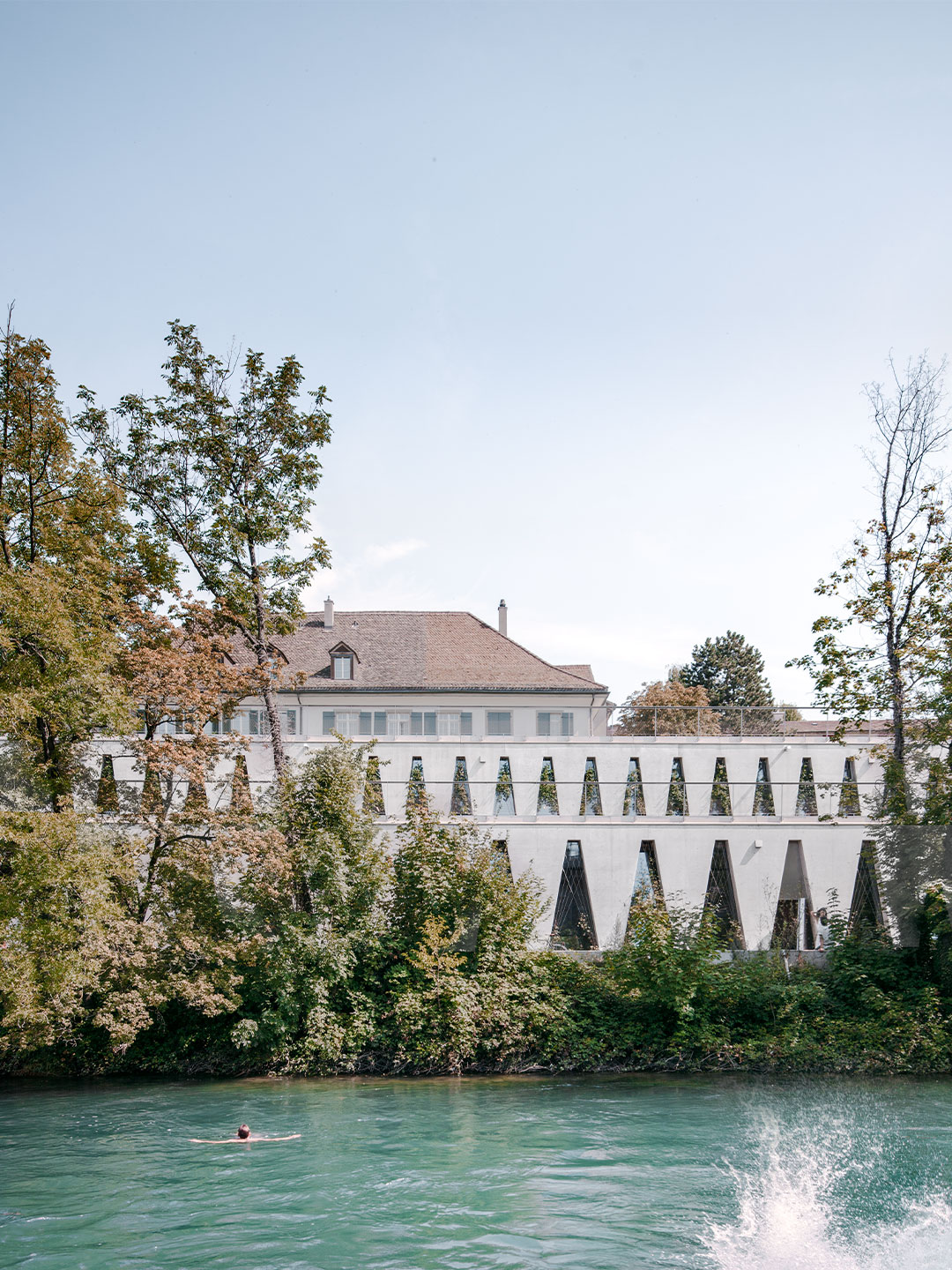
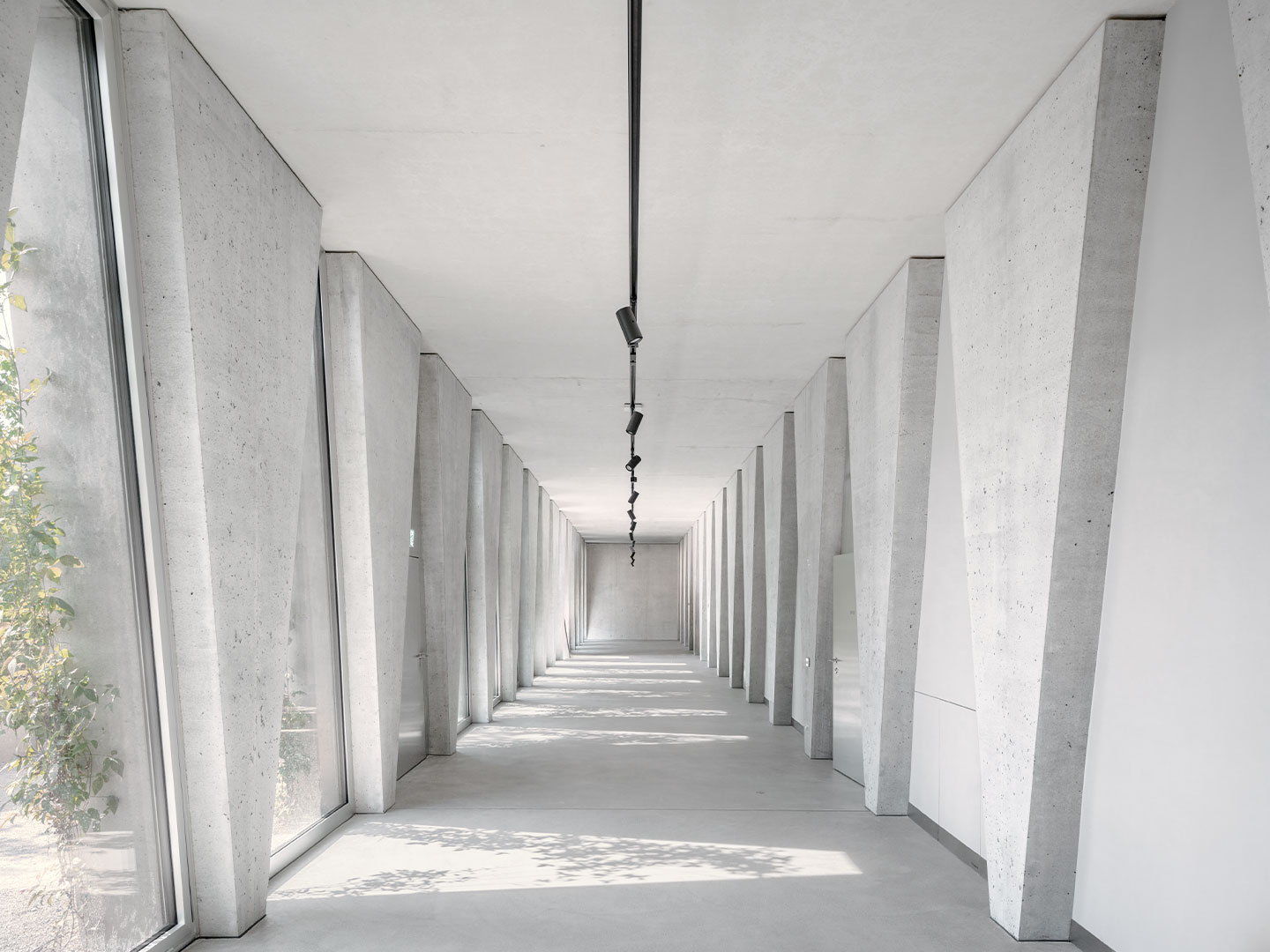
During the years, the office has been invited to contribute
to several international exhibitions, between which the Chicago Architecture Biennale (2017) and to the Biennale di Venezia (2014 and 2016). In 2016 Barozzi Veiga presented ‘A sentimental monumentality’, an installation and an essay that defined the conceptual framework of its work, later compiled in the monographs Barozzi Veiga edited by Park Books (2014), a+u 535 (2015) and A-Mag (2018).
Fabrizio Barozzi (1976 Rovereto, Italy) studied architecture at the Istituto Universitario di Architettura di Venezia and completed his academic studies at the Escuela Técnica Superior de Arquitectura de Sevilla and at the Ecole d’Architecture de Paris La Villette.
Since the beginning of his career, he maintained a balance between his professional activity and his academic involvement. Between 2007 and 2009, he has been Professor at the International University of Catalonia in Barcelona and, in 2009, he was Professor at the University of Girona. He has been Visiting Professor at the Istituto Universitario di Architettura di Venezia (2013-2015) and at MIT Massachusetts Institute of Technology, (2016-2018). In 2020 he is going to teach again as Visiting Professor at the Cornell University in Ithaca, New York.
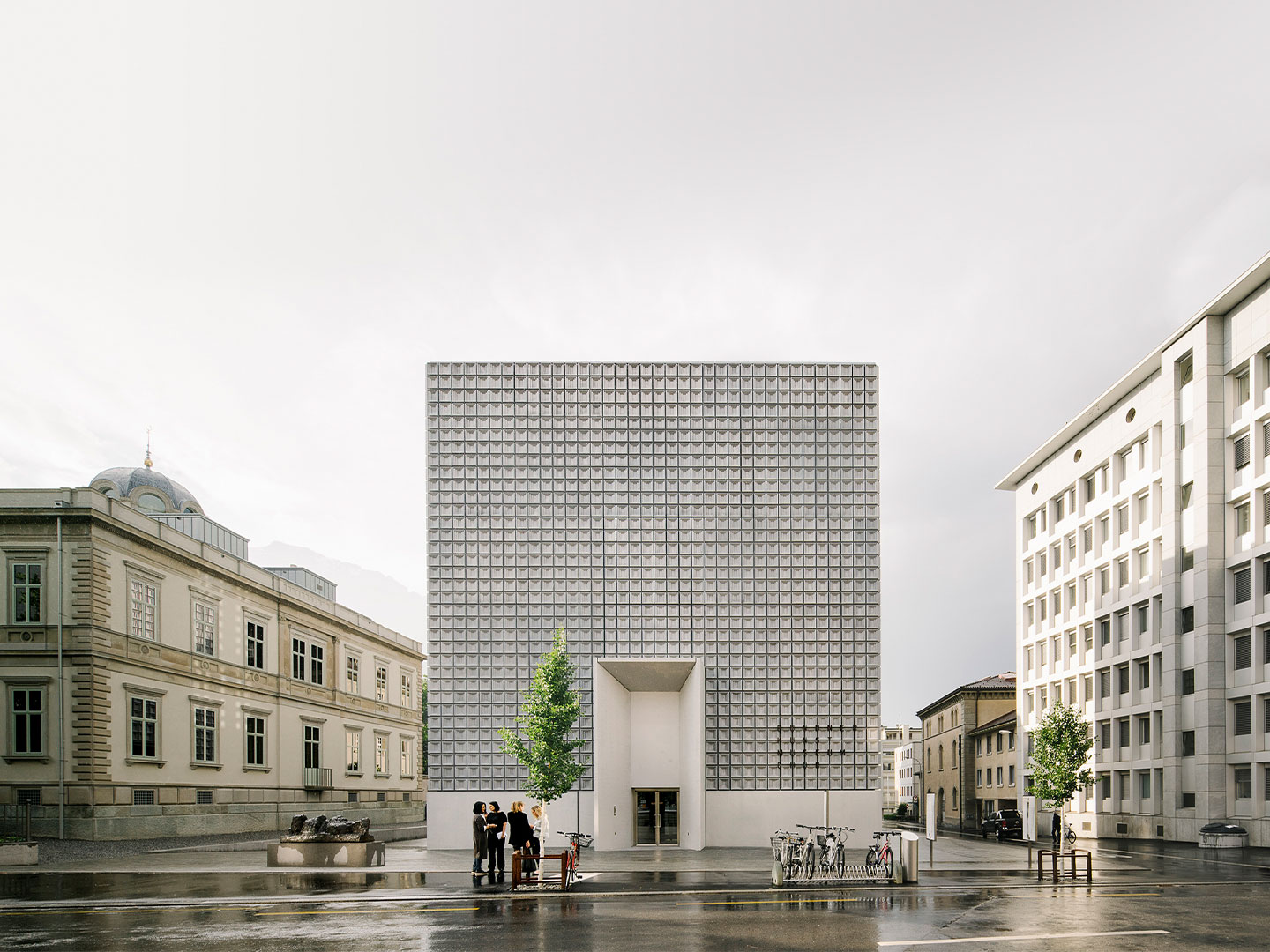
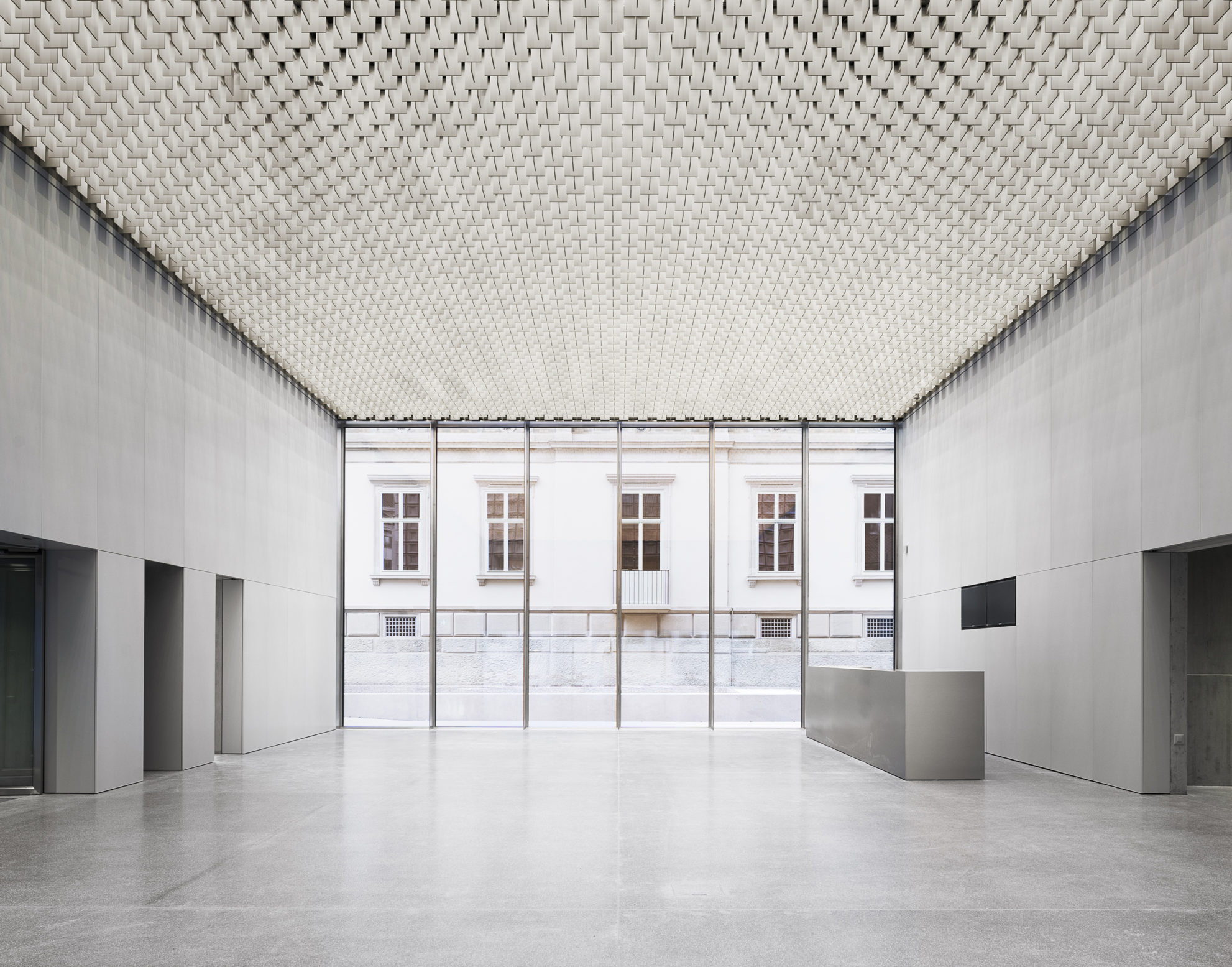
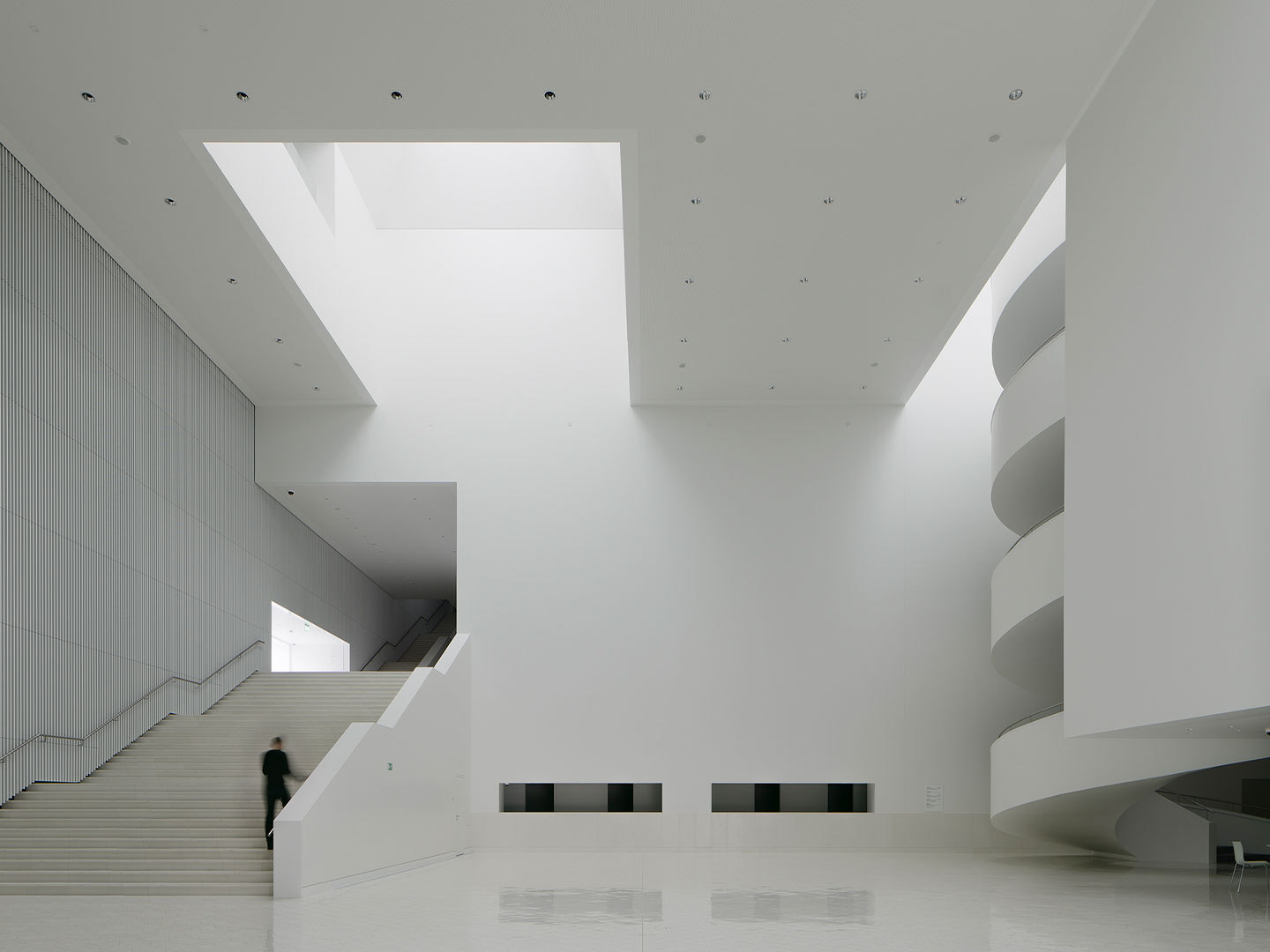
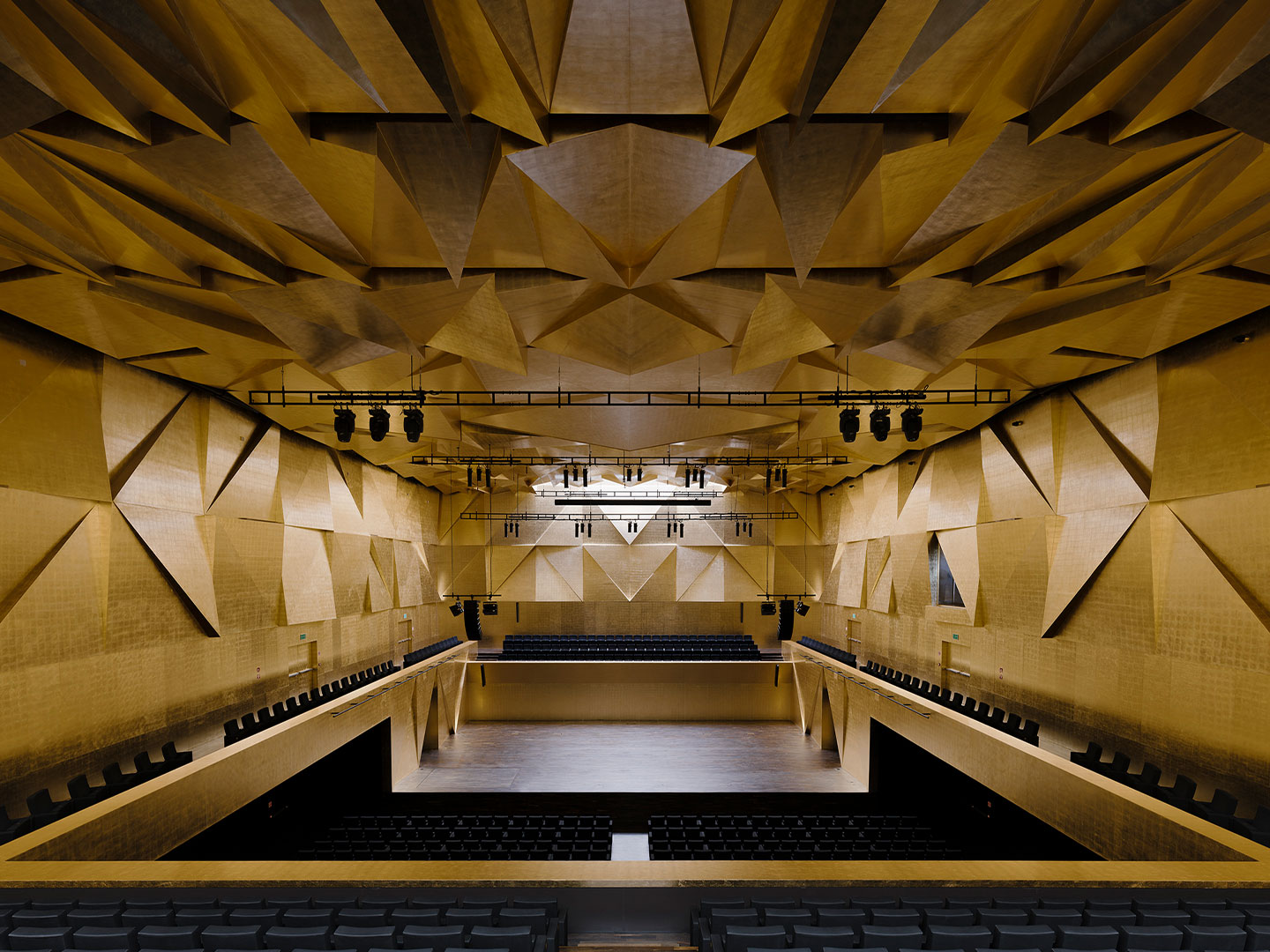
Barozzi Veiga’s work, which mainly includes cultural and educational buildings, is characterised by the intention to arrive at solutions that are rooted in place.
Related stories
- Watch: Alec Tzannes is the first guest in the all-new inDETAIL architecture series.
- Watch: Architect Jayson Blight joins inDETAIL speaker series.
In this week’s architecture and design video round-up (above), pull up a pew at the bar of Kink in Berlin, illuminated by the gentle glow of a tangled neon rope sculpture by Swiss artist Kerim Seiler.
Interior designer Brahman Perera pulls back the curtains on the new workspace for construction company Ironside in South Melbourne. And revisit The Calile Hotel, the next impressive project to be explored from the pages of FOLIO 4, a new magazine by Brickworks.
For more information on each of this week’s stories, see below.
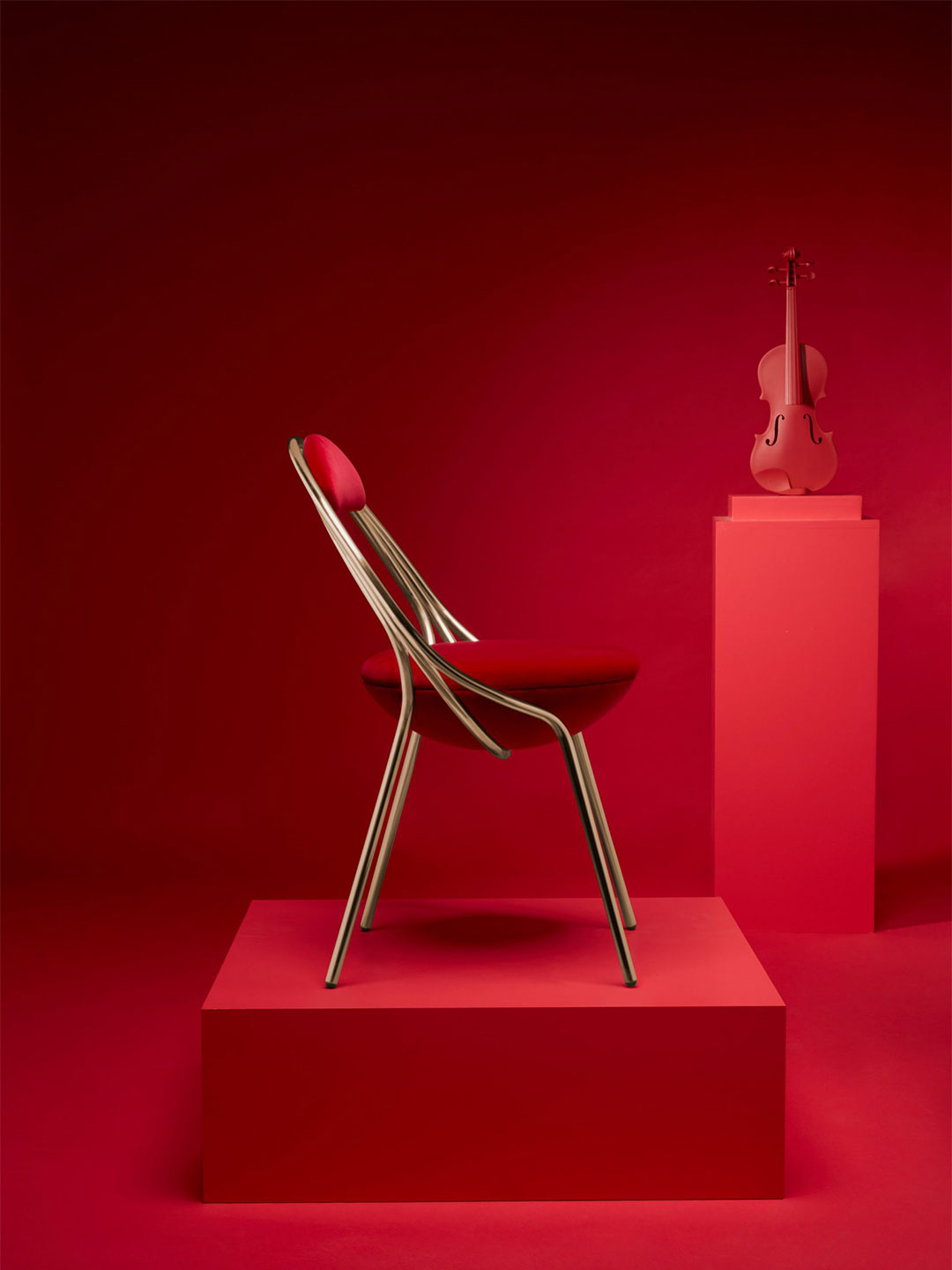
- ‘Maestro’ chair by Lee Broom: The British designer has unveiled the new chair alongside a spectacular short film at the 2020 London Design Festival. Read more.
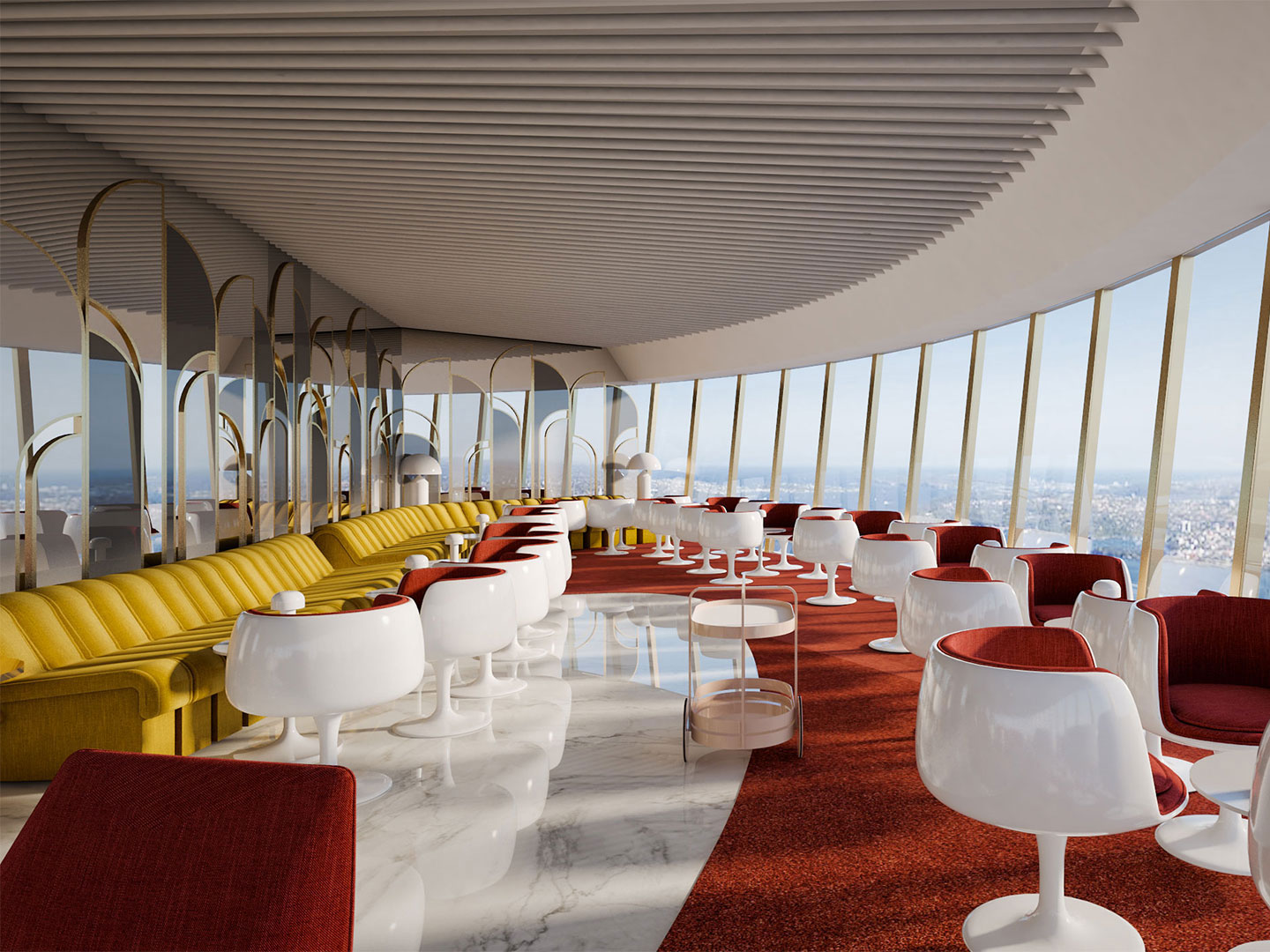
- Bar 83 at Sydney Tower: Loopcreative rolled out the red carpet at Bar 83, the sky-high cocktail lounge at the top of Sydney Tower which makes a nostalgic nod to classic sci-fi films. Read more.
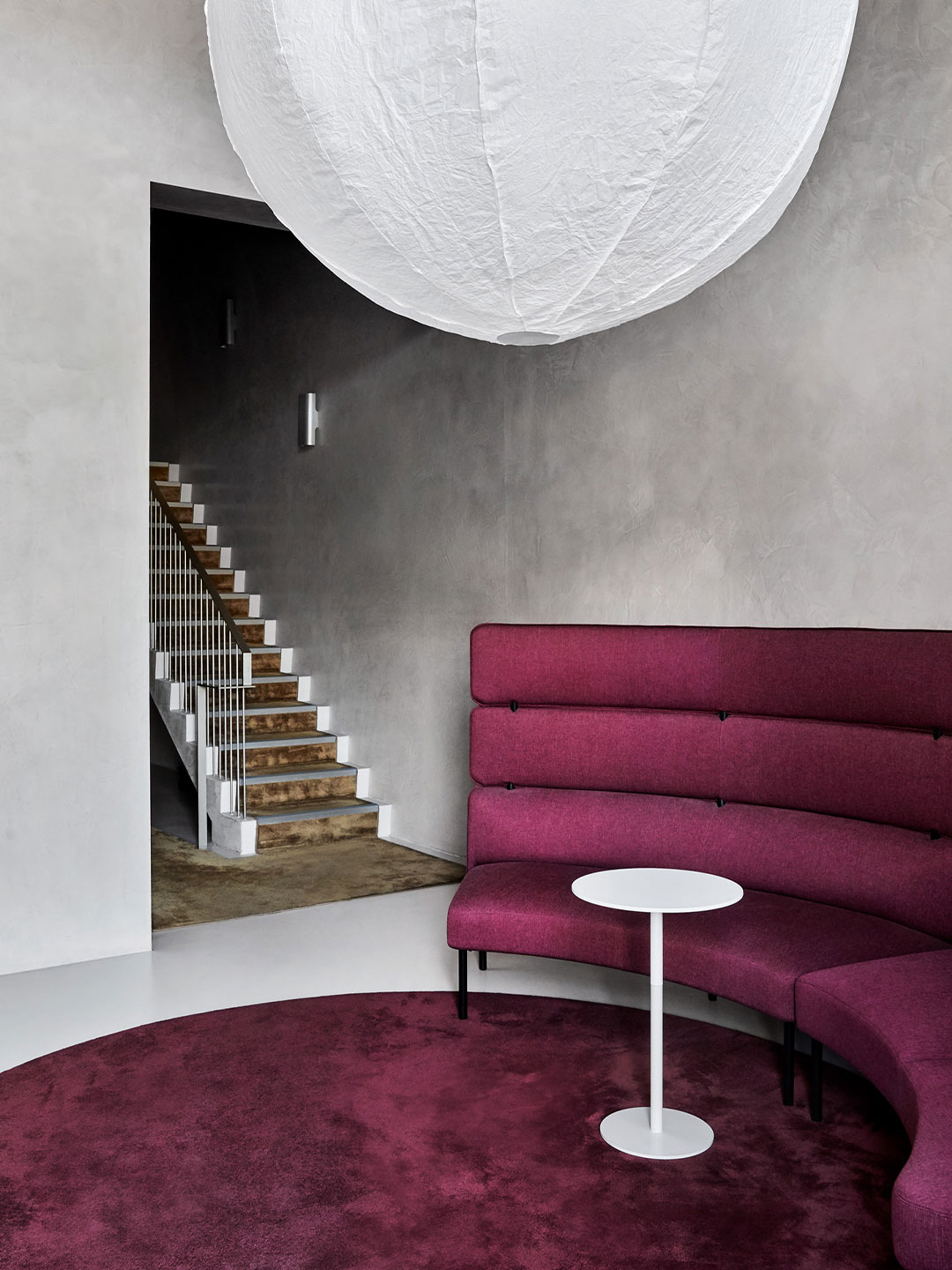
- Ironside workplace: Brought to life by interior designer Brahman Perera, the impeccable workspace for construction crew Ironside celebrates the site’s industrial charms. Read more.
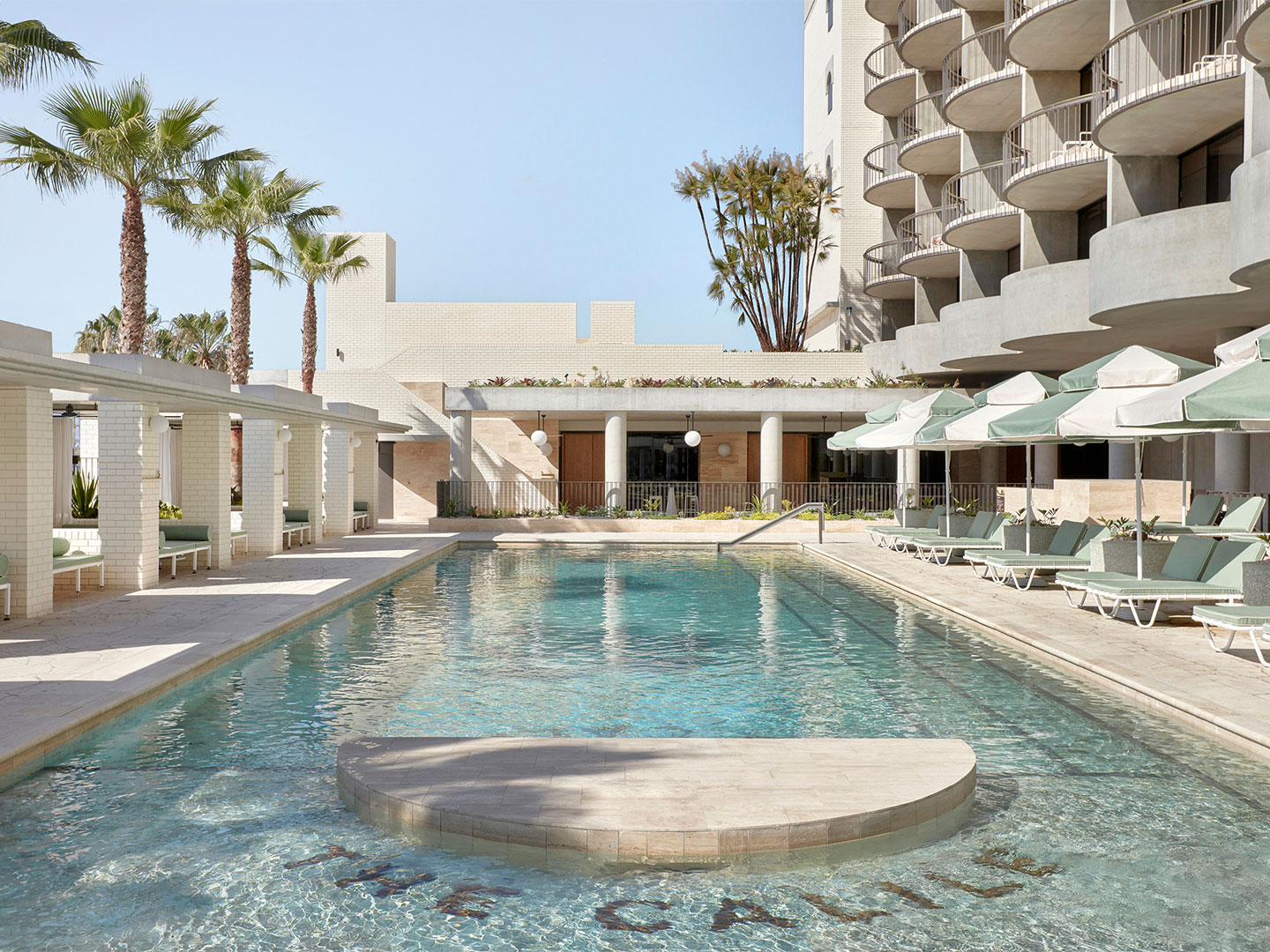
- The Calile Hotel x FOLIO 4: The glamorous holiday destination is just one of the impressive projects featured in the 4th edition of FOLIO, a free publication by Brickworks. Read more.
Take a seat on ‘Maestro’, the new chair by Lee Broom and sip an early evening cocktail at Bar 83.
Related stories
3 House by Channon Architects and Burton Architects explores the pragmatic versatility of masonry in medium density housing on small lots. Comprising an office, a granny flat and a family home, the project focusses on an adaptive plan, where the functions of its self-contained spaces can change when needed. Located on a corner block in New Farm, Brisbane, the site was already occupied by a four-room workers’ cottage. The reimagined cottage was the first dwelling to be developed, becoming an office with a granny flat and car park tucked underneath, followed by a separate 3-bedroom house with two-car garage constructed at the rear.
For the inaugural episode of inDETAIL, Alec Tzannes AM, founder of architecture practice Tzannes, took to the stage to deliver a compelling presentation, titled Architecture for Sydney: Are we at the threshold of a new design era?
Alec’s presentation was bookended by a casual conversation with event host and design aficionado Tim Ross and an in-depth Q&A session with architect and writer Stephen Varady.

Place translates into design if you can let go of something to do with yourself and start thinking about what makes a better community, a better world, a better place.
About Alec Tzannes
Alec is the founding director of Tzannes. He established the firm’s distinctive design philosophy and collaborative work practices with a record of design excellence across a wide range of projects.
“Our aim is to uplift the human spirit through our architecture,” says Alec. “We are interested in the design and delivery of enduring architecture of substance – advancing the discipline of architecture as a city-making proposition in the process of fulfilling our client’s briefs. Our design philosophy means that we address each brief with distinctive and relevant propositions, creating artefacts in the process that have an appreciating value in every respect – culturally and materially.”
Alec has served the community in a number of other roles including as National President of the Australian Institute of Architects (2006-7) and as Professor of Practice and Dean of UNSW Built Environment (2008-15). He retains an ongoing relationship with UNSW as an Emeritus Professor undertaking research and teaching roles, contributing to the firm’s commitment to thought leadership in design and architecture practice. In 2017 UNSW honoured Alec’s achievements with the degree of Doctor of the University honoris causa.
In 2018, Alec was awarded the Australian Institute of Architects’ Gold Medal. The Gold Medal recognises distinguished service by architects who have designed or executed buildings of high merit, produced work of great distinction resulting in the advancement of architecture or endowed the profession of architecture in a distinguished manner.