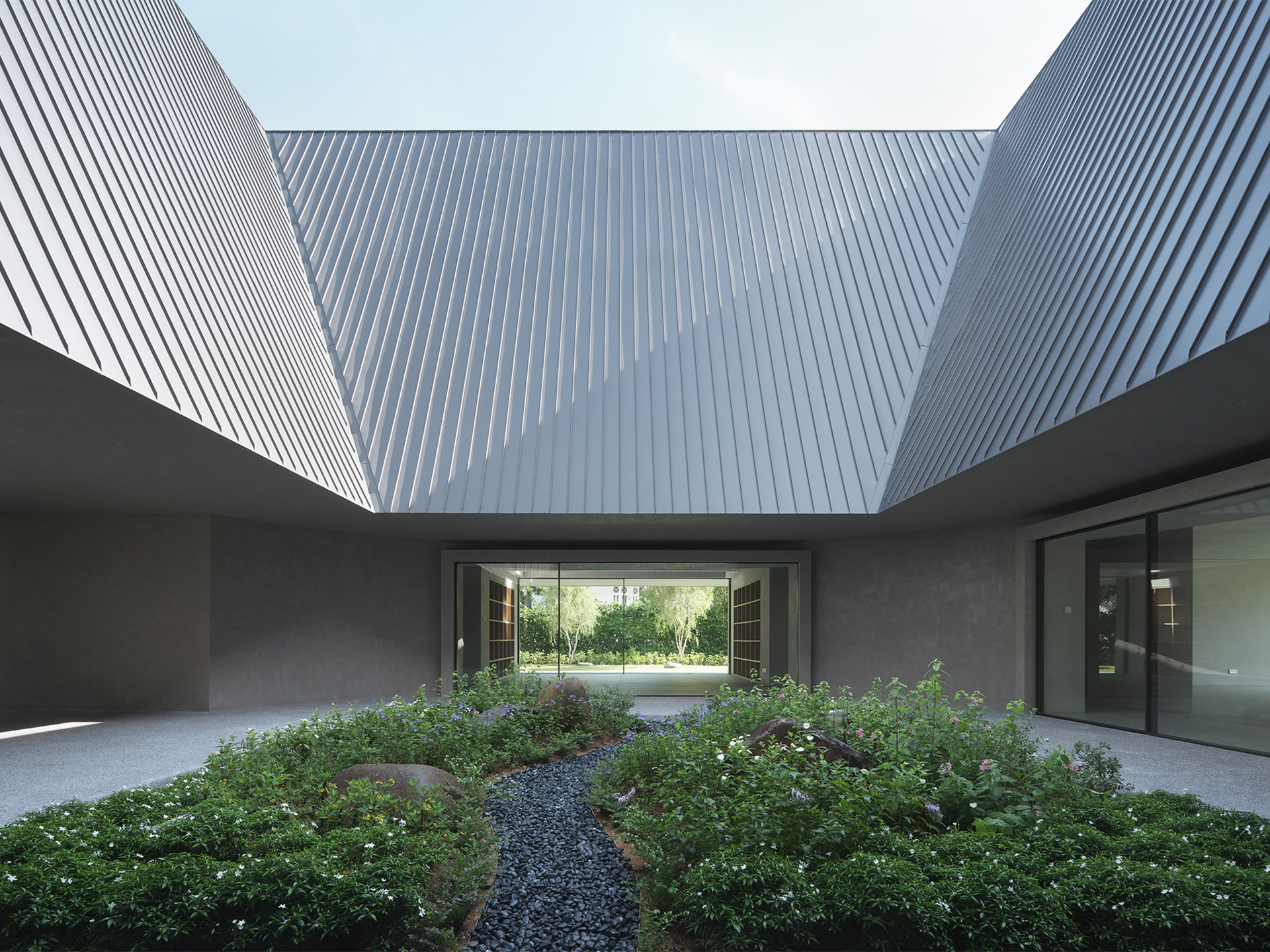
The traditional Chinese courtyard house or siheyuan is a typology well-known for its illustration of Confucian ideals, accommodating extended family units wherein many generations live under one roof. To live under the same roof means to live together, and this metaphor is the nexus that ties the notion of community, especially in an intimate context, to the form crafted for this project. For this private residence commission, Neri&Hu were given a set of unique requests by the client: the new house constructed in place of the previous one should accommodate all three siblings, who as adults have outgrown their shared house; it should include a small memorial space in the form of a garden for their late mother; and lastly, the new construction should retain the memory of the pitched-roof form, a defining feature of their childhood home.
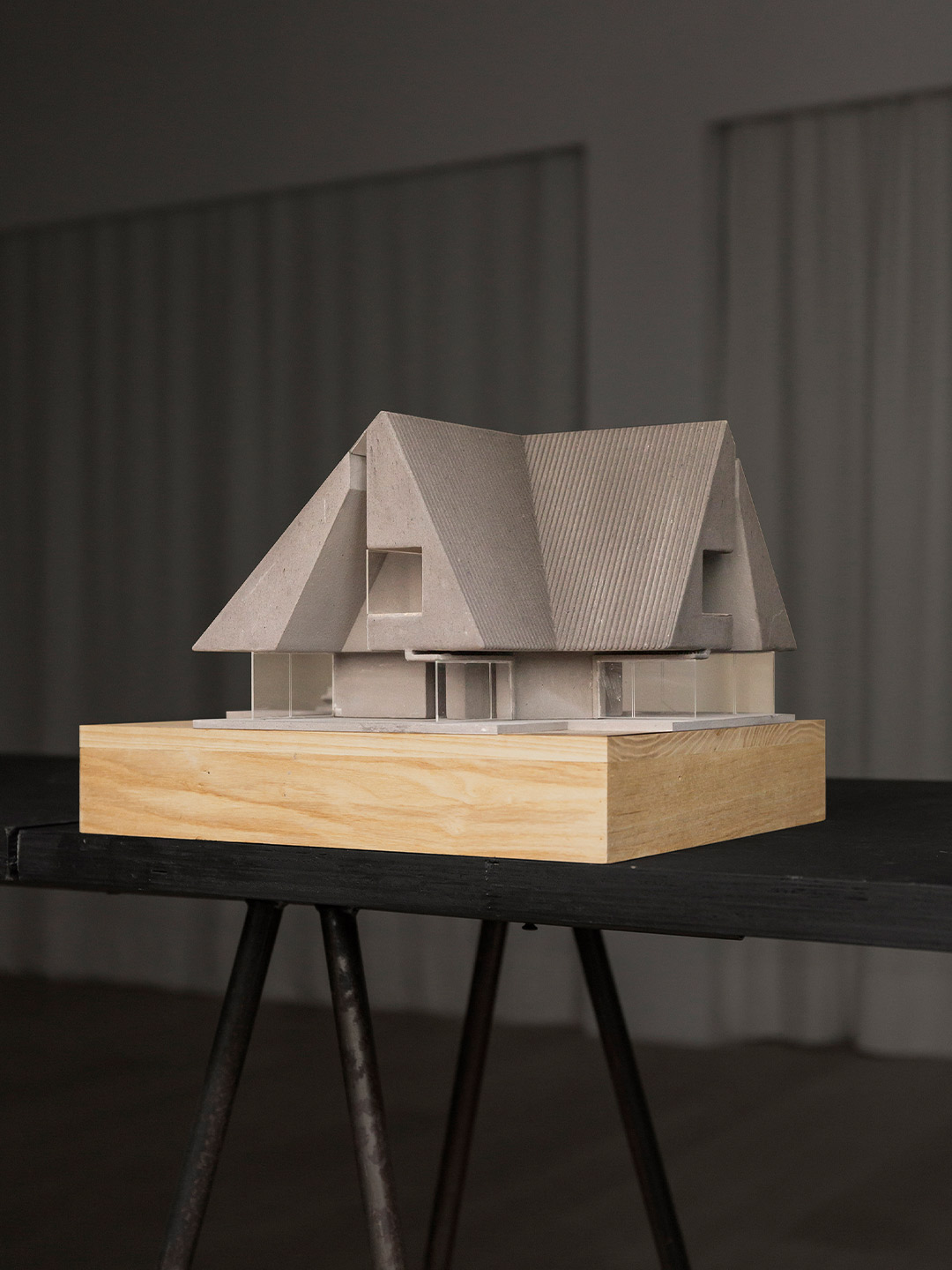
In this project, dubbed the House of Remembrance, Neri&Hu has explored how notions of communal living and collective memory can be expressed spatially. The original site featured a lush vegetated edge that formed a natural green buffer along the perimeter, a feature that the designers have retained. The previous house was built in the style of the British colonial bungalow, with hybrid elements of traditional Malay houses such as deep roof eaves for rain sheltering, as well as Victorian details. Understanding the functional importance of the roof and the client’s emotional attachment to its form, Neri&Hu embraced the symbolic nature of the pitched roof and combined it with a reinterpretation of the courtyard house.
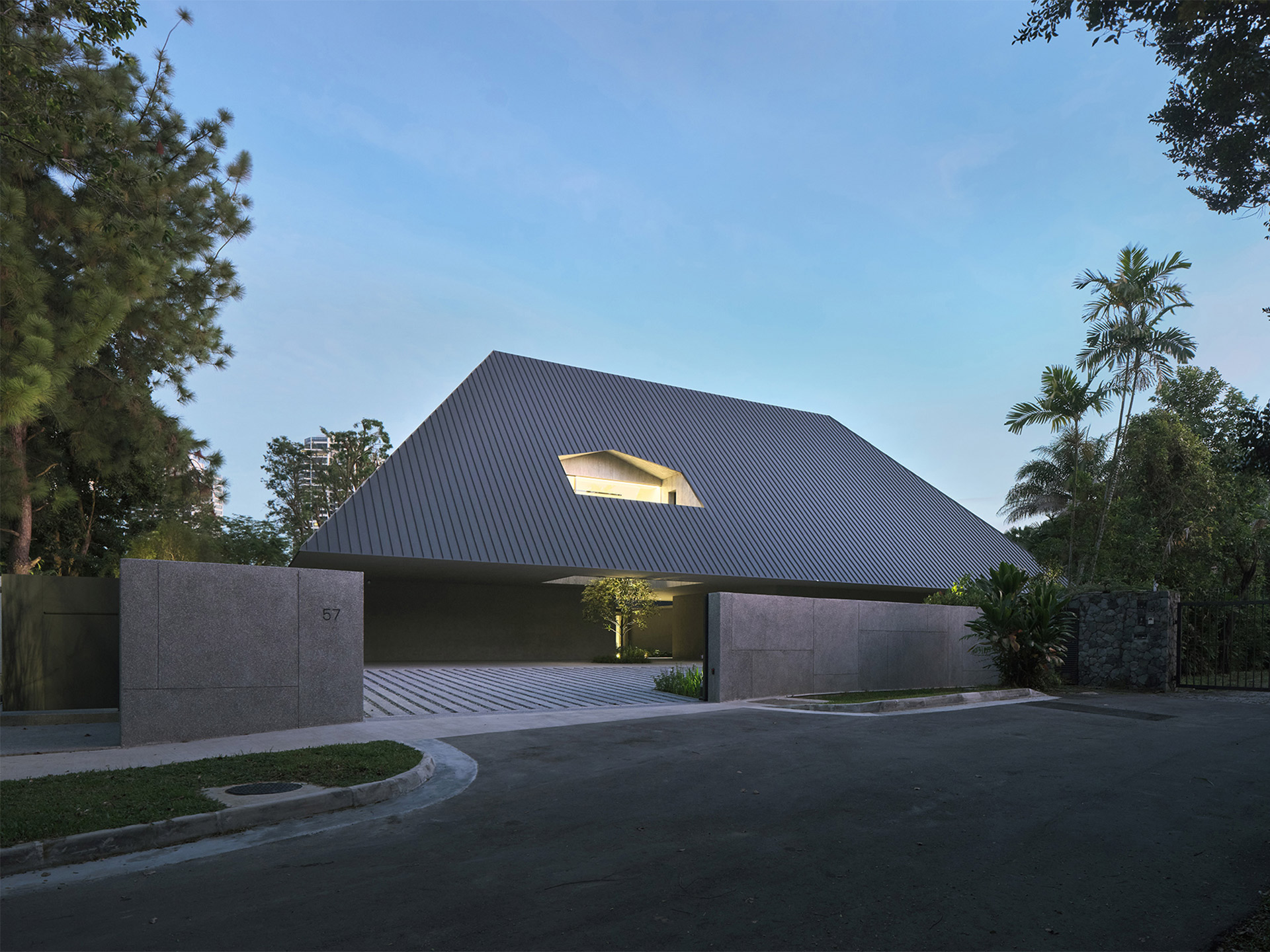
House of Remembrance in Singapore by Neri&Hu
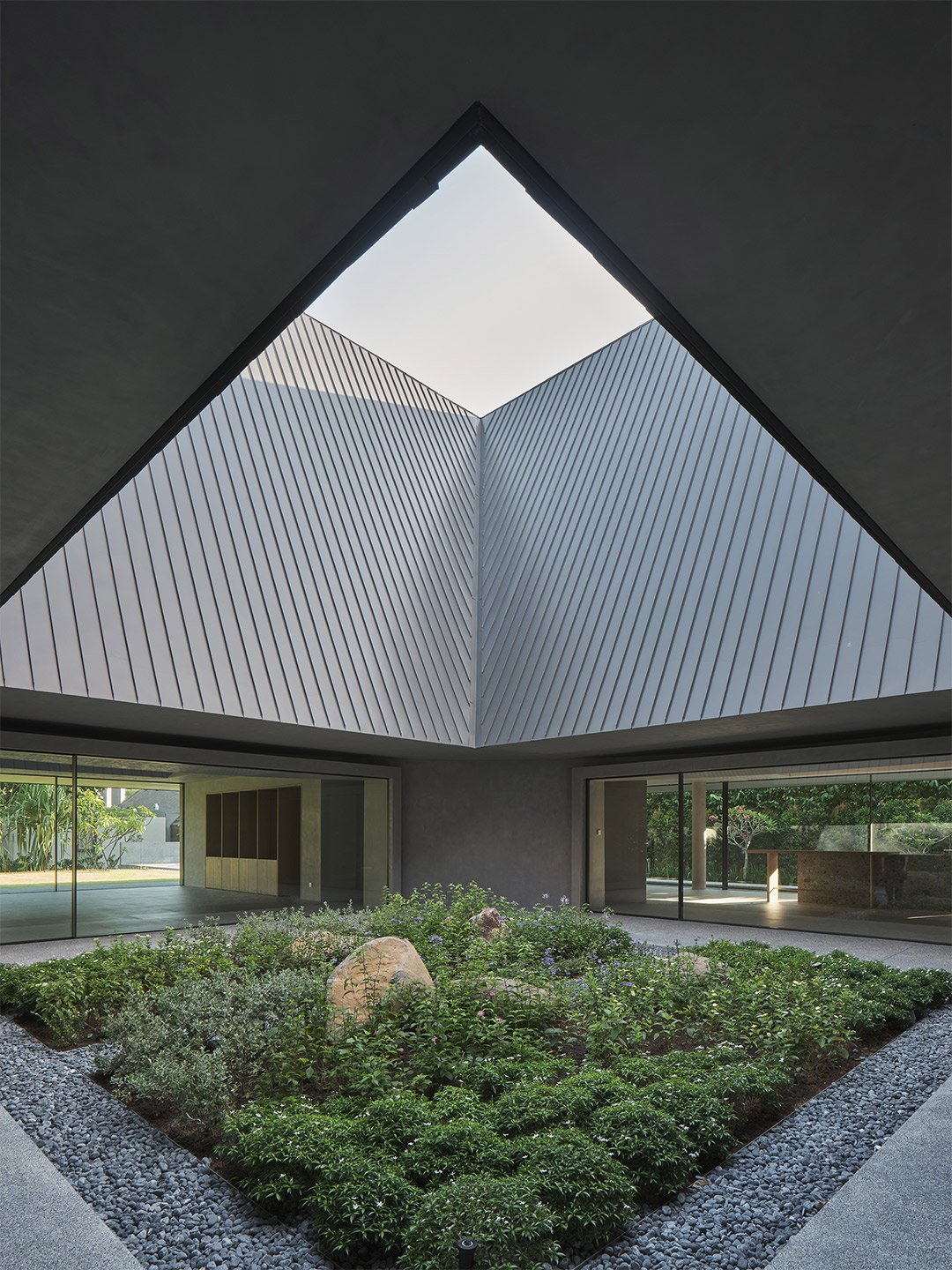
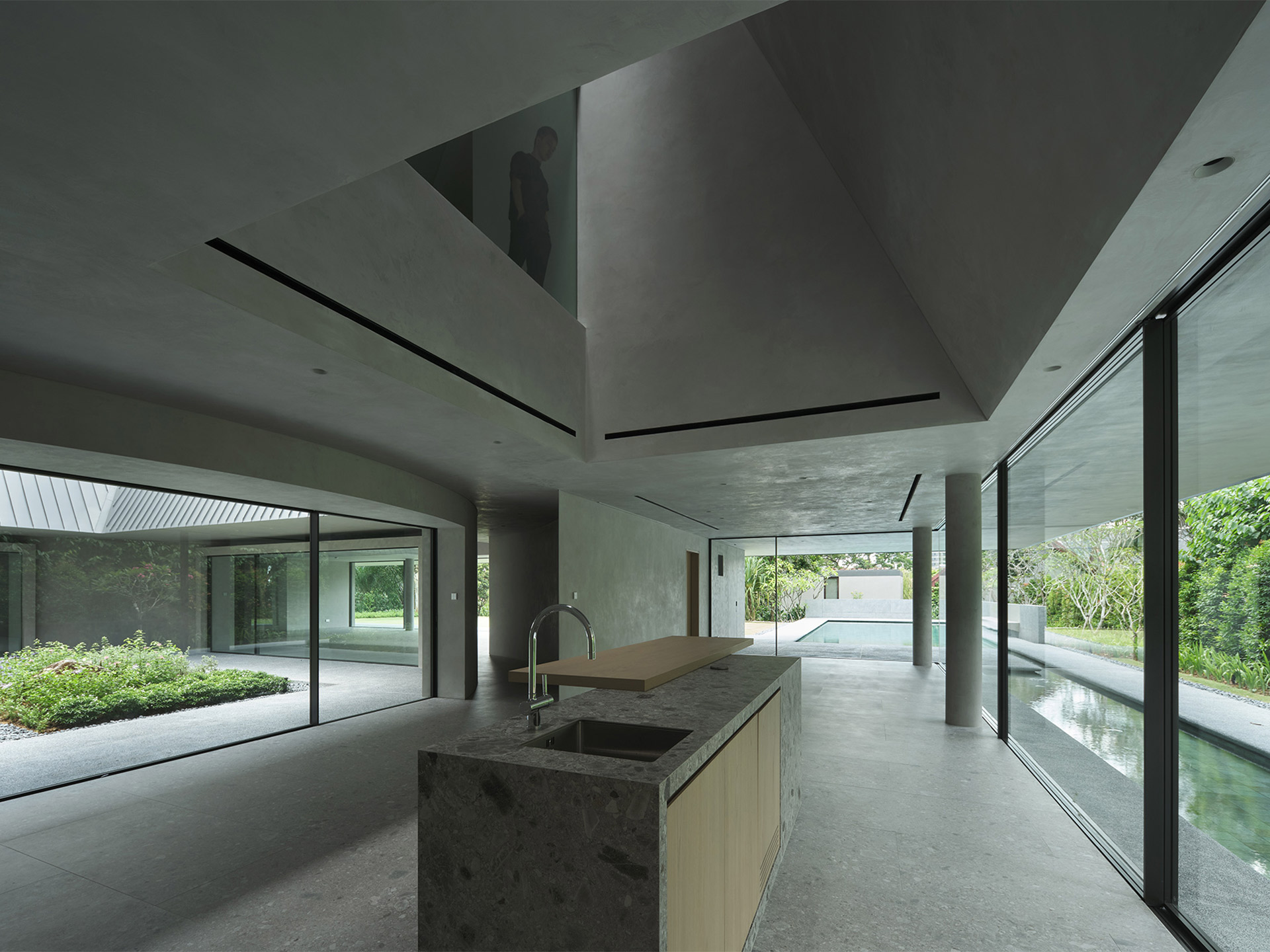
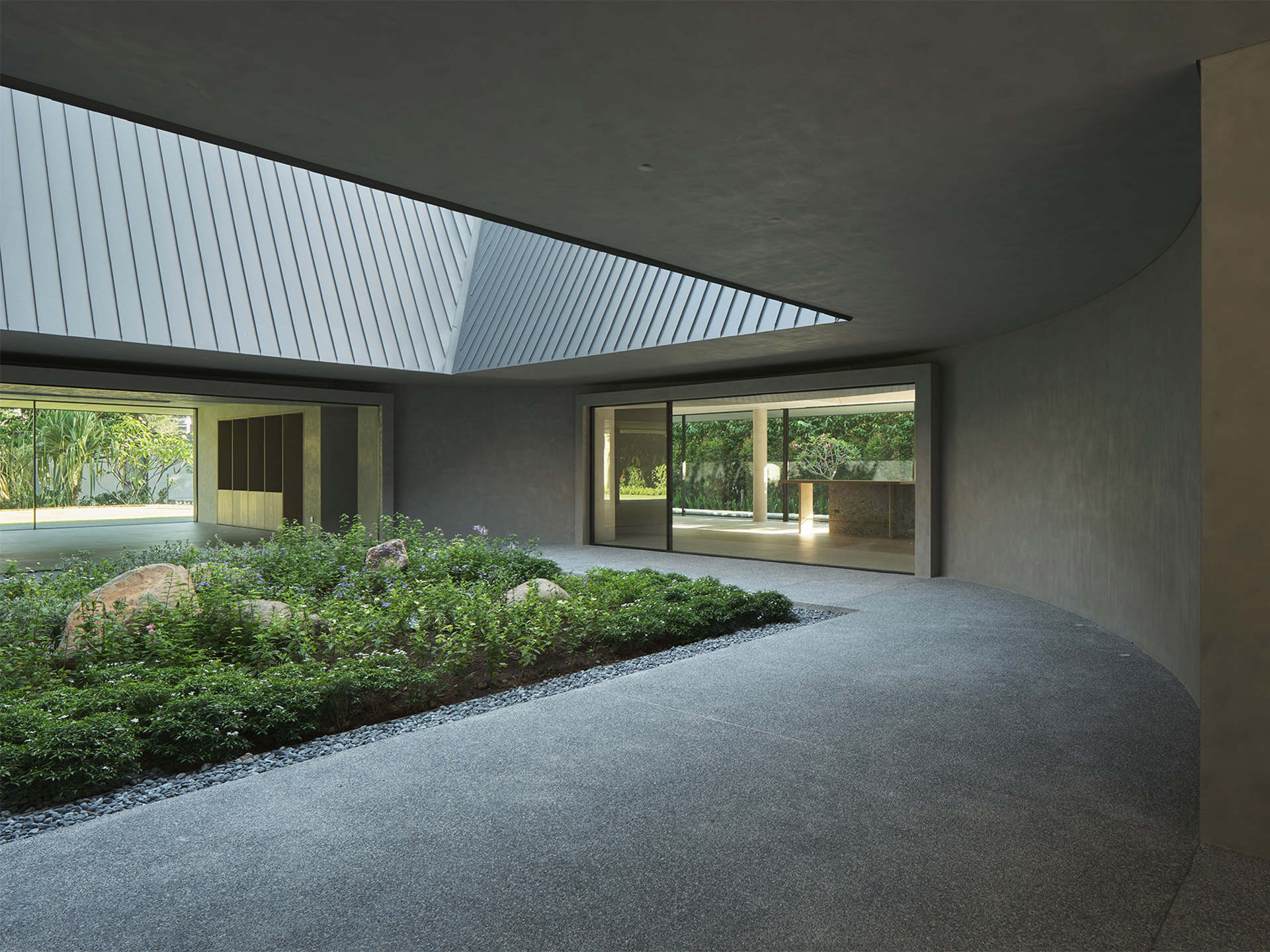
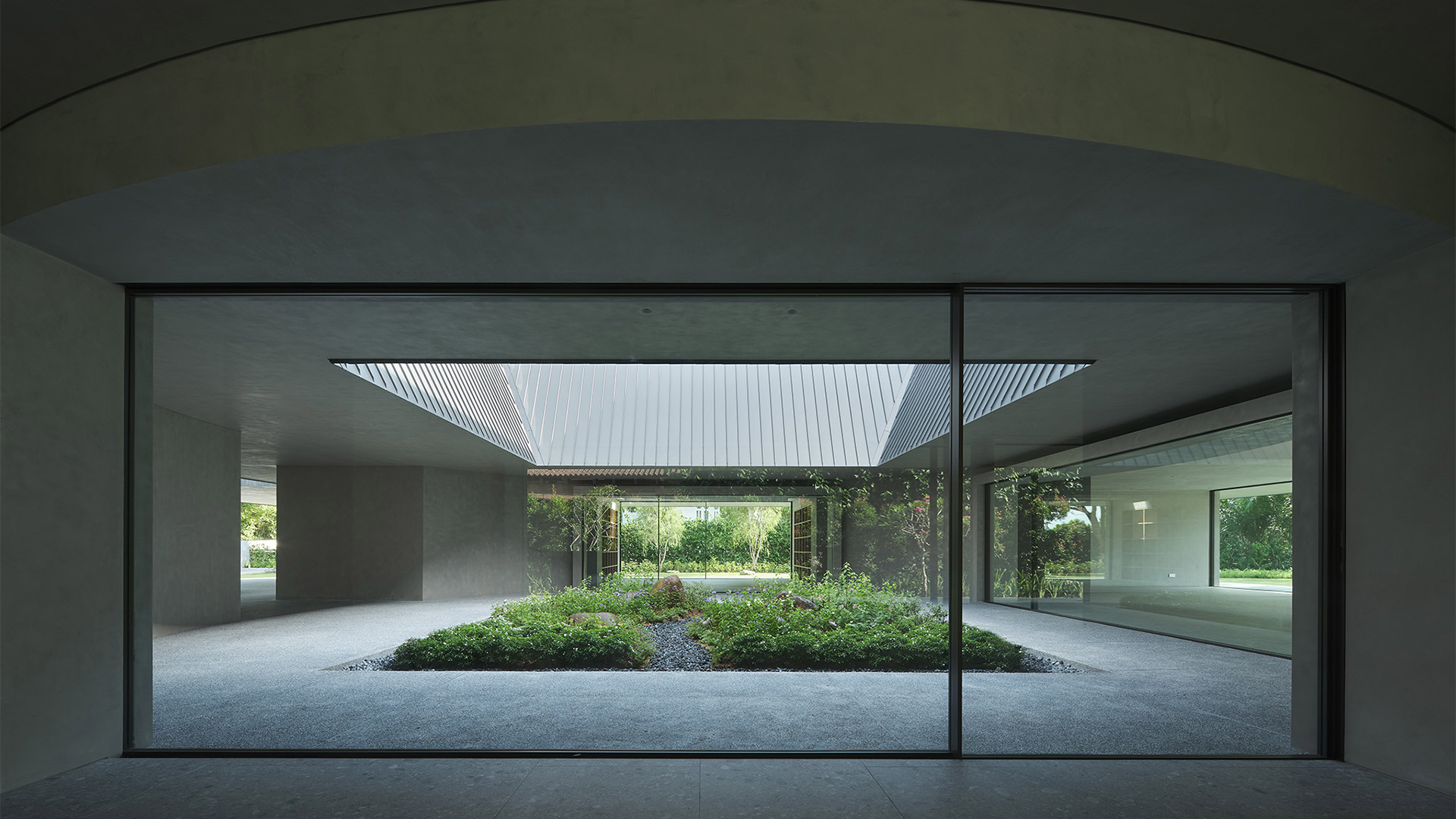
The new two-story house organises all communal spaces around a central garden, which occupies the courtyard space serving as a memorial garden for the family’s matriarch. The ground level is extroverted in nature, with expansive glass walls to connect all spaces to the gardens along the edge of the site. Neri&Hu aims to maximise visual transparency from the communal areas – living room, open kitchen, dining room and study – so that from the ground floor the inhabitants may look into the central memorial garden while cocooned by the dense vegetation surrounding the house. Large glass doors can slide open, so that in optimal temperate conditions the house can take advantage of cross ventilation and direct access to the gardens.
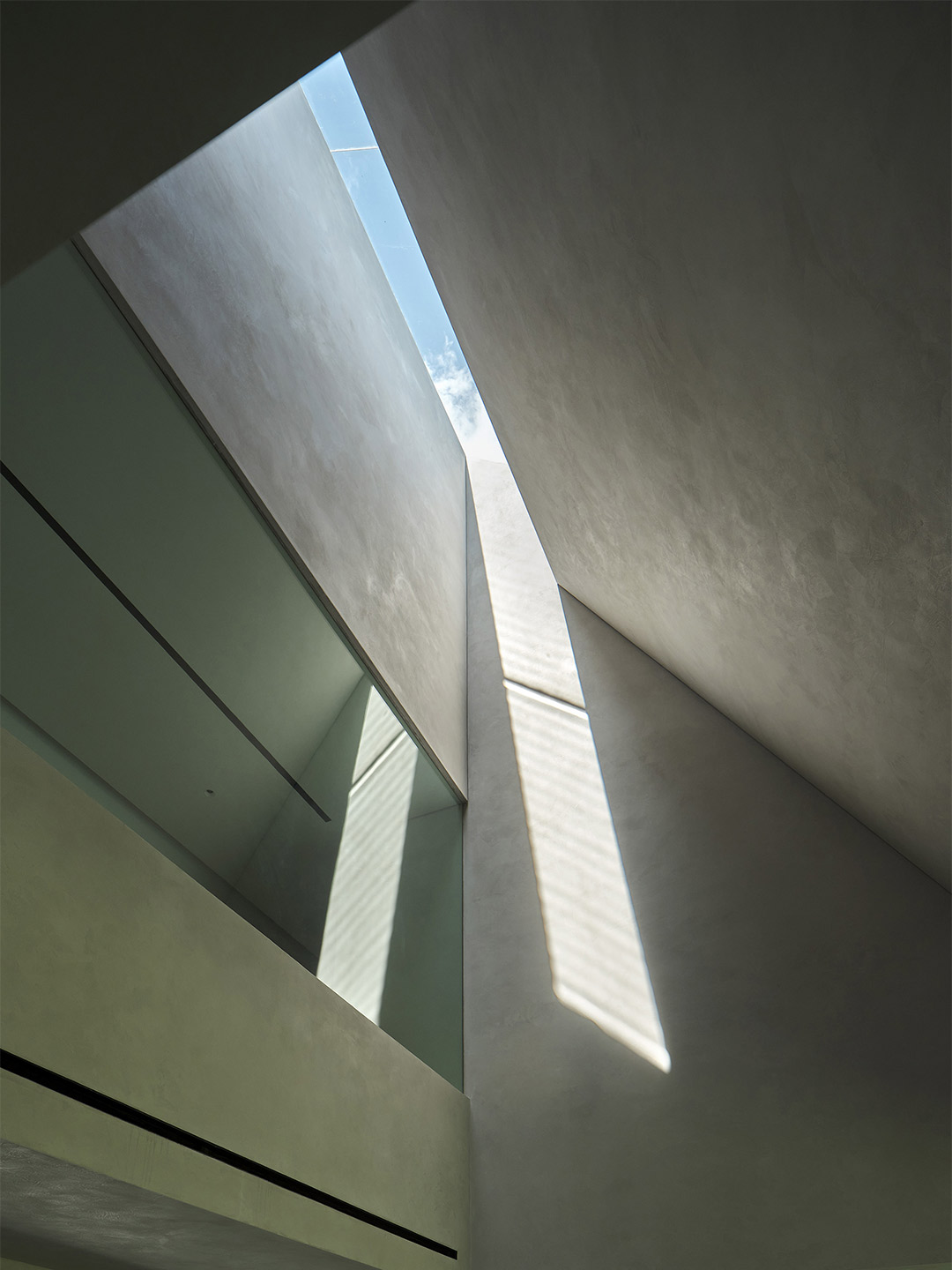
For the upper level, Neri&Hu pursues the idea of the pitched-roof form as not only a signifier of shelter, but also an element that both unifies and demarcates the public and private realms. All private bedrooms, located on the upper introverted level, are housed within the roof’s steep gables so that when seen from the exterior, the house retains the appearance of a single-story hipped-roof bungalow. Skylights and large glass walls connect to bedroom balconies where views are oriented outwards to the perimeter garden spaces. Through sectional interplay, the design team introduce three double-height areas to connect the communal functions and the corridors above. These spaces of interpenetration create vertical visual connections to allow one to peer into the public realm from the private.
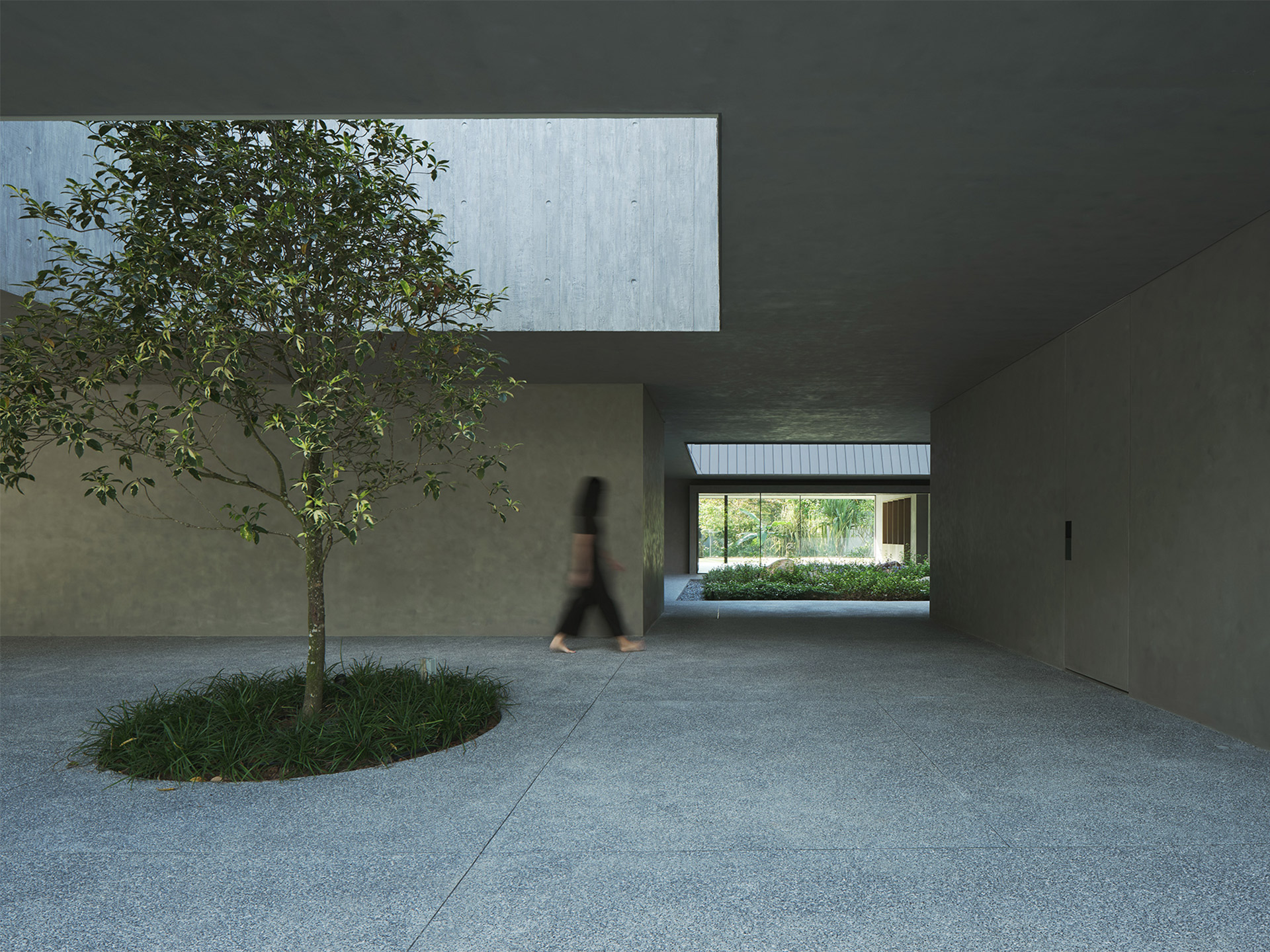
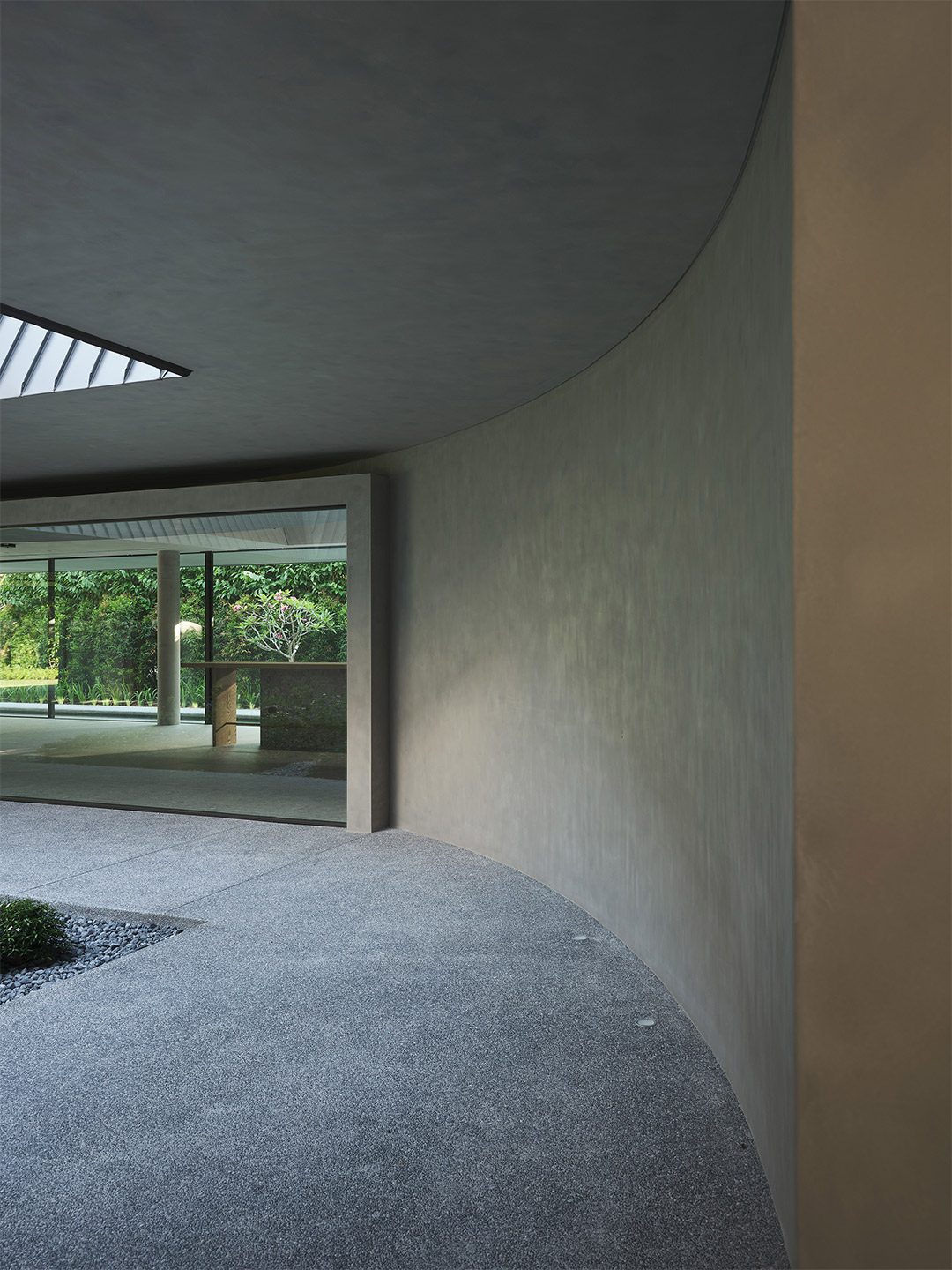
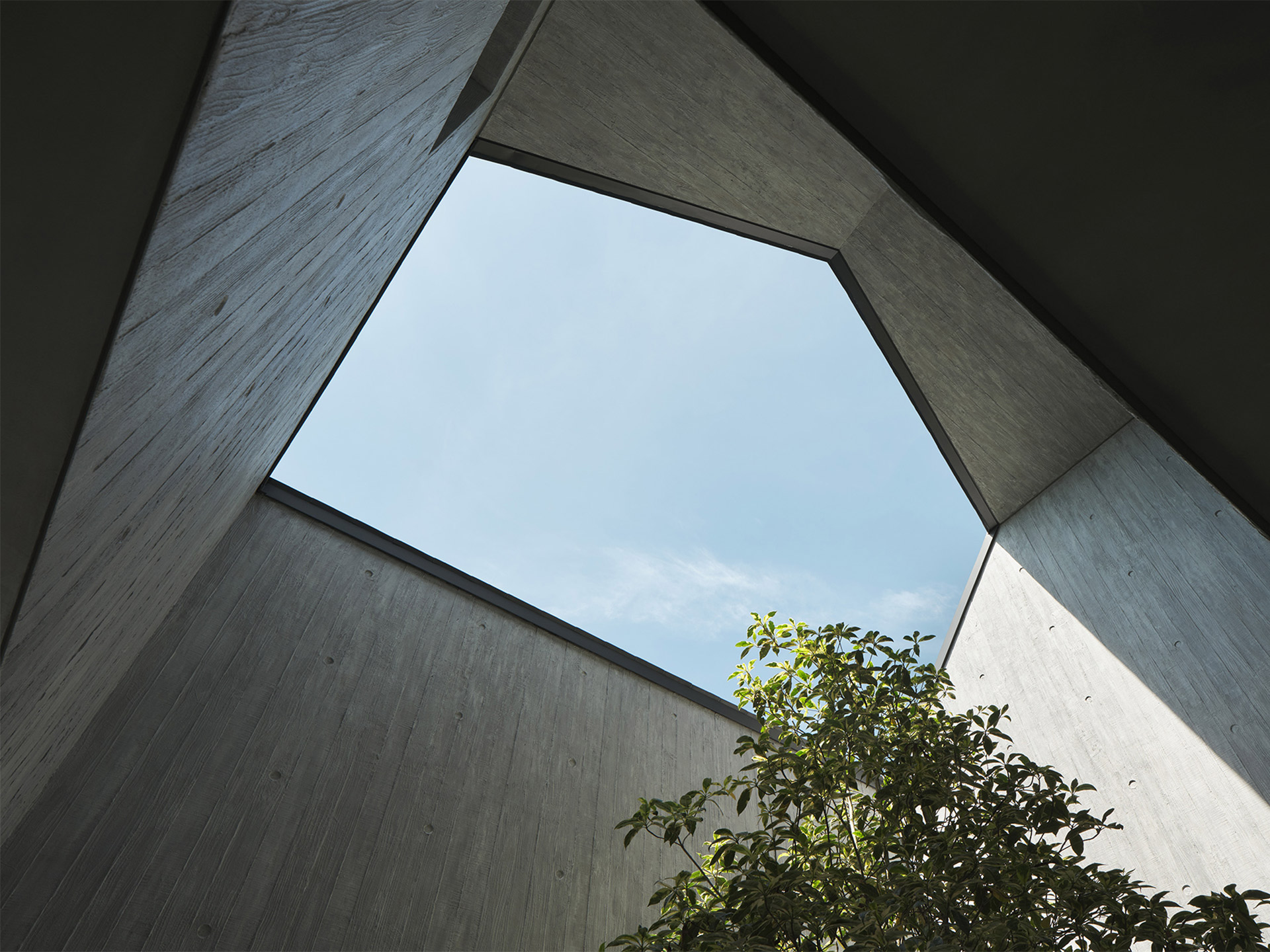
One can see a carved void in the roof volume, which frames a small tree before arriving at the central memorial garden. On the exterior, where balconies and sky wells are carved out from the volume of the pitched-roof form, the walls transition from smooth to board-formed concrete to take on the texture of wooden planks. The circulation on the ground floor is based on the shape of the circle to reinforce the ambulatory experience of walking in the round and to define the memorial space as a sacred element. Since the circle has no edges or terminating vantage points, it allows one to always find a return to the centre both spiritually and physically. The garden symbolically defines the heart of the home as an ever-palpable void, persisting as the common backdrop to the collective lives of all inhabitants.
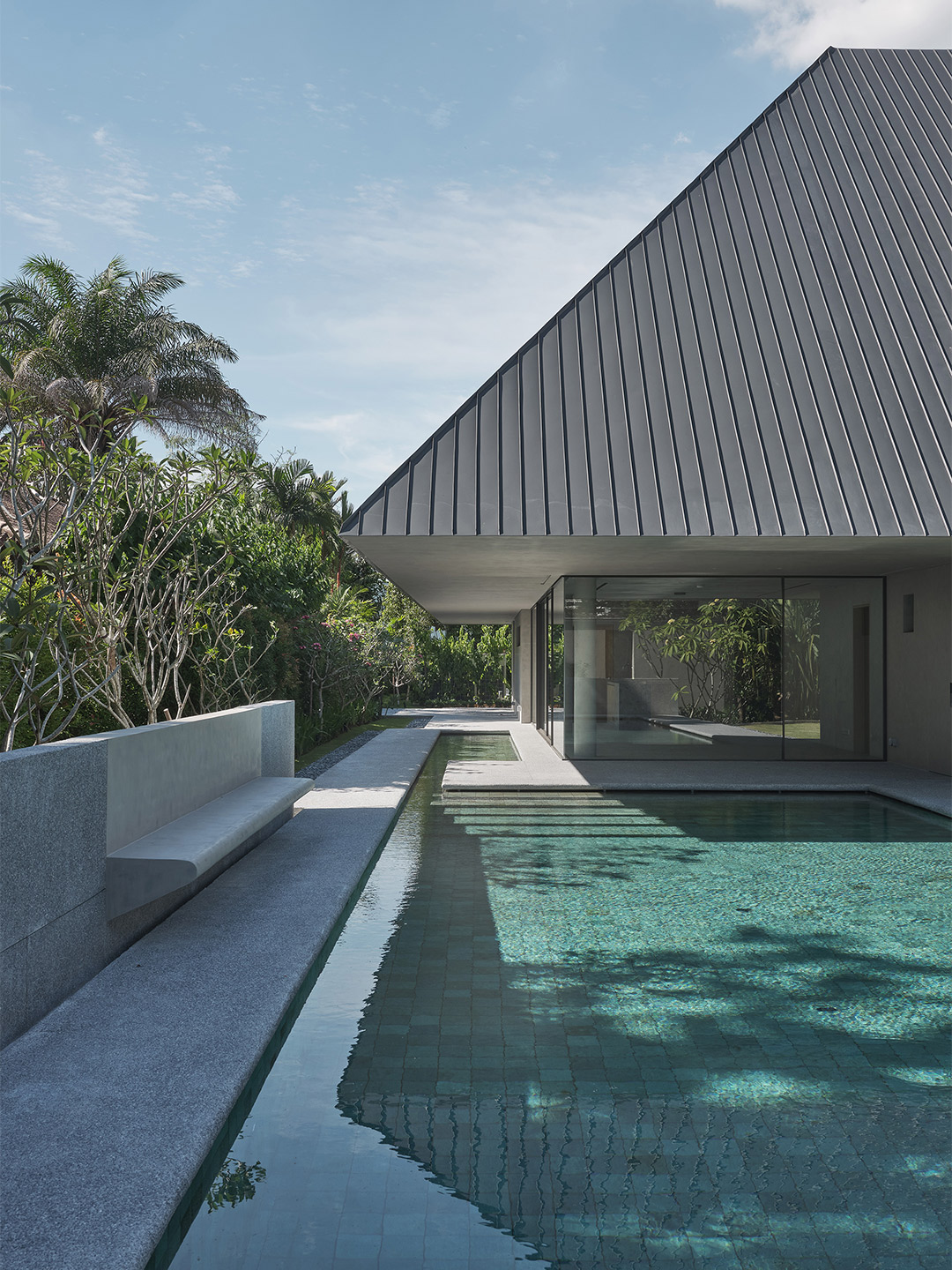

The garden symbolically defines the heart of the home as an ever-palpable void, persisting as the common backdrop to the collective lives of all inhabitants
Love the House of Remembrance by Neri&Hu? Catch up on more hospitality architecture and design and residential design, plus subscribe to receive the Daily Architecture News e-letter direct to your inbox.
Related stories
- Resa San Mamés student accommodation in Spain by Masquespacio.
- The bar and restaurant at La Sastrería in Valencia by Masquespacio.
- Mama Manana restaurant in Kyiv by Balbek Bureau.
- Gold ‘n’ arches: Bun burger restaurant in Milan by Masquespacio.
The traditional Chinese courtyard house or siheyuan is a typology well-known for its illustration of Confucian ideals, accommodating extended family units wherein many generations live under one roof. To live under the same roof means to live together, and this metaphor is the nexus that ties the notion of community, especially in an intimate context, to the form crafted for this project. For this private residence commission, Neri&Hu were given a set of unique requests by the client: the new house constructed in place of the previous one should accommodate all three siblings, who as adults have outgrown their shared house; it should include a small memorial space in the form of a garden for their late mother; and lastly, the new construction should retain the memory of the pitched-roof form, a defining feature of their childhood home.
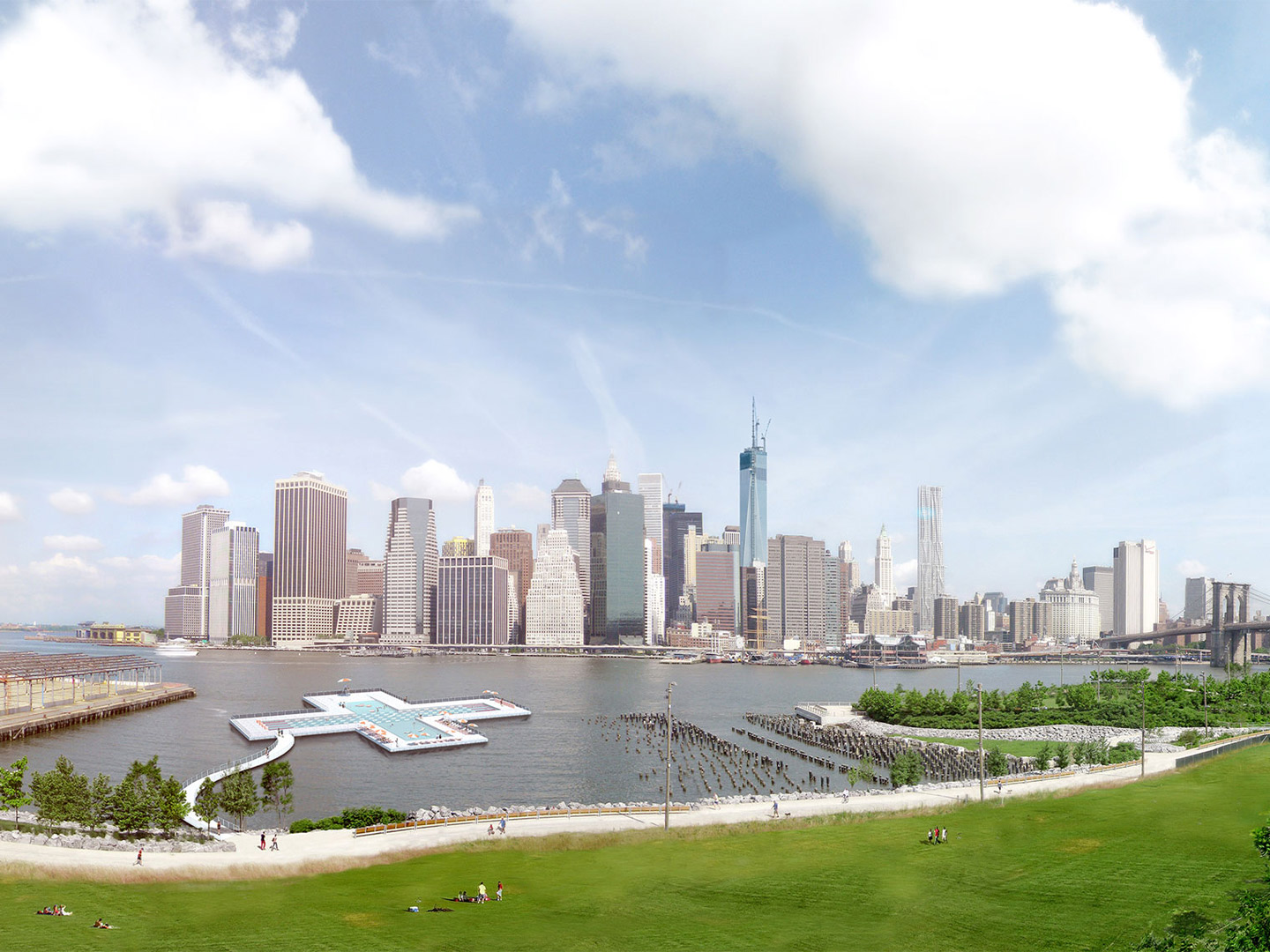
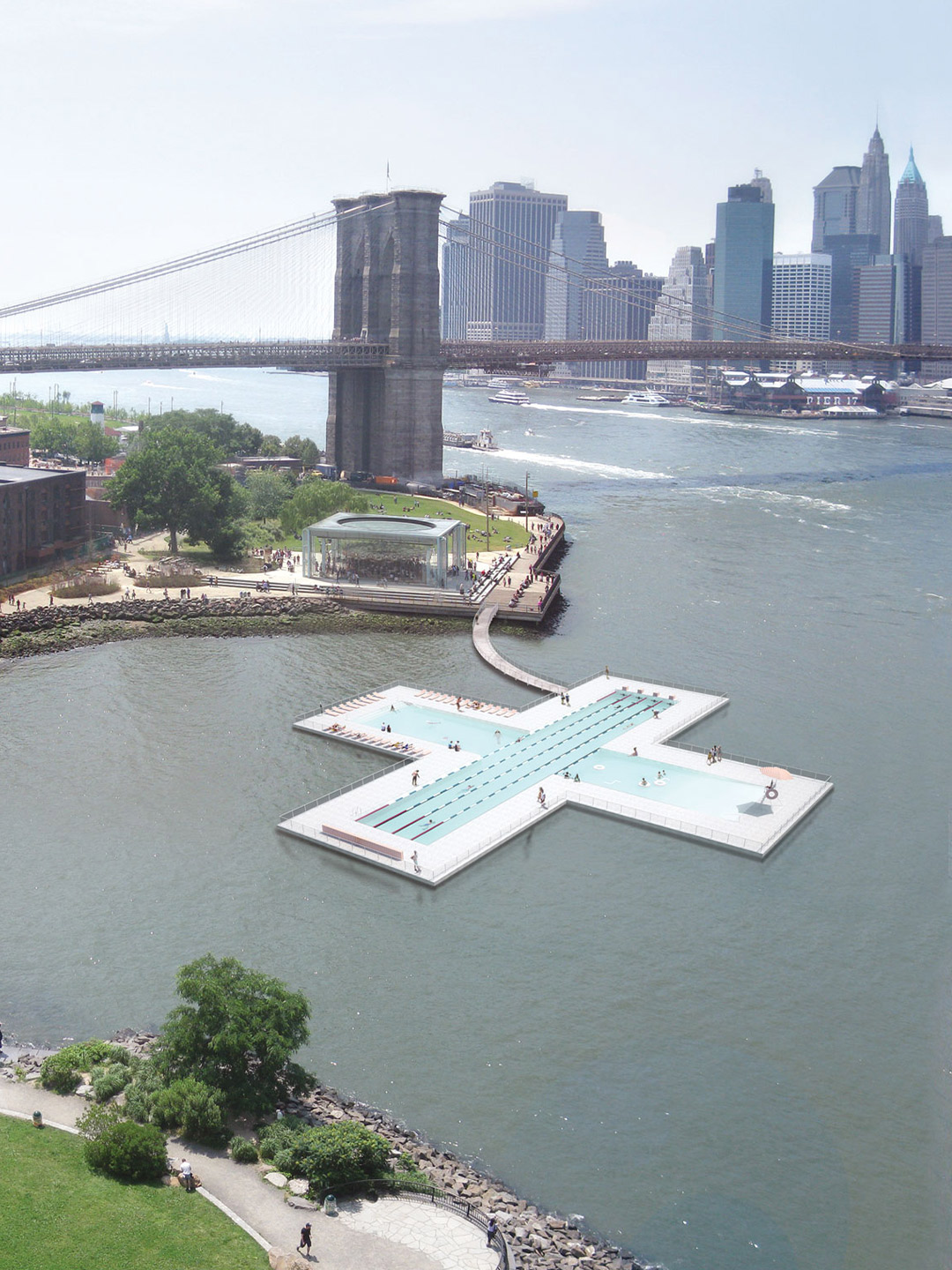
Employing patented technology, the plus-shaped pool is designed to filter the very water that it floats in – more than 1,000,000 gallons per day – making it possible for up to 50,000 New Yorkers to swim in clean river water each year. Something that hasn’t been possible since the 1930s. “Plus Pool strives to reclaim the river as a recreational resource for the city, while educating the public about issues affecting water quality,” says a statement from the + POOL team.
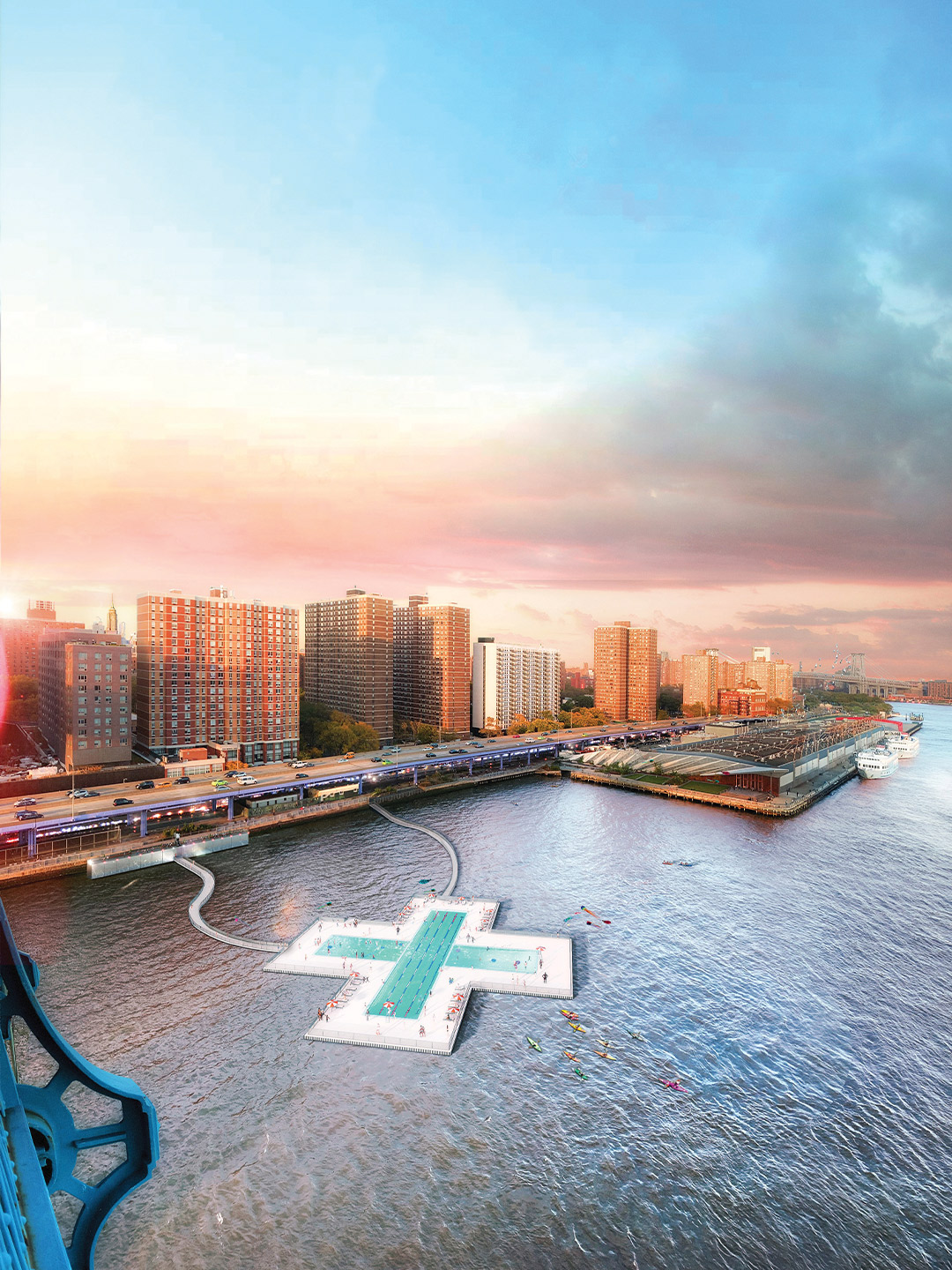
Big plus: The floating + POOL in New York
“New York is an incredible place to live. You can do almost anything here. Anything, except swim in the river,” the team continues. “[Plus Pool] started with a simple idea: instead of trying to clean the entire river, what if you started by cleaning it piece by piece? And what if you could change how New Yorkers see their rivers, just by giving them a chance to swim in it?”
Like a giant strainer dipped into New York’s East River, + POOL promises to filter the polluted river water within its walls, removing bacteria, contaminants and undesirable odours. “The team has engineered a filtration system that brings raw river water to an acceptable microbiological standard for swimming, and patented the design,” explains the + POOL team. By leaving only safe, swimmable water that compiles with local and state standards, the project team believes this will change the public’s attitude towards the river. “A public demonstration of the full system at the site will provide the team with data to take to permit authorities and greenlight the project.”
Following in the footsteps of public-private projects such as The High Line, the not-for-profit + POOL initiative was co-founded more than ten years ago by two design studios, Family and PlayLab. While Family has since dissolved, PlayLab continues to spearhead the project, fuelled by the belief that + POOL will become a welcome place for everyone to enjoy; a literal ‘big plus’ for residents and visitors of New York City.
“Our non-profit [organisation] supports the development and eventual operation and maintenance of Plus Pool,” says the team, noting that the non-profit organisation will also support the “preservation, restoration and conservation of natural bodies of water, promote water stewardship, and educate the public about the importance of clean water”.
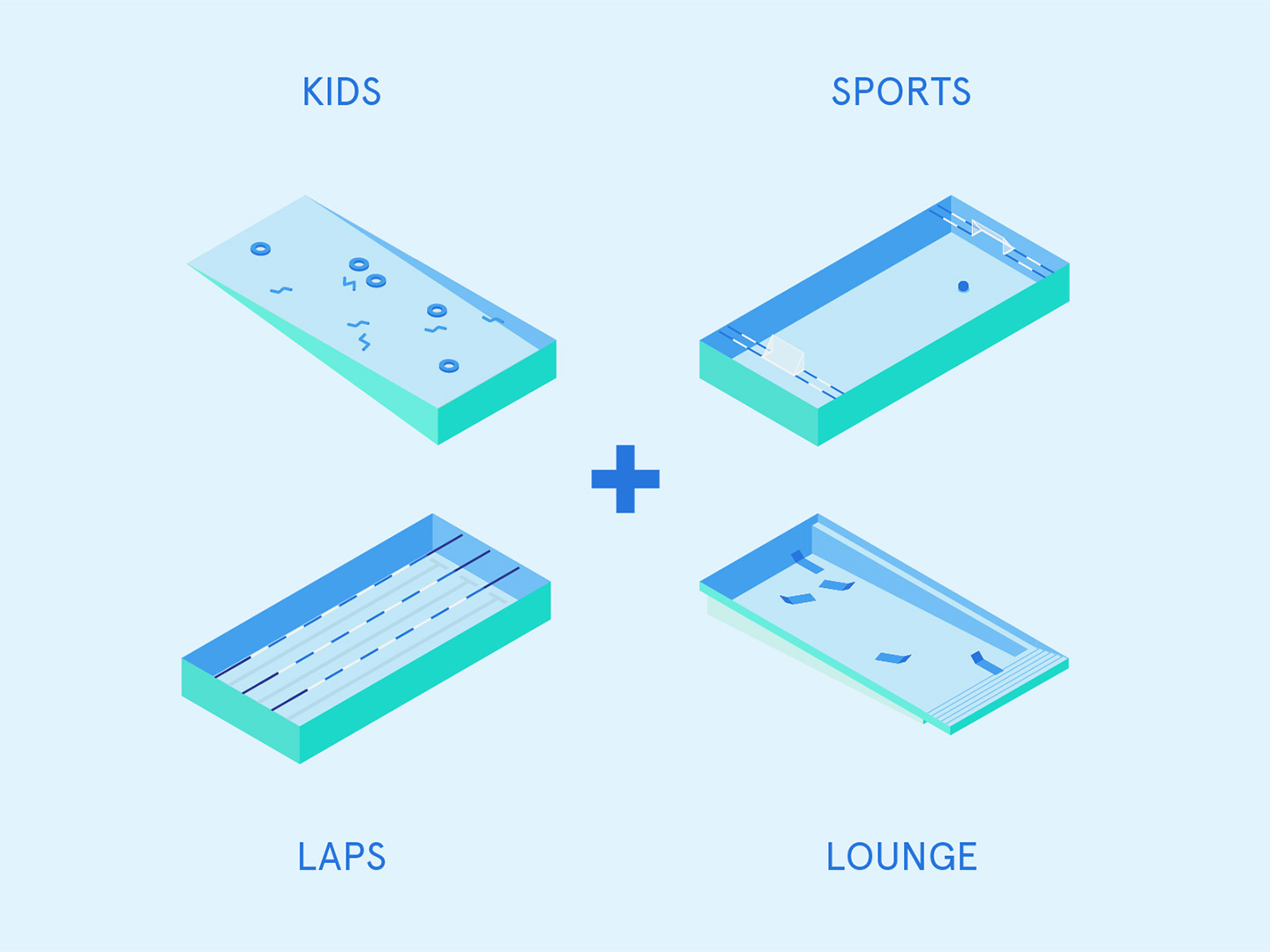
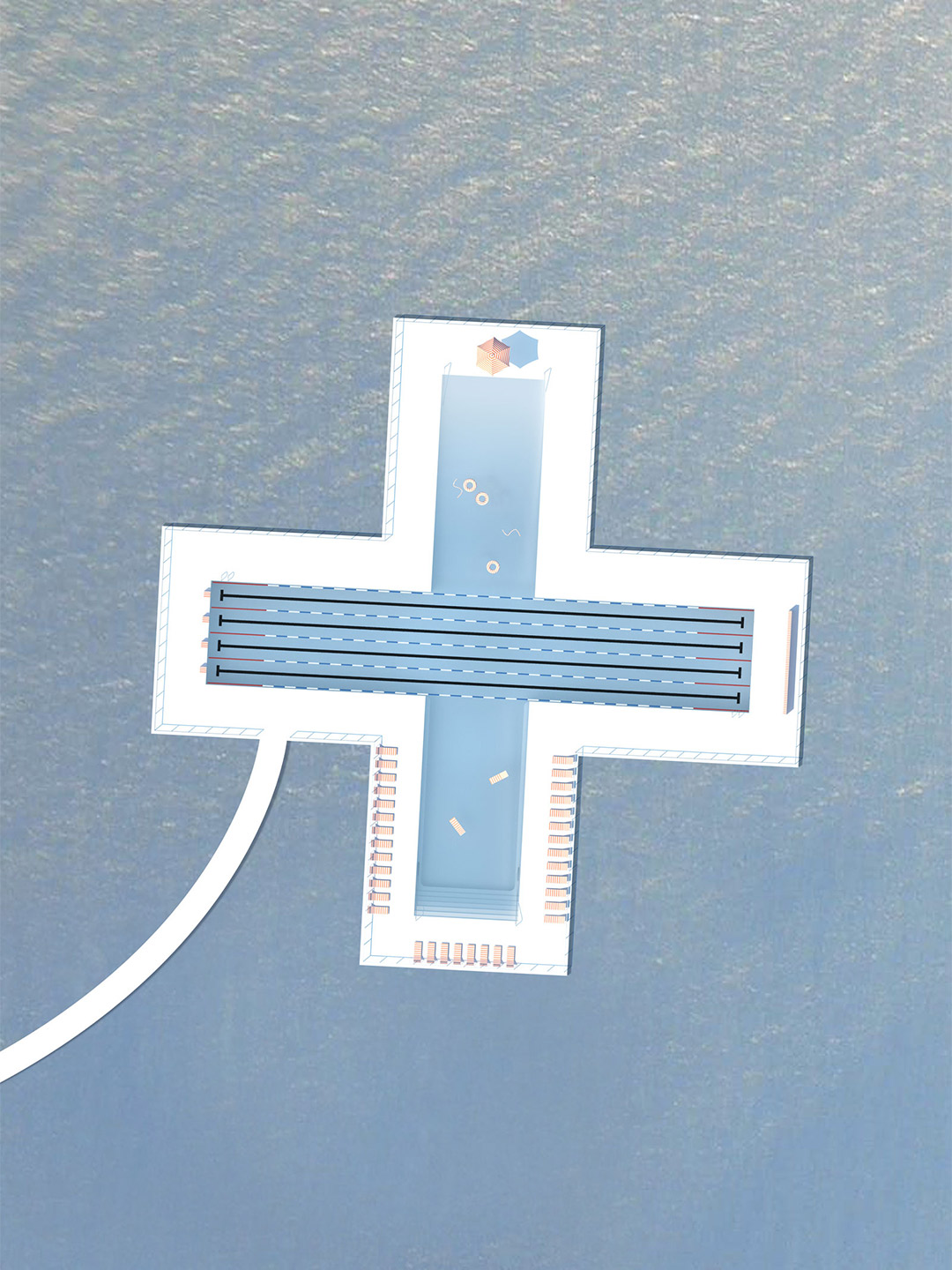
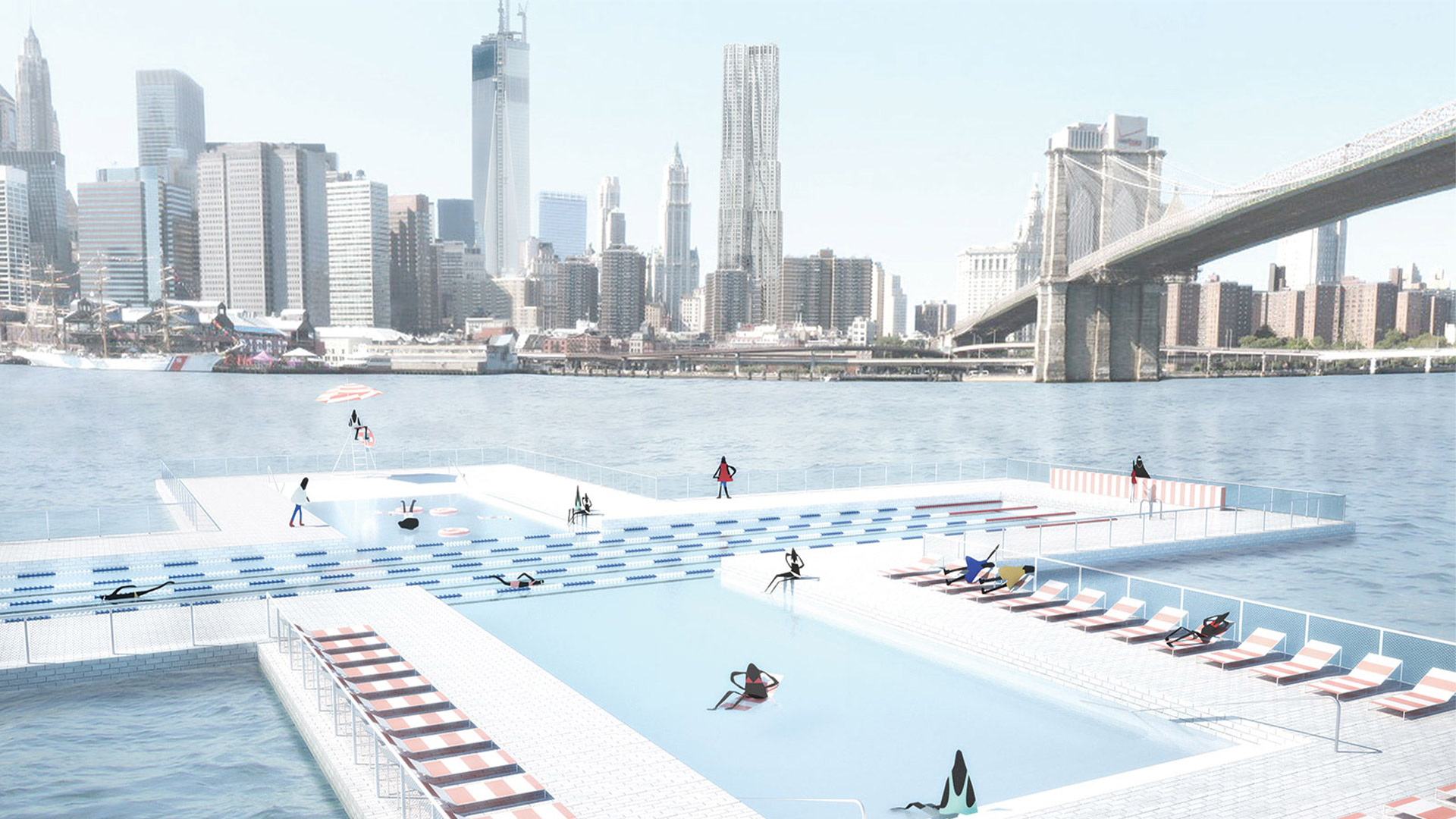
Illustrations of the pool show that its plus-symbol design would facilitate four swimming areas in one, including a kids’ pool, sports pool, lap pool and lounge pool. Each could be used independently to cater to all types of swimmers, combined to form an Olympic-length lap pool, or opened completely into a 835-square-metre leisure pool. But no matter which way the facility is ultimately enjoyed, the + POOL project team say it’s bound to make a splash: “Its universally recognisable shape and unusual offshore siting immediately positions Plus Pool as an iconic piece of public infrastructure.”
Catch up on more architecture and design highlights. Plus, subscribe to receive the Daily Architecture News e-letter direct to your inbox.
Its universally recognisable shape and unusual offshore siting immediately positions + POOL as an iconic piece of public infrastructure.
Related stories
- Introducing the New Wave collection of 80s-inspired vases by Greg Natale.
- Carla Sozzani curates new colours for classic Arne Jacobsen chairs.
- Adam Goodrum stamps all-Australian style on new breezeblock design.
The traditional Chinese courtyard house or siheyuan is a typology well-known for its illustration of Confucian ideals, accommodating extended family units wherein many generations live under one roof. To live under the same roof means to live together, and this metaphor is the nexus that ties the notion of community, especially in an intimate context, to the form crafted for this project. For this private residence commission, Neri&Hu were given a set of unique requests by the client: the new house constructed in place of the previous one should accommodate all three siblings, who as adults have outgrown their shared house; it should include a small memorial space in the form of a garden for their late mother; and lastly, the new construction should retain the memory of the pitched-roof form, a defining feature of their childhood home.
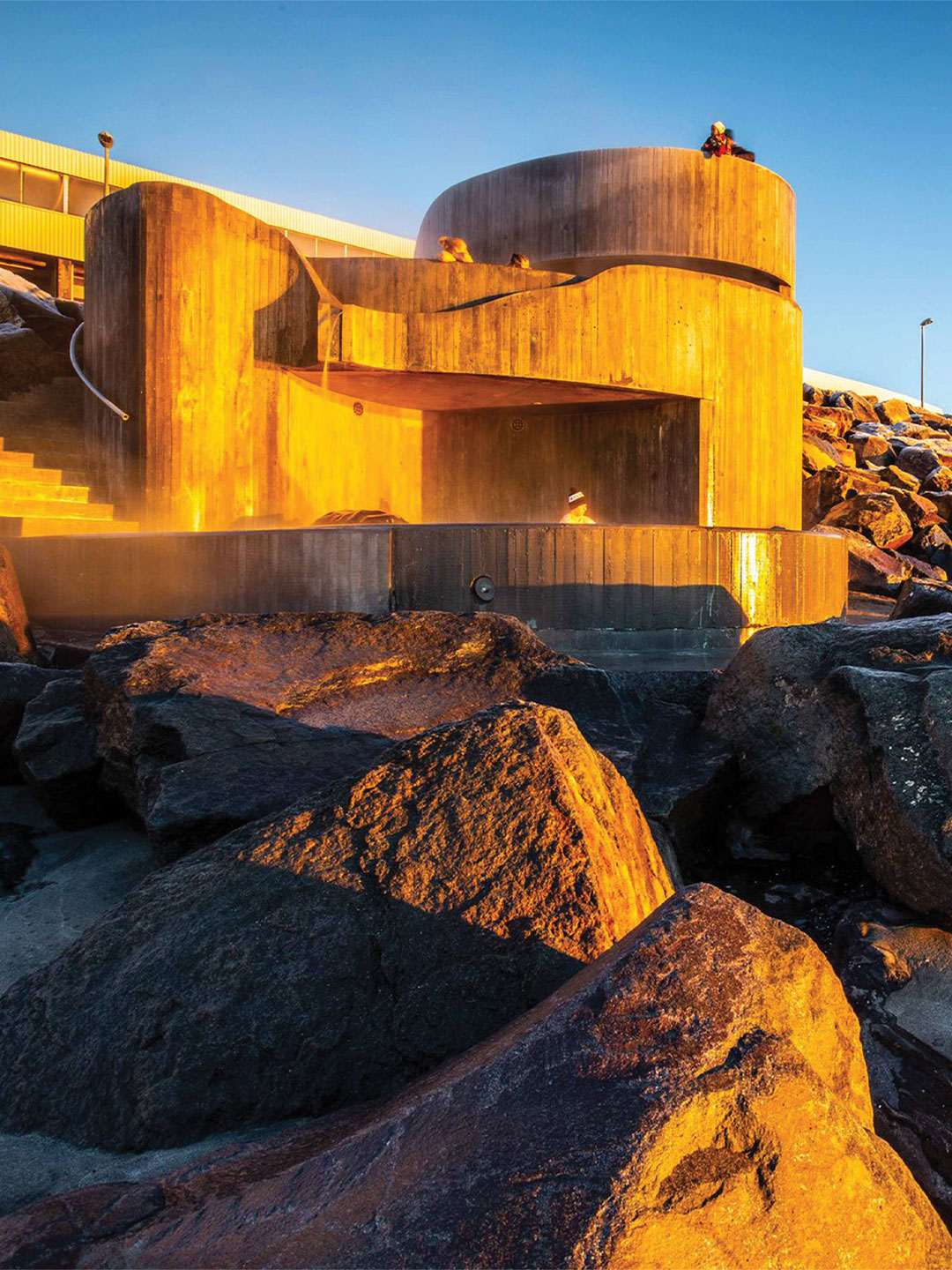
Designed by Icelandic firm Basalt Architects, the Guðlaug baths expand upon the country’s geographical assets and its long-running history of geothermal bathing, becoming the region’s first natural bathing facility in an urban setting. Exposed to the vast and, at times, unforgiving North Atlantic Sea, the series of stepped concrete baths are nestled into a manmade rock garden on Langisandur Beach, a popular spot for locals and a hidden gem yet to be fully discovered by tourists.
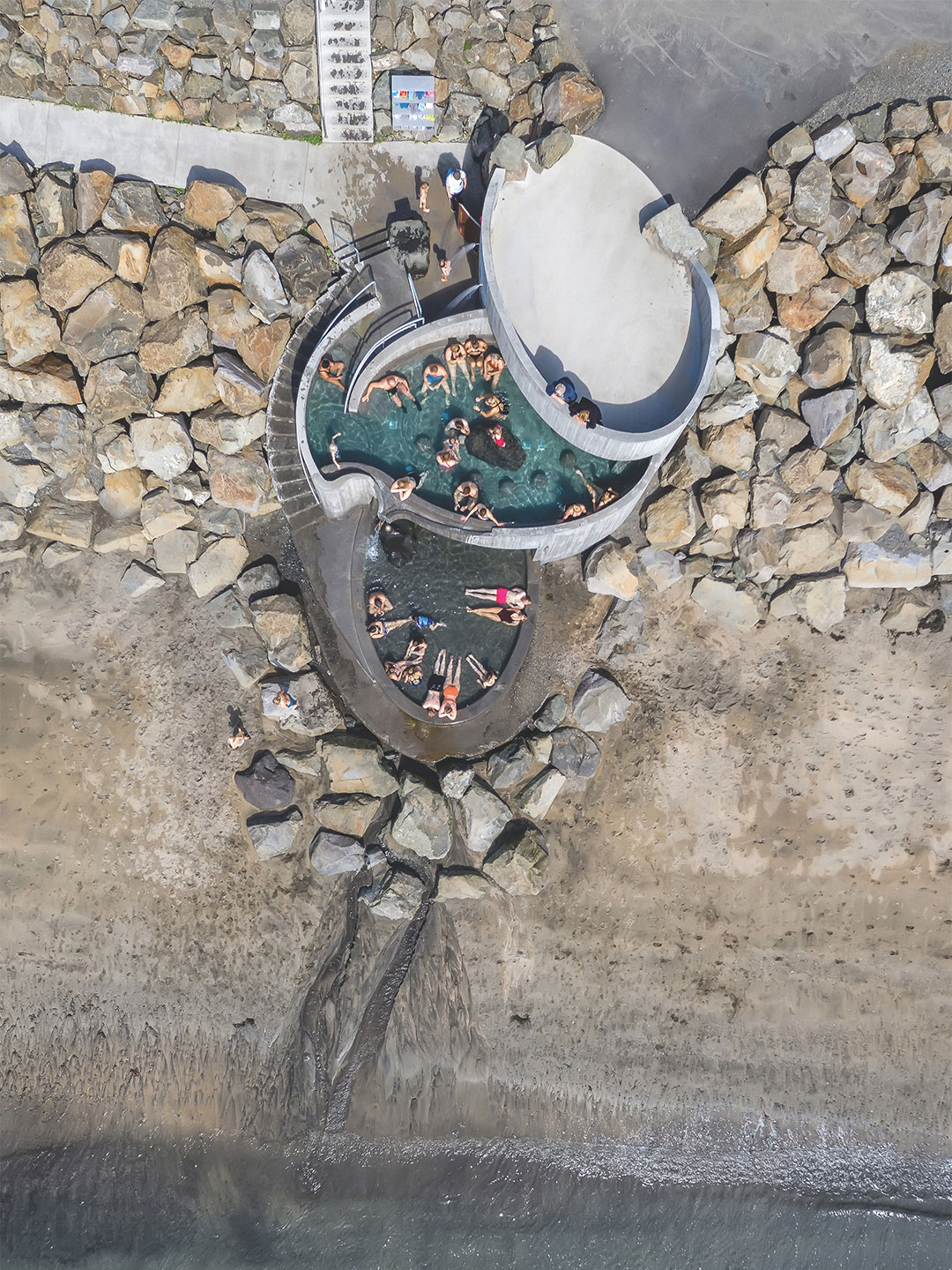
Guðlaug geothermal baths in Iceland by Basalt Architects
Seeking to meet the needs of current and future users, the overarching goal of the geothermal bathing project was to boost public health by bolstering the area’s potential for outdoor recreation. The client’s brief for the architects was simple: create a hot pool placed anywhere by the beach. “Having total freedom can be a difficult challenge, but not in this case,” says Hrólfur Karl Cela, partner at Basalt Architects. “First of all, the location we chose on the beach is behind the town’s soccer stadium. The stadium provides shelter from cold northern winds [and its] underbelly presented a fantastic opportunity to house future development for the beach in a sustainable, cost-effective way.”
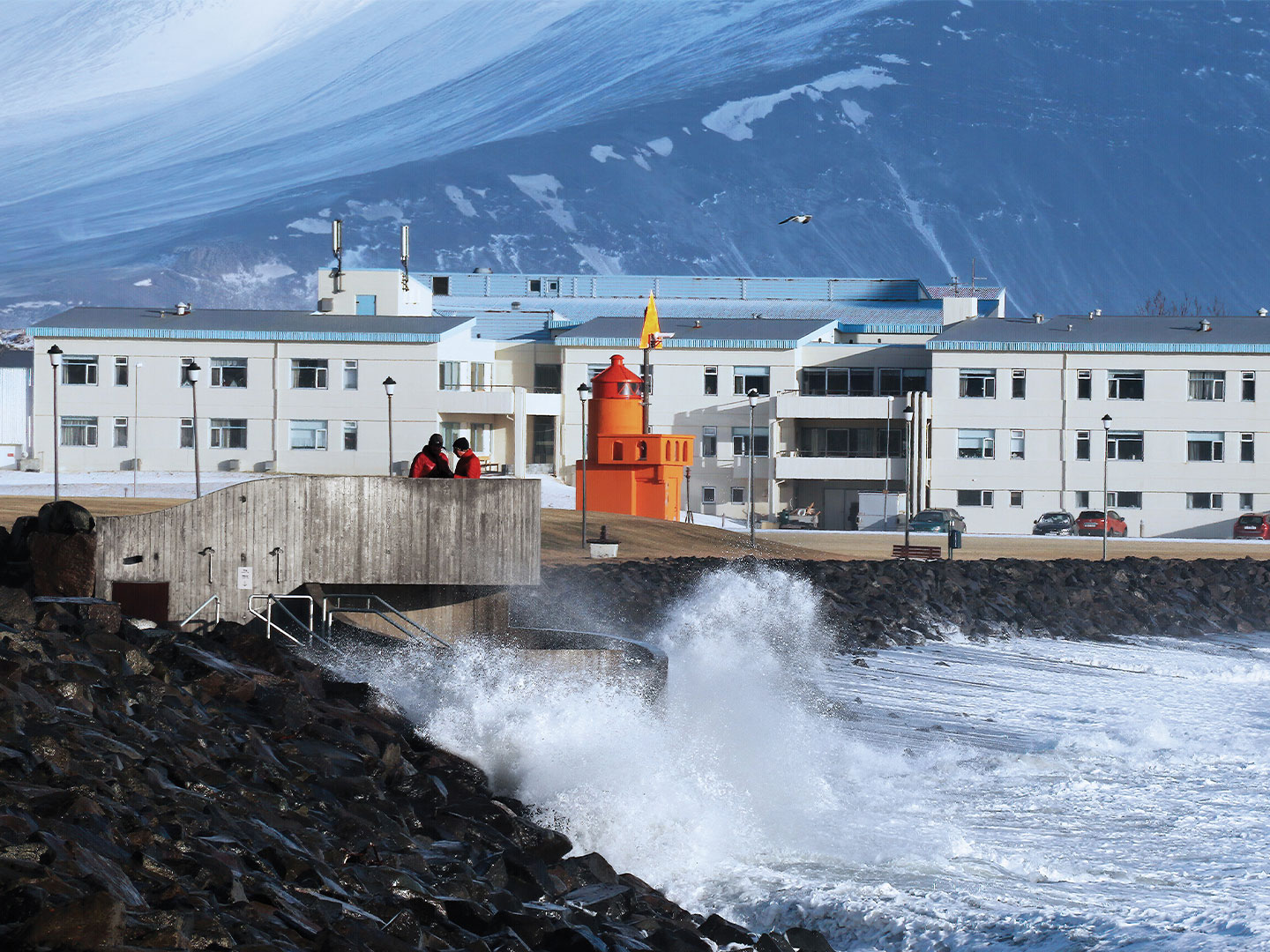
Shelter was a primary concern for the architects as the brutal Atlantic storms are well-known in these parts, partnered with ocean currents that have seen boulders thrust from the sea and deposited on the nearby walking path. The materials that can withstand such awesome force are limited. But rising to the challenge, the architects discovered through testing that marine-grade concrete reinforced by corten and galvanised steel would stand up against nature’s wrath.
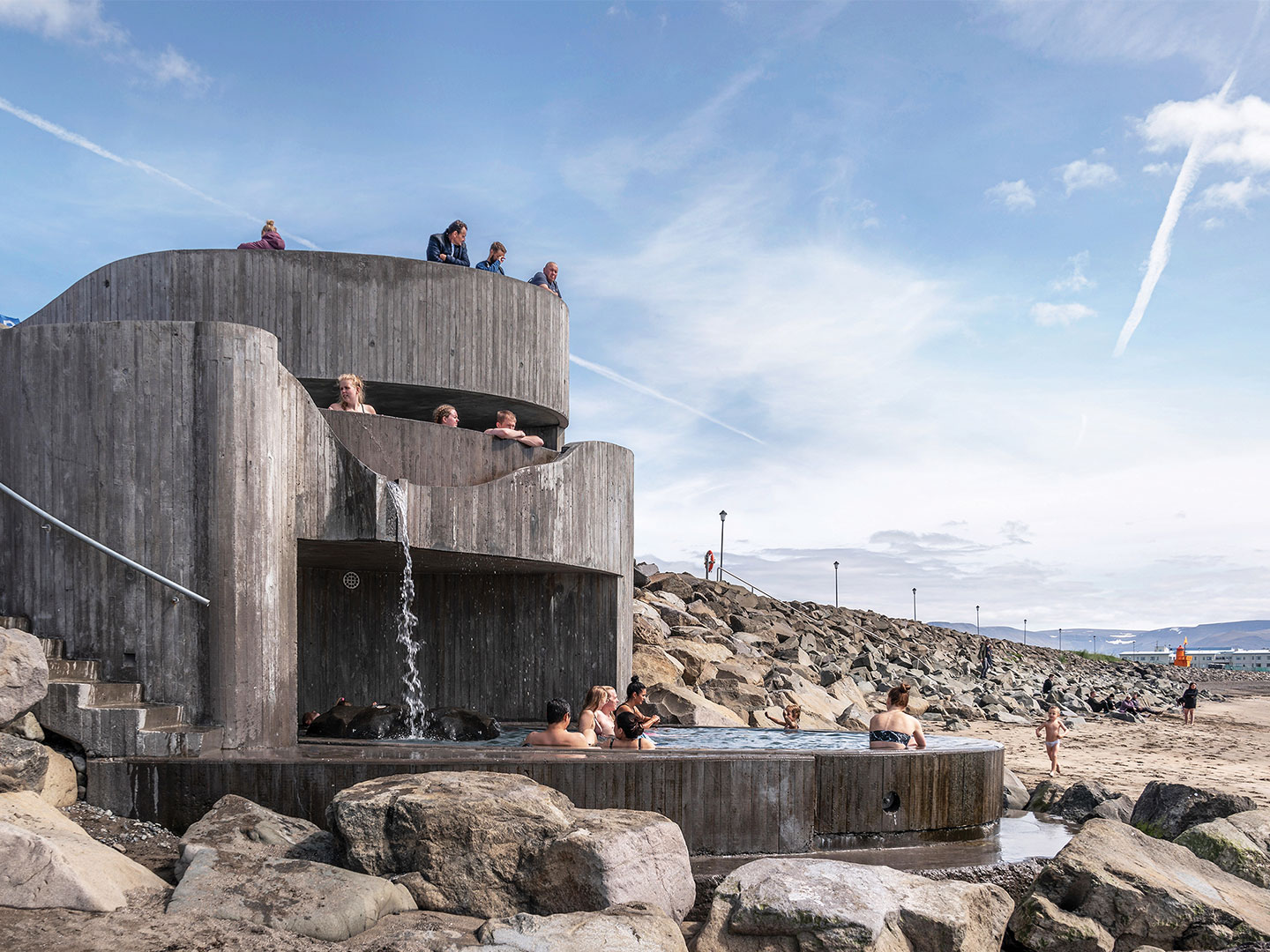
The sand foundations and the tidal movement of the ocean called for precast concrete elements to limit construction time on-site and also ensure quality and longevity. “Just as the tides affect and change the experience of the users it was also a major concern for construction, as all work had to be timed according the tidal and weather forecast. This means the structure is for the most part precast off-site and hoisted into place in pieces,” Hrólfur says. “It required patience as it meant splitting the construction over two seasons, the first to do the foundation work and have it set and tested. Then starting again months later to finish.”
“Building something on a beach without reaching solid bedrock is quite an engineering concern. We all know the parable of the foolish man who built his house on the sand. And let me just say that there was great skepticism and many people believed this project could never work. The team of engineers worked closely with us and The Icelandic Road and Coastal Administration, who oversee Iceland’s coastal barriers, to come up with the solution.”
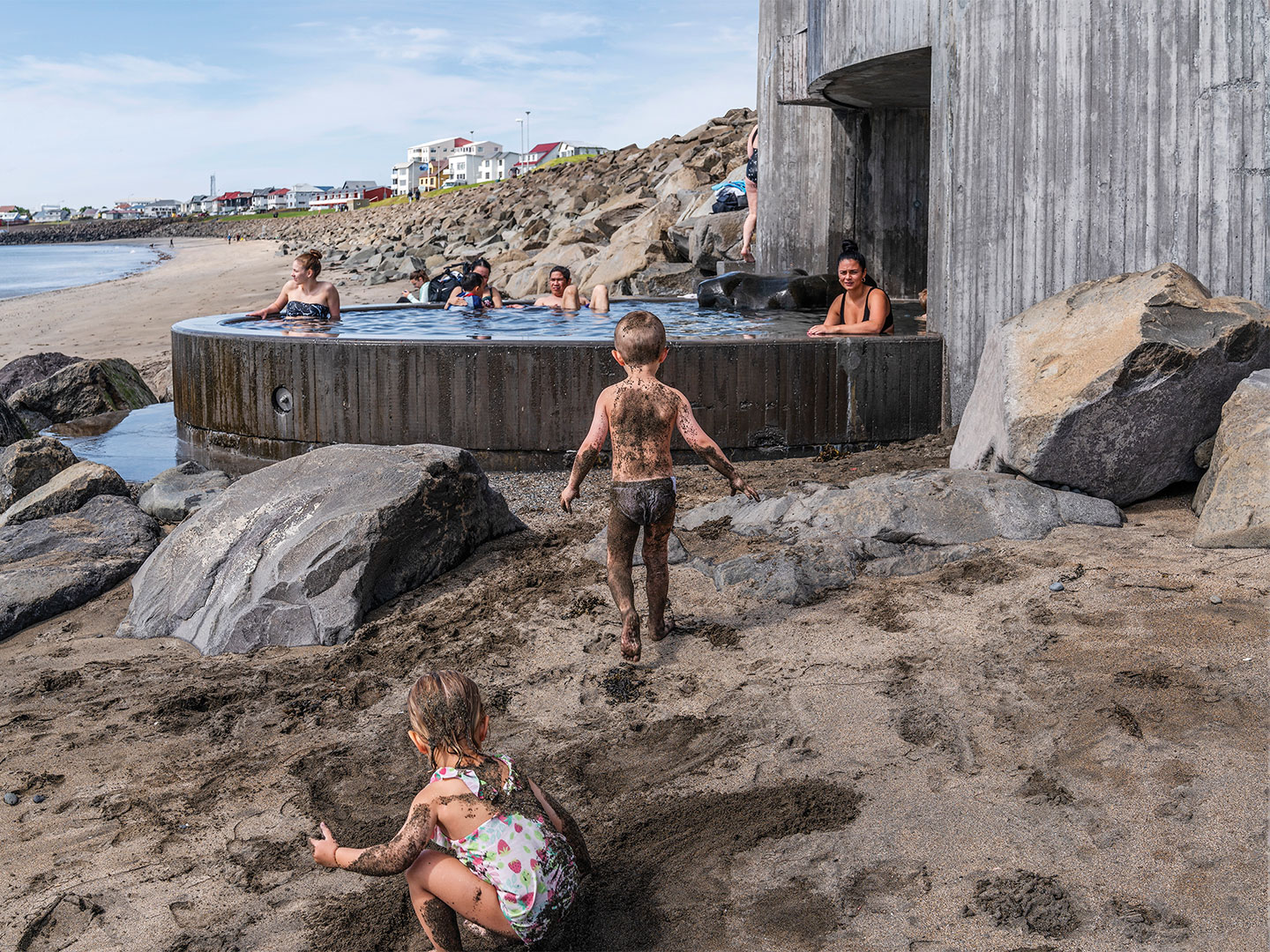
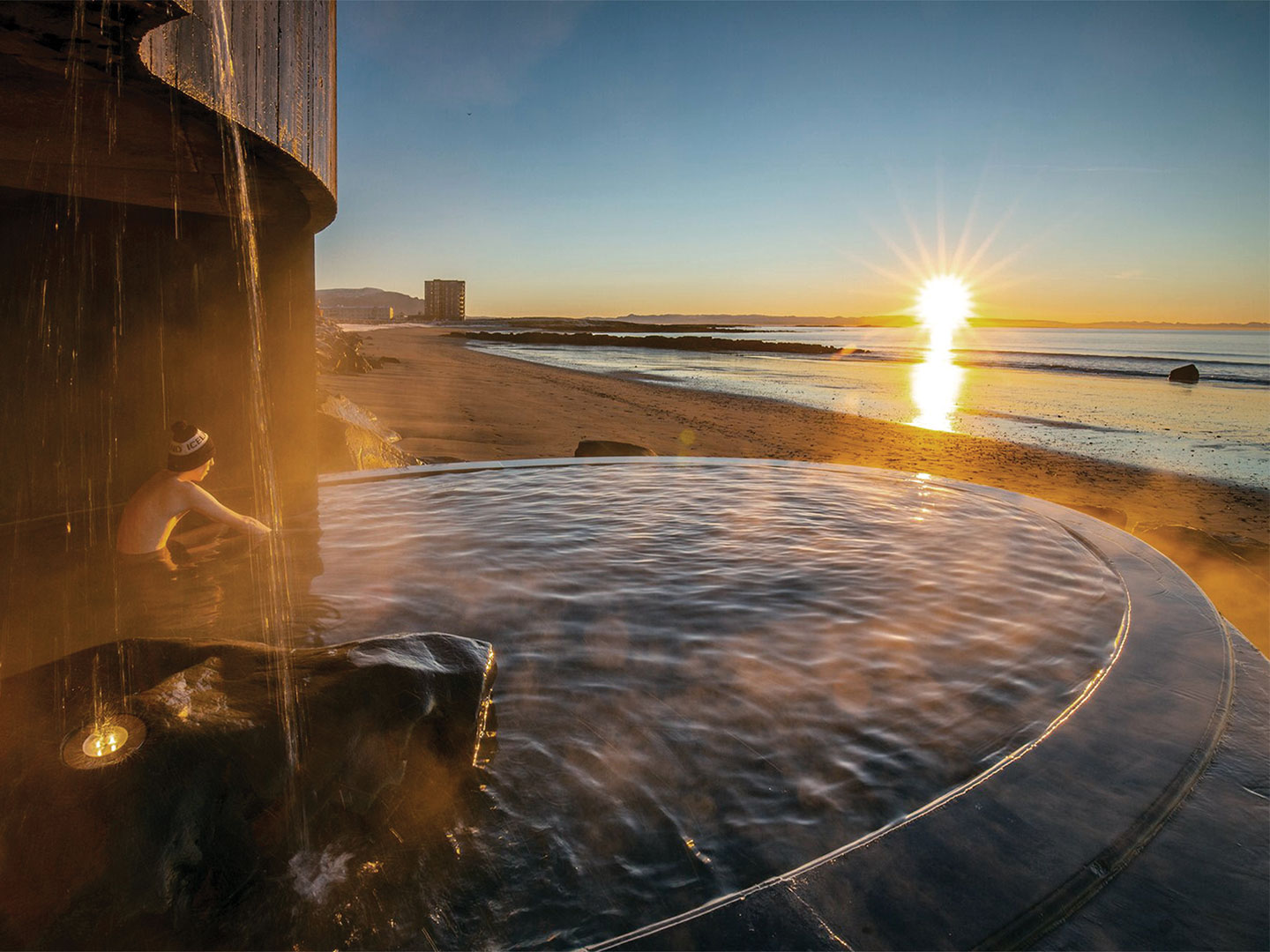
While paying homage to its historic hot-tub predecessors, Guðlaug was informed by the small sea pools that form in the sand around rocks on the beach as the tide flows in and out. This concept was developed into a three-tier structure, straddling the rock barrier, where each tier revolves around a single rock. The top tier is a viewing deck “inspired by the bow of a boat”. The middle tier is the main heated pool, sheltered from the weather by the viewing deck. And the lower tier “beach pool” is fed by the cascading overflow of the main pool, acting as a mid-temperature dipping point between the steaming hot water and the frigid Atlantic Ocean.
“The experience varies depending on seasons, time of day and weather,” Hrólfur says. At low tide, the beach stretches out and lukewarm pools from the overflow of the baths appear on the sandy beach. At high tide, the design allows users to experience the explosive power of the ocean under their feet. “For some locals, bathing in Guðlaug has become part of a daily routine. Guðlaug is a very socially driven community project and at the same time very welcoming to visitors.”
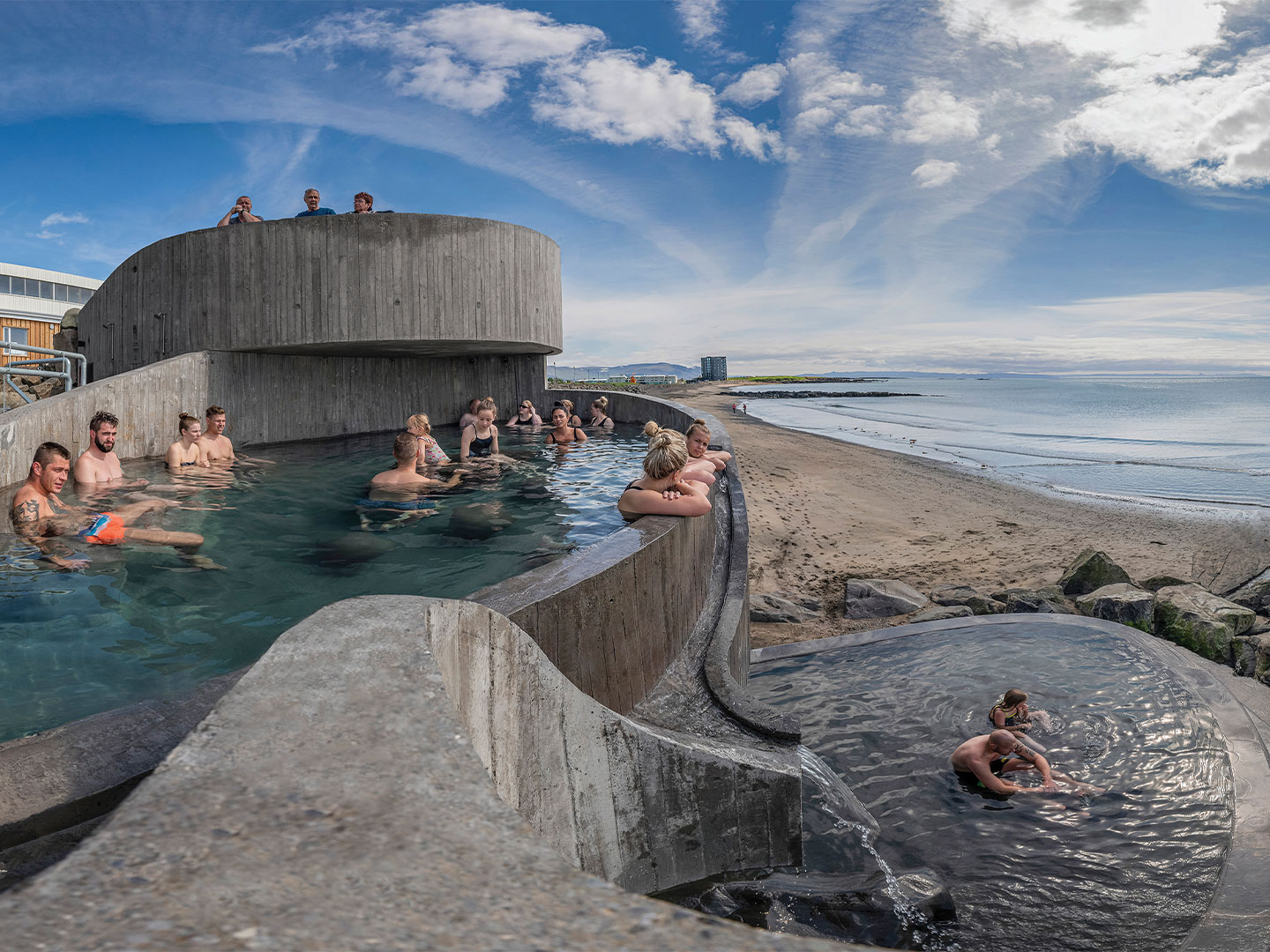
“Typically there is a nice mix of locals, people from the capital area and tourists – at least before Covid. And usually a mix of couples, families, lone rangers and groups of friends,” Hrólfur says. “People tend to spend a couple of hours, traversing between the main pool to the beach pool and the ocean, dipping their toes – or more, depending on tolerance – into the Atlantic.”
Guðlaug has become so popular that the architects say the site’s geo-tagged location is a smash-hit on Instagram. Visitors use the social media platform to document their daily experiences in the baths, from scenic panoramas of the spectacular view across the Faxaflói Bay and Reykjavík city skyline, to selfies and rather cheeky “belfies” (a selfie of one’s buttocks in bathers).
“One thing has to be said, because Guðlaug is open and free for everyone there is always a sense of amicability and a kind of camaraderie,” Hrólfur adds. “Part of the magic of Guðlaug is that it is different things at different times, keeping people coming again and again.”
Catch up on more architecture highlights and public spaces, plus subscribe to receive the Daily Architecture News e-letter direct to your inbox.
For some locals, bathing in Guðlaug has become part of a daily routine. Guðlaug is a very socially driven community project and at the same time very welcoming to visitors.
Related stories
- Resa San Mamés student accommodation in Spain by Masquespacio.
- The bar and restaurant at La Sastrería in Valencia by Masquespacio.
- Mama Manana restaurant in Kyiv by Balbek Bureau.
Melbourne-based developer Tim Gurner, the founder and director of eponymous property group Gurner, has recruited an all-star design team to compose the company’s first luxury hotel. Architect Ed Glenn of Powell and Glenn will spearhead the sustainability-focussed design, working in close collaboration with Jerry Wolveridge of Wolveridge Architects. Landscape architect Myles Baldwin is onboard to cultivate the property’s lavish tropical gardens while Tim’s wife, stylist and interior designer Aimee Gurner will guide the direction of the project’s sumptuous interiors. “It has been inspiring watching my wife Aimee, Ed Glenn, Jerry and Myles put together this incredible creation,” says Tim. “Something I know people will fall in love with.”
News highlights
- Gurner has lodged plans for the company’s first boutique hotel, comprising 18 luxurious rooms, a wellness spa, restaurant and bar.
- 16 prestigious residences will accompany the development, each of which will be listed for sale.
- The site for the development is one of the last remaining beachfront plots in Port Douglas, Queensland.
- The project team includes architects Ed Glenn of Powell and Glenn, Jerry Wolveridge of Wolveridge Architects, landscape architect Myles Baldwin and interior designer Aimee Gurner.
- The project is set to break ground in 2021.
Situated at 67–73 Murphy Street, one of the last remaining pockets of vacant beachfront land in Port Douglas, Queensland, the 18-room boutique hotel is planned to be accompanied by 16 private residences. While the hotel and its spa, restaurant and bar tenancies will remain under the ownership of Gurner – marking a “new chapter” in the company’s portfolio – the prestigious homes will be listed for sale. “Port Douglas has been an incredibly important part of our family’s life over the past 15 years and is without doubt our favourite destination to visit in Australia,” says Tim. “We want to give back to this amazing town and create something that does not currently exist.”
“We are exploring a number of new asset classes across tourism, wellness, accommodation and food and beverage,” he adds. “These next few years will be all about pushing the boundaries of our portfolio and recreating the luxury experience we provide to our apartment residents at a much larger scale.”
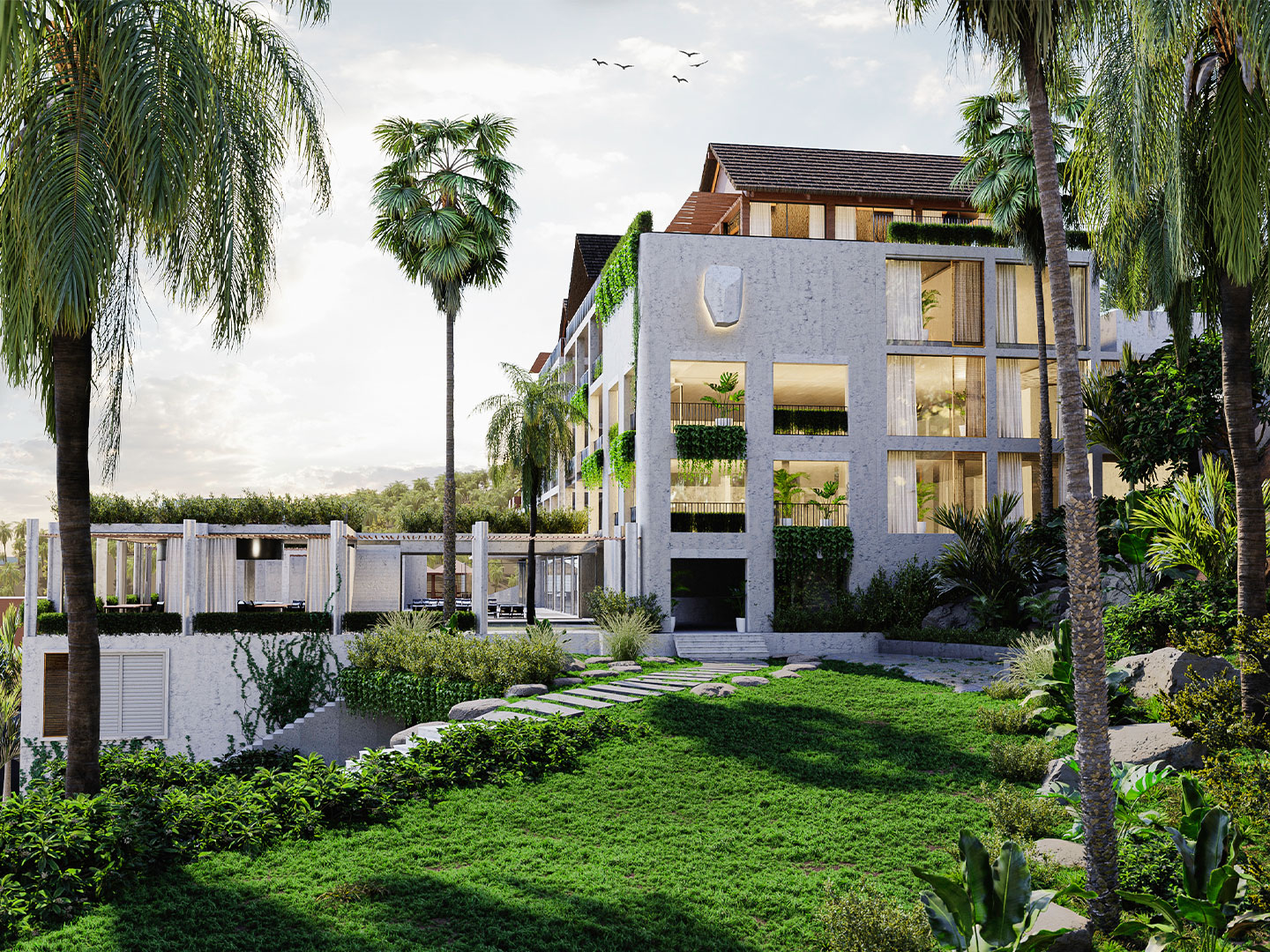
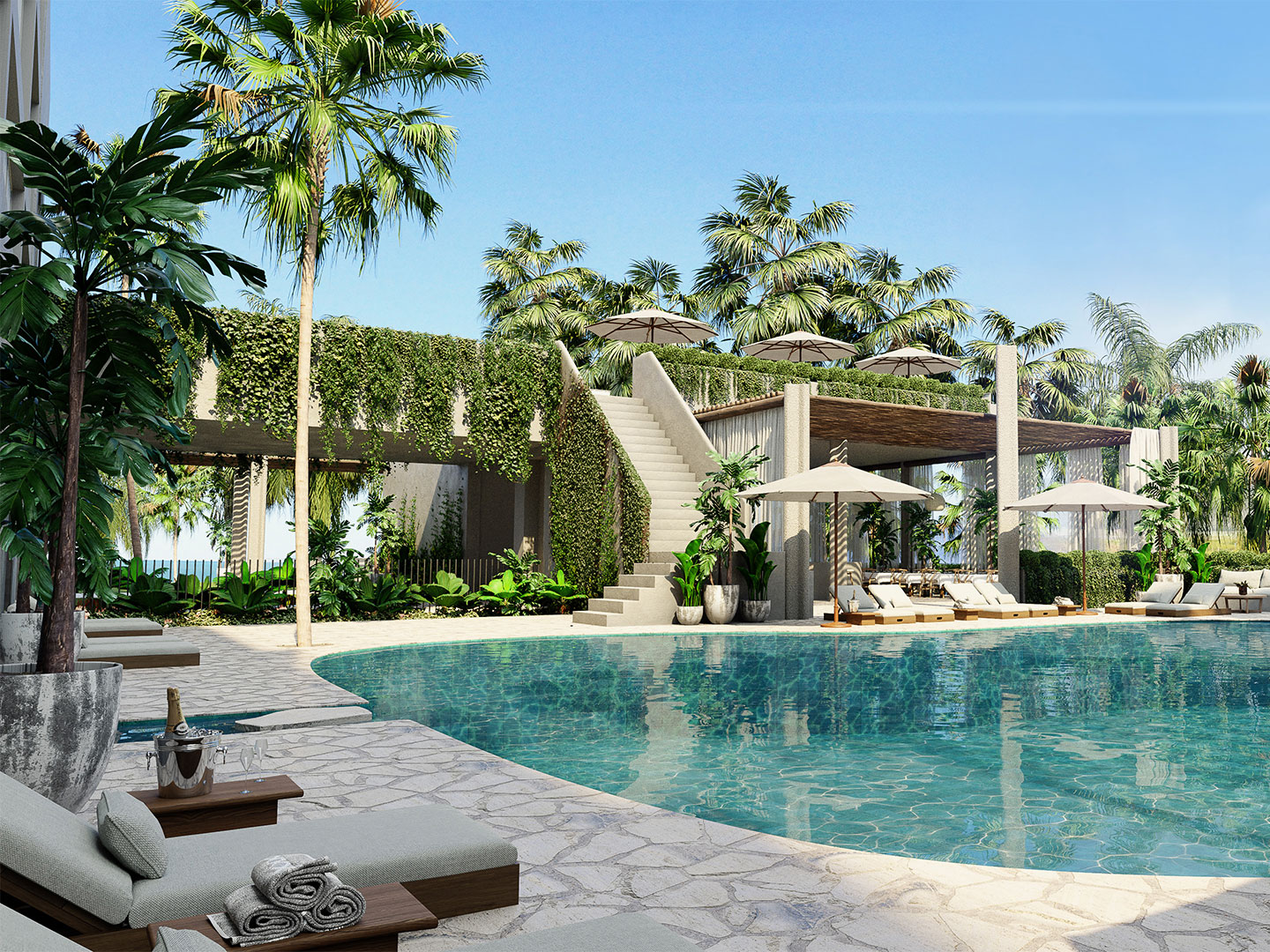
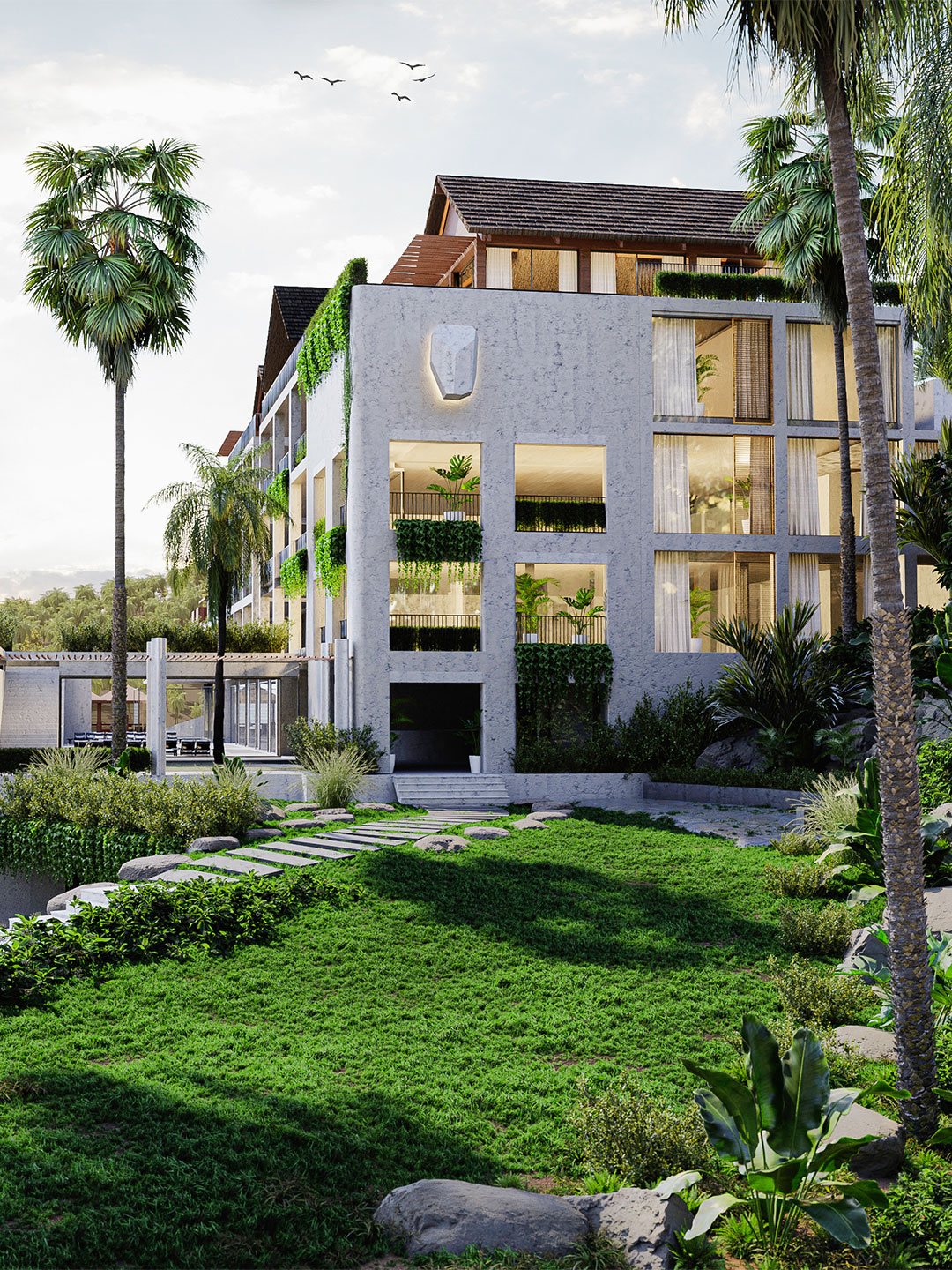
Initial town planning designs submitted this week show that both the residences and the hotel have been designed to draw inspiration from the idyllic Port Douglas vernacular, translating to an architectural response which is “part grounded” to the earth and “part floating” among the palm fronds. An abundance of verdant foliage is forecast to cascade down the buildings’ facades, seamlessly integrating the dwellings with the lush locale.
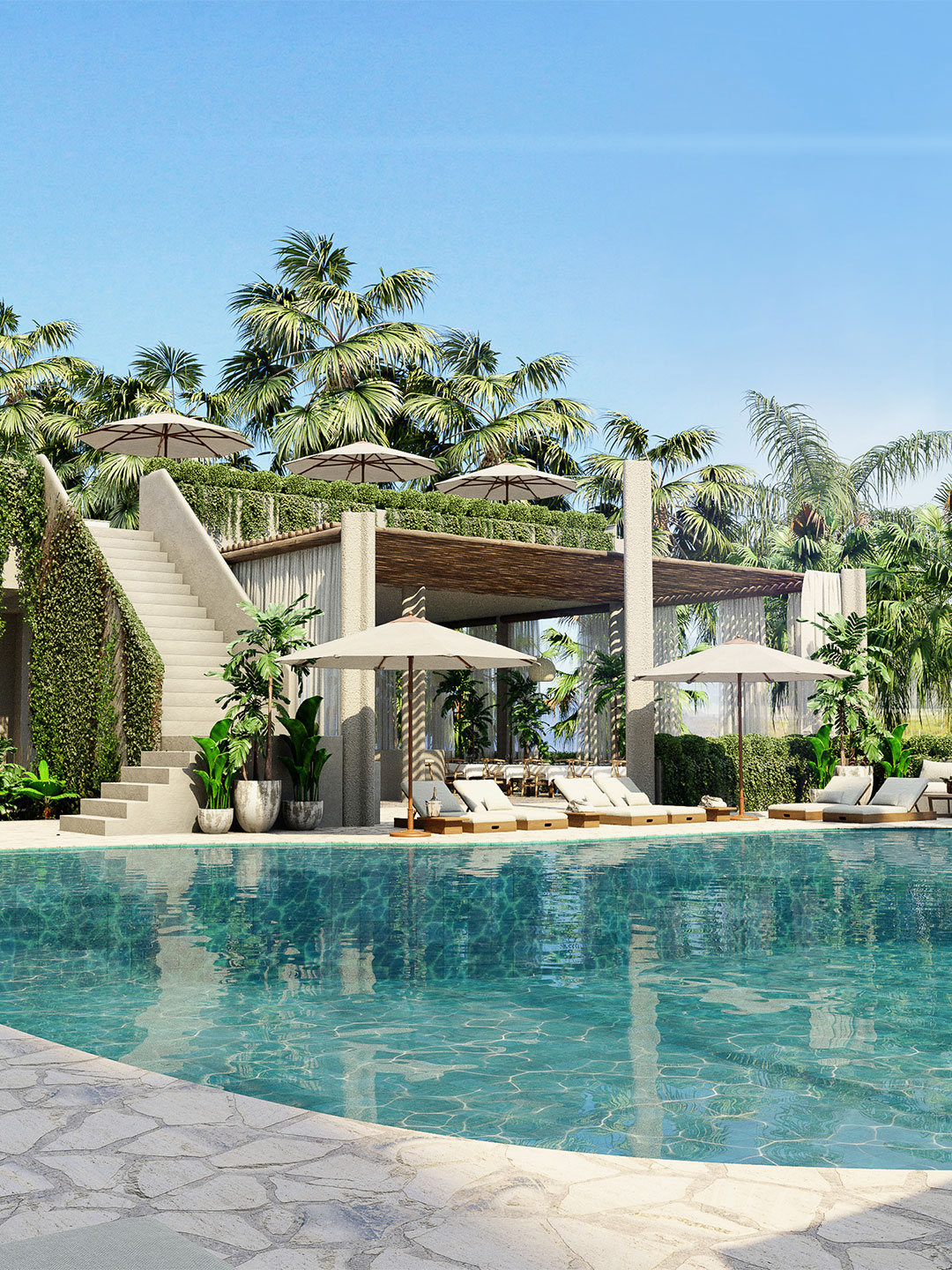
Featuring a restrained palette of materials that evokes the laidback spirit of Far North Queensland, artist’s impressions of the development illustrate dual-sided terraces with pitched roofs and plantation shutters, surrounded by tranquil swimming pools and private landscaped retreats. “We will not be doing any of this by halves,” says Tim. “People can expect it to be something truly special when it is complete – private, luxurious, homey and welcoming at every point.”
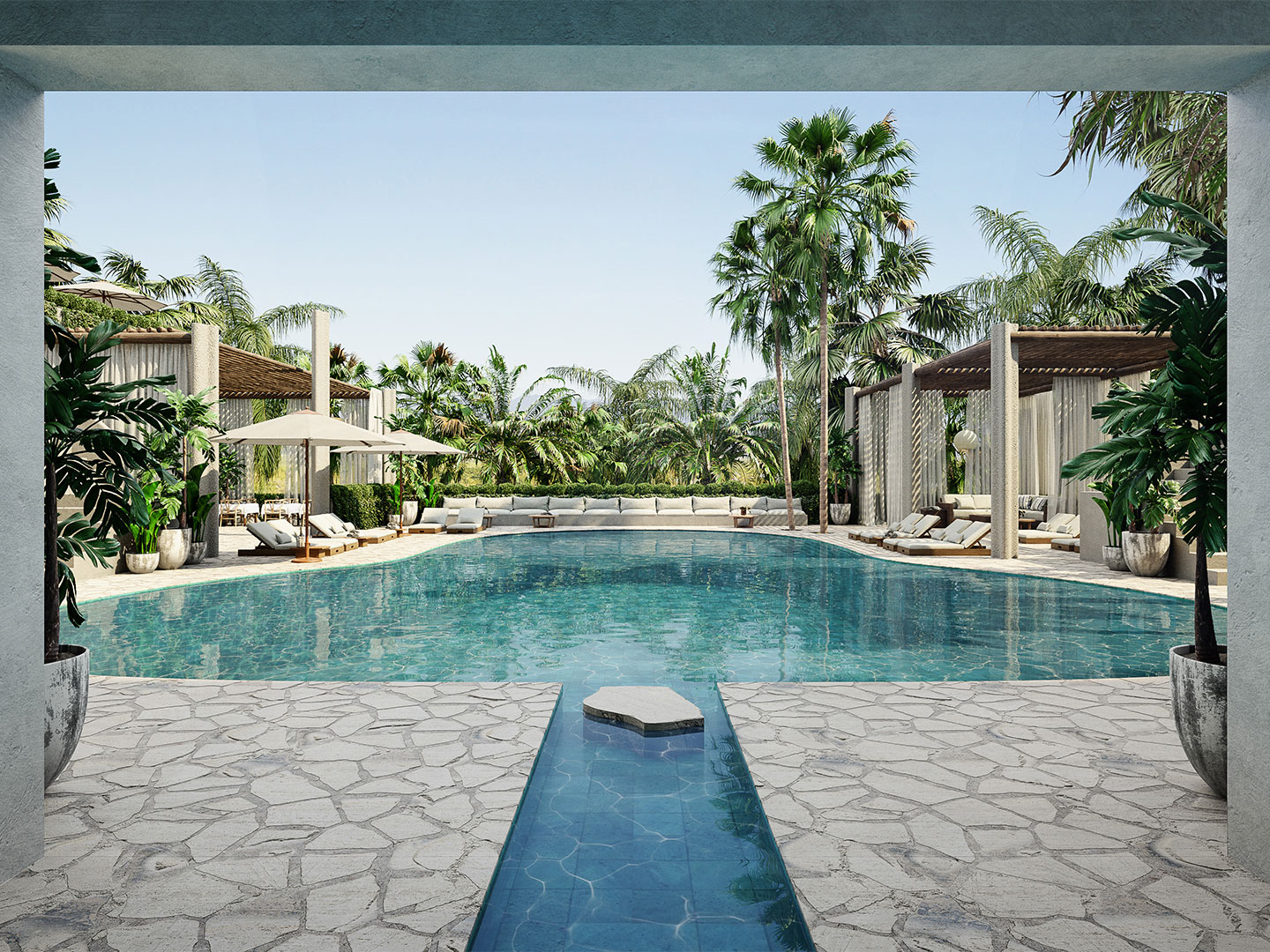
The hotel will include holistic wellness facilities comprising a spa, sauna, ice baths, cryotherapy, pool and treatment rooms, operating under the umbrella of Gurner’s own Samsara Wellness brand. Melbourne’s sold-out Saint Moritz project by Gurner will be the first site to roll out the developer’s wellness offering, followed by Port Douglas, ensuring that Far North Queensland enjoys access to luxury experiences on par with the Whitsundays and Byron Bay region. “When you look at what Antony Catalano has been able to do with Raes [at Wategos Beach], offering something truly special and unique, and what the Oatleys have done with Qualia on Hamilton Island – they are without question a big inspiration for what we are doing,” says Tim.
“We have been incredibly fortunate over the past seven years to have built a defining portfolio of luxury residential projects along the eastern seaboard of Australia,” he adds. “Now we want to take this philosophy and evolve it into something that extends the lifestyle offering through boutique hotels.”
Related stories
- Queensland’s ‘coral ark’ by Contreras Earl Architecture set to spearhead global rescue mission.
- Koichi Takada and Lat27 envision the world’s greenest residential building.
- Singapore’s Eden building and its skyward gardens are in sync with the city-state’s biophilic vision.
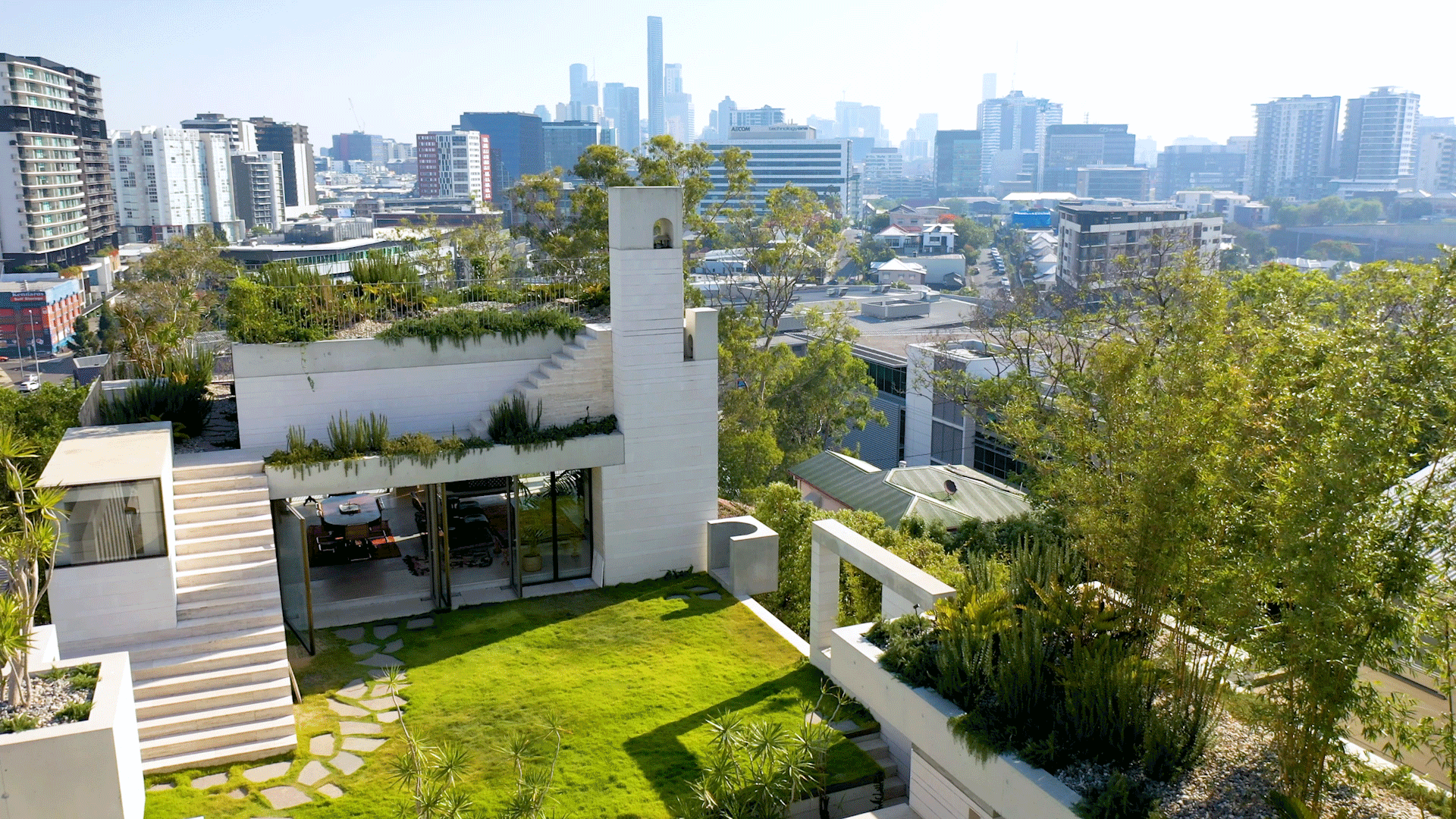
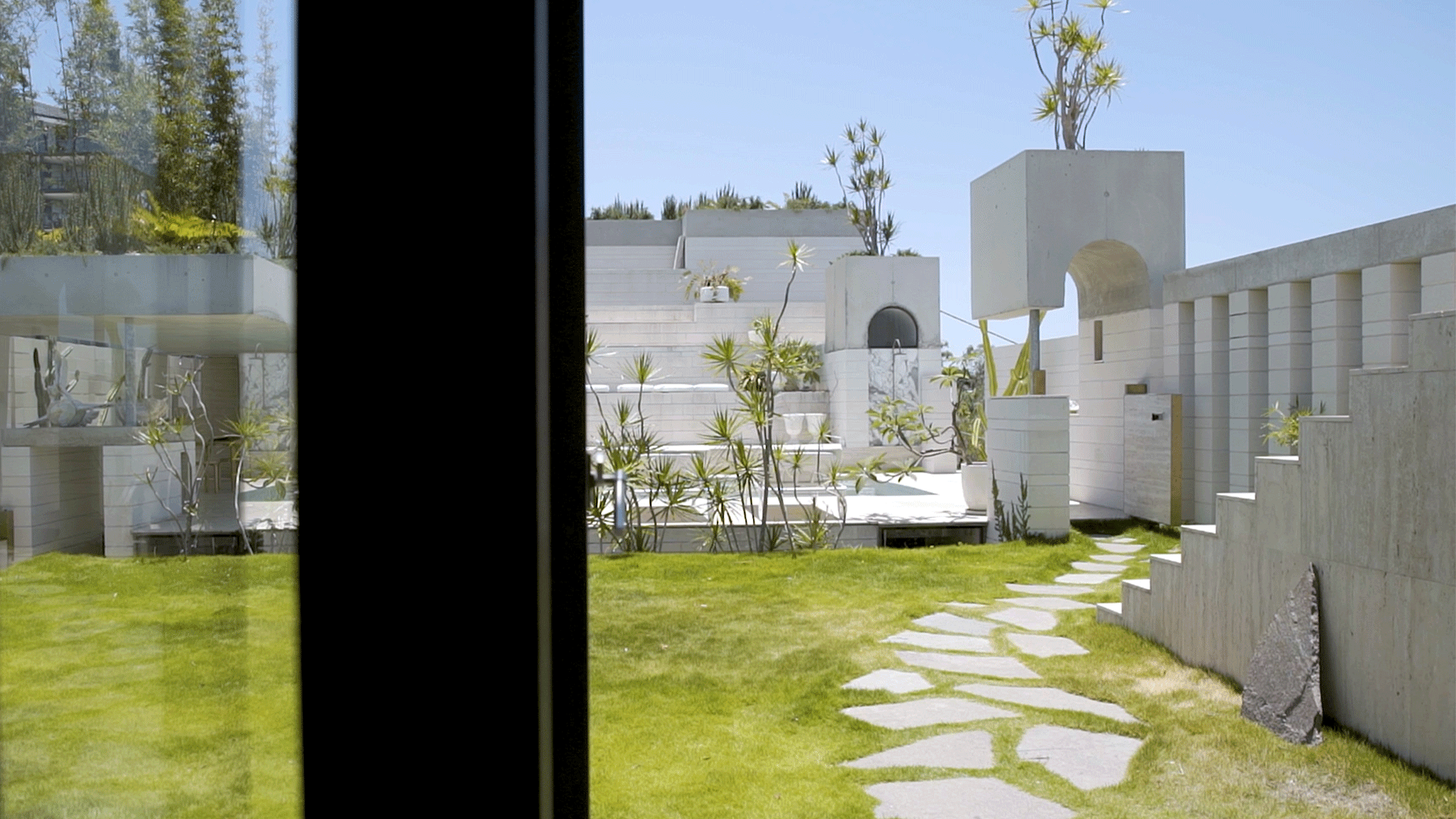
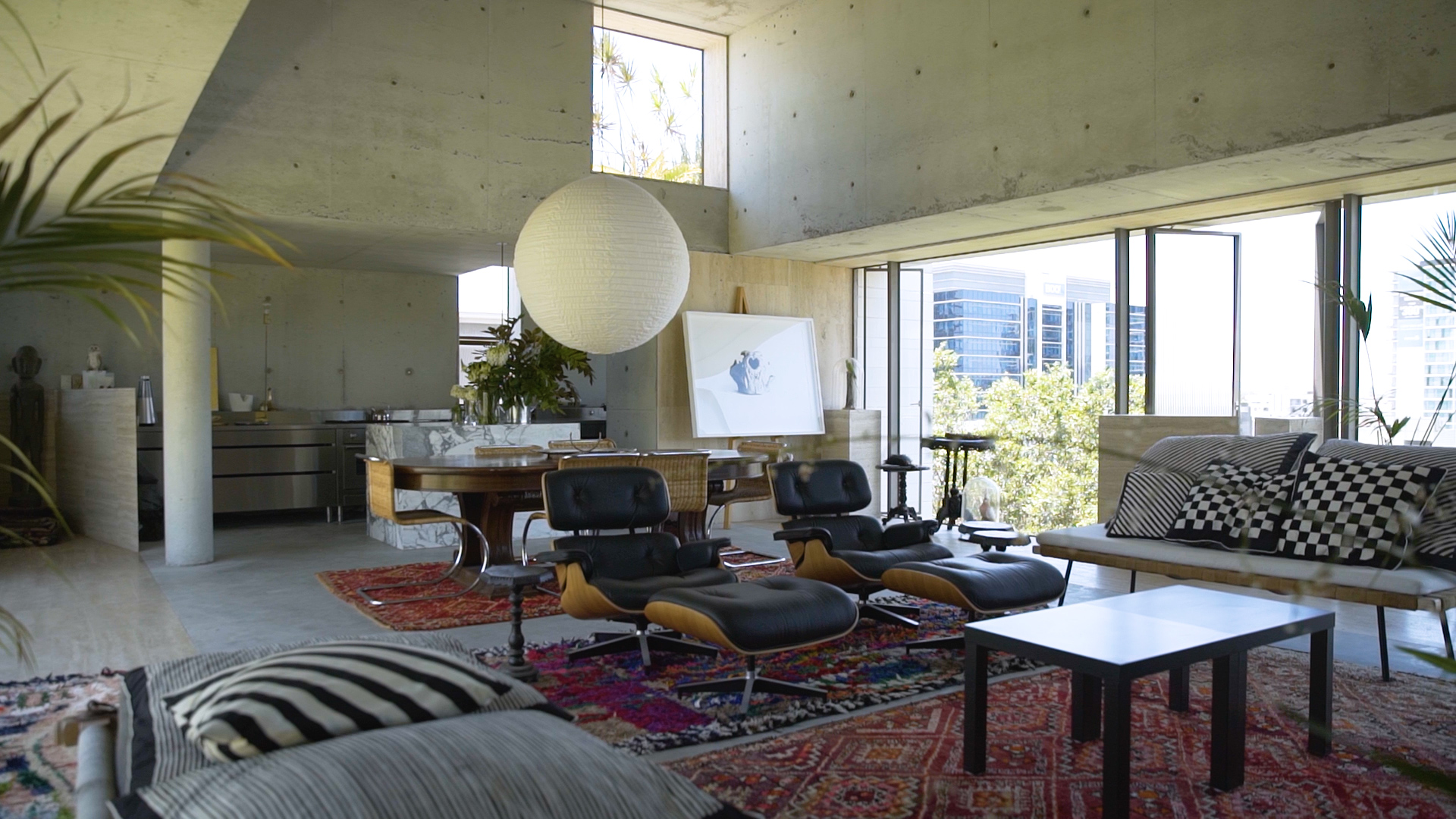
Perched high on a cliffside plot in Bowen Hills, a suburb just north of Brisbane’s CBD, La Scala is the private residence of Ingrid Richards and Adrian Spence of Richards and Spence. Drawing upon four years of collected ideas, the architects desired to create a house where the outside space acted solidly as its centrepiece. The resulting dwelling – a section of which was resolved by Ingrid with a sketch on a napkin while on holidays – evokes snapshots of the Mediterranean and Central and South America. Its bare masonry standing out under Queensland’s famed blue skies.
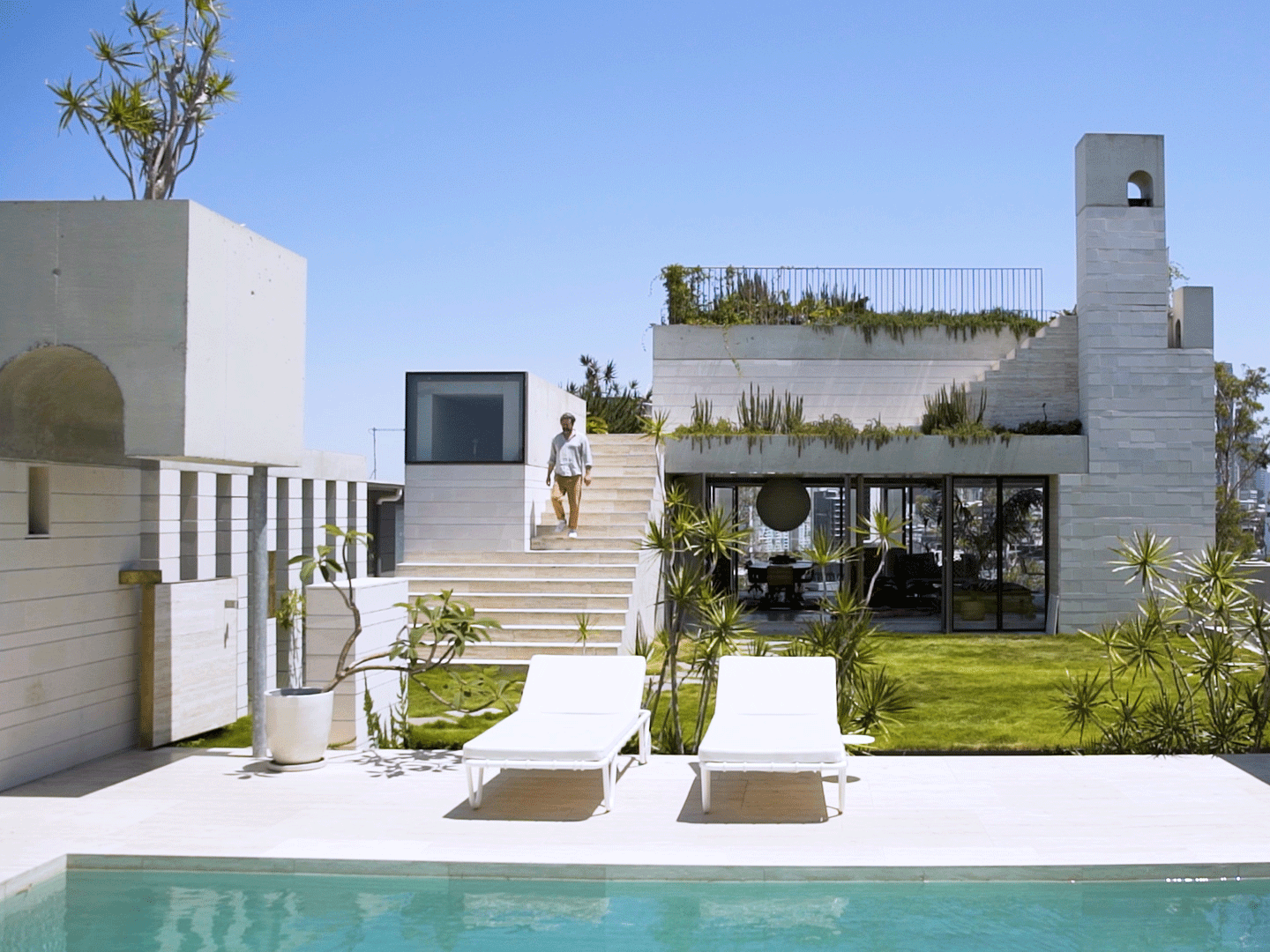
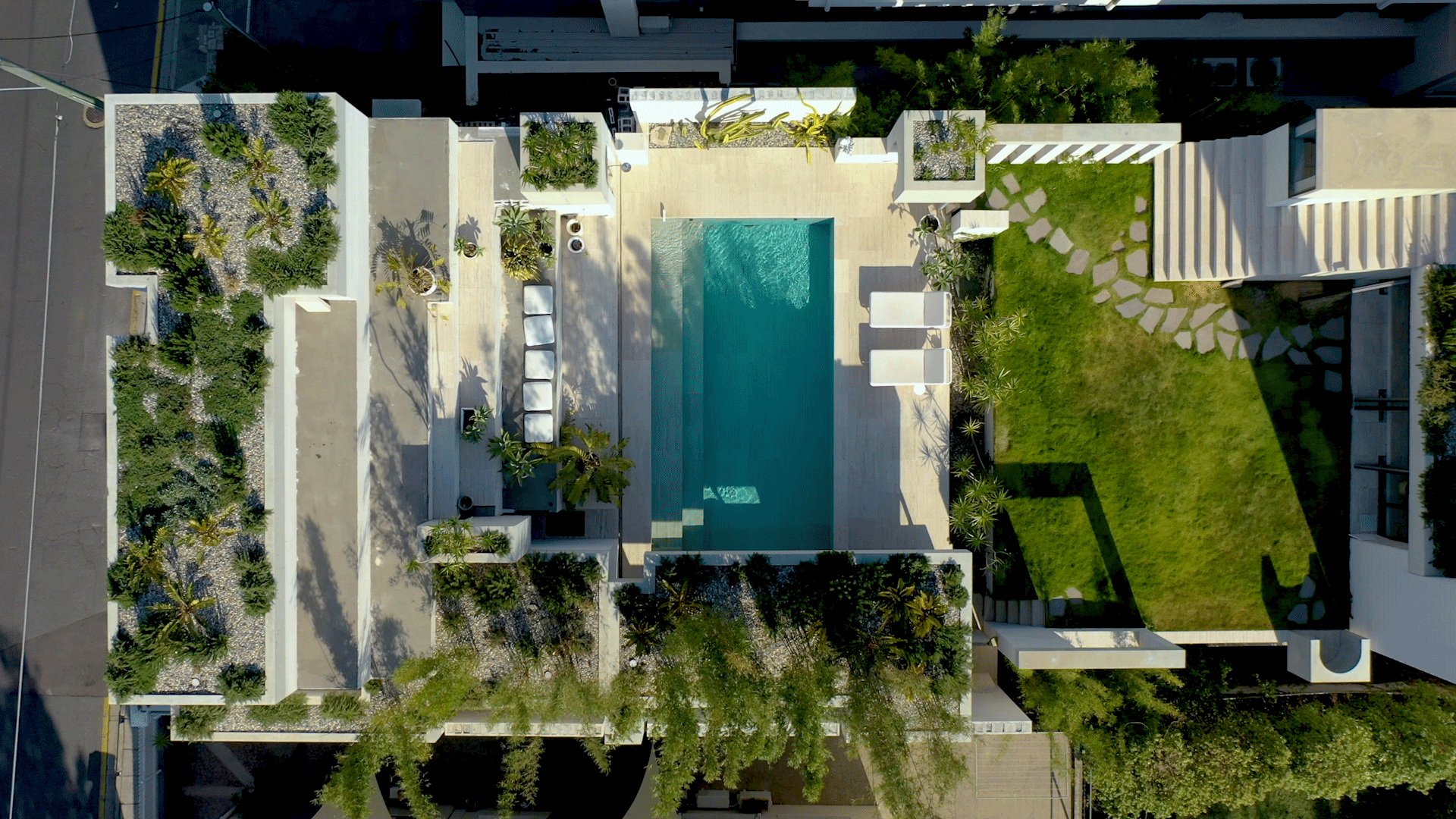
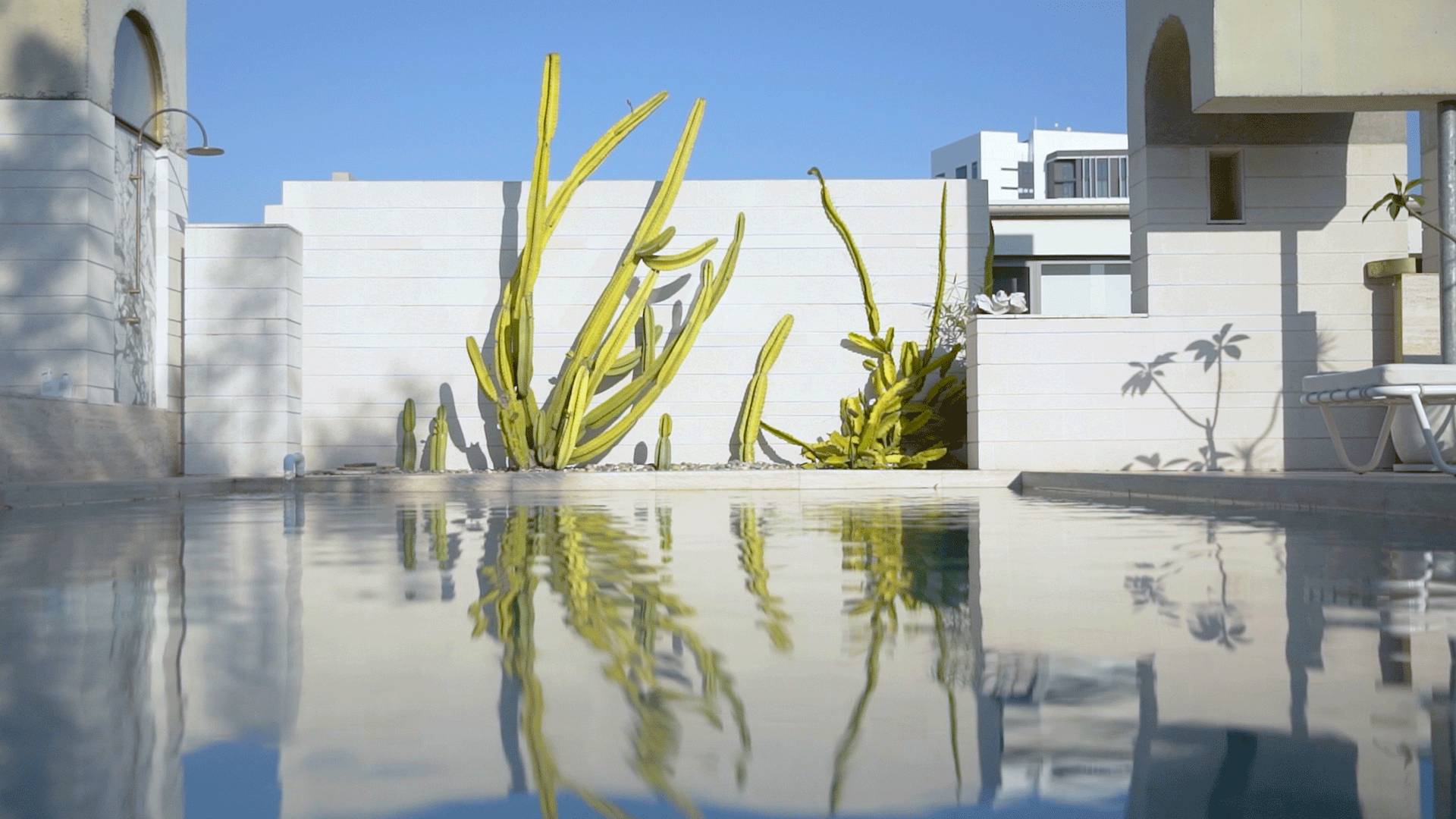
Bookended by two distinct sections of the house, the outdoor oasis reads as a multi-level amphitheatre-like arrangement of full- and half-height concrete masonry blocks, laid in horizontal gestures. Gently tiered terraces contain tufted grass and rambling foliage, while glistening reflections off the enticing pool dance across the garden walls. Few homes have an outdoor swimming pool at the heart and, of those few, it’s unlikely any match the glimmering beauty of La Scala.
The home represents a defiant inversion of the norm. “Our town planning regulations are very prescriptive in the way that they assume you are going to put a house in the middle of the block and have a yard around it – and we wanted to do the opposite,” says Adrian. Placing emphasis on the outdoors and specifying raw, light concrete blocks for the construction were appropriate choices in a city that basks in seemingly endless sunshine. The bold material choice also marks a continuing theme for the architecture practice who has employed near-whitewashed concrete blocks in other designs, including the Calile Hotel, with both aesthetics and sustainability in mind.
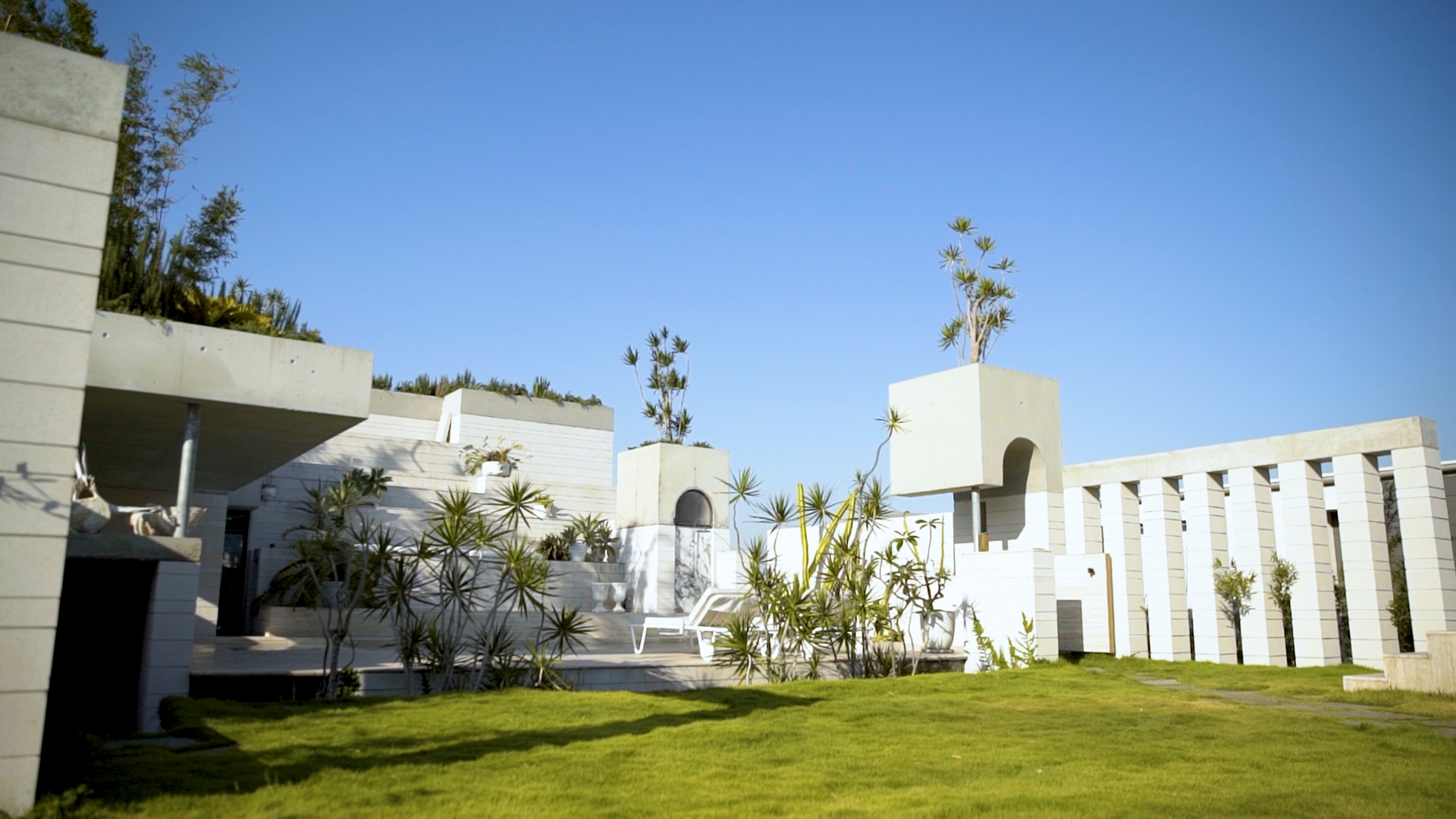
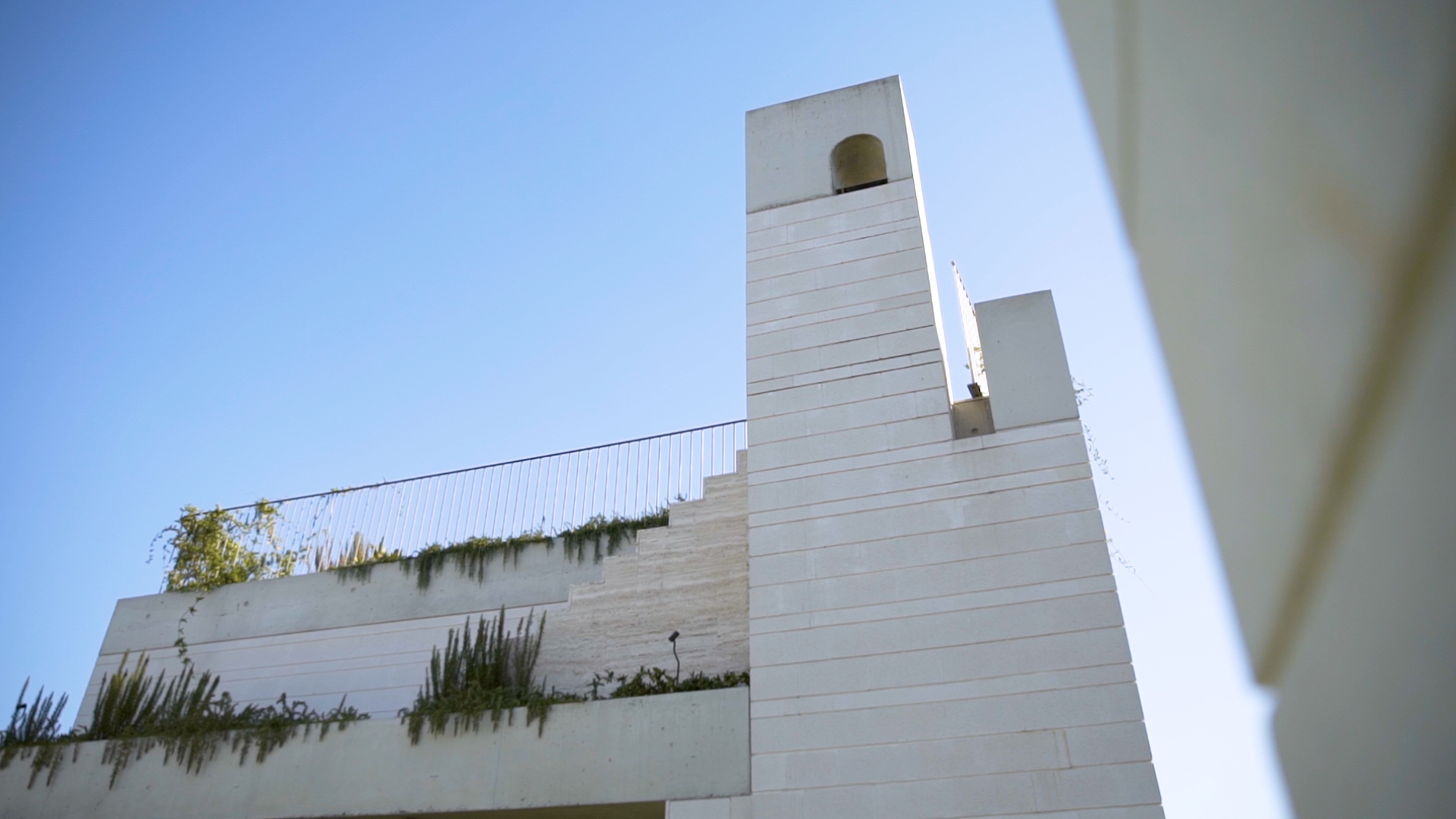
“For our work in Brisbane, we’ve tended to use a light-coloured masonry,” says Adrian. “I think that’s because we feel it’s appropriate for the hot-weather city we’re in.” Longevity has also played a part in the home’s design, with Richards and Spence giving consideration to the life cycle of the building beyond their own residence, and, according to Ingrid, tapping into “the kind of sustainability that’s about not having to keep rebuilding the same thing over and over again”.
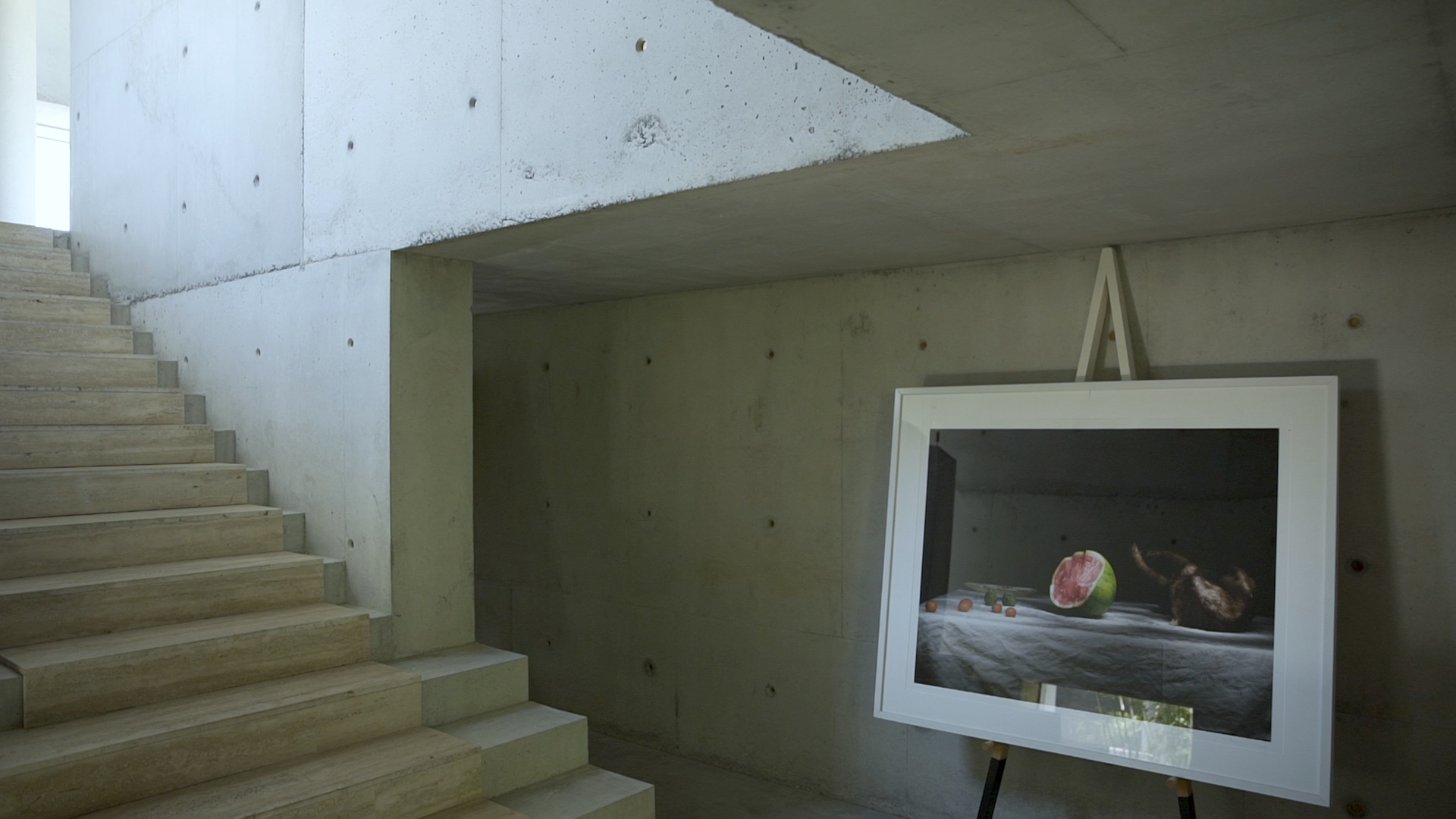
“We thought this building in another 10 years could become a gallery or a restaurant or have some other use beyond purely domestic,” says Adrian. “We try to make things that are flexible so they can endure different types of occupation.” While Adrian describes the masonry as looking “almost like a ruin in the way it’s kind of naked … in its detailing”, the house has a glamorous, sun-kissed vibe that’s undoubtedly ideal for entertaining.
For now, Richards and Spence can do just that, making particular use of the monumental outdoor space – whether for parties or in private. “There’s a point where, if you’re lying in the pool facing the building, you get a silhouette of the sky and it feels really wonderful,” says Ingrid. “It feels like you’re alone even though we’re quite close to the centre of the city.”
We thought this building in another 10 years could become a gallery or a restaurant or have some other use beyond purely domestic.