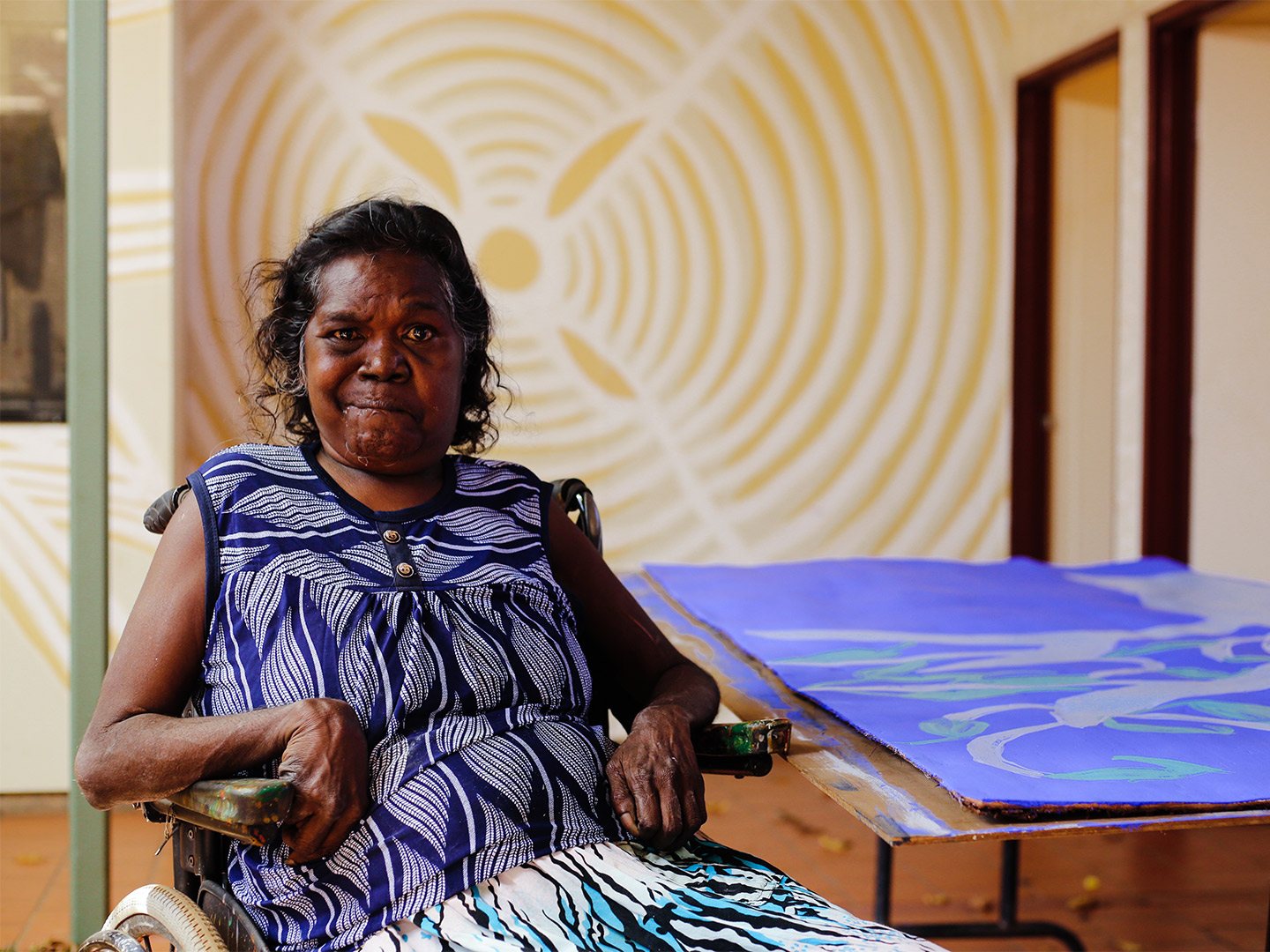
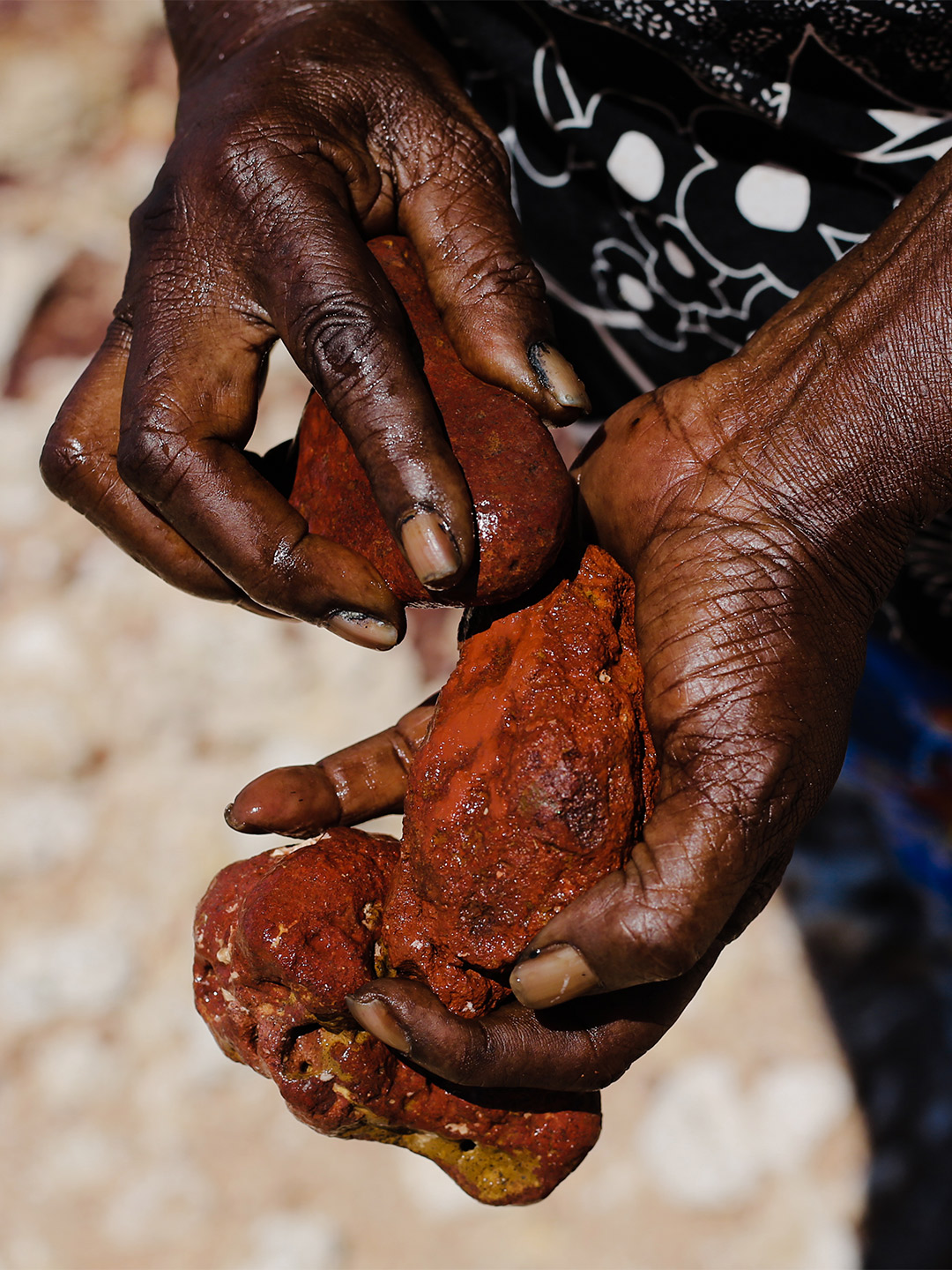
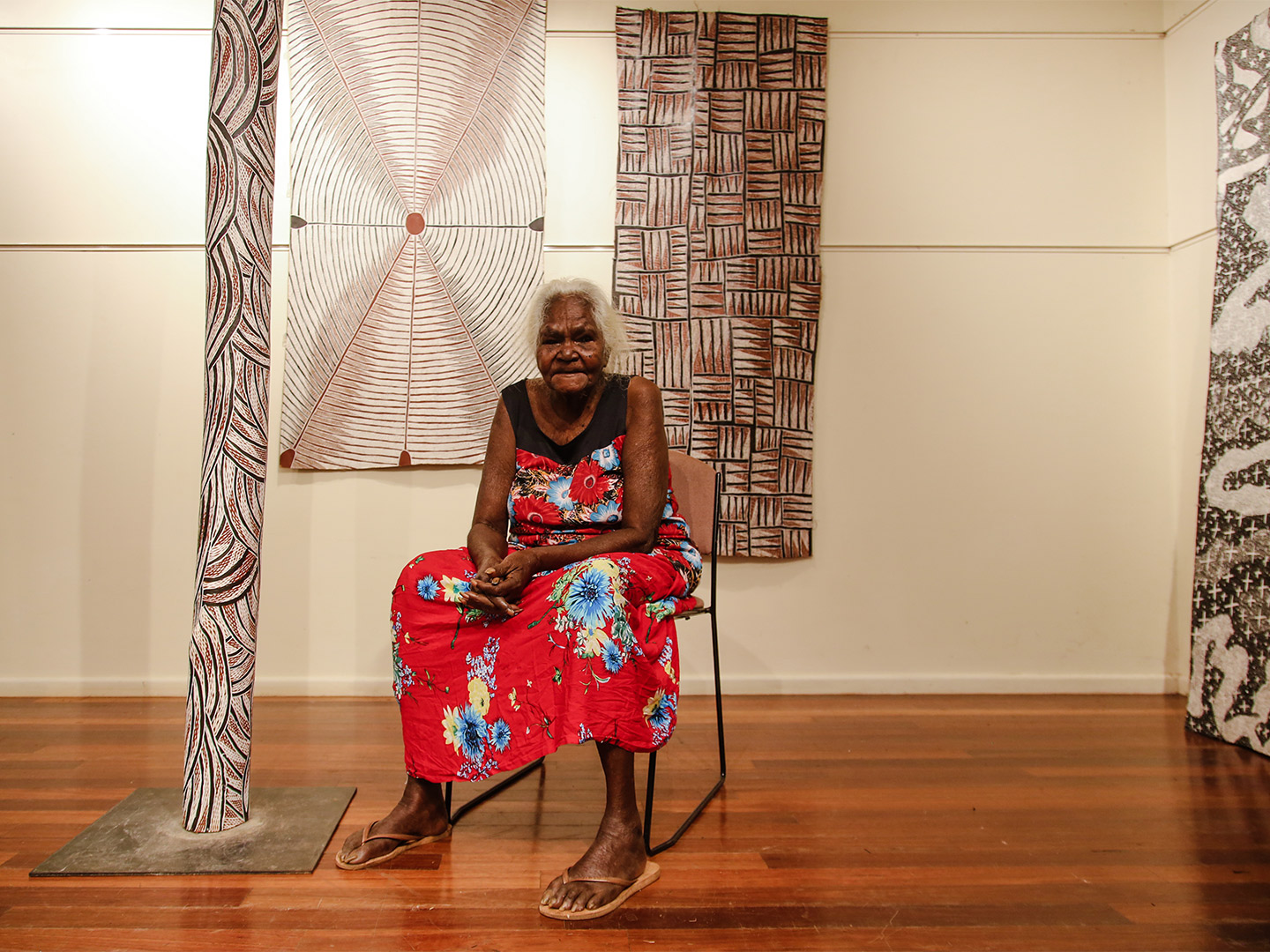
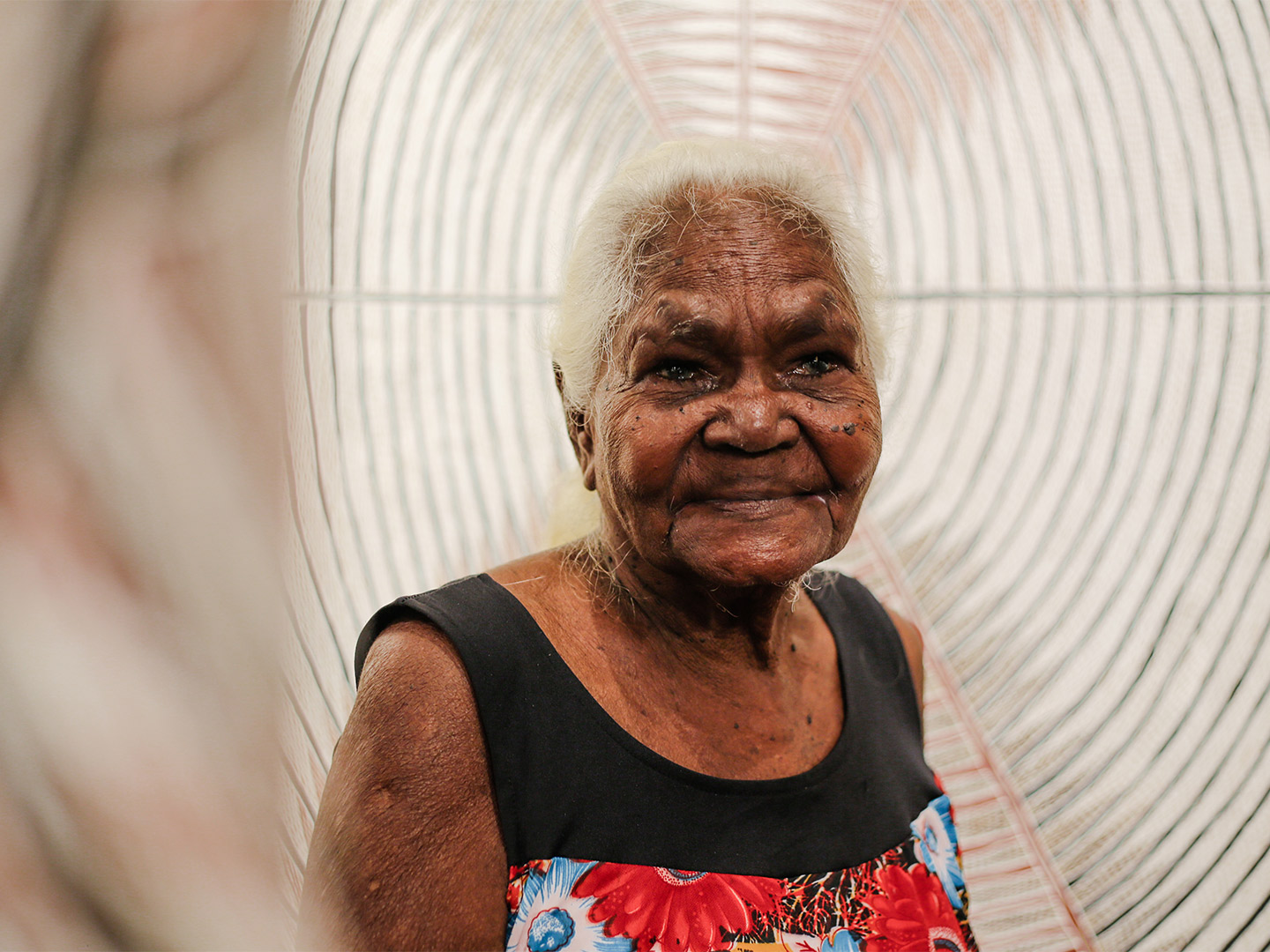
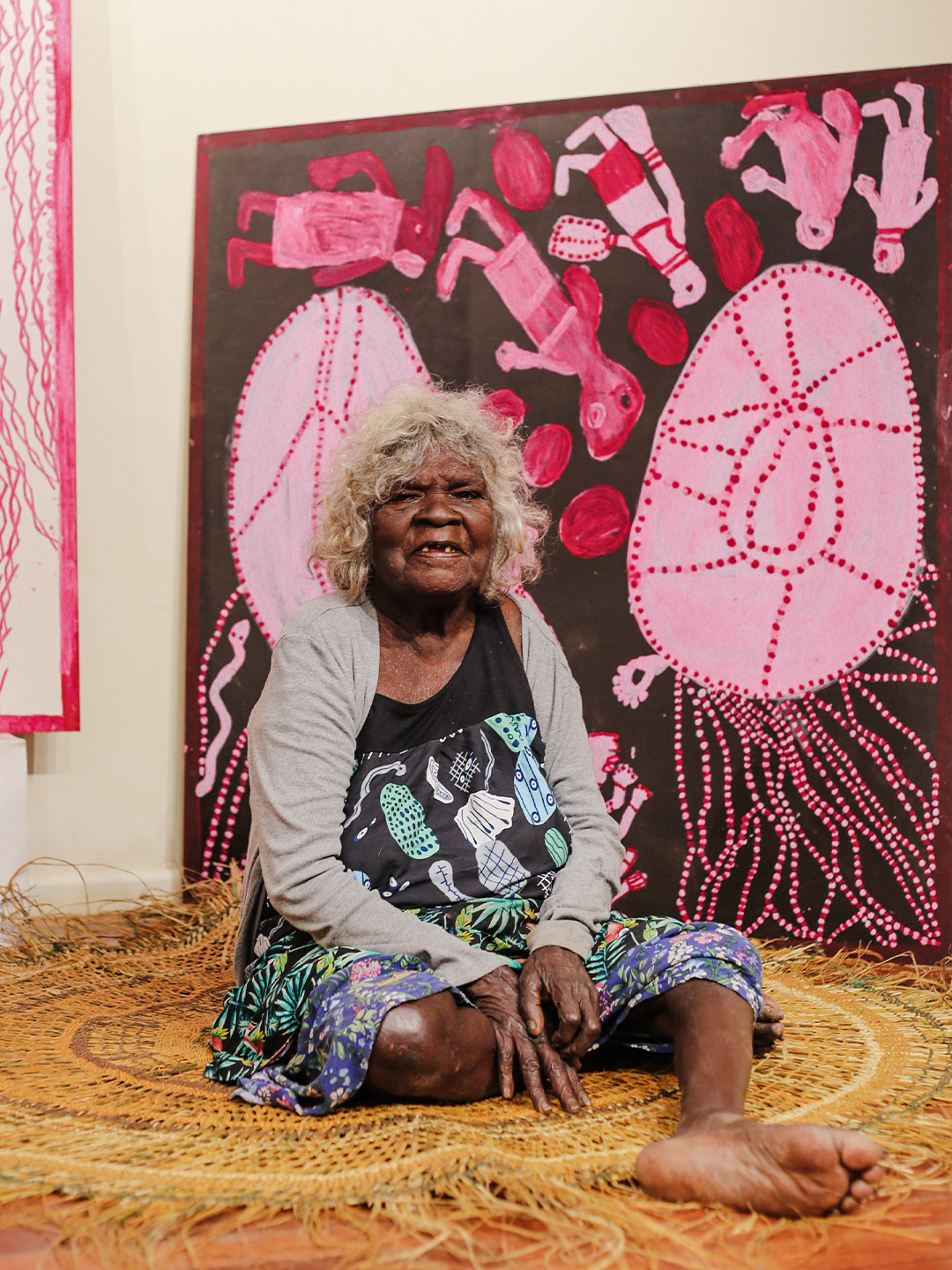
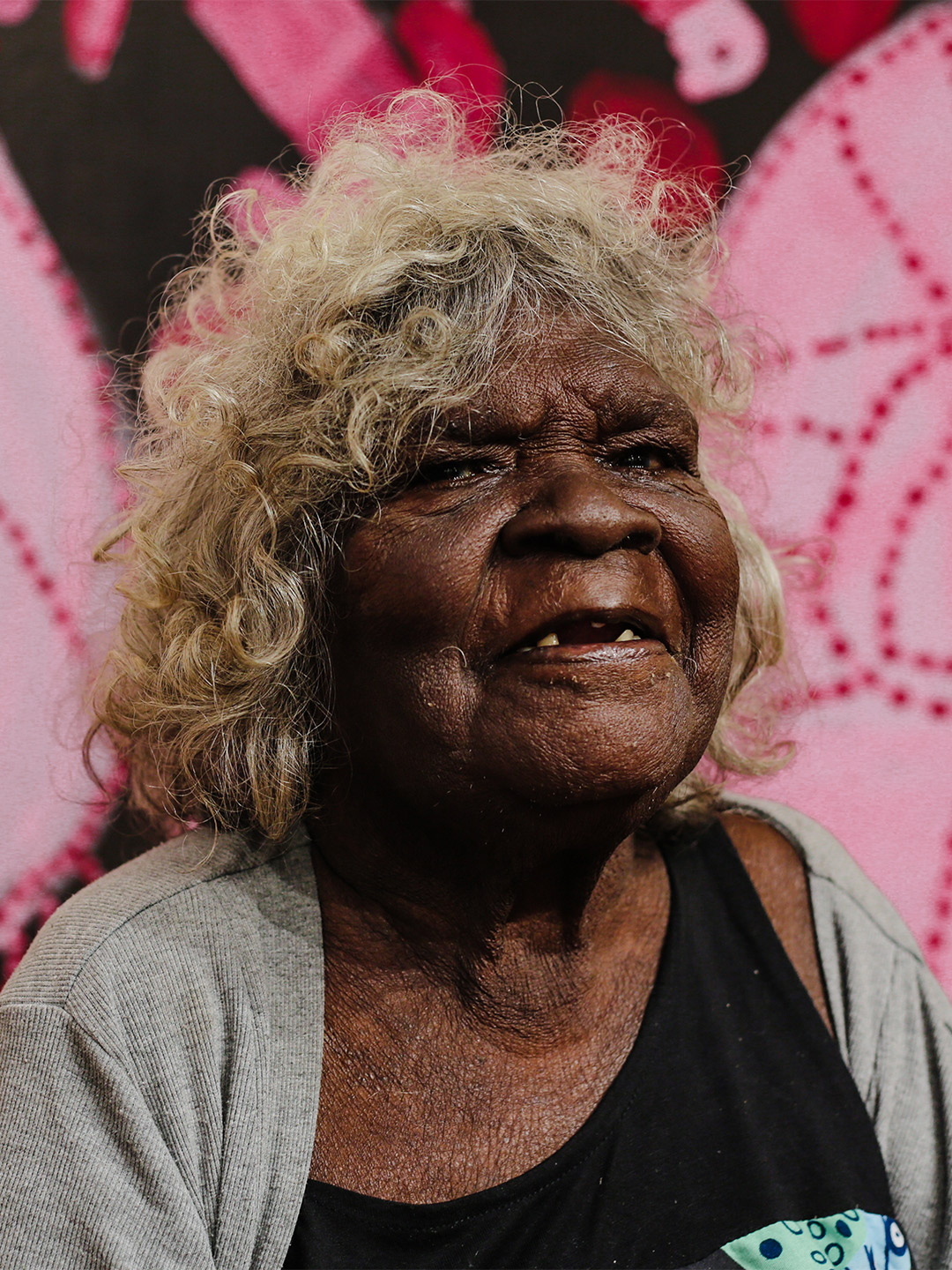
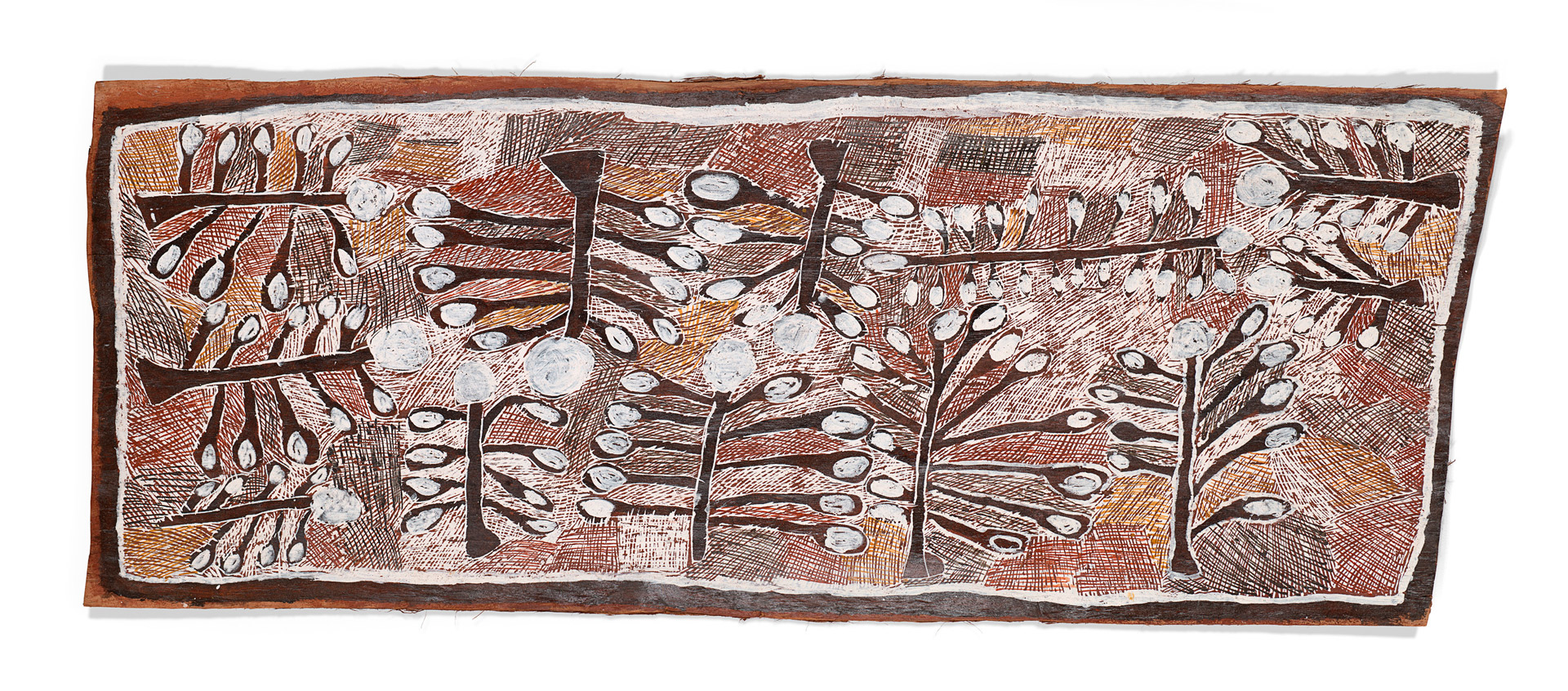
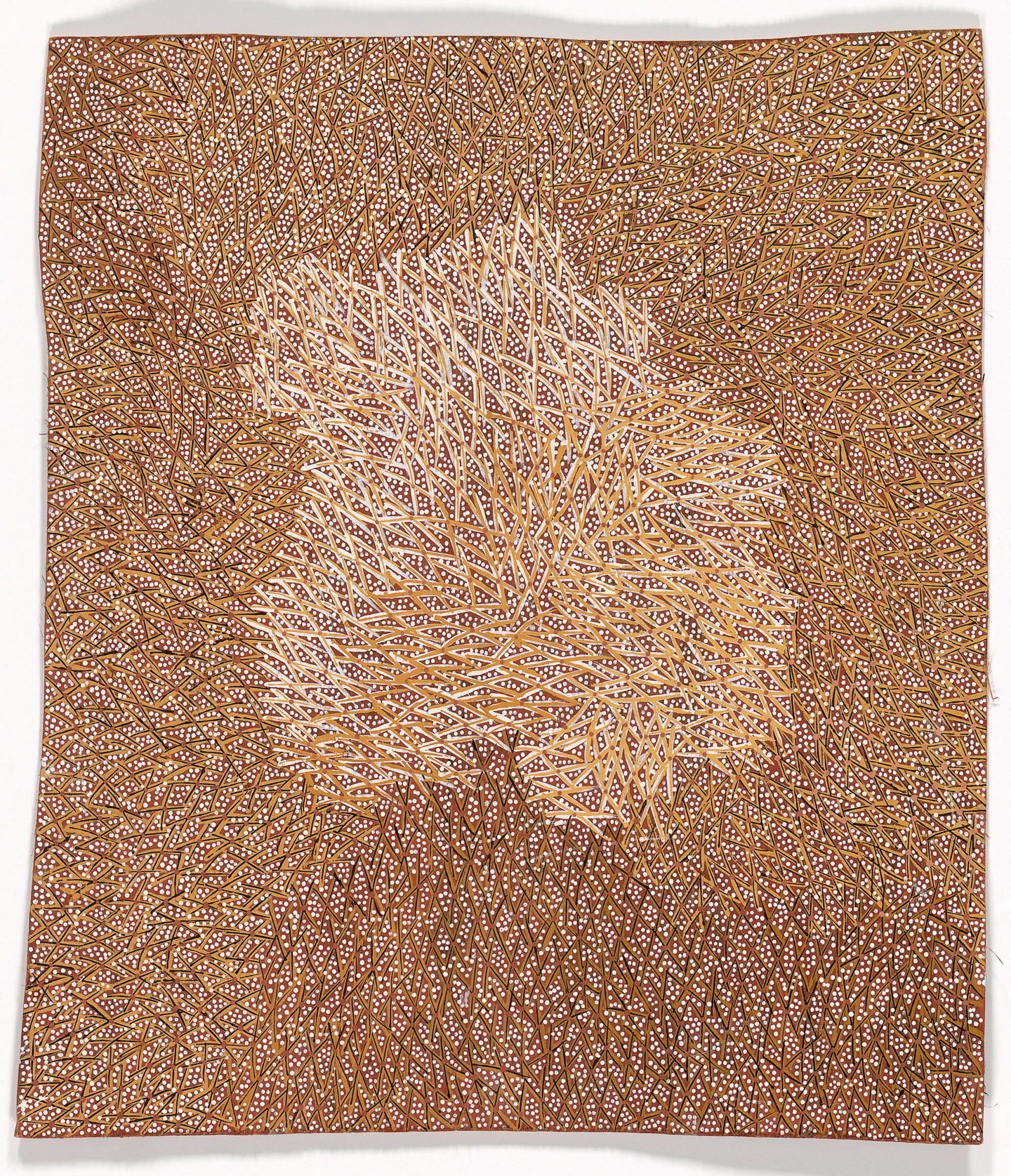
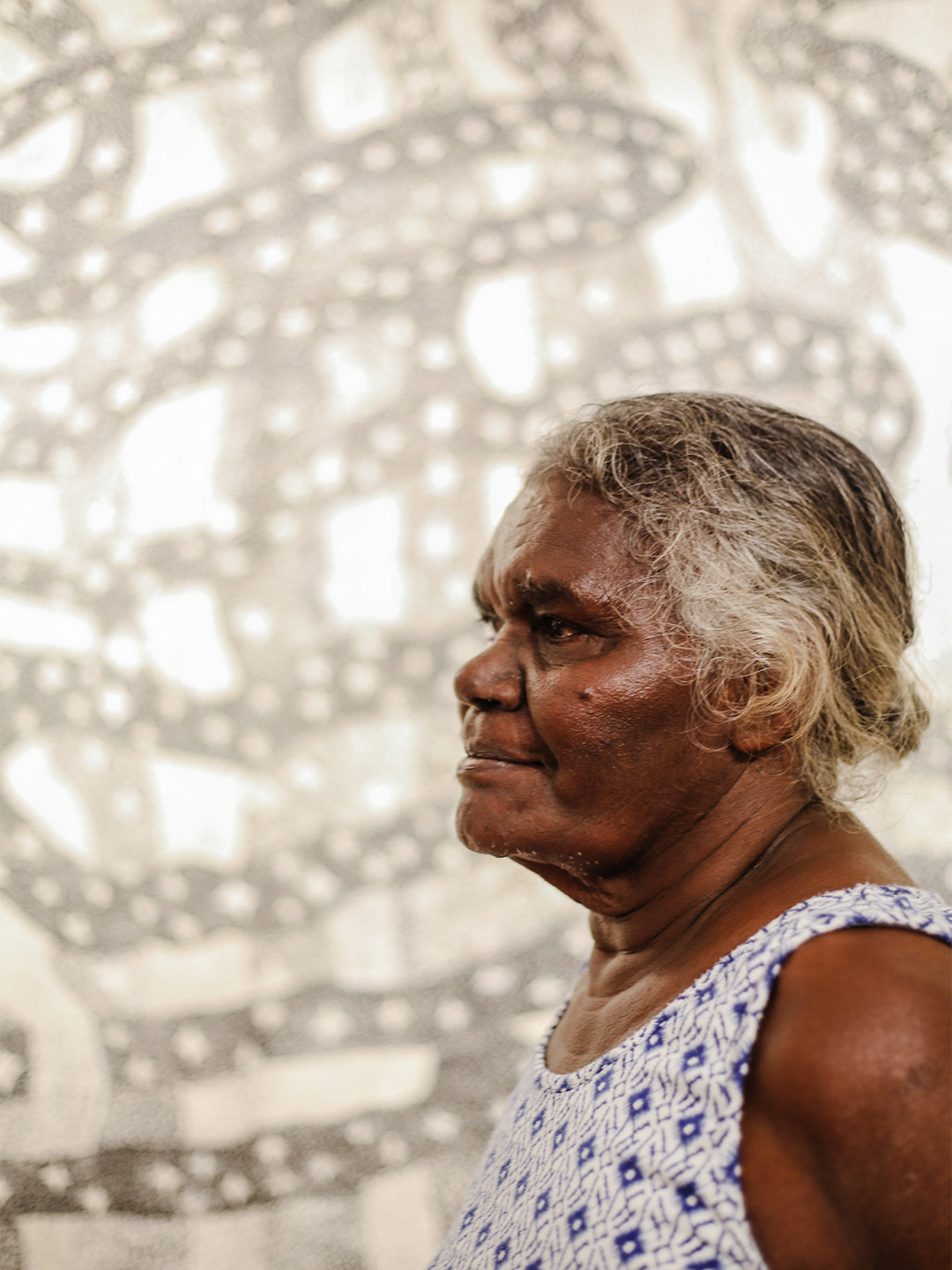
Prior to 1970, the Yolŋu women of north-east Arnhem Land would never have painted sacred themes on bark or larrakitj (the name given to hollow timber poles). Certainly not in their own right. However, in recent decades, a number of female artists have taken to these media, becoming renowned both nationally and internationally for daring and inventive works that challenge ancient tradition. The National Gallery of Victoria in Melbourne has been acquiring a selection of these works for more than two decades. Particularly those by female artists from the Yolŋu-run art centre, Buku-Larrngay Mulka, known simply as Buku. The NGV now holds one of the most significant collections of work by Yolŋu women, and ‘Bark Ladies: Eleven Artists from Yirrkala’ is the exhibition that will present these important pieces to the public this December.
Buku is located in a small Aboriginal community called Yirrkala, the place referenced in the exhibition’s title, which is approximately 700 kilometres east of Darwin, the capital of Northern Territory in Australia. According to the staff at Buku, local Yolŋu Law dictates that ‘land’ extends to include the sea. They suggest that both dry land and sea are connected in a single cycle of life, which the Yolŋu people celebrate through their songs, sacred designs and art-making practices. “Both Yolŋu men and women are known for channelling this unique world view into innovative works of art,” the Buku team explain.
‘Bark Ladies’: An exhibition of work by the Yolŋu women of Arnhem Land to open at NGV
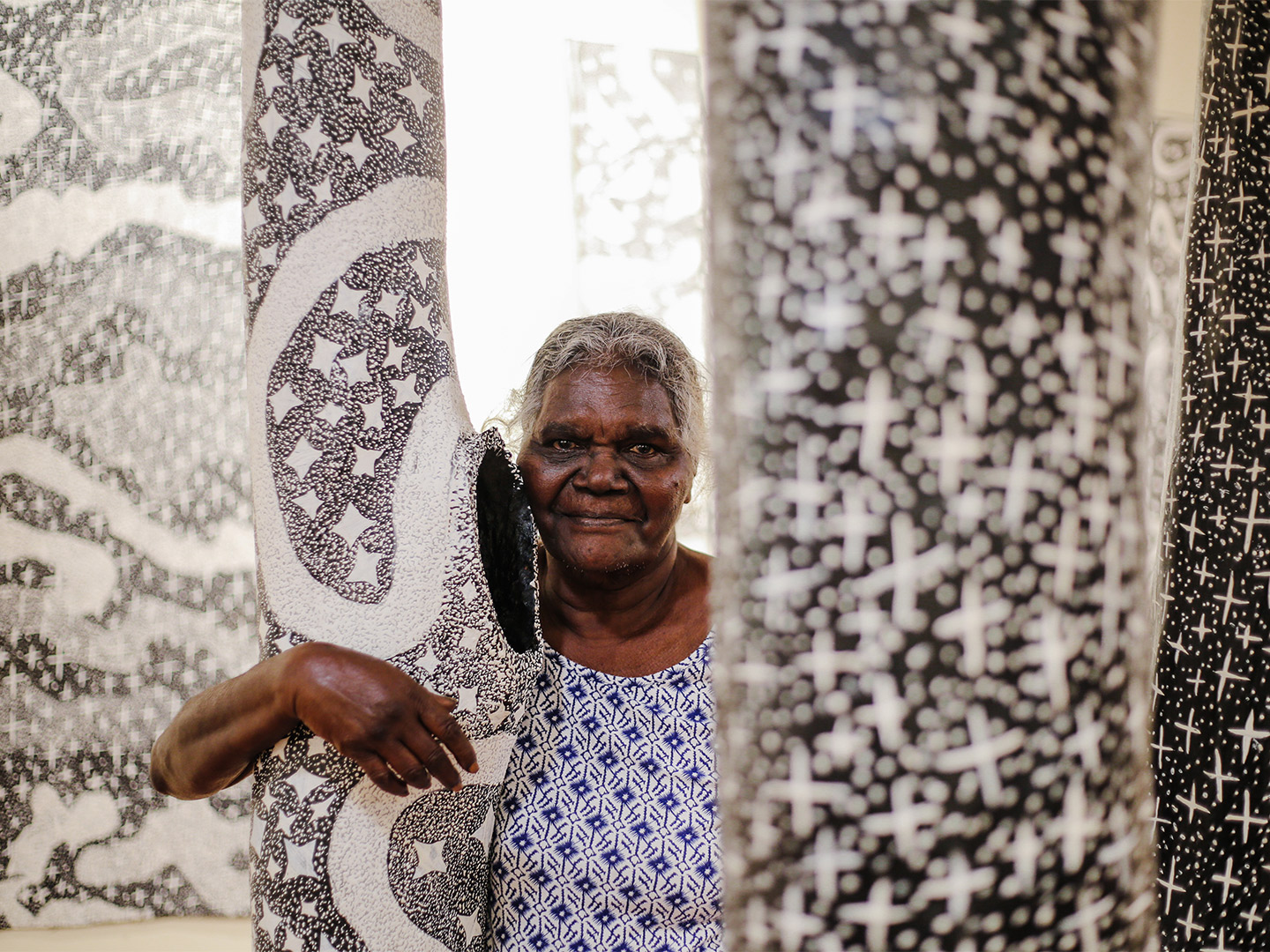
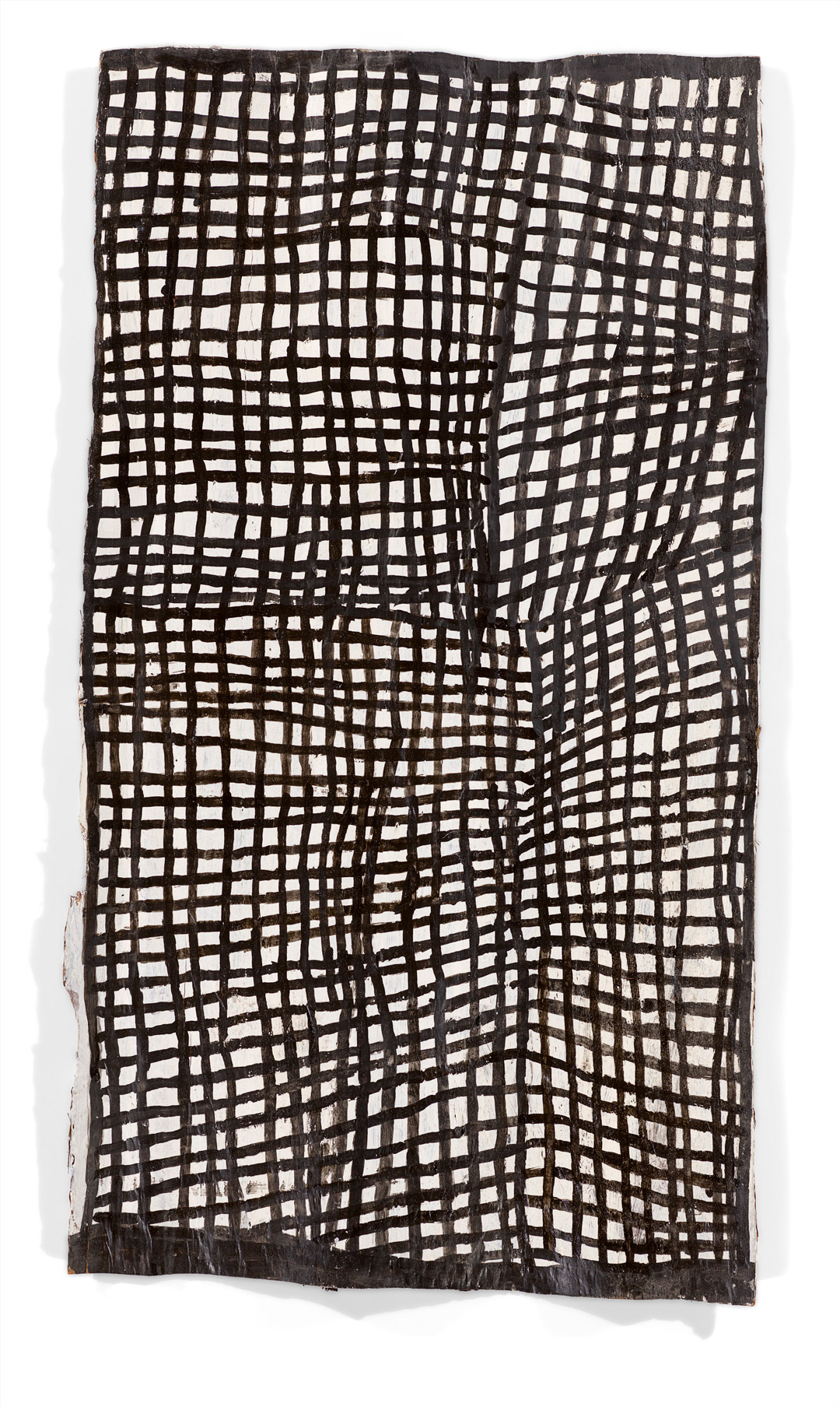
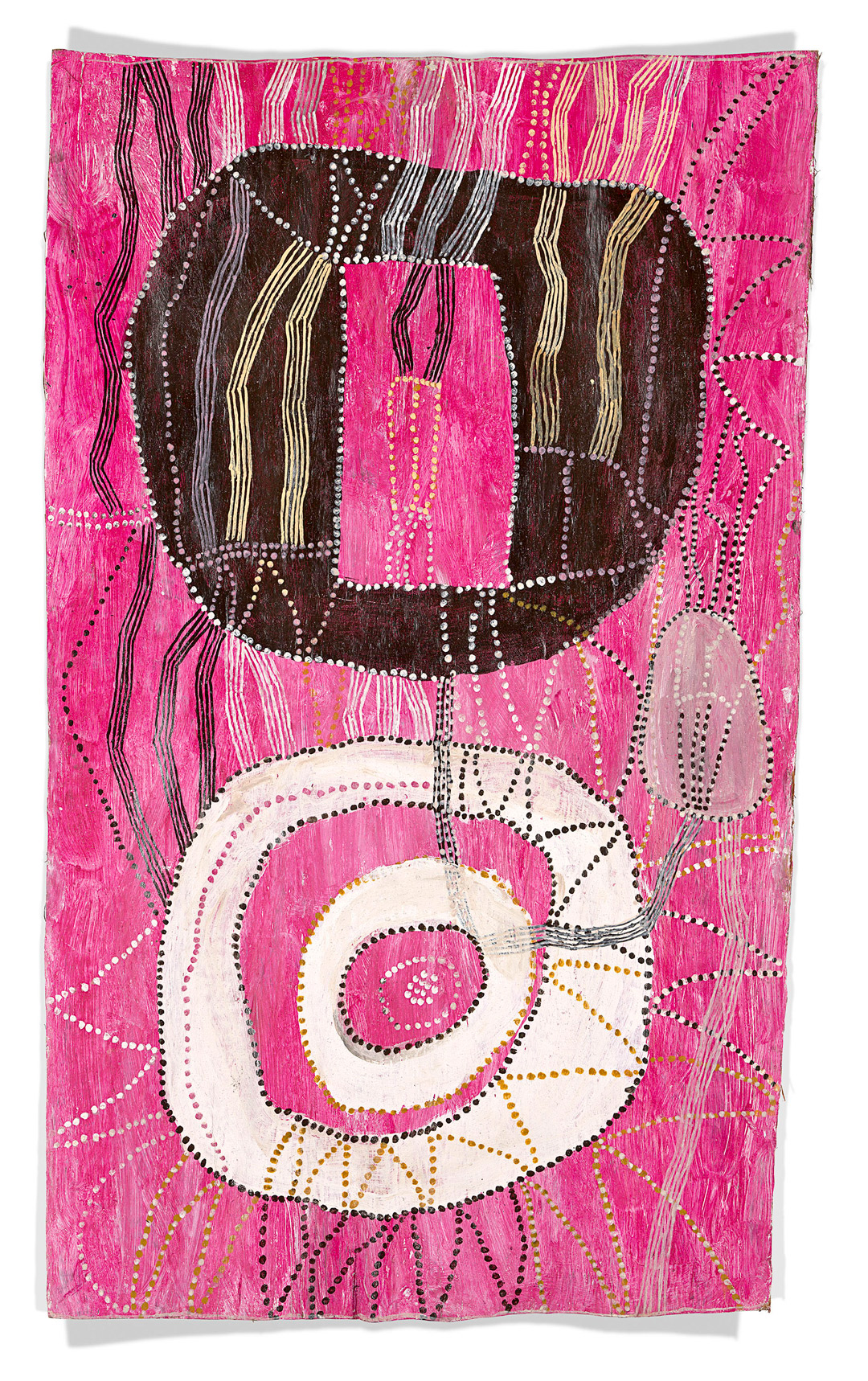
The ‘Bark Ladies’ exhibition begins with the significant bodies of work by the sisters Nancy Gaymala, Gulumbu, Barrupu, Ms N Yunupiŋu and Eunice Djerrkŋu Yunupiŋu. In this first space, audiences will encounter stories about Yolŋu conceptions of the universe, fire, and creation, as well as bold contemporary paintings that explore rhythm, tonality and gesture. In the second gallery space, visitors will experience other significant works by artists from the community. Among these are optical illusions by Dhuwarrwarr Marika; waterlilies by Malaluba Gumana; monochromatic stars by Naminapu Maymuru-White; bold visions in pink and blue by Noŋgirrŋa Marawili and Dhambit Munuŋgurr; as well as the last produced paintings by the late master-painter Ms Wirrpanda.
A highlight from the exhibition is a newly commissioned large-scale, floor-based work by Naminapu Maymuru-White depicting Milŋiyawuy, also known as the Milky Way or River of Stars. Maymuru-White’s work extends across the entire floor of Federation Court and has been developed in collaboration with the NGV. This work is complemented by a multimedia cinema on the mezzanine floor, where audiences can sit and listen to the artist recounting her story of the work, a deeply moving story that is connected to the mortuary rites of the Manggalili clan whose deceased souls are turned into stars.
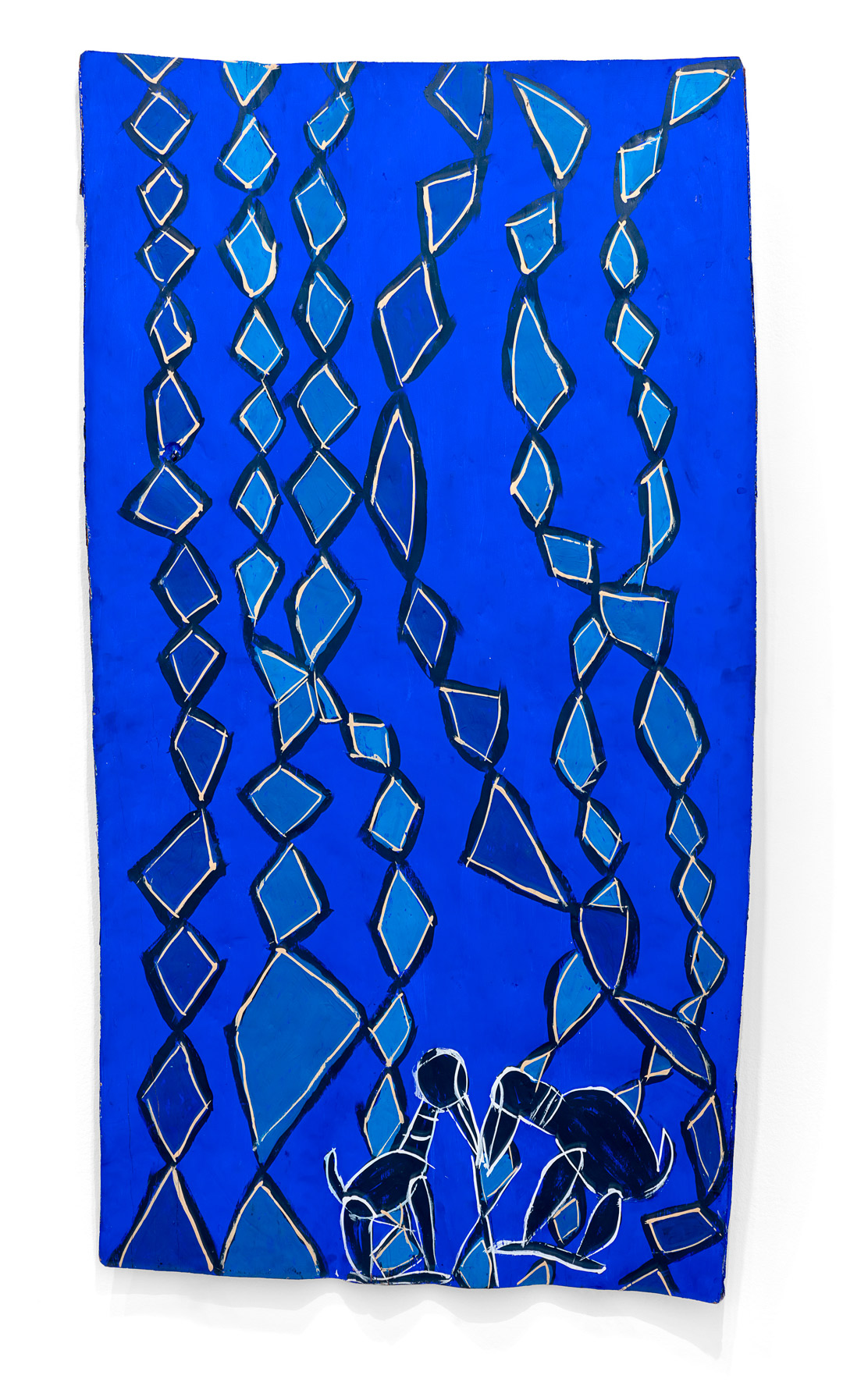
Three recently acquired bark paintings by Eunice Djerrkŋu Yunupiŋu titled I am a Mermaid, New Generation and My Wedding will also be on display. These vivid and technicolour paintings tell the story of the artist’s conception. The paintings illustrate how Yunupiŋu’s unborn spirit visited her father in the form of a mermaid, and how her father tried to spear the mermaid, believing the spirit to be fish. He then fell asleep and upon waking, Yunupiŋu’s mother confirmed with her husband that she was with child, thus bringing their daughter into the world.
A further highlight is Dhuwarrwarr Marika’s Birth of a Nation, which was recently included as a finalist in the 2020 National Aboriginal and Torres Strait Islander Art Awards. The designs in Marika’s work contain within them the identity of the coastal place known as Yalangbara. Yalangbara is the fabled landing site of the Djang’kawu Sisters, the major creator beings who arrived there from their mythical island Burralku.
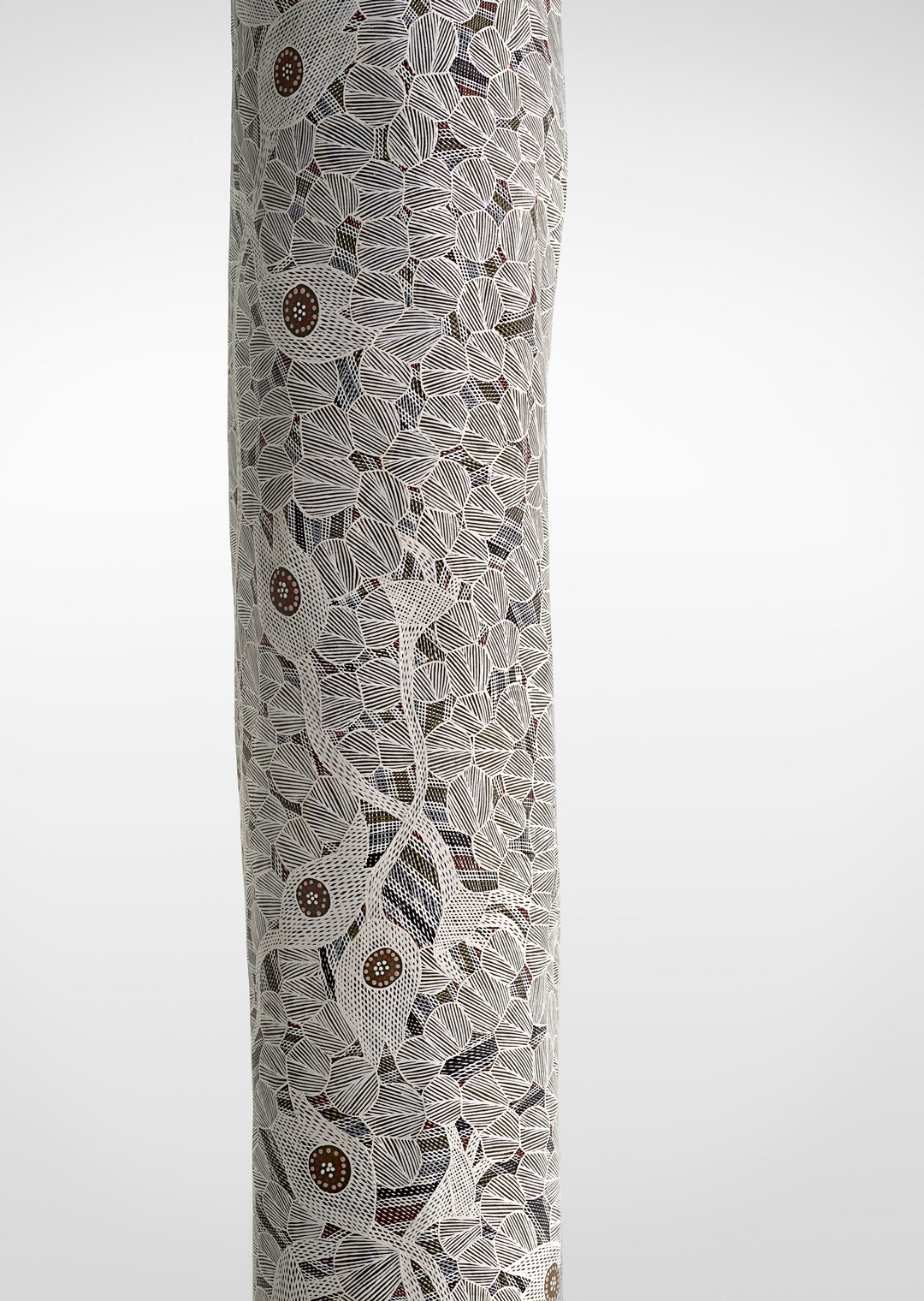
Also on display is a collection of larrakitj, including nine recently acquired ‘pink poles’, painted by Noŋgirrŋa Marawili. Each of Marawili’s works have been rendered in an arresting array of pink tones produced by mixing recycled printer cartridges with earth pigments and ochre. Signalling a daring departure in both technique and colour, Marawili’s distinctive larrakitj feature the sacred cross-hatched design for the freshwaters of the Djapu clan, whose ancestors hunted using woven fish traps. Marawili’s works are to be presented among a selection of larrakitj within a mirrored room, creating the illusion of an infinite grid. Larrakitj were traditionally used by Yolŋu people as a type of coffin or bone container placed following a ceremony as a memorial to a deceased person after death.
‘Bark Ladies: Eleven Artists from Yirrkala’ is presented by the National Gallery of Victoria (NGV) in collaboration with Buku Larrngay Mulka Centre and is on display from 17 December 2021 to 25 April 2022 at NGV International, 180 St Kilda Road, Melbourne. Entry is free.
While the charms of the old red-brick building have established it as a landmark in the streets of Pascoe Vale, the school has also developed strong connections with the community.
Catch up on more architecture, art and design highlights. Plus, subscribe to receive the Daily Architecture News e-letter direct to your inbox.
Related stories
- Venus Power collection of rugs by Patricia Urquiola for cc-tapis.
- Bitossi celebrates centenary in Florence with new museum and 7000-piece display.
- Casa R+1 residence in southern Spain by Puntofilipino.
Located at Museumpark in the centre of Rotterdam, an hour’s drive south-west of Amsterdam, Depot Boijmans Van Beuningen is the first art facility of its kind, offering a no-holds-barred approach to the city’s 151,000-piece collection. “The assignment was to offer a glimpse behind the scenes of the museum world and make the whole art collection accessible to the public,” say the team from MVRDV, the Dutch architecture firm tasked with bringing the project to life. They fulfilled the brief by creating a series of unconventional exhibition halls, joined by an enormous amount of open storage space for art and design, all tucked within a reflective, rounded volume that responds to its urban parkland surroundings.
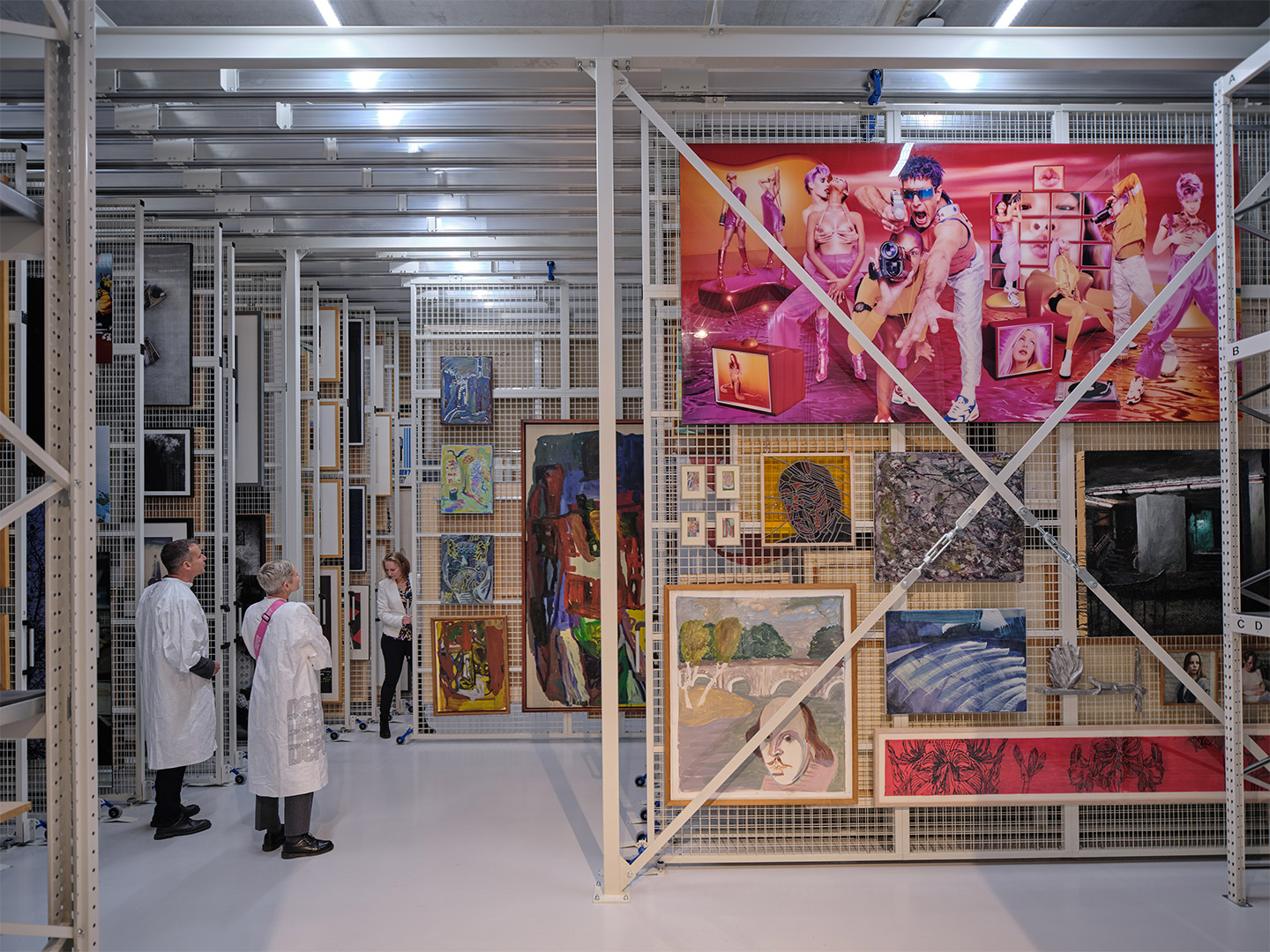
Breaking away from a tradition of concealment, the design of the Depot shines a light on “previously invisible” artefacts by unlocking its storage vaults for public access. “Currently many international museums can only showcase six to seven percent of their collections in exhibitions,” the MVRDV team explain. “The remaining 94 percent is [usually] hidden in storage,” they add. Visitors to the Depot can expect to immerse themselves in the complete backstage theatrics of the facility, and experience first-hand what maintaining and caring for an invaluable art collection actually entails, either by themselves or with a guide. “They can also observe conservation and restoration processes, packaging, and [the] transportation of works of art,” the MVRDV team say.
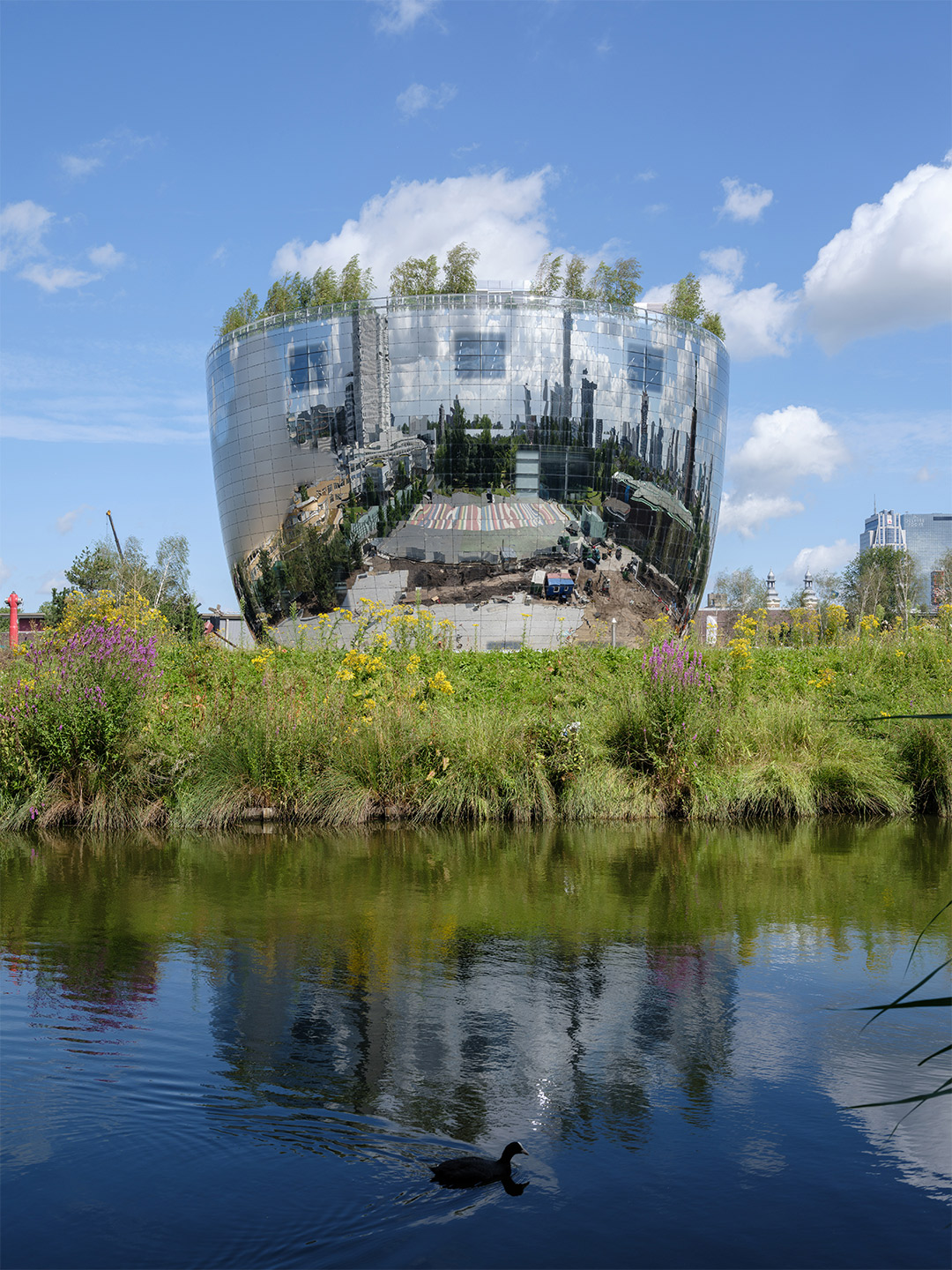
Depot Boijmans Van Beuningen in Rotterdam by MVRDV
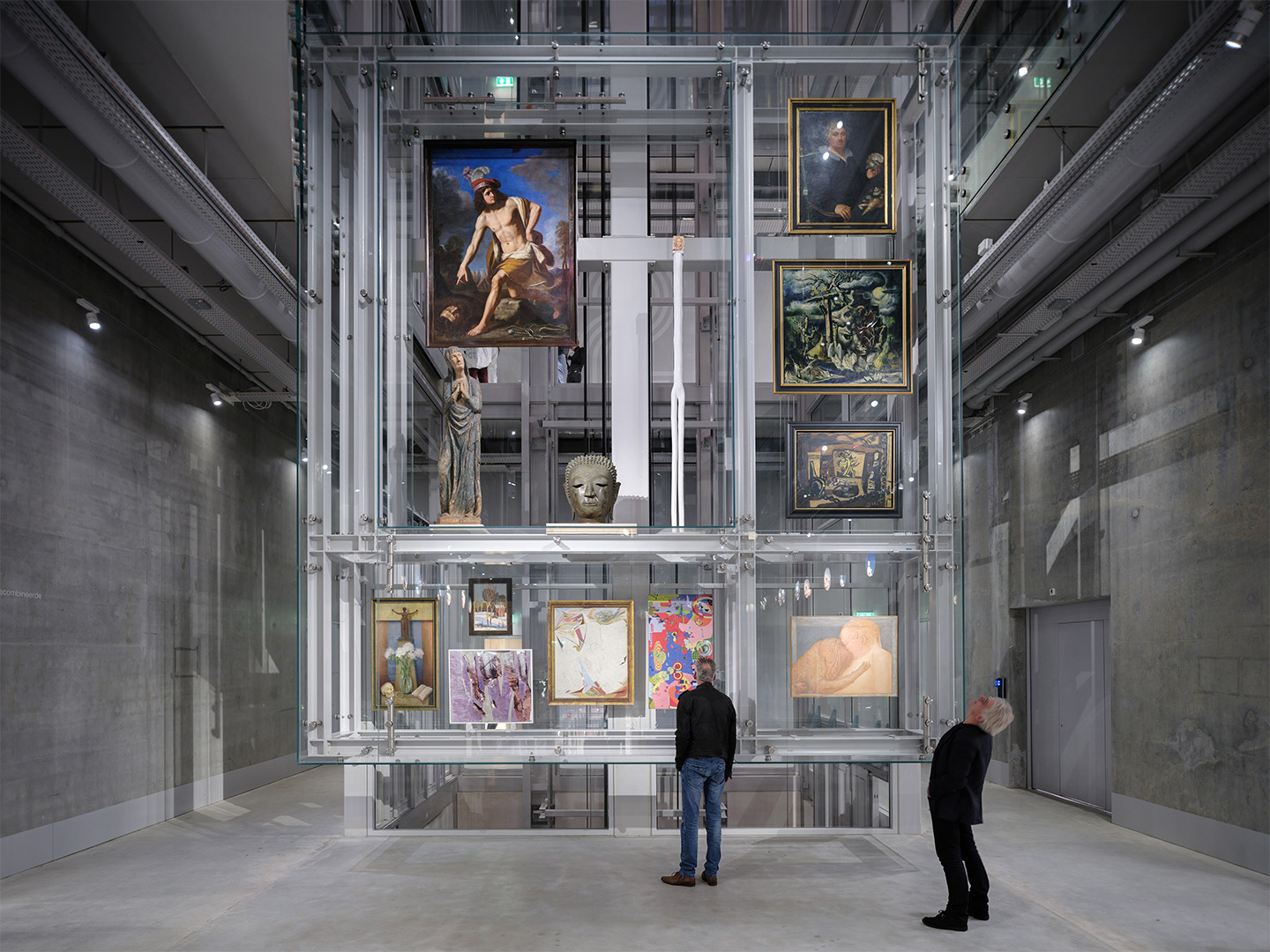
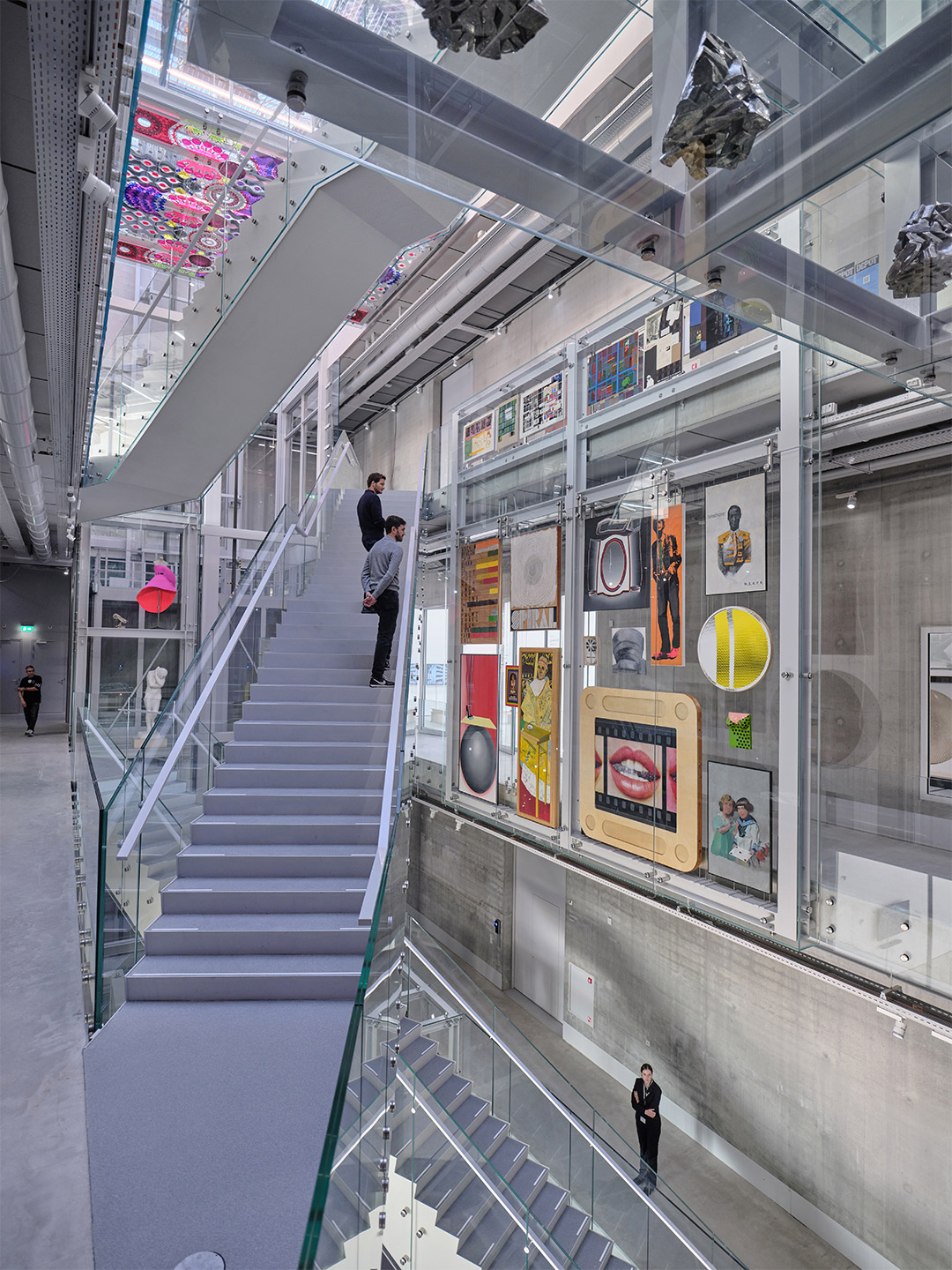
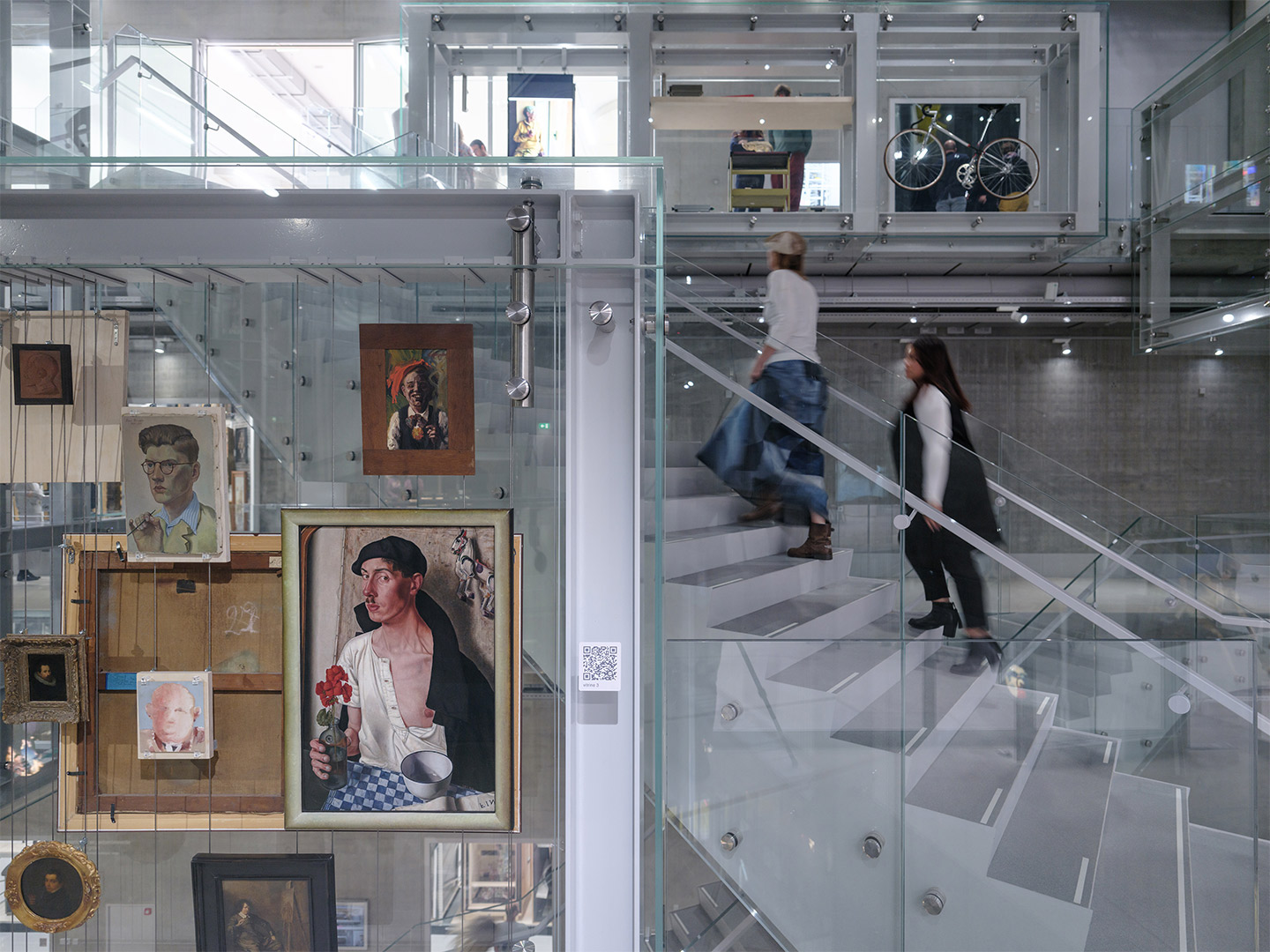
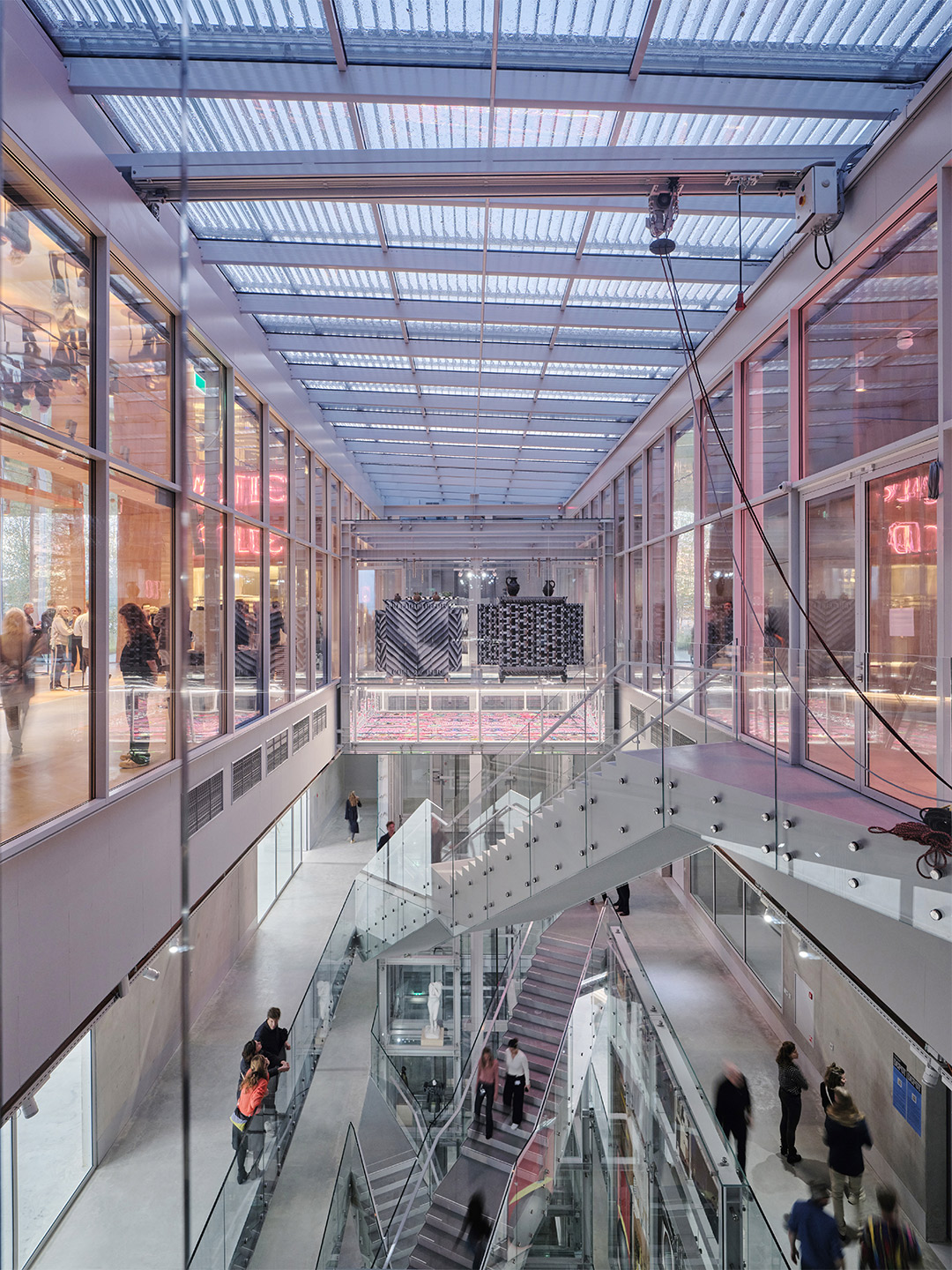
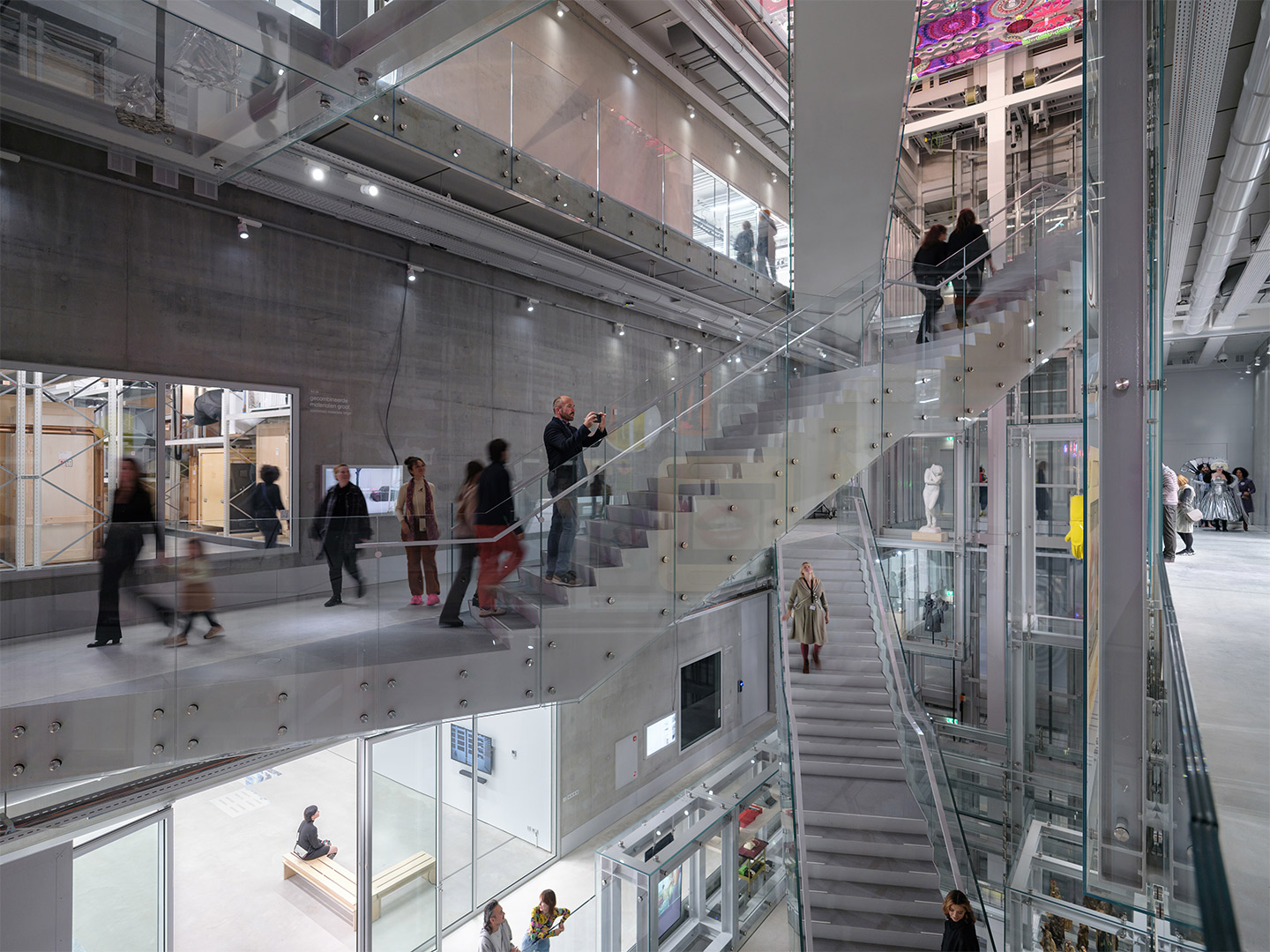
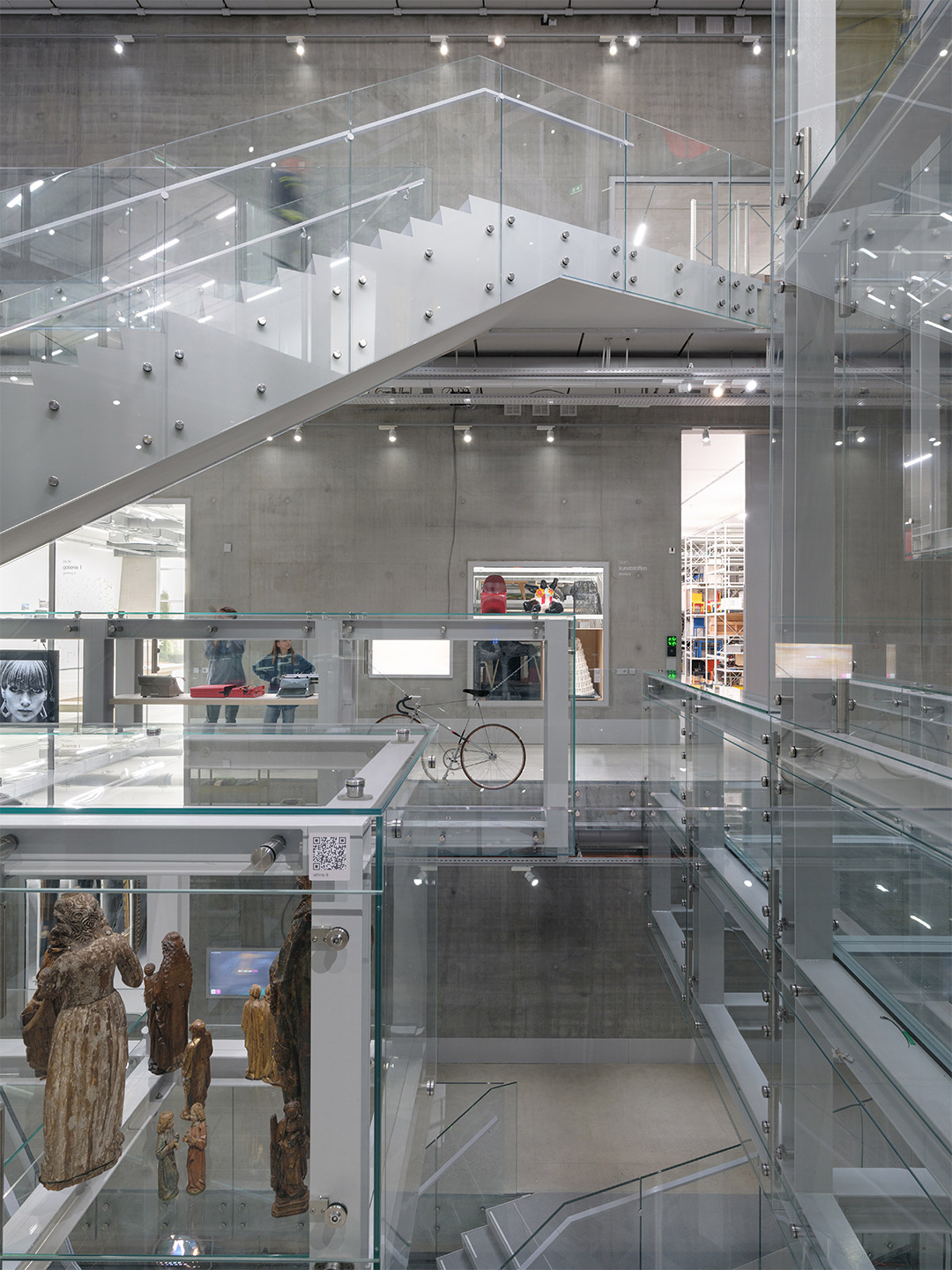
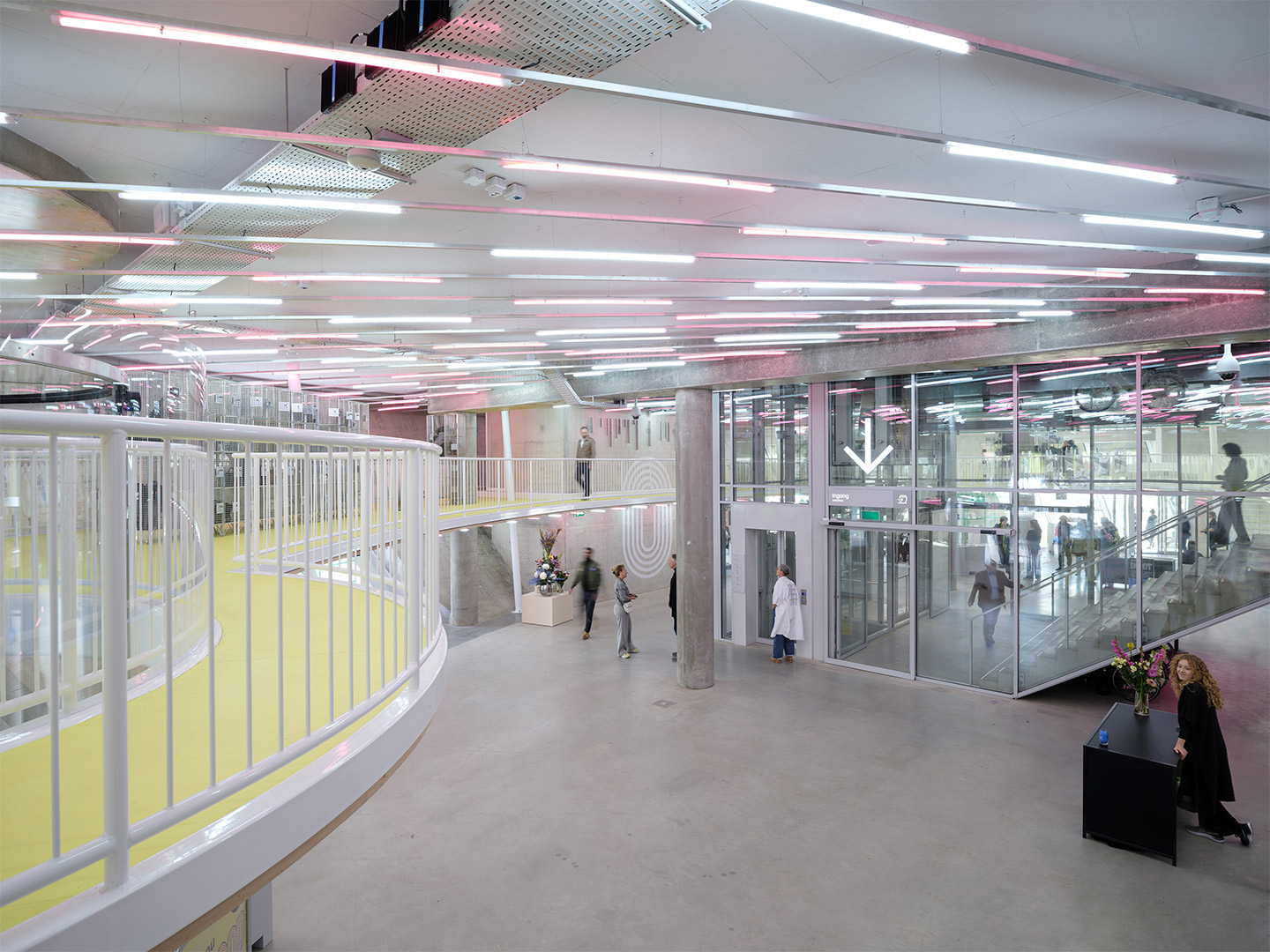
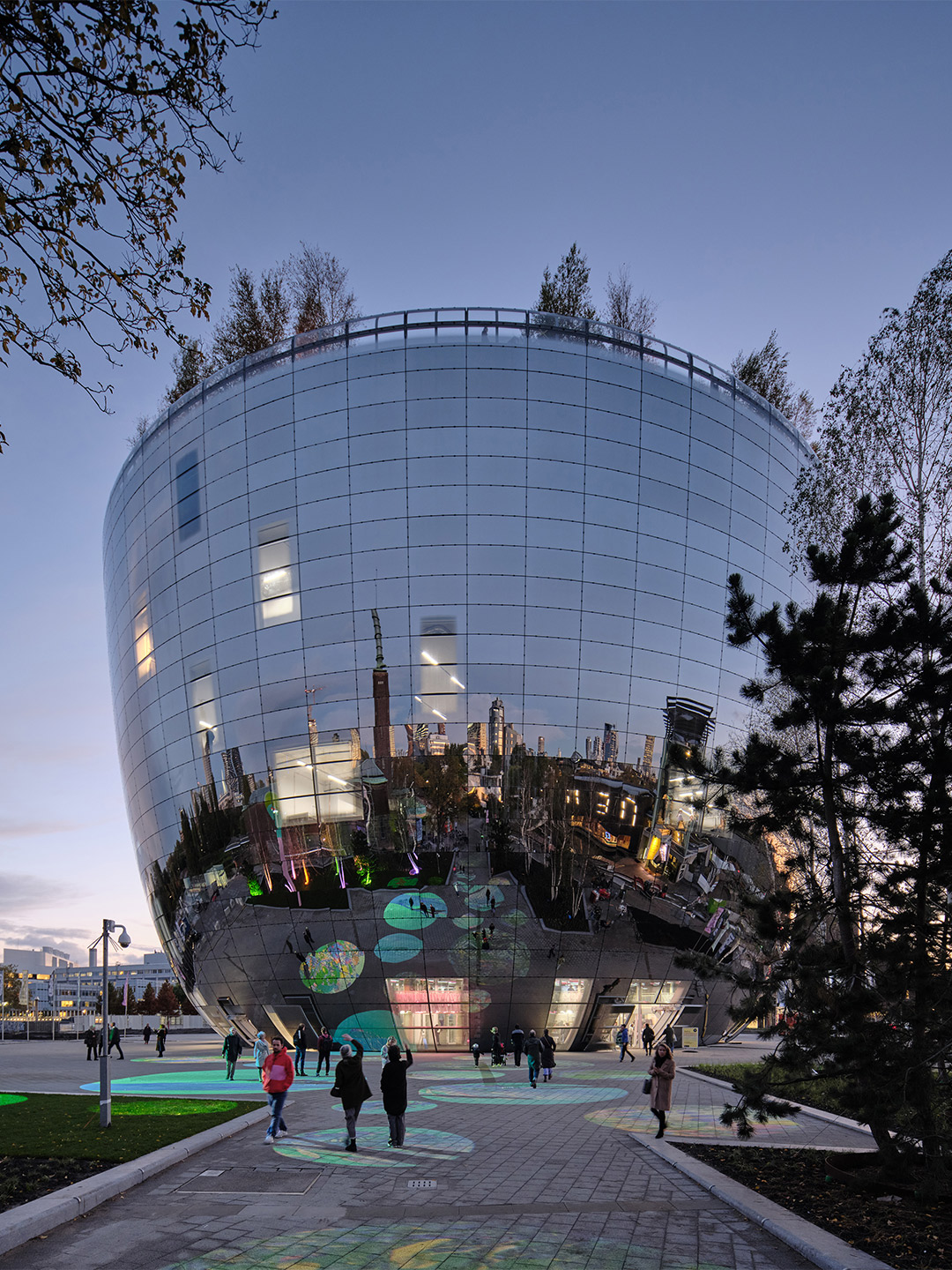
Described as being “in the round” by the architects, the form of the 39.5-metre-high Depot is ovoid. It’s a deep bowl-like shape where the ground-level footprint is small and circular – mostly maintaining views and pedestrian routes through the Museumpark – while the roof area broadens in its circumference. Surrounded by artworks upon entry, visitors are led upwards through the building via five large zig-zagging stairways that are reminiscent of etchings by Italian archaeologist-architect Giovanni Piranesi. The crisscrossing staircases deliver visitors to exhibition rooms and curators’ studios, as well as to the rooftop and the atrium. The latter is filled with 13 glass display vitrines that show an evolving “lightly curated” selection of the Depot’s many treasures.
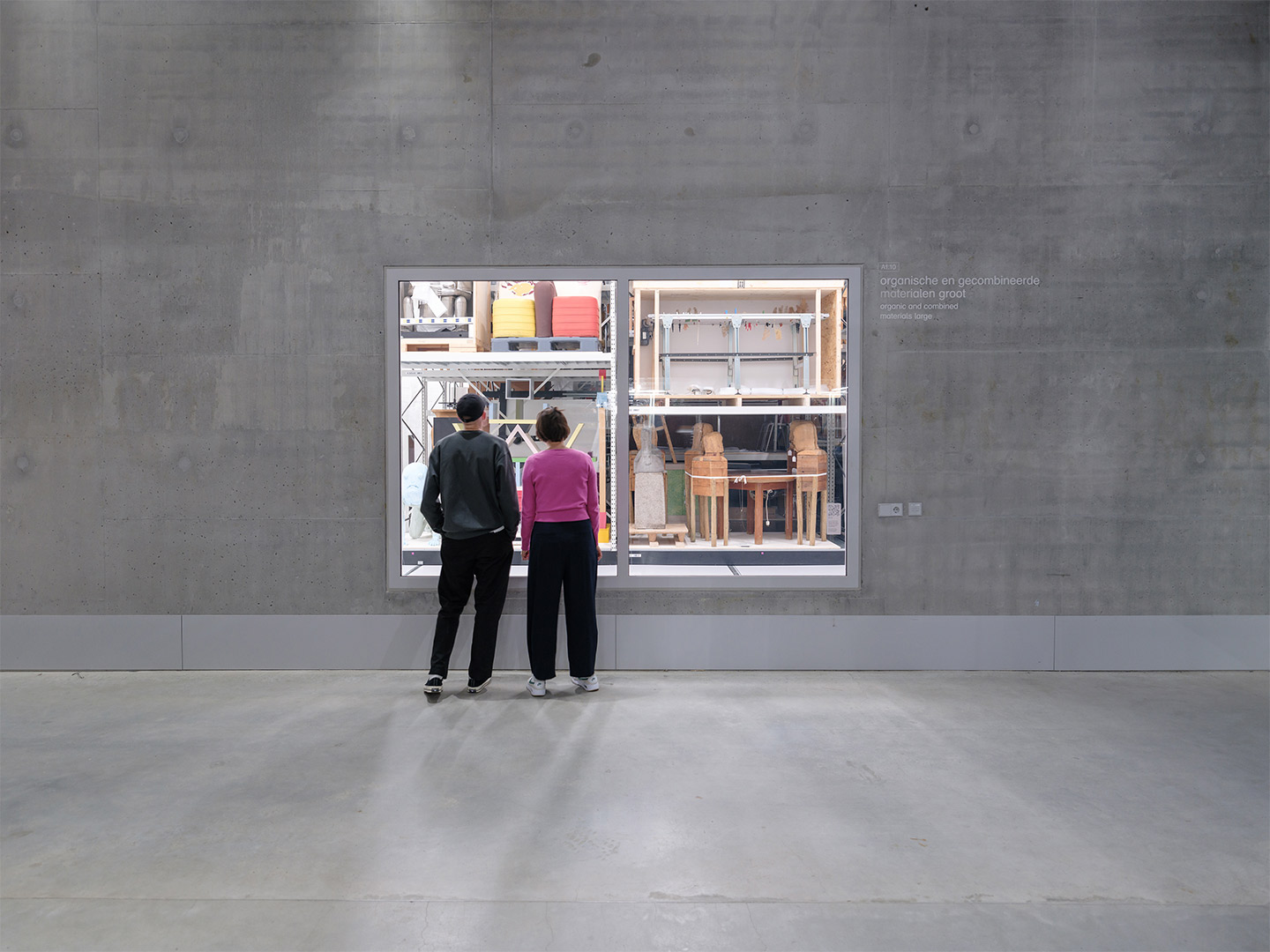
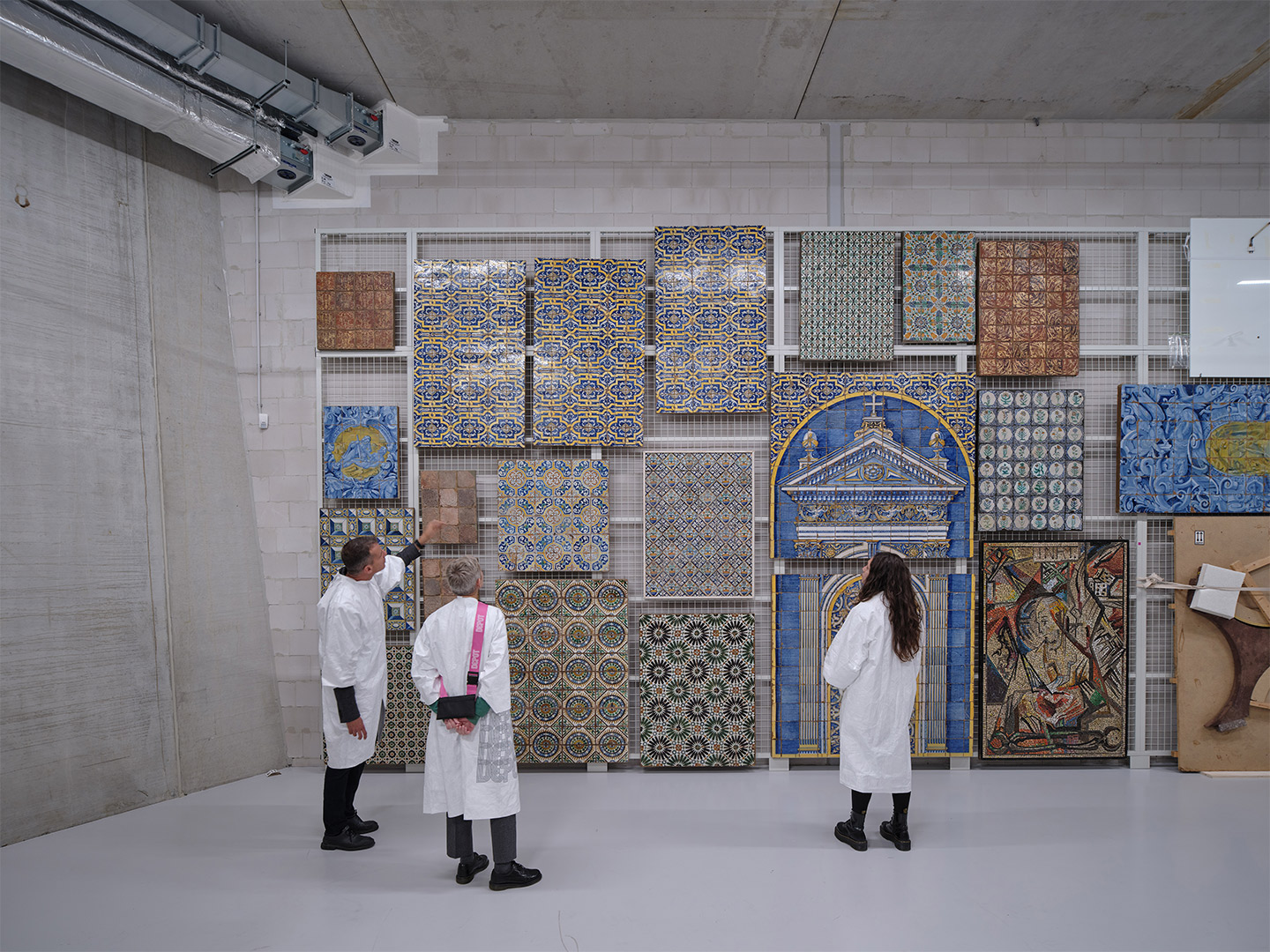
Since 99 percent of the building can be visited by the public, and the collection is completely accessible, the MVRDV team consider their design for the Depot “fully democratic”. But this level of transparency means that not everything is as highly polished as a typical gallery. As in a closed depot, the works of art are stored with efficiency in mind – they stand wrapped, hanging from moveable racks, displayed in glass cabinets or exhibited in one of the gigantic display cases suspended in the atrium. Prints, drawings and photographs are kept in enclosed spaces (but visitors can submit requests to view works from these collections) and the film and video archive can be viewed in special projection rooms.
Artefacts are stored on the basis of climatic requirements rather than being curated by artistic movement or era. Each storage space is provided with a specific climate that is maintained by a climate control system. There are five different climate zones, suited to works of art produced with different materials: metal, plastic, organic/inorganic, black-and-white and colour photography. “This method of storing the art collection calls for specific climatic conditions in which the air is not overly cold, warm, humid or dry,” the architects explain.
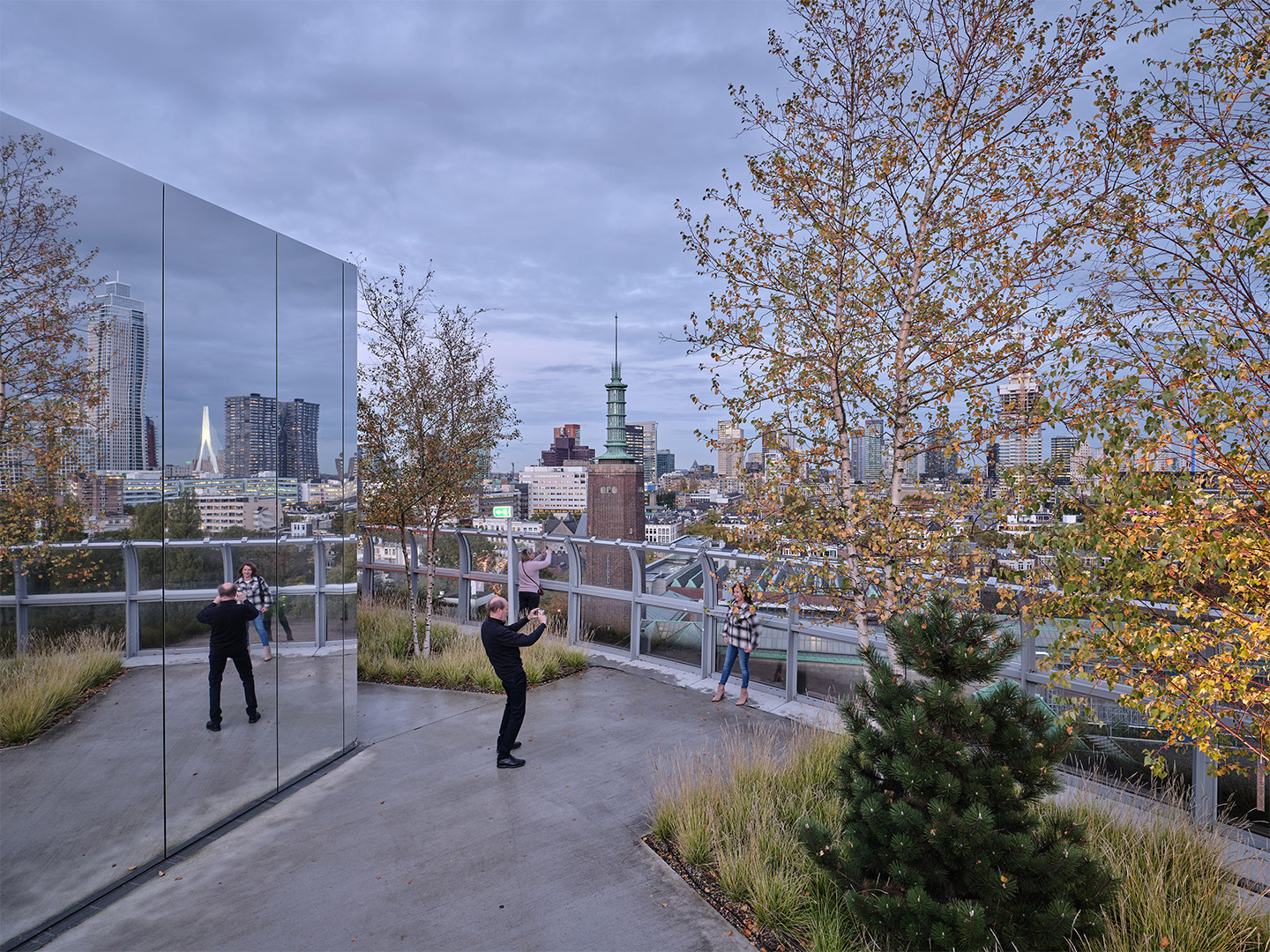
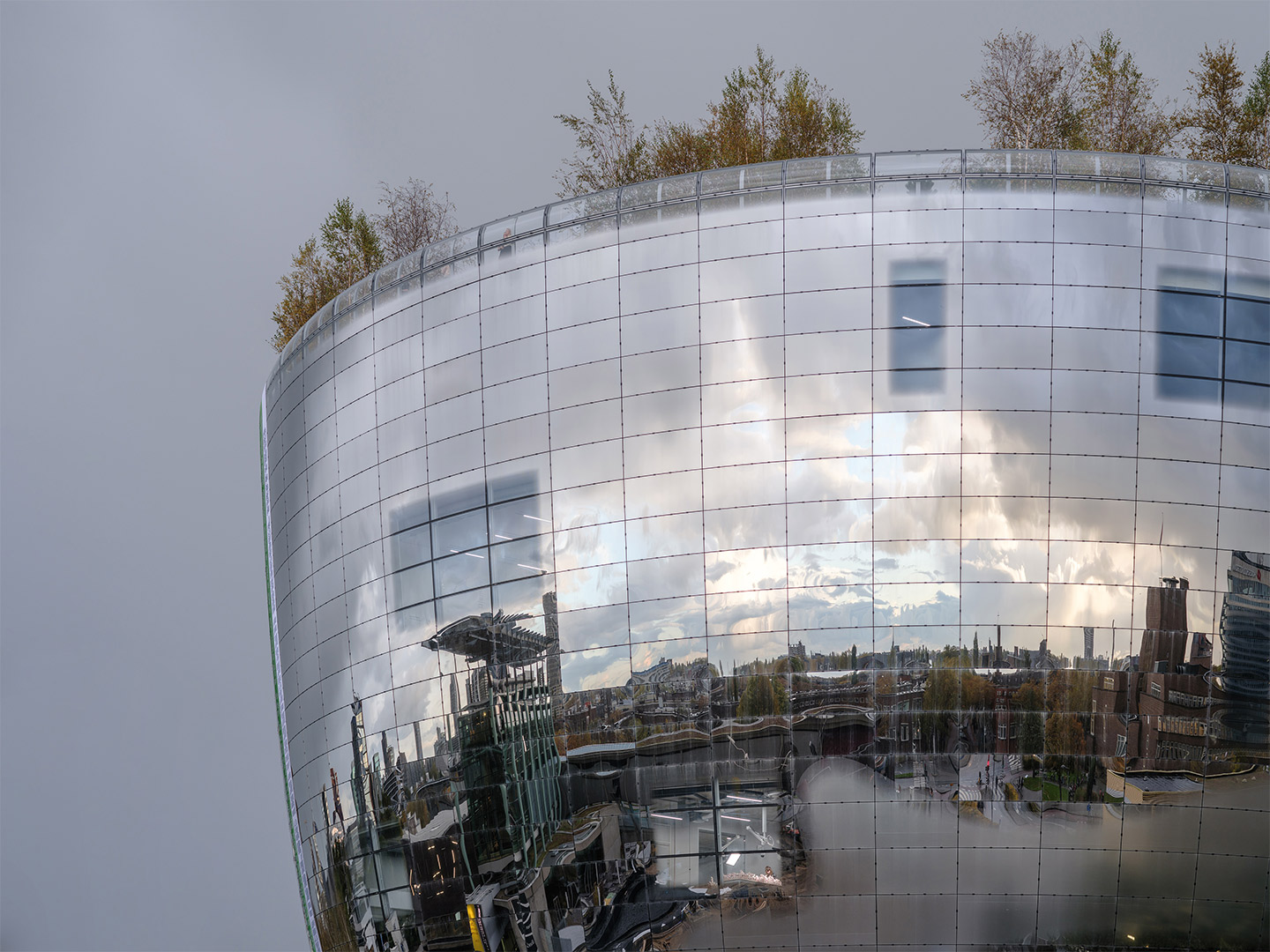
Not to be overlooked, one of the building’s most striking features is its reflective facade, comprised of 6609 square metres of glass subdivided into 1664 mirrored panels. These panels were “adopted” by many inhabitants and cultural institutions of Rotterdam for 1000 euros each as a gesture of support for the Depot. The MVRDV team say the mirrored panels “ensure the integration of the design with its surroundings, by reflecting and thus honouring the activity and the nature of the Museumpark” which was designed by landscape architect Yves Brunier with OMA in the nineties.
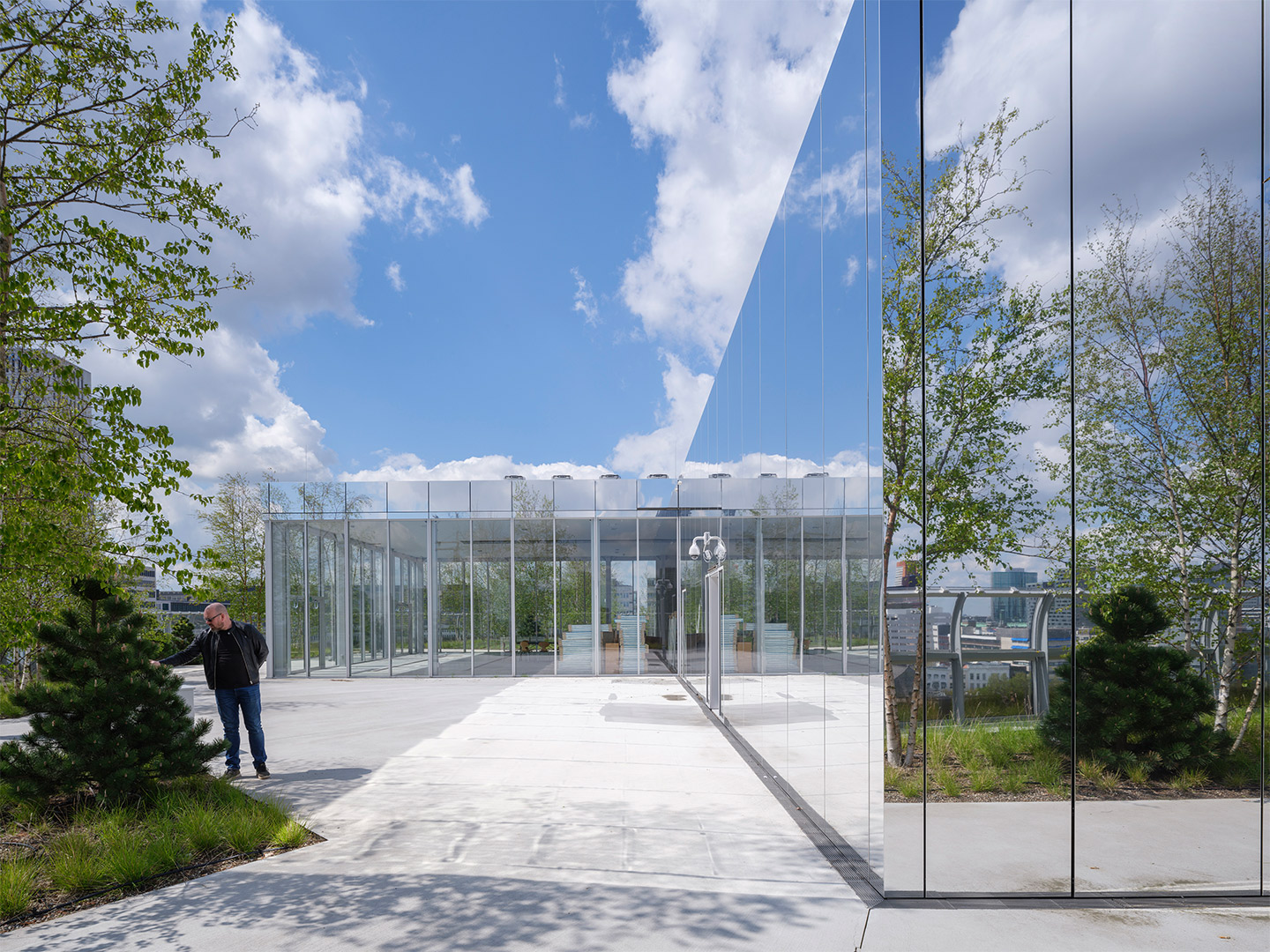
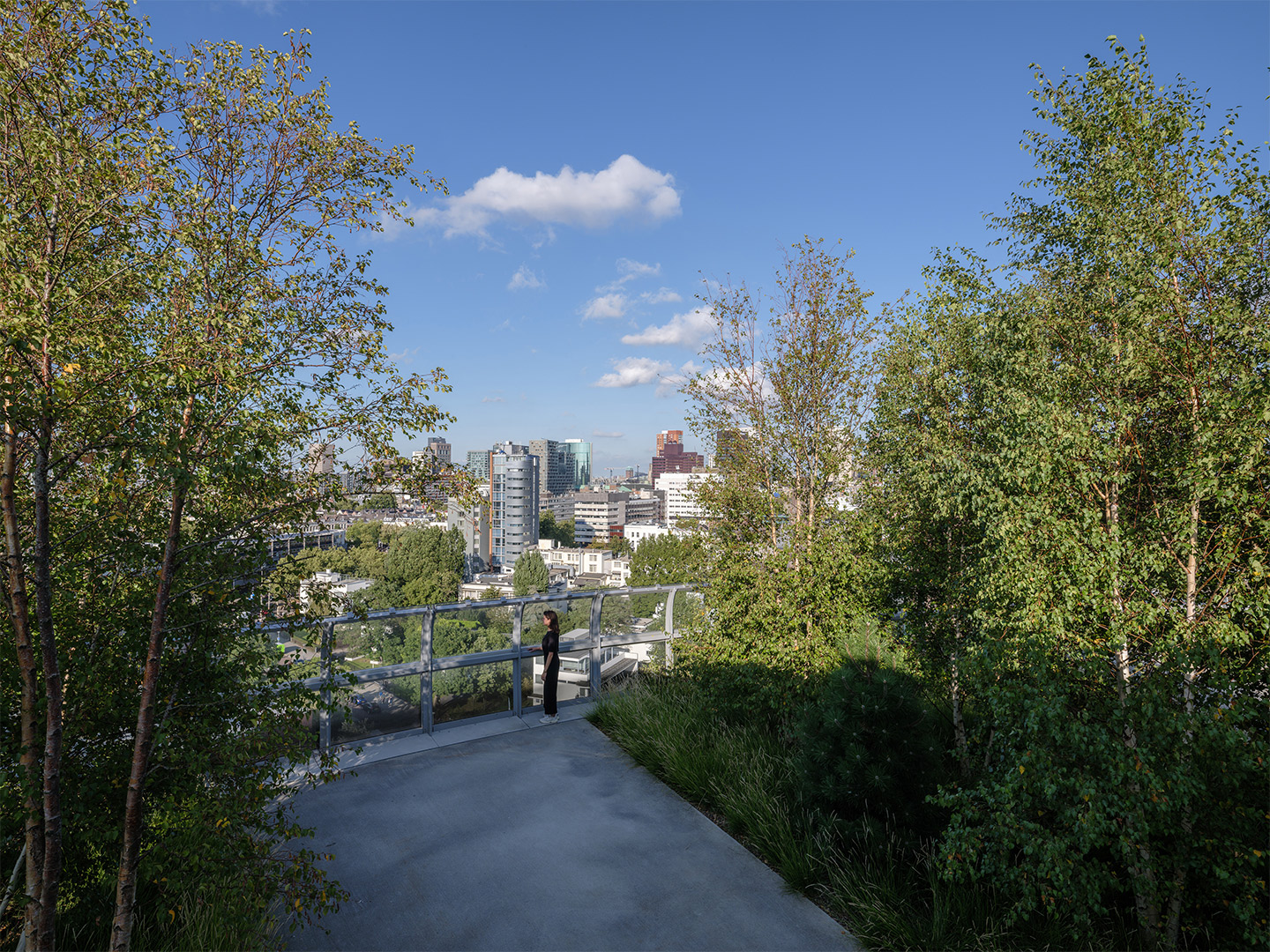
The parkland space lost by the footprint of the Depot building has been replaced with more open public space, by way of a “rooftop forest” populated by 75 multi-stemmed birch trees, planted alongside fir trees and grasses. The birches were bred in a special tree nursery for three years before they were planted on the rooftop terrace in the spring of 2020. Accessible via an express lift, the rooftop is situated on the sixth floor of the Depot, at a height of about 35 metres, offering visitors breathtaking views across the city of Rotterdam.
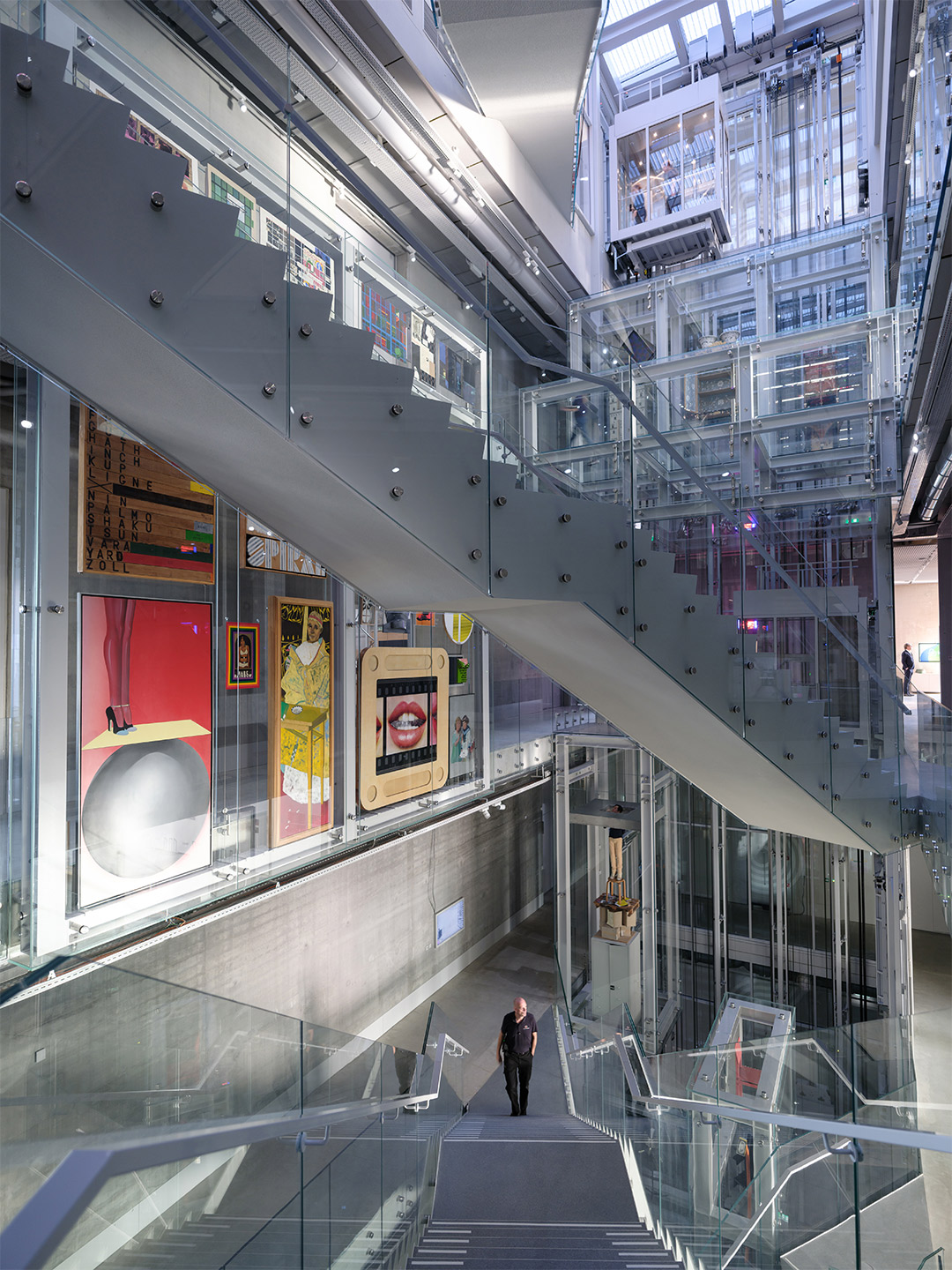
When it comes to sustainability, the Depot strives to reduce the use of energy and water during its operation. A combination of geothermal heat exchange, solar panels, LED lighting and high-performance insulation makes the building “energy neutral” with regards to building-related energy consumption. Rainwater will be stored in the basement and used for irrigation and toilet facilities, reducing the building’s water consumption. “This water storage, combined with the green roofs, makes water run-off minimal, with any remaining run-off directed into the pond of Het Nieuw Instituut, which is converted into a water basin for the surroundings,” say the MVRDV team. “In this way, the Depot can be disconnected from the sewage system for rainwater.”
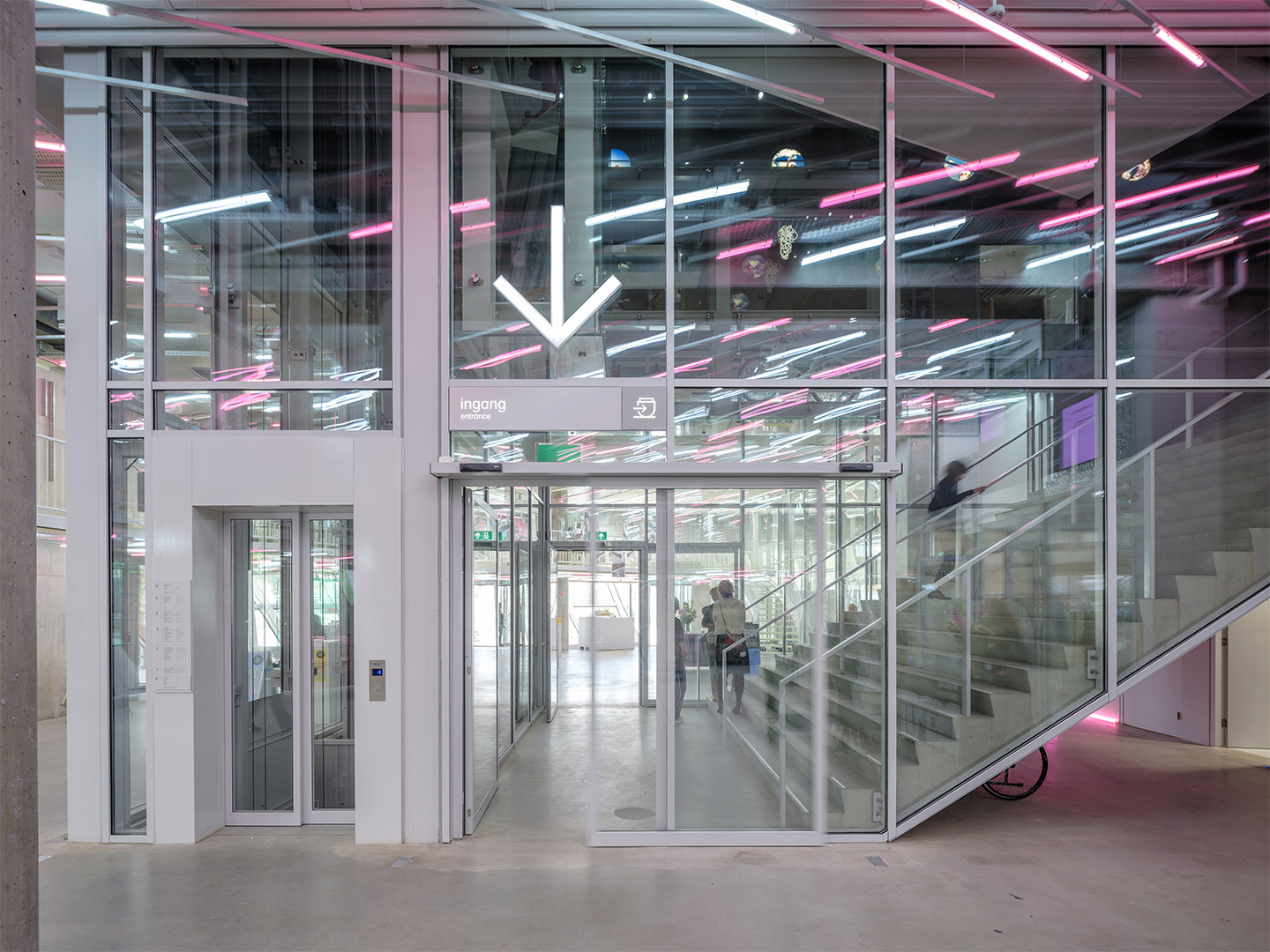
While the facility’s core task is to simultaneously store and display art, the architects designed the Depot as a canvas for other creatives as well. The entrance and atrium were developed in close collaboration with local artists John Körmeling and Marieke van Diemen; the interior design of the rooftop restaurant is by Amsterdam-based firm Concrete; and a permanent artwork by Swiss visual artist Pipilotti Rist is projected onto the building’s side. Expected to attract up to 250,000 visitors per year, including tourists, school groups and Rotterdammers, Depot Boijmans Van Beuningen has drawn the attention of museum officials globally. It’s a place where the world of art-collecting is intertwined with visitor circulation, ensuring the city of Rotterdam’s collection is kept safe and on-show for generations to come.
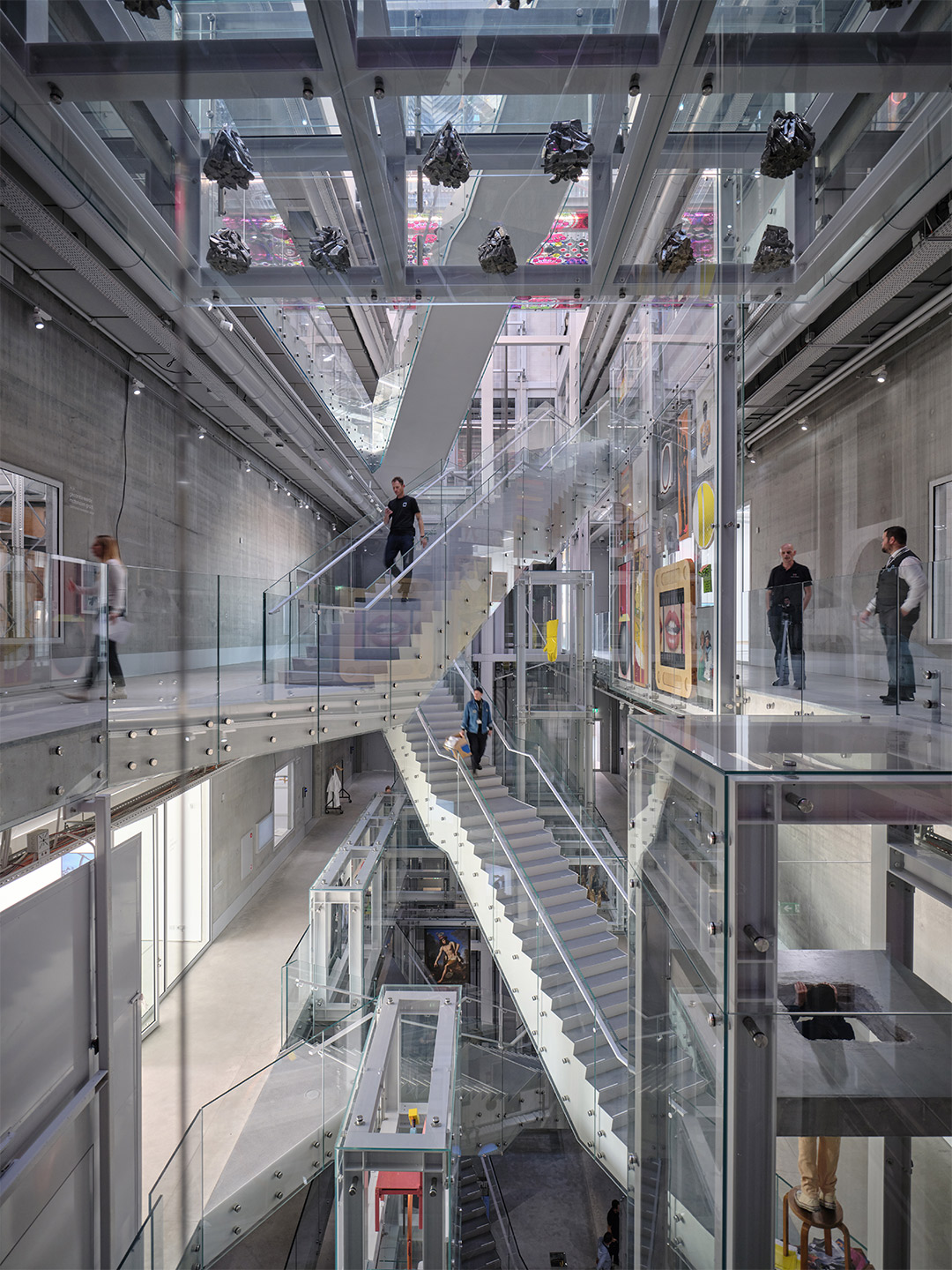
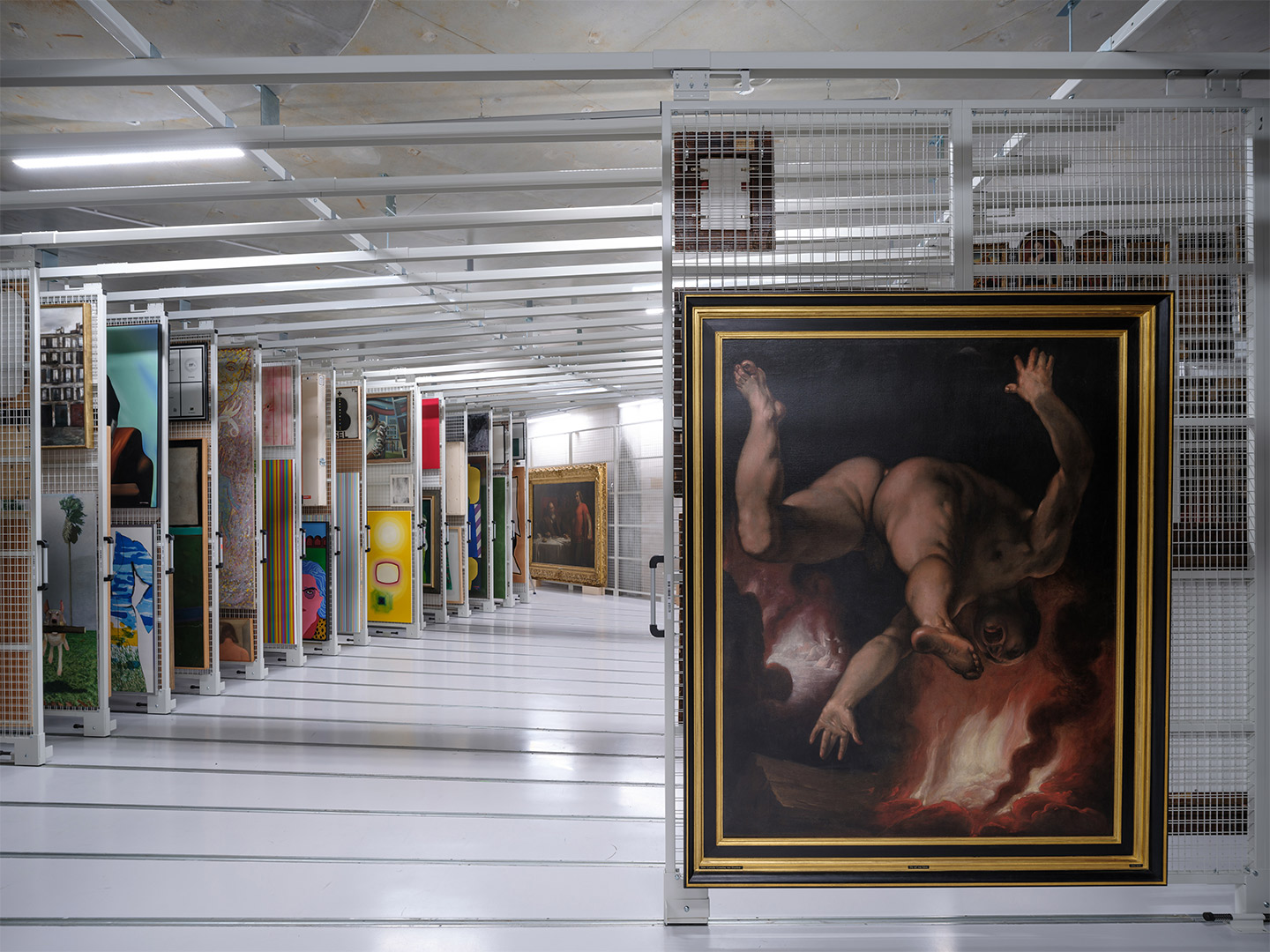
Visitors to the Depot can expect to immerse themselves in the complete backstage realm of the institution, and experience what maintaining and caring for an invaluable art collection actually entails.
Catch up on more architecture, art and design highlights. Plus, subscribe to receive the Daily Architecture News e-letter direct to your inbox.
Related stories
- Venus Power collection of rugs by Patricia Urquiola for cc-tapis.
- Bitossi celebrates centenary in Florence with new museum and 7000-piece display.
- Casa R+1 residence in southern Spain by Puntofilipino.
Located at Museumpark in the centre of Rotterdam, an hour’s drive south-west of Amsterdam, Depot Boijmans Van Beuningen is the first art facility of its kind, offering a no-holds-barred approach to the city’s 151,000-piece collection. “The assignment was to offer a glimpse behind the scenes of the museum world and make the whole art collection accessible to the public,” say the team from MVRDV, the Dutch architecture firm tasked with bringing the project to life. They fulfilled the brief by creating a series of unconventional exhibition halls, joined by an enormous amount of open storage space for art and design, all tucked within a reflective, rounded volume that responds to its urban parkland surroundings.
NGV: ‘She-Oak and Sunlight: Australian Impressionism’
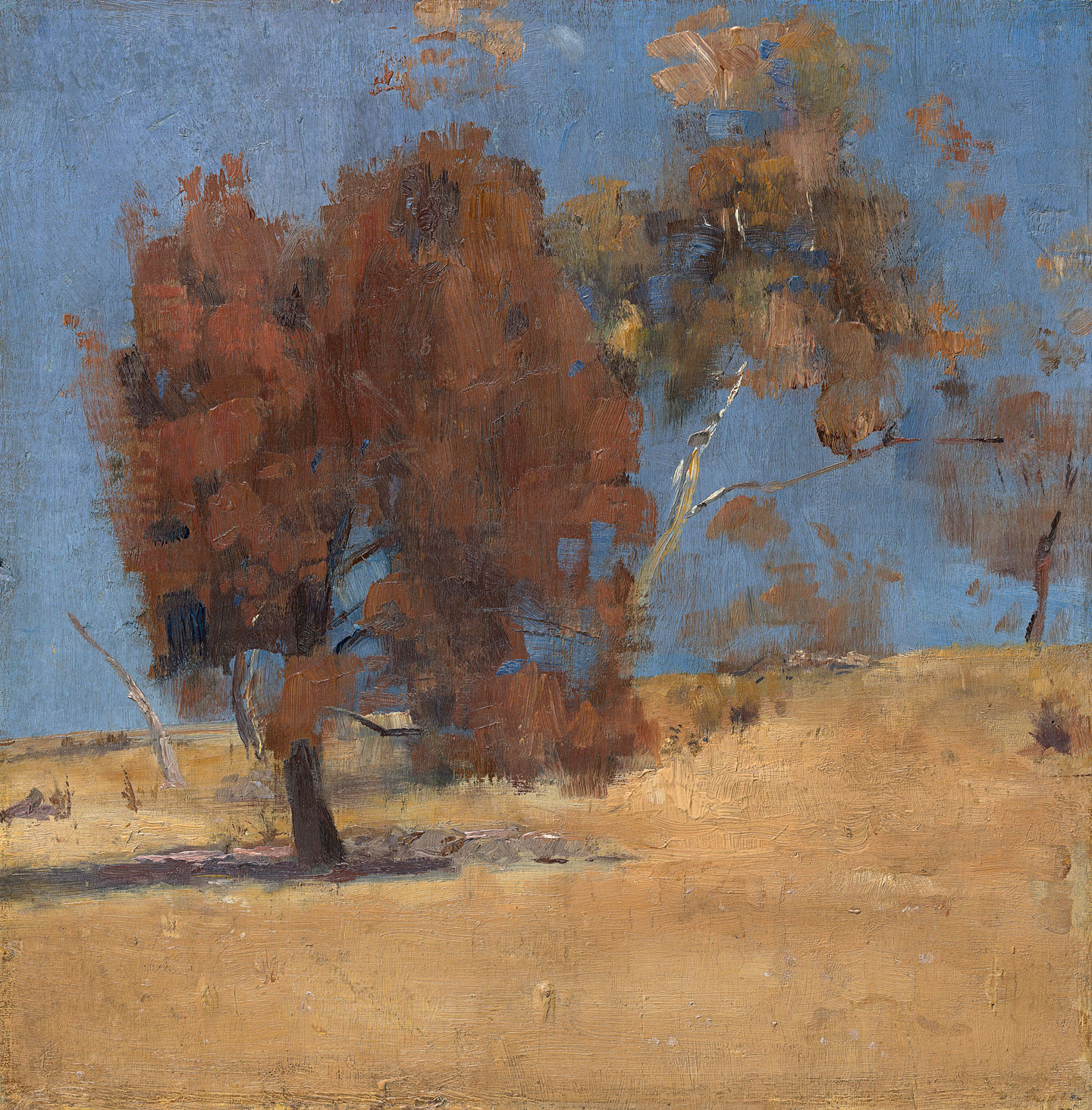
Demonstrating the multifaceted nature of this much-loved movement, ‘She-Oak and Sunlight’ reveals the many forms of Impressionism in Australia, including painting the landscape en plein air (‘in the open air’). The exhibition spotlights the broader global context, personal relationships and artistic synergies between Australian Impressionists and their overseas counterparts by exhibiting Australian artworks alongside those by Claude Monet, Alfred Sisley, James Abbott McNeill Whistler and others drawn from the National Gallery of Victoria (NGV) Collection.
Expanding upon ‘She-Oak and Sunlight’, the NGV has announced the release of a four-part web series that celebrates and explores the continuing legacy of painting outdoors and its impact on the practices of contemporary Australian artists working today. Episode one, premiering May 12, will feature contemporary landscape painter Adam Pyett, whose practice deeply explores the very nature of painting by using Australian landscapes as a subject to explore relationships between light and colour. Following Adam’s episode, Victorian-based contemporary landscape painter Mary Tonkin will join the series, along with fashion designer Lyn-Al Young.
The ‘She-Oak and Sunlight: Australian Impressionism’ exhibition continues at The Ian Potter Centre: NGV Australia at Federation Square in Melbourne until August 22.
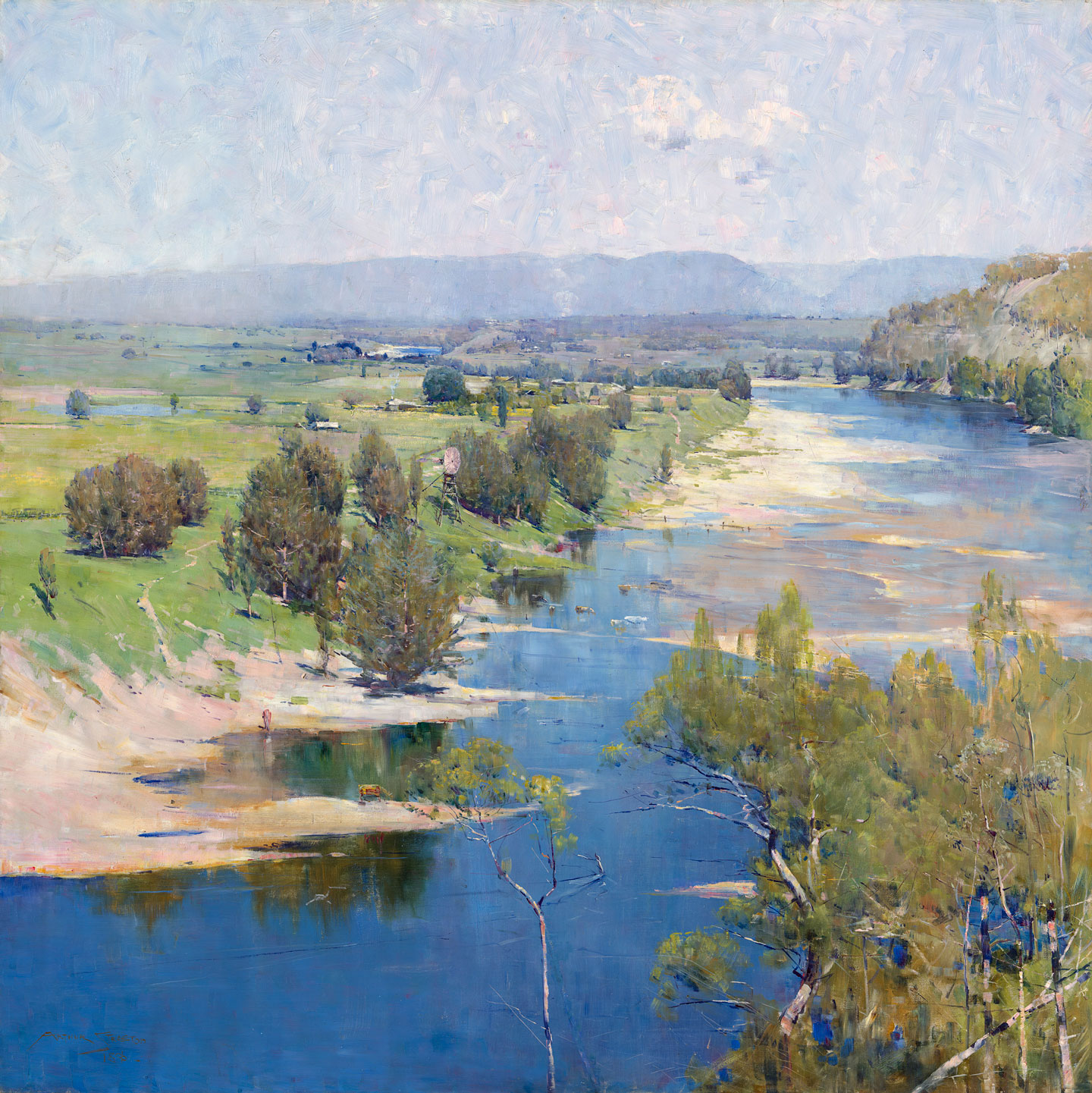
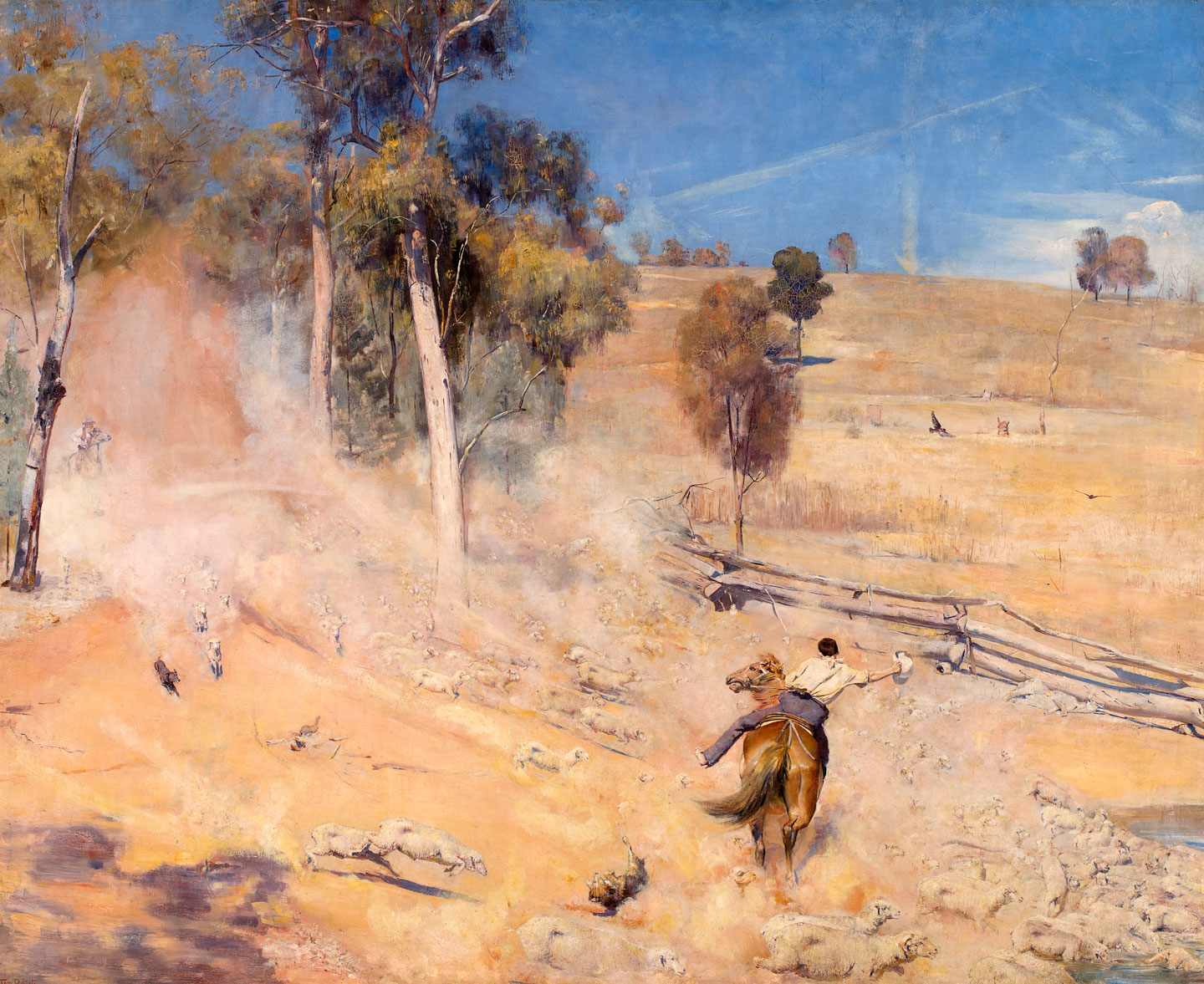
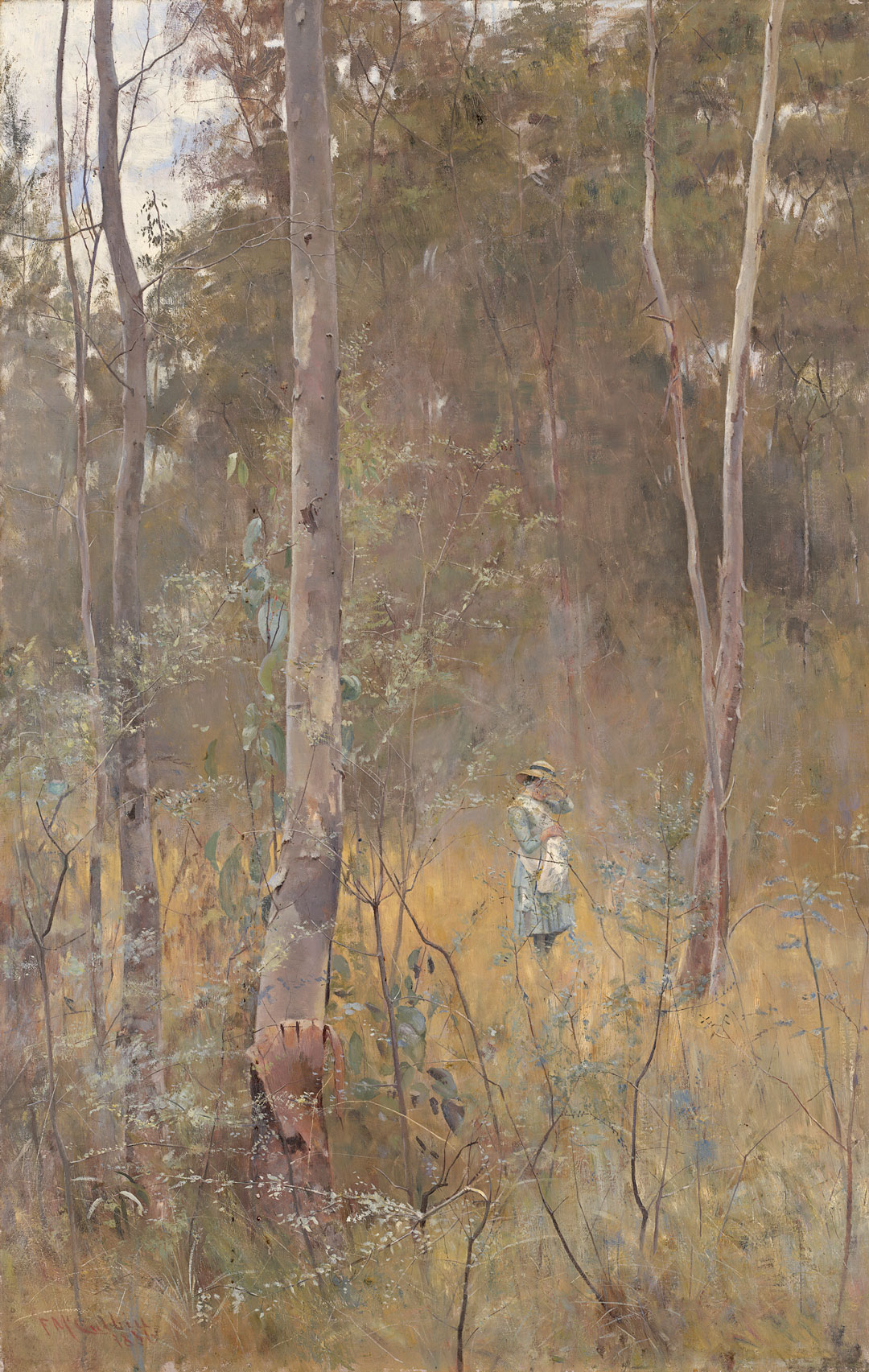
Demonstrating the multifaceted nature of this much-loved movement, ‘She-Oak and Sunlight’ reveals the many forms of Impressionism in Australia.
Follow the latest art and design news and catch up on artist interviews, plus subscribe to receive the Daily Architecture News e-letter direct to your inbox.